Featured

White Elephant Appetites

The term “white elephant” originated in Southeast Asia. Monarchs possessed white elephants to convey that they ruled justly, and that their kingdoms enjoyed peace and prosperity.

The white elephant was considered sacred, so it couldn’t be used for labor; it was an animal that did not contribute to a household, but had to be fed and sheltered.

 Expensive for an elephant.

The gift of a white elephant from a monarch also was troublesome. On the one hand, a recipient had the monarch’s favor, but on the other hand, the elephant could not be given away and was costly to keep.

A white elephant is, accordingly, something whose value does not equal its cost to maintain. Today, a white elephant is a “used” item that’s no longer wanted by its owner.

Two friends and I went to the Oakland Museum’s White Elephant Sale yesterday. Lily had purchased our $5 tickets at the beginning of January, and yesterday was the first $5 day for the sale. If we wanted to pay $40, we could’ve gone last Sunday. Our goal, however, was to get the best deal possible, so a $40 ticket didn’t qualify for that.

We wanted to find a white elephant that we could transform into a treasured object.

The Oakland Museum’s White Elephant Sale is sponsored by the Oakland Museum Women’s Board, an organization of just over 100 members. However, this group of women recruit thousands of volunteers who work all year long collecting used items for their annual White Elephant Sale which is held each January to March. This year, 2024, is the 65th anniversary of the event.

Why would these women work year-round to hold a rummage sale? Since they began holding this event, their organization has raised over $30 million for the Oakland Museum. That’s why.

We got to the White Elephant Sale Warehouse on Lancaster Street at approximately 9:30 a.m. The doors were going to open at 10:00, and the line of people waiting with tickets to get in was two blocks long. Everyone was dressed in coats, hats, and gloves for a chilly day in Oakland and a threat of rain. A woman who lived in a condo came outside to find out why hundreds of people were standing on the sidewalk outside her building. Her eyes were as big as saucers.

Volunteers scanned our tickets and wrapped bracelets around our wrists.

Friends asked each other which department they would visit first.

“Tools,” said one guy, standing next to his two fellow male rummage sale fans.

“Garden,” I said, imagining statues of angels, terra cotta pots of all sizes and shapes, and wrought iron tables and chairs.

“Art,” said a woman dressed in a pink jacket, her hood pulled over her wind-blown hair.

Finally, the doors opened, and the coat-shrouded shoppers in front of us filtered through the wide doors into the windowless interior. Portable toilets were set up outside at the bottom of the entrance stairs. We climbed the old steps to the metal porch, showed our bracelets, and walked inside.

Think of a football field, 100 yards long by 160 feet wide. The interior of the Oakland Museum’s White Elephant Warehouse is almost twice that size. The building is over 90,000 square feet. The organization organizes donations for sale into 17 huge departments: men’s clothing, women’s clothing, children’s clothing, sewing, linen, kitchen appliances, China, dishes and baking ware, tools, garden, art, bric-a-brac, toys, musical instruments and music, lamps, furniture, and accessories.

My heart fluttered like a hummingbird in flight as I entered the building.

We rushed like we were being followed by bears, turning right for the garden department. Lily immediately found two metal buckets and a watering can. She grabbed them and got in line to check out. Buyers must check out their treasures before leaving a department. The volunteers write up a receipt, wrap up the items, and take payment. Or, like we did, you can pay for everything at a cashier near the exit.

Becky found a trellis, clutched her fingers around it and got behind Lily. As I passed them, Lily pointed to two more watering cans and asked me to get them for her.

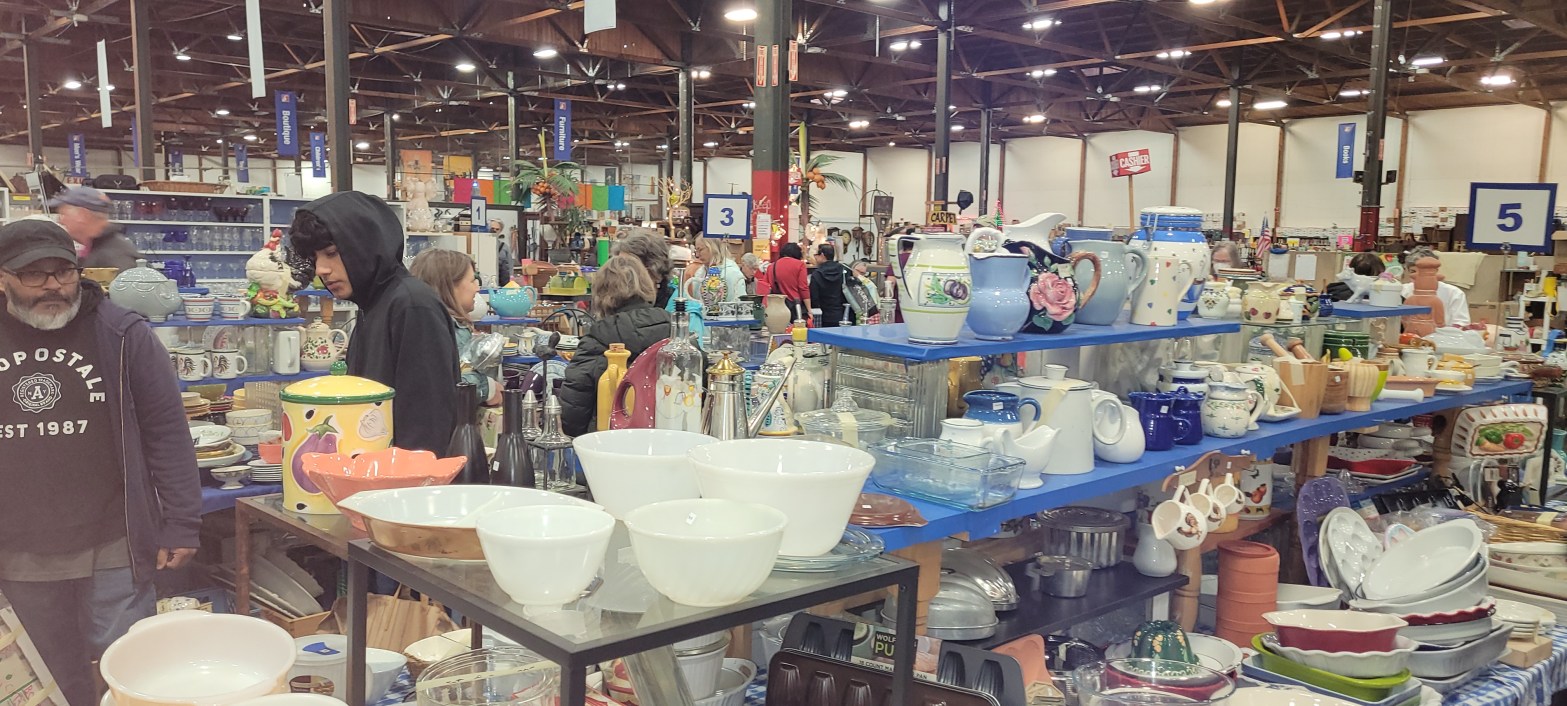
After the garden department, we separated, each of us following our personal whims. As I wandered in the dishes and baking ware department, I joined hordes of treasure-hunters in picking up items, inspecting them, and then either tucking them under their arms or putting them back on the shelf for someone else.

Teapots, mugs, bowls, plates, platters of all sizes and design, wine glasses, glasses, cast iron skillets, ladles, cutlery, and a hundred other kitchen items covered table after table, shelf after shelf. There was pewter, pottery, stainless steel, stoneware, glass, and copper.

I found sixteen 4-ounce canning jars with lids for my sister who loves to can. I also found a white mixing bowl for my daughter. I would’ve bought something for myself, but I knew my cupboards at home were full of treasures from past sales. I have a white oval platter that I bought last year and three glass serving bowls from other years.  

Becky went to the art department and bought a pastoral painting in an ornate wooden frame. She also bought dishes. Lily bought a 24-inch brown wooden bench to put near her front door.

After much wandering from China to art to bric-a-brac to furniture to everywhere, I found a 30-inch garden statue of a young girl holding an umbrella. I hemmed. I hawed. I walked away and wandered some more. I watched a few other women touch the statue and look at it from several angles. I turned it around, placed it on a table, stood it on the floor. I considered its color—a shade of verdigris. After walking away several more times, I came back.
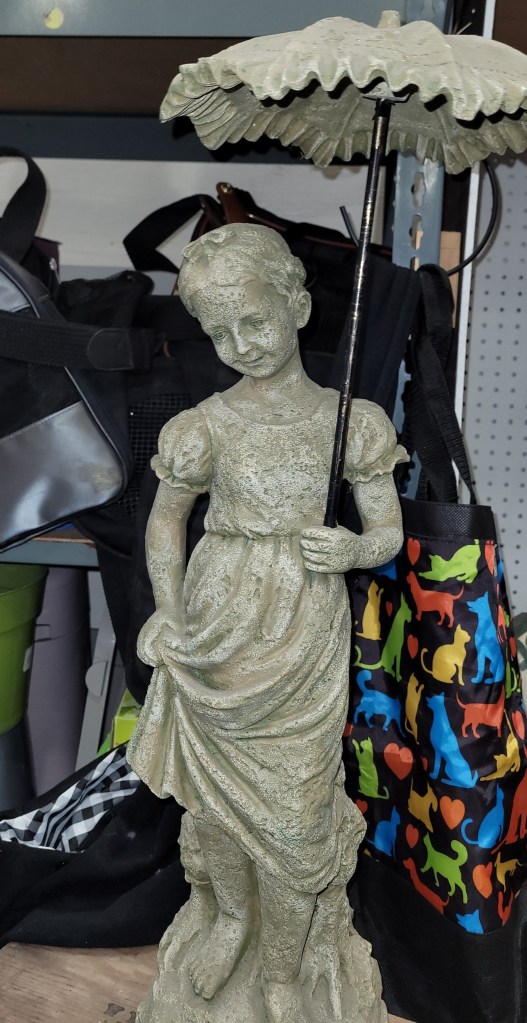
Finally, it was noon, and my friends would be about finished with their hunting, so I picked up the statue, tucked it under my arm, and got in line to check it out. It was heavy, so, while I waited, I put the statue on the floor and nudged it forward inch by inch.

Even if I didn’t like it, I was supporting the museum. And it was cheap.

We packed our treasures into the back of Lily’s car. In order to fit into the back seat, I had to push Becky’s trellis and painting over. I leaned them against the inside of Lily’s bench legs so they wouldn’t decapitate me if Lily stopped short in traffic.

Teasing drops of rain hit the windshield. Gusts of wind shook the car as Lily navigated out of Oakland and back into suburbia.

I got great deals. Becky came out with a few bags of bargains, and Lily, well she brought home several packages of treasures.

Thank goodness we bought treasures instead of white elephants. Our yards are too small for an elephant.

Featured

How I Evaluate Publishers

I finished my novel last month, and now I am submitting it to publishers. During the process of finding the right publishers, I’ve learned a lot, and I’m sharing it with you.

Use a Good Source of Publishers

I didn’t know where to find the names of publishers, so I asked a writer friend what to do and she gave me two links of independent publishers. She suggested that I choose six of them and present my manuscript to them. Here are the links:

Publishers Group West: https://www.pgw.com/distribution-services/publisher-list, and Consortium Book Sales and Distribution: https://www.cbsd.com/publishers/our-publishers/.

I started to go down the list of publishers from Publishers Group West. What I found was a lot of publishers that didn’t accept the type of novel that I wrote, which is a coming-of-age novel. Some wanted non-fiction. Others were looking for fantasy, crime thrillers, adventure, historical, or memoir tomes. I spent hours and hours looking at their websites without a viable candidate. What I needed was a list of publishers who focused on coming-of-age novels or literary genres.

Another write friend told me to buy the current Writer’s Market. What a brilliant suggestion. This book contains 183 names of publishers and pertinent details in alphabetical order. Better yet, on page 855, is a “Book Publishers Subject Index” where I found three columns of publishers interested in literary novels. I’ve been investigating the websites for the companies on this list and, already, I have identified six publishers that are appropriate for my novel.

Find a Publisher that Publishes Your Type of Novel

I already mentioned how I was looking for a publisher interested in coming-of-age or literary novels, but I want to explain this further.

I found out that publishers have mission statements that explain the purpose of their company. For example, one publisher I reviewed has a mission to publish the works of authors from the Midwest. I live in California, so the chances of them picking up my novel is unlikely. Another publisher aims to publish books written about queer subjects. My book doesn’t qualify for this either. I don’t want to waste my time sending my manuscript to someone who doesn’t want it.

Buy a Book from a Target Publisher and Read It

I found a publisher that wanted coming-of-age novels, so I ordered one of its previous publications. When the book arrived, I didn’t like its cover, binding, or even the style of writing by the author. I felt like I would be disappointed if my book looked similar, so I didn’t send my manuscript to this publisher.

I bought a book published by another publisher. Immediately, I liked the cover and the binding. I even noticed how the cover design demonstrated complementary colors since I once taught art in an elementary school.

I read the book from cover to cover, including the book flaps and the quotes from other authors on the back cover. I liked the story and noticed how it was the kind of story that I could write.

I also read the author’s “Acknowledgments” and found out that her story was similar to mine in another way. The author is Caucasian, writing about a story set in a Central American country. I am Caucasian and my story takes place in South America. The author thanked her publisher for agreeing to print her book even though she wasn’t native to Central America, and she argued that an author should not have to be a native to the setting of her story.

I had heard about the argument of cultural correctness, but, as this author pointed out, many novels would not exist today if men could only write about men, women about women, Hispanics about Hispanics, and so forth.

I sent my novel to this publisher with a comment in my query letter that asserted that writing about a setting into which I was not born was part of my inspiration for writing the novel in the first place. I also mentioned that I had read the other author’s “Acknowledgements” and agreed with her. I’m sure this editorial team will be impressed that I went to the trouble to carefully familiarize myself with one of their previous publications.

Read the Submission Guidelines

Unfortunately for busy writers, every publisher has different submission requirements. I searched each publisher’s website to find them. Sometimes, I had to find the submission link at the bottom of the publisher’s page.

Some of them use a program called Submittable that is built into their website. One publisher allowed me to attach my manuscript to this portal and fill in my name and previously published works in the blank fields. Another publisher who uses Submittable didn’t allow any attachments. Instead, I had to summarize my 300-page novel in 150 words, write out my “hook,” and list my previously published works.

Other publishers wanted me to submit via email. One wanted a query letter, a one-to-two-page synopsis, an annotated chapter outline, a market analysis including competitive research, at least two sample chapters, and my curriculum vitae.

I had to do some research for this. For the query letter, I modeled my letter after a sample query letter that I found on page 23 in Writer’s Market. I scoured the publisher’s website to find the name of the main editor and addressed my letter to her. After I wrote it, I had one of my writer friends review it. She thought my version was solid.

For the synopsis, I wrote a 700-word version and had it reviewed as well. My writer friend helped me improve it to add pertinent and alluring details.

My novel has 40 chapters in it, so writing the annotated chapter outline took several days. I listed each chapter and its title and then added a paragraph or two about its content. I must say that this exercise helped me take another look at my novel. Along the way, I made changes to my manuscript to make the plot stronger.

I searched the Internet to find out how to write a market and competitive analysis. I found some excellent articles by the Blue Ridge Mountain Christian Writers’ Conference that explained what this was.

My final market analysis identified my target market as college-educated women between the ages of 20 and 30 who were interested in travel, cooking, gardening, or hiking. I also identified my secondary market as women who were members of book clubs and who enjoyed discussing life events such as the death of a parent or breast cancer. I even described my tertiary market as high school teachers and college professors who require reading for writing assignments.

For the competitive analysis, I identified six books that were comparable to mine. I explained how each of these books were similar, how they were different, and how related the purpose of each story was to mine.

When it came to developing my curriculum vitae, I divided my publications into poetry, short stories, and academic publications. Since I haven’t previously published a novel, I didn’t include this category. I also listed that I have a Masters in English concentrating in Literature and Composition.

The work for this one publisher was so comprehensive that I have used portions of it for other submissions.

Keep Track of Your Submissions

I’m not sure how many publishers I will need to contact in order to get my book published, so I devised a way to keep track of them. On Microsoft Word, I made a four-column table with the headings—Publisher Name, Requirements, Date Sent, and Response Expected. Under the name of each publisher, I typed in either the email of the company or Submittable so I can remember how I sent my work.

I feel that my date columns are extremely important. The Date Sent column shows me when I submitted my work. The Response Expected column tells me when the publisher promises to get back to me. Some publishers do not contact writers if they are not interested, so this column will also tell me when to stop waiting for a response and reach out to another company.

My life’s dream is to get my fictional novel published by a traditional publisher, and so I’m going to do everything I can to make that happen.

Featured

Rain

Photo by Ahmed Zayad on Unsplash

When Don woke up, it was raining.  The water that he ran in the tub sounded like rain chortling out of a storm pipe.  The water that streamed from the kitchen faucet for his tea beat into the kettle like rain on a wheelbarrow left out in the yard.  Rain. Rain. Rain.  It had rained for months.

Don’s mother had died at 10:05 a.m. on the same morning that Don worked his last day.  He was looking forward to retirement, and one thing he would do more was spend time with his mother—playing Scrabble, going out for hamburgers for lunch, driving her past her old house where prolific flowers signaled the change of seasons. 

At 10:06 on the day she died, the rain started.  He had kissed her on the forehead as she lay quiet in her hospital bed, checked to see if she was safe, and slipped out of the room to live the rest of his life without her. 

Claire had managed the funeral and service arrangements which were beautiful.  On the day Mom was buried, the sun came out for a couple hours—just enough time for Mom’s ten children to say their prayers and lay red roses on her casket.  When the casket was lowed into the ground and the earth filled in her vacancy, the grounds men laid the large spray of red roses over the dirt.

Then the rain began again.  It rained while they cleaned out Mom’s room at the assisted living home.  Maddy took all their mother’s clothes home in garbage bags.  A few weeks later, she knocked on Don’s door and handed him a teddy bear.  The bear was blue and green and peach and red, made from pieces of Mom’s shirts, pants, and dresses.  It looked both happy and sad as Don sat it on the couch in his living room.

Soon, the group texts began.  Don shared memories of his mother with his nine siblings every day.  Old memories.  Vague memories.  Disputed memories.  Sunny memories.  Rainy memories. 

Some people in the text posted pictures of what they made for breakfast.  Don posted pictures of his new seedlings and old pumpkins.  He talked about his clocks inherited from Mom and Dad.  Claire posted perfect plates of salmon dinners.  Rita identified the birds that Maddy found in her garden by looking them up in her bird bible.  Beatrice posted old photos of Mom from her twenties when she was thin, before she had ten children. 

The siblings discovered each other again.  Most of them had moved out of town since their childhood, and their communication had been through Mom for the most part.  Through their texts, they found out that Don had the best green thumb, Claire grew flowers but not vegetables, Rita was a bird and owl watcher, Maddie loved wine and dessert most of all, Beatrice was just starting a walking routine, Minnie continuously created new jam recipes, Jim was the handyman at his job, Carol had learned how to play guitar, Ron still told the best jokes, and Geo wrote poetry in his spare time. 

The texts started usually around 7 a.m. in the morning and lasted until the last sibling drifted off to bed.  Good mornings.  Breakfast recipes. Descriptions of walks.  Flower postings.  Loaves of bread.  Jars of jam.  Bowls of soup.  Directions to parks.  Comments on the news.  Revelations about hobbies.  Progress on quilts, puzzles, and charity projects.  Movie recommendations and dinner plans.  All these subjects and pictures streamed between the ten children that Mom left behind.

A few months later, the rain stopped.  The sun came out like a herald of good news, and Don woke up to the birds chirping outside his bedroom window. 

When he wandered out into his living room, he saw his colorful teddy bear leaning over on its side and bent down to sit it upright, and, as he did, the sun blazed through the window and lit up the bear in a shaft of light.

“Let’s go visit Mom, today,” Don said to his bear.  “The sun is out and I know she’ll be happy to see us.”

Half an hour later, after an oatmeal breakfast and coffee with chocolate, Don put the bear in the passenger seat of his blue truck, and drove to the cemetery.

When he got there, the sun streamed like yellow curtains through the oak trees whose branches spread over the graves like kind arms.  The green grass, which covered the shallow hills and valleys, glistened with diamonds of left-over rain. 

Don drove his truck onto the center road and stopped it in front of his parents’ graves.  There they were—lying side by side like happy campers in sleeping bags.  Their gravestone rose from the top of their plots like a crown, and Don noticed that one of his siblings had stuck some colorful plastic flowers into the metal vase in front of the headstone. 

Don knelt down in the middle of his two parent’s plots, reached out, and placed his teddy bear on his mother’s side of the stone near the flowers.

He paused for a few minutes, furrowed his brow, then recited the Hail Mary prayer, and his words wafted through the cemetery like a low whisper.  When he finished praying, he looked up at his teddy sitting quietly.

“You can’t stay here,” he said.  “We’re just visiting.  You and I have to go home and live some more.”

Don looked at the words of his mother’s name on the head stone and the dates of her birth and death.  92 years long.  Somehow, not long enough.

“Thank you for giving me life, Mom,” Don said, placing his hand on his heart gently. 

He reached over, lifted his teddy bear from the ledge beside the plastic flowers, and held the bear against his bent frame.

“I’m always here, Mom, for you, just as you were always here for me.”  Then Don slowly stood up from the ground, brushed the wet grass off his jeans, and walked back to his truck.

When he got into his seat, he checked his phone to see if any of his siblings had posted another message.  A few rain drops fell onto the windshield as he drove away. 

The Multiplication Staircase

Grandpa strode into Rosie’s hospital room with a handful of daisies.

“I brought you some flowers today, Rosie,” he said. He grabbed a tall cup from a side table and stuck the flowers into the water in the cup.

Rosie smiled and scooted up in bed, pulling her two leg casts with her. She was happy to talk to someone who wasn’t a nurse or a doctor.

“I used my imagination this morning to make up a new story for you,” said Grandpa.

“I’m ready to hear it!” replied Rosie.

So, Grandpa began.

“A girl named Rosie lived in a house that was older than her grandmother, a cottage with a brick staircase leading up from the street. On both sides of the stairs, hydrangeas grew in the spring and summer under the shade of ancient redwood trees that stood like giant sentinels guarding the home.

“Every front yard on Rosie’s street had one or two coastal redwoods, native trees that had been planted when the houses were built in the early 1900’s. None of the houses matched, but all looked cozy with open front porches; low-pitched gable roofs; and earth-toned sidings of wood, stone, or brick.  The street, Hawthorne Terrace, was a tidy three-block stretch of narrow sidewalks, and, on the east side, a 43-step stone staircase that descended to Euclid Street where, her mother told her, a street car once stopped to take passengers to San Francisco. 

“Rosie had spent the eight years of her life walking around the winding streets and staircases of her neighborhood with her mother. Now, she was in third grade, and every day when she walked from school to home, she paused on Buena Vista Way, at the top of a hill, where she could view San Francisco Bay—Oakland’s downtown, the Bay Bridge, San Francisco’s ever-changing skyline, the small and big islands in the crystal blue water, and the Golden Gate Bridge.

 “But that day, she was lost in thought. Rosie had failed her math test.

“Failed.

“She couldn’t remember her multiplication tables. When she had stared at the test, the numbers got jumbled inside her head. She became confused and scared.

 “Rosie turned right on Euclid as a tear dropped onto her cheek. She wiped it off quickly with her fingers and took a sharp left to ascend the 43 steps to Hawthorne Terrace. She grabbed the black wrought-iron railing and pulled each foot up the cement stairs one by one. Usually, she counted the stairs to make the trek easier, but, that day, she was worried about how to tell her mother she had failed.

“Suddenly, Rosie slipped. Her body twisted away from the rail like a flag whipped by wind around a pole. Hanging by one arm, she swung back and rammed into the railing’s vertical bars. Finally, she let go of the banister and fell hard onto a cement stair, her legs tangled beneath her.

“How did Mom climb the stairs without falling when she walked to the store or caught the bus on Euclid Way? Rosie always ran out of breath before she reached the top and, often, she fell and scraped a knee or grazed her hands.

“Mom was snipping the hydrangeas in the front yard when Rosie finally reached home. ‘Hey, buddy, how ya doin’?’ Mom said, standing up from her garden stool, her hands clutching a pair of shears. The hydrangea bushes bloomed with vibrant pink blossoms behind her—the flowers like ballerina pink tutus on a crowded stage. A pail of old blossoms stood next to the stool.

“Rosie looked down at her shoes, one untied, the shoe string dragging behind her.

“’What’s up?’ Mom laid her shears on the stool, stepped over to the stairs where Rosie stood, and put her arms around her. ‘Did something happen at school today?’ she asked, lines furrowing her brow.

“’You’re going to be disappointed,’ Rosie said, staring but not seeing anything.

“’Tell me anyway,’ Mom said. ‘Otherwise, I can’t help you.’

“Rosie sat down on the brick steps next to Mom. ‘I failed my math test. I can’t remember my multiplication tables’ she said, wringing her hands in her lap. ‘Not only that, when I was walking home, I fell, bloodied my leg, and scratched my arm.’ Rosie rubbed her hip and showed her mother her injuries.

“’Hmm,’ said her mother. ‘I have an idea. Let’s first have a snack and rest. Then, I’ll help you figure this out.’

“Rosie and her mom ate slices of apples and cheese while they sat on the front porch watching the bees flitting among the hydrangeas. Rosie described how she had painted a pink hydrangea with dots of watercolor paint during art time.  ‘I can’t wait until you see it, Mom,’ Rosie said, her face lighting up as she spoke. ‘It’s really good. I used a leaf coated with green paint as a press to make the flower’s leaves.’

“Her mom put her arm around her shoulders and squeezed. ‘I can’t wait to see it. We’ll frame it when you bring it home.’ Her mother then rubbed her hands together and wiped them with a napkin. ‘Now, it’s time for your math lesson,’ she said. ‘Let’s take a walk.’

“’What?’ Rosie looked up at her mother with a question on her face.

“Rosie’s mom stood up and reached for Rosie’s hand. She pulled Rosie to her feet and they walked down the brick stairs together.

“’Where are we going, and what does a walk have to do with math?’

“’You’ll see,’ said Rosie’s mother. When they reached the narrow street sidewalk, they turned left and walked north where another set of stairs on the street rose up to Scenic Avenue. This staircase was made out of thick eight-foot-wide old railroad tie planks, each dark step set into the hill and secured with huge iron bolts. The stair rail was built out of redwood posts with a diagonal lattice in-between. Rosie’s mother sat down on the bottom step and gestured for Rosie to sit down next to her.

“’Aren’t we going to climb the stairs?’ Rosie asked, rubbing her forehead with the back of her right hand.

“’We will,’ said her mother. ‘When you’re ready.’

“Rosie sat down.

“’Multiplication tables are like addition which repeats itself,’ said Rosie’s mom. ‘We’re going to practice the two-times-table while sitting on this step.’

Rosie looked up at her mother out of the corner of one eye. ‘Hmmp!’ she said.

“Rosie’s mother held up two fingers. ’Two times one is just a single two. Two times two is two twos.’ She held up two fingers with her other hand. ‘If I count them—one, two, three, four, I find out that I’m just adding two—two times.’

“’That makes sense,’ said Rosie. She nodded her head and counted her mother’s fingers.

“’If I add two more, I have six,’ said her mother.

“Rosie felt a flutter in her chest. ‘And another two is eight. Another two is ten. Six-twos is twelve! This is easy!’

“Rosie and her mother sat on the bottom step while Rosie figured out how to multiply two from one to twelve. Her mother tested her several times and soon, she wasn’t making any mistakes.

“’Time to move,’ said Rosie’s mother. She inched herself up to the next big step. While they sat on the second step, Rosie practiced the three times table. Rosie used her fingers at the beginning, but pretty soon she was seeing the number three multiply in her head, and she soon memorized all the threes up to twelve.

“’Let’s go up,’ said Mom, scooting up one more stair.

“The breeze felt good on Rosie’s face and the velvety, seashell-shaped gardenias blooming on the bushes nearby filled the air with an exotic perfume. Rosie memorized the four times table in less time than she had learned the three times table.

“’One more up,’ said Mom, lifting herself with her arms to the next step.

“First, Rosie’s mom counted in fives. ‘5, 10, 15, 20, 25, 30, 35, 40, 45. Can you do that?’ She asked Rosie.

“’I don’t know,’ said Rosie, but she tried anyway. ‘5, 10, 15,’ counted Rosie all the way up to 60.

“’You just gave me the answers to all the five-time tables,’ said Rosie’s mom.

“Rosie’s eyes opened wide. She started with five times two and the rest were easy. Before her mom could even move, Rosie rolled herself up to the next step.

“Rosie worked hard learning the six-, seven-, eight-, nine-, and ten-times tables. Each time she completely memorized a number’s table, she and her mom moved up another step. After ten, they practiced the elevens. After the hard elevens, they practiced the twelves. By the time Rosie had memorized the twelves, her stomach was growling. It was almost dinner time.

“’The final challenge,’ said Rosie’s mom, rising to the next step. Rosie followed her.

“On each successive step, Rosie’s mom tested her with a time table from two to twelve. Rosie got all the answers right until she got to 11 times 11. Her mind went blank.

“Rosie’s mom smiled as if she didn’t have any worries at all. She worked with Rosie on the same step while Rosie reviewed all the answers for the 11 times table.  Then, Rosie’s mom tested her again, ‘What’s 11 times 11?’ she asked.

“’121!’ shouted Rosie, clapping her hands together and raising them above her head like a champion.

“’Up to the last stair!’ said her mom. When her mom tested her with 12 times 7, Rosie got the right answer. ‘You’ve won the championship of the staircase times tables!’ her mom said, clapping wildly.

“Rosie shook her head in disbelief. Just a few hours ago, she had been crying about failing her math test, and, now, she knew she’d never fail a multiplication test again. ’How’d I do that, Mom?’

“’You did it by climbing one step at a time until you were ready for the next one,’ said Rosie’s mom. It is really that simple.’”

Grandpa folded his hands in his lap in the chair beside Rosie’s hospital bed.

Rosie looked into his hazel eyes. “I need to learn my multiplication tables, too.”

His eyes glittered like a green field wet with raindrops. “You won’t have any trouble at all. My imagination just showed you how to learn them.”

Grandpa put on his beret, stood up from his seat, bent over, and kissed Rosie on her forehead.

Rosie threw her arms around his neck. “Your imagination is a genius!”

“See you tomorrow,” he said.

After Grandpa left, Rosie looked out the window at the cloudless blue sky that rose upward into forever and ever. She imagined all kinds of staircases up there: wooden, cement, tile, and marble ones; ascending and descending stairs; steps with flowers growing through their cracks; stairs in the rain; stairways filled with people feeling joy and sadness; and steps full of families and friends. So many kinds.

But it didn’t matter how many stairs there were. She now knew how to climb them, one step at a time.

Armistice Day Duck Hunt, 1940

Armistice Day, 1940 is remembered as the day a fierce storm altered the lives of hundreds of families living near the Mississippi River in Winona, Minnesota.

The ducks hadn’t flown down from Canada as they usually did each fall, flocking to the soggy islands and inlets of the Mississippi on their way south to avoid the bitter cold of the north. After weekends rowing their skiffs in vain through the currents of the river, hunters came home empty-handed. Instead of golden-breasted ducks for Sunday dinners, wives substituted farm hens or smoked sausages from the icebox.

There was talk, though, that on Armistice Day, the ducks were coming. Leon heard it from his friends at the Brom Foundry. After church on Sunday, it was the main topic of conversation.

The night before November 11, Leon cleaned his shotgun and packed a lunch of three bologna and cheese sandwiches and a thermos of coffee.  The next morning, he dragged his skiff away from the dock of his boathouse at Minnesota City and paddled over to an island near Twin Creeks before the sun slit the horizon.

Hundreds of other men joined him. They wedged their canvas-protected bodies in sand pits and damp gullies. Gusts of wind and promises of the ducks’ imminent arrival blew in from the south and west.

About eleven that morning, the ducks came, their forms propelled by the wind as they soared over the hunters’ heads. Thousands covered the sky like a swarm of disturbed bees.

The men pointed their shotguns at the flocks, took aim, and fired repeatedly.  They hardly contained their joy as masses of plumage fell to the ground. Leon was so preoccupied, he didn’t notice, at first, how fierce and cold the winds had become.

By early afternoon, his hands were so stiff, he couldn’t hold his rifle, much less point the barrel and shoot. He started to pick up the dozens of ducks around him, but lost interest as the winds threw him to the ground and curled down his neck into his bones.

Within hours, temperatures dropped more than 50 degrees and winds reached 80 miles per hour. Water skated over the great river like sheets of glass and soaked Leon and other hunters on the unprotected island. Angry waves beat the men’s canvased bodies and gripped them with a hurtful cold. Their fingers numbed; their noses and cheeks became frost-bitten.

Leon, his friend, Gerald, and three other men used their boats as shields against the wind. They squatted behind the tin defenses, ducking their heads and scrubbing their gloves together. Leon shouted out to Gerald about lighting a fire. Gerald shook his head, his eyes filled with fear.

Finally, Leon poked his head over the rim of his upturned boat, awkwardly aimed his gun, poked a numb finger in the trigger, stiffly pulled it back, and shot at the branches of a dogwood tree. Again and again, he volleyed until a branch fell, lifted by the gale on the way down. At first Gerald watched, then he aimed and shot, too, and after about twenty minutes, several more branches had collapsed to the ground.

Leon and Gerald gathered the branches while the other men huddled behind their boats. Leon waved to instruct the men to create a circle with their boats, the open sides facing inside. Leon and Gerald then arranged the branches in the center of the circle and lit a fire, Gerald using the lid of an ice chest to buffer the lit match against the wind.

Outside the circle of boats, winds blew snow into steep drifts as the daylight waned. Between the trunks of trees and knives of rain, Leon saw other hunters crouched near the ground, their arms crossed against their chests, their heads bent so low that their necks looked broken. One man was layingh with his back against a stump, his head thrown back, his mouth open. His hair was stiff in the rain. His eyes were closed.

The sky darkened quickly. Leon no longer could see the men among the trees. The rain turned colder and hit his face like steel pins. Even the darkness felt frozen.

Between slices of rain, Leon saw shadows crawling on their hands and knees toward the black river. They moved like crabs, their arms and legs clumsily dragging across the mushy ground and one by one tumbling over the banks into the gloomy abyss of water.

Leon’s group of men huddled around the fire inside the circle of skiffs, beating their hands until they were bruised and blue. They lost feeling in their limbs. Sometime in the middle of the night, they pulled the boats closer together for more protection and waited in bleak darkness.

The hours of fear and oblivion dragged on and on, and, when Leon could barely stand the cold, he howled into the wind like a wolf. His voice, unheard by his companions, warmed his chest. He squatted, then sat, then laid inside the rim of the boat, hoping that movement would keep his blood from freezing. When he could focus his thoughts, he pictured his wife—Lily’s face as she peeled cucumbers over the sink, her farm apron hitched around her thick waist. He imagined the blonde heads of his five children. Their faces bobbed in his mind like balloons, and then they were lost again.

Finally, daylight touched the eastern side of the river like a glimmer of hope. As the sky brightened, the icy rain unfroze. The gale-force winds relaxed, and the men felt their bodies unthaw like slabs of beef. They let the rain put out the fire, then crawled out of their makeshift hut of skiffs and started for home.

As soon as the sun came up along the Mississippi River, relatives gathered at boat docks for news of their men. Planes droned overhead searching for life and dropping packages of sandwiches, whiskey and matches where they found it. Parties of men in boats with broken motors paddled with difficulty out to the islands. They returned with chilled and shriveled hunters, breathing, but frozen with dreams of death.

Leon rowed up to the Minnesota City boat dock by himself. From the riverbank, his eleven-year-old son, Paul, watched him guide a strange boat alongside the pier, stiffly throw its rope around the post, and crawl onto the ledge. Once safe, Leon laid face up on the wood, his arms and legs askew. He didn’t move for a full five minutes.

Finally, Paul ran down the bank and down the pier until he reached his father. “Dad, Mom was scared. She prayed the rosary all night. Us kids fell asleep, but when I woke this morning, she was still sitting in her rocking chair, praying.”

Leon looked up at Paul’s face. His blonde hair was covered by a wool cap. He wore a parka and gloves. His cheeks and nose were red. Even dressed for winter, he was skinny.

Slowly, Leon positioned himself on his hands and knees. He put one boot down, and stood up by pushing himself up, first on his elbows, then his hands, then knees, and finally to his feet.

When he put his arms around Paul’s 11-year-old body, his heart thawed.

He had made it home.

ADAPTED FORTUNE COOKIE WISDOM

Today, I broke open a fortune cookie to find this fortune: “The really great man is the man who makes everyone feel great.” Since I’m a woman, I immediately changed “man” to “woman” so that I could apply it to myself. Then, the more I thought about it, the more I liked my “adapted” quote better.

When people think about the great characteristics of men, they often include “leadership” as one of those traits. Not so for women. Good traits for great women often include self-effacement, submissiveness, sweetness, and obedience.

I inserted “woman” in this fortune to point out that women don’t have to be doormats or voiceless handmaidens to bring greatness into the world. In contrast, women who act as spineless or voiceless females hurt and limit the potential of both themselves and men. I know women who are their family’s breadwinners, but who still allow their husbands to act as the “head of the family.” I also know women who are treated so badly in their relationships that they have no power whatsoever—no equal voice in their marriage, no personal confidence, and no respect from their children. These situations occur when men act as insensitive partners and women allow men to control and diminish their lives.

Women can be transformative leaders, but it’s going to take a global village to make that become a natural expectation.

 I’ve spent the last five years writing my first novel, Learning to Whistle, about a woman finding her personal power, something that all women struggle to do. My novel is coming out on April 7, 2026 by She Writes Press, a publisher that has been a true blessing in my life.

Through the community of She Writes Press, I’ve learned about the countless ways that women and men can boost the success of women. First of all, I’ve learned that publishing is a process. Experiencing the progressions of editing, rewriting, re-examining, publicizing, and sharing success has given my writing life a bigger vision to follow. With my new perspective, I will forever learn better ways to express myself and to make a difference. My writing career isn’t dependent upon how much I publish, but, instead, about how I nurture my own heart and how many other souls I raise up.

I’ve learned about the power of community and that people who promote the success of others experience their own greater rewards. I’ve cheered for my fellow She Writes Press authors when they win awards and followed their social media pages. I’ve purchased their books, read them, and written reviews.

But, in return, I’ve received immeasurable benefits. Through my fellow She Writes Press authors, I’ve found a reputable company to publish the audio book of my novel. Through Brooke Warner’s Substack posts, I’ve discovered great memoirs, such as Joyride by Susan Orlean and All the Way to the River: Love, Loss, & Liberation by Elizabeth Gilbert, which have exposed me to examples of the grit it takes to be a successful author. Warner also connected me to Jane Friedman, who publishes her own writing blog and offers numerous writing classes. My publicist, Caitlin Hamilton Summie, introduced me to podcasts and blogs that promote writers such as Compulsive Reader that, on December 28, 2025, published an interview of me by my daughter, Rachael Brandt at https://compulsivereader.com/2025/12/28/an-interview-with-tess-perko/ on December 28, 2025. Hamilton-Summie also connected me to the author Suzanne Simonetti, who writes alluringly realistic tales about women and their struggles—good writing I can emulate.

I don’t suppose anyone will ever label me as a “great” woman, but, then again, I don’t seek fame. I seek to be—not a doormat, not a handmaid, not only a mother, not merely a wife, not solely a friend—but a full participant in the human race who happens to have the valuable perspective of being a woman.

What am I going to focus on in 2026—polishing my leadership skills until I lead with grace and ease.

Women: Six Sure Ways to Empower Your Leadership Ability

My parents didn’t raise me to be a leader. I was taught to be a follower, that women were supposed to be demure, passive, obedient, and silent. This early training manifested itself in numerous ways; for example, I expected men to drive, my dates to pay the bill, and males to make the important decisions.

Thinking this way hindered my ability to grow to my full potential for decades. I had to learn to overcome the proclivity not to give my opinion, disagree, stand up for my beliefs, or lead others. When I worked in the corporate world, I experienced discrimination which only perpetuated my lack of development, but, finally, when I took a job in the field of education, I was encouraged to lead and to think with unlimited potential because my teaching job demanded it.

I want to share some of the ways that I changed my perspective from being reluctant to becoming empowered with leadership ability.

Adopt New Roles

Women can practice being leaders by adopting new roles within their personal lives. After I married my husband, he lost interest in driving. At first, I didn’t like taking on this responsibility, but when I associated driving with exercising my leadership skills, I felt positive about it, and now I’m comfortable driving all the time. This may seem like a small change, but it helped me adjust to being in charge in other situations as well. It’s easier to take one step at a time than to jump up the whole staircase.

Practice Speaking to a Variety of Audiences

Teaching is one of the best ways to practice speaking in front of an audience. First of all, teaching requires daily or almost daily speaking to students, and a teacher can become well-practiced at opening and closing lines which occur for each class period. Another advantage to practicing speaking as a teacher is that the teacher is considered the most knowledgeable person in the room, which automatically builds confidence. The teacher develops her lesson plans, practices them, and presents the information in ways for all types of learners to understand. This involves work and a lot of practice.

People who want to become leaders can take the opportunity to become a teacher for others. All disciplines and industries need strong teachers.

Speaking as a leader, however, involves communicating to a variety of audiences: peers, colleagues with different skills, superiors, or strangers. Each type of audience has different expectations and a leader must anticipate what they are and how to fulfill them.

Some women join a Toastmasters group to learn how to be comfortable speaking about a variety of subjects to a variety of audiences. Others speak up when they attend conferences with peers, and some volunteer to lead charitable groups.

Admit Mistakes

One of the best ways for a leader to bond with an audience is to admit when she makes a mistake while speaking. She may misspell a word, forget a plus sign, or explain a concept incorrectly. Someone in her audience may point out her mistake, or she may find it herself while speaking. Audiences are human and they’ve made mistakes, too, so when a speaker confesses that she has blundered and admits it, the audience feels that she is more approachable, likeable, and believable.

Use Affirmations to Build Courage

Fear is the number one impediment in becoming a leader, and so I’ve found a way to build courage whenever I become anxious. On the bulletin board next to the desk where I write, I have pinned an affirmation that says I lead with grace and ease. This affirmation helps me remember that being a leader doesn’t have to be stressful. If I know I have the potential, I can approach leadership as if it is a natural expression of my personality. I keep my affirmation close by and recite it aloud whenever I see it.

Emulate Other Female Leaders

I am involved in a women’s charitable organization. One of the women in the group speaks in front of our meetings with confidence, talks loudly enough for everyone to hear, presents informative material, employs a sense of humor, and exudes a positive attitude. I admire her.

When I had to lead an important luncheon, I decided that I was going to try to emulate this woman. I spoke clearly, added a joke or two, and presented our honored guests with a gracious and optimistic manner.

After the luncheon was over, this woman sent me an email telling me that she was astounded with my leadership ability. How ironic that I was trying to emulate her. Of course, I let her know and now we admire each other.

Let Others Shine

A leader doesn’t always have to do all the talking. The best leaders give the spotlight to others so that they can shine. For example, teachers often ask students to explain a concept or to analyze a piece of literature. Directors ask their managers to update a team about a project’s progress, and chairpersons are expected to inform an organization about committee work.

When I was leading a charitable luncheon during which the organization awarded scholarships to college students, I asked each scholarship recipient to share his or her story with the club members. Their stories were profoundly interesting and took up more time than I did in presenting them. The luncheon was an astounding success due to the fact that the club members felt a connection with the recipients after learning their stories. All I did was stand back and let them speak.

Women have numerous talents to share with their communities, but many of us have been trained to take a back seat. It’s time for women to sit in the front. Both women and the world would benefit from more female drivers.

What I Learned about My Dad’s Vietnam Deployment from Reading The Women by Kristin Hannah

Photo by Kirt Morris on Unsplash

I was fifteen years old when my father went to war in Vietnam, not old enough to understand the news or to pay attention to adult worries. But I remember my dad standing at the front door with my mother hanging onto him, tears streaming down her face.

When my dad came home, we expected that he’d sit in his big armchair set in a corner of the living room, gather his children around his feet, and tell stories about what he saw. But he didn’t. He sat in his armchair, staring at the blank television with furrows in his brow for hours each night after work and during the long afternoons on the weekend. We crept past his chair silently afraid of his morose temperament.

When I discovered The Women by Kristin Hannah, I thought it would be an opportunity for me to learn about my father’s Vietnam experience that he never shared with us. The book tells the story of a young woman, Frances Grace McGrath, who becomes a nurse and signs up to serve in the army in Vietnam in 1965. She joins the Army Nurse Corps since the Air Force and Navy require her to have more clinical experience than she has.

Frances, known as Frankie, is inspired to sign up for service because her father has a wall in his study of the family’s military heroes, and she wants to be on that wall. The only woman on the wall is her mother in a wedding picture. Just before her brother leaves for the war, one of his friends tells her that women can be heroes, too.

My father, on the other hand, tried to avoid going to Vietnam. By 1965, he had been in the Air Force for twelve years and was a senior flight mechanic, a valuable skill for a war being fought with helicopters and airplanes. 1965 was the year that President Johnson increased troop deployment to Vietnam and began direct combat operations to shore up the South Vietnamese defense against the communist Viet Cong and North Vietnamese forces. My father petitioned not to be sent, so he was deployed instead to Mildenhall, a U.S. Air Force base in the United Kingdom. I was only nine years old. The bad news was that he had to leave his circle of friends in California to serve there for almost four years. The good news was that his family could join him, his wife and all nine kids. We came back to California in 1969. But this alternate deployment did not protect him from being shipped off to Vietnam.

In 1972, when the war was raging and tempers were flaring at home about it, I still didn’t know much about the war even though I had seen pictures of U. C. Berkeley students protesting it on television.

In April 1972, my dad closed the front door on his family and flew to serve at Cam Ranh Bay, an air base Vietnam used for the offloading of supplies, military equipment, and as a major Naval base. My father was assigned to serve as the senior flight mechanic on a huge transport plane known as a C-5B, a plane that can transport a fully equipped combat unit with oversized cargo. He wrote numerous letters home. In one, he writes about how he sprained his ankle in the shower. In another, he describes how a bomb went off outside the plane, the noise ringing in his ears.

I know my father took soldiers to the front lines and brought home dead men in body bags. He didn’t tell us that, but when I read about the use of C5-B planes, that’s what I learned. I know also that the planes were used to rescue Vietnamese women and children and bring them to the United States. Once, my father described how they had to shut the cargo door to keep out the hordes of civilians trying to board the plane.

After my father died and I was helping my mother with his estate, I came across some paperwork relating to a lawsuit about Agent Orange. Apparently, my father had been exposed to it in Vietnam. I had heard of it and thought that it was some kind of chemical used in a war. In The Women, I learned that it was a deadly herbicide used to kill jungle foliage to prevent the Viet Cong from hiding. Exposure to it causes cancer, birth defects, and other illnesses. My father died when he was 76 years old from heart trouble. His grandfather had lived to the age of 98 years old. Could he have lived longer if he hadn’t been exposed to Agent Orange?

Dad only stayed in Vietnam for eight months. He came home early since President Nixon had decided to withdraw U.S. troops by January 1973. Dad flew into Beale Air Force Base and my mother rushed to see him as soon as he landed.

By 1972 in the book, Frankie is home, experiencing nightmares and guilt for being part of a war that Americans didn’t want. She had seen soldiers without limbs, chest wounds, and mangled heads. They haunted her in her dreams, and when loud noises went off around her, she ducked for cover.

I don’t know if my father had nightmares like Frankie. I don’t know how the war protesters made him feel. Unlike Frankie, whose military service was ignored by her family and country, I think my father had emotional support waiting for him at home. My parents had a large community of friends in their church, who rallied around him when he returned. Finally, after months of grim silence, he got out of his armchair and settled into life again. A few years later, he retired from the Air Force and went back to school to get his contractor’s license. His last job was building candy stores for See’s Candies.  

Frankie’s story taught me how the women who served in Vietnam received little or no credit for their valor even from their own families. As a woman, I’ve experienced a lot of inequality, so the story affected me deeply. But as the child of a soldier in Vietnam whose life was profoundly affected by a parent’s suffering,  I’m thankful that it uncovered some of the mystery of my father’s Vietnam deployment.

Sorrento and Capri: The Most Beautiful Places

Photo by Krystian Tambur on Unsplash

I love nature and architecture, so when I think of beauty, I think of these things.

In 2022, I toured Italy with my husband Bob. The first stop was Sorrento where we stayed at Excelsior Vittoria Sorrento, a gorgeous hotel on the Bay of Naples.

I don’t remember what the room looked like, but I remember the large veranda that overlooked a patio of the hotel and the crystal blue water. The patio had lounge chairs and a table and chairs. On each pillar around the edge were pots of red geraniums. Across the water, Mount Vesuvius rose to the sky and the Atlantic Ocean stretched out to the west.

I sat at the little table with my diary and wrote descriptions of the view. It was a magical setting.

One morning we woke up early to take a tour of the Blue Grotto, a cave in the cliffs that was nearby in Capri. When the bus dropped us off at the edge of the cliffs, we climbed down some rickety iron stairs and crawled into little touring boats that were being rowed by husky Italian saliors.

The tide was high that day, so we had to lie down in the boat as we entered the cave’s entrance. Once inside, however, we were surrounded by the most beautiful cobalt blue water, clear and luminous in the light from the cave’s doorway.

The saliors rowed the boats around the interior of the cave and sang to us. Their voices echoed through the halls of the cavern.

Marketing My Book My Way

My first novel will be published early next year, which means I’m in the middle of marketing it. I’ve scoured social media to follow how other authors are approaching this process, but instead of finding comfort in the knowledge about what others are doing, I’ve become anxious that I’m not doing enough. I have a publicist that has guided me through the process of obtaining blurbs and is continuing to coach me through a Kirkus Review and social marketing as my publishing date approaches, but other marketing individuals and organizations have tried to convince me that I should be doing much more than I am.

This predicament has resulted in some soul-searching. Was I doing enough? Did I need to hire more marketing experts to make sure I was getting as much publicity as possible?

What I concluded was that I needed to stay focused on what I was comfortable doing even if it meant I did less marketing than other authors. My goal is for my publishing process to be a joyful experience more than a financial windfall, so I plan to eliminate anything that creates stress or unpleasant experiences.

Grounding Myself

Meditation has always been an important way for me to stay grounded when people or situations bring anxiety into my life. As part of my morning routine, I spend about ten minutes taking deep breaths to create a calm and positive attitude toward this marketing process. Throughout the day, if I notice stress building up in my body, I take more deep breathes to wipe it away.

Avoiding Pressure and Competition

I still examine Facebook and other social media sites to get ideas about what other writers are doing, but, now, I make a conscientious effort not to pressure myself or to compare my situation to anyone else. For example, one author I know traveled across several states to convince independent book stores to carry her book. Another author went on a nine-week book tour, visiting several book stores and other venues. When I see this kind of reporting, I remind myself that I’m only willing to do what feels joyful to me.  

My approach is like a treasure-hunt. If I see an idea for marketing that someone has done, I picture myself doing it. If I think it will make me feel happy about my book, I’ll add it to my marketing plan.

Refusing Comparisons

I have no dreams of becoming a New York Times best-selling author. The only thing I care about is that the women who read my novel feel better able to cope with a difficulty in their own lives as they read about the trials of my protagonist. I’ve wanted to write a novel for decades and I’ve finally done that. If it helps make someone’s life better, then I’ve achieved my goal.

James: Tom Sawyer’s Literate Companion

I recently read James, Percival Everett’s story about the runaway slave, Jim, who accompanied Tom Sawyer down the Mississippi River. The story is told from the slave’s perspective which gives Everett many opportunities to reveal the slave’s character.

The most remarkable thing about this story is how Everett portrays Jim as a well-read and highly literate man, not mentally bound by the psychological chains of slavery. Instead of being illiterate, he is able to effectively communicate ideas, can understand complicated information, and is capable of critical thinking.

Ability to Read and to Understand Complicated Subjects

Early on in the story, the reader learns that Jim has taught himself to read by studying the books in Judge Thatcher’s library. In addition to learning how to read, however, he also has developed the ability to think about complicated subjects such as civil liberties and how the morality of religion conflicts with the concept of slavery. He has read the literature of philosophers such as Voltaire who advocated for civil liberties through freedom of speech and freedom of religion and has seen texts by John Stuart Mill who wrote about individual liberties. We also learn that he knows of the works of Rousseau and John Locke, both of whom influenced the French and American Revolutions. Jim proves his literacy and ability to think about complicated subjects by contemplating the differences between being enslaved or possessing individual rights.

Awareness of the Effects of Various Language Skills

Before Jim runs away,he teaches his daughter and other slave children the difference in speaking like a slave and speaking like a literate human being. He cautions them to never make eye contact with a white person, never speak first, or ever to broach a subject directly with another slave since these are the behaviors of someone who is confident about their opinions. In fact, he teaches them not to express opinions of any kind and to let the whites identify any problems that come up.

He coaches them on using poor pronunciation, incorrect spelling. The goal is to make the whites think that blacks are stupid and that they can’t express themselves clearly. This puts the whites in the position of feeling superior and protects the blacks from being blamed for trouble. What is made abundantly clear, however, is that Jim and the children he teaches are capable of distinguishing between the language that keeps a person subservient and a language that empowers them.

Ability to Write

At one point in the story, Jim asks a slave to get him a pencil so he can write. Young George steals a pencil from his owner, gives it to James, and eventually loses his life because of his “crime.”  However, James keeps the pencil in his pocket, the safest place he can find to avoid losing it. The pencil represents his ability to write down his own ideas, one of the most empowering aspects of being a literate person.

Use of Literacy to Make Better Decisions

Jim’s literacy allows him to make better decisions about how to survive. At one point, since he knows he’s being searched for under the name of “Jim,” he tells a white man, Norman, to call him February, but to say that he was born in June. If he hadn’t been able to read, he’d not have known the order of the months or how to manipulate them to help save his own life. When he returns to Judge Thatcher’s library, he forces Thatcher to show him how to use the map to find the farm where his wife and daughter are living.

Jim wouldn’t have been successful at escaping slavery without his literate skills. His literacy allows him to communicate with people he meets, analyze his predicaments, and form judgments about how to survive. In the end, when the sheriff asks him if he is Nigger Jim, he elevates his name to the more formal version, James. After all, he is no longer the slave that was once given the name of Jim.

Building a Sentence, Step by Step

Photo by Dmitry Shamis on Unsplash

You know what excites me? Crafting sentences that overflow with content and brim with alluring vocabulary. When I read Stanley Fish’s book, How to Write a Sentence and How to Read One, I became giddy with pleasure, thinking about all the future memorable sentences I could write. In one chapter, Fish demonstrates how to expand a four-word basic sentence into one that reveals character, moves the plot, and illustrates how the setting affects a story. Let me show you what he suggests with my own example.

My basic four-word sentence is: her brother went to the meeting.

Now, if I want to build the character of the brother, I must say something about him. Here’s my first addition: her brother, a tall and lanky 56-year-old with a cantankerous and rude demeanor. But I could say even more. Here goes: her brother, a tall and lanky 56-year-old with a cantankerous and rude demeanor who always arrived twenty minutes late to every appointment and made excuses for his tardiness. Now, the reader knows that this guy is unpleasant and too arrogant to take responsibility for his short-comings.

Next, let me tackle how he went to the meeting. I replace the verb “went” with a more exact one and add some related information: her brother, a tall and lanky 56-year-old with a cantankerous and rude demeanor, who always arrived twenty minutes late to every appointment and made excuses for his tardiness, rolled his wheelchair across the snow-packed sidewalk in thirty-degree weather, wearing a down jacket, gloves, wool hat, and earmuffs. Not only does this addition explain how he got to the meeting, but under what conditions. It also infers that he was determined to go since driving a wheelchair over the snow in freezing weather is tough.

Ok, home stretch here. Let’s finish by adding something about the meeting: her brother, a tall and lanky 56-year-old with a cantankerous and rude demeanor, who always arrived twenty minutes late to every appointment and made excuses for his tardiness, rolled his wheelchair across the snow-packed sidewalk in thirty-degree weather, wearing a down jacket, gloves, wool hat, and earmuffs, to get to his AA meeting. Whoa, I only added one more word, here, but a term full of meaning and content. Now, the reader might associate the brother’s tetchy deportment with his alcohol problem that he is struggling to overcome.

I like this sentence so much I’m going to paste it on the bottom of this post, so I can admire it. Happy sentence-crafting to you, too.

Her brother, a tall and lanky 56-year-old with a cantankerous and rude demeanor, who always arrived twenty minutes late to every appointment and made excuses for his tardiness, rolled his wheelchair across the snow-packed sidewalk in thirty-degree weather-wearing a down jacket, gloves, wool hat, and earmuffs-to get to his
AA meeting.

by Tess Perko

Reference: Fish, Stanley. How to Write a Sentence and How to Read One. Harper. 2005.

Sausage Roll Saturdays

One of my favorite comfort foods is a sausage roll – a flaky pastry crust surrounding a warm filling of seasoned ground sausage. When I went shopping with my mother on Saturday at the outdoor market in Bury St. Edmunds, Suffolk, England, she bought each of us a sausage roll just before we got on the bus to go home. 

But a lot happened before that magical moment. When we arrived at about 9 a.m., my mother let me wander around by myself while she and her woven basket went grocery shopping. First, I crept into the 900-year-old Moyses Hall, the town museum built of stone. One of its twin-pointed roofs was topped by a steeple and weather-vane. A gigantic clock built into the stone kept time for the market-goers. Like a slueth, I inspected the manacles used for prisoners during Medieval times, gawked at paintings of local pastoral scenes, and read about superstitions and witchcraft.

Next, I hurried over to Boots, a pharmacy store that had two stories. On the second floor, the shelves were filled with fragrant soaps, lotions, and bath salts. I held my nose over the shelves, inhaling the scents one by one. Once in a while, when I had a little money, I’d buy a single rose or lavendar-scented bath salt square to keep in my dresser drawer. 

My final destination was the Waterstones Bookstore, a narrow retail space lined with wooden shelves from floor to ceiling, filled with more books than I had ever seen in my life. I found tomes of fairy tales stashed in the shelves in the back corner of the store. Since I had no money to buy one, I sat on the floor, cross-legged with a book in my lap, and read as long as I could, absorbing the words and stories into my brain so I could think about them long after I went home. 

But magical mornings never last long enough. Too soon, it was 11:45 and time to meet my mother at the bus stop. When I arrived, she held a greasy Purdy’s bakery bag in her hand with two sausage rolls. We ate them on the bus, licking the flakes of pastry off our fingers and wishing that the morning didn’t have to end.

Making a Plan to Have Fun

This is not my idea. I got it from my daughter who is the most entertaining person in our family. She’s an adult—thirty-three-years-old—who loves to have fun. What she did is to make a list of things she wanted to do during Fall to make her life more enjoyable. She downloaded a free template from Canva and made one column for the activity and another for checking it off when she completed it.

What did she include in the columns? Well, for one, nothing cost a lot of money. One thing she wrote was to buy paper Halloween cups to enjoy when she had coffee. She has a dog, so she walks a lot, and a holiday coffee cup would be a super conversation starter for all the other dog walkers in her neighborhood.

Here are some things I would write:

  • To make lamb stew
  • To read On Writing: A Memoir of the Craft by Stephen King
  • To watch a movie in a movie theater
  • To take flowers to a friend that needs cheering up
  • To go to a craft fair with a friend
  • To take a hike to a natural labyrinth near my house
  • To visit my local library
  • To wander around in a large nursery
  • To prune my roses
  • To send my daughter a card for no reason except to say “I love you.”

Five Ways to Read Like a Writer

Photo by Michael Satterfield on Unsplash

When I was a child, I sat in a corner on the floor, reading fairy tales and getting lost in the dreamy and, sometimes, cruel, plots. I wasn’t yet a writer.

Now that I AM a writer, I read differently. I give myself permission to stop anywhere to observe the author’s craft. Here are five things I do.

Make Notes in the Book

I read books on my Kindle and via paper. The reason I use a Kindle is that it’s easy to hold while reading in bed. But, if I find an author whose writing I want to analyze, such as Barbara Kingsolver’s Demon Copperhead, I buy the paper version, and I write notes in it. Notes are better than highlighting since they help me remember why I marked a particular sentence. I’m not going to give the book away since I know I’ll come back to it over and over again to think about Kingsolver’s wording, sentence placement, or plot twists.

Look Up Words

Building vocabulary is a lifetime endeavor. I’m always finding new words while I read, especially when I read authors from other countries such as England and Australia. Different cultures seem to emphasize different vocabulary. For example, the other day, I came across the word “palaver” which means a prolonged and idle discussion. I look these words up, but I don’t take the paper dictionary off the bookshelf to do this. I’ll either use the dictionary feature on my Kindle or a dictionary app on my phone to make the task more efficient. Then, I’ll think about how the word fits into the author’s sentence and also how I might use it in my own writing.

Think about Word Choice

In Demon Copperhead, Barbara Kingsolver begins Chapter 40 with this sentence: “One look at her and I was gone” (319). The word that caught in my throat was “gone.” When I read it, I couldn’t wait to read the rest of the chapter. I had to find out what she meant by it.

That’s how powerful one word can be. I want to be the kind of writer that can use words to grip a reader, make her heart pump, send pulses through her body, and keep her reading. The only way for me to become better at this is to read how other writer’s do it. Which word does she choose? Where does she put it?

Evaluate How a Sentence is Structured

Believe it or not, sentence structure can make an action more compelling. Short sentences or phrases create tension or drama. Long sentences can paint a picture. Here’s a sentence from Demon Copperhead: “In my high-water jeans and the old-man shoes Mr. Peg had loaned me at Christmas, I joined the tribe of way-back country kids with no indoor plumbing and the Pentecostals that think any style clothes invented since Bible times is a sin.” This sentence not only describes what Demon was wearing, but it also says something about the two types of kids that he hung out with. In other words, it packs a punch.

Think about How an Author Uses Dialogue to Create Character

People don’t use the same words, have similar accents, or form identical sentences. Writers can say a lot about a character by creating dialogue that is unique to him or her. For example, in The Great Alone by Kristin Hannah, Large Marge says, “’Sit down or I’ll knock you down” (162). Large Marge is a big woman who is not afraid to threaten a man and her words illustrate this. If she was small or complacent, she would’ve said something completely different.

The Close

I can’t think of any better way to become a mature writer than to read voraciously. The true writer that gets excited about great prose.

Six Steps Back to Confident

I hate feeling inadequate, unsuccessful, afraid of failure, or irrelevant. But that is exactly how I feel immediately after I read comments about my writing from my editor. Which I did yesterday, a Saturday.

My first reaction to her comments was why was she working on a Saturday and bothering me while I was having a wonderful mother/daughter day? As I read her email of criticism, my chest filled with anxiety and fear infiltrated my whole body. I couldn’t bring myself to open the attached manuscript which contained her specific comments—line by line. My state of mind was so low that I went to bed considering giving up getting published.

Yet, after I fell asleep, I dreamed about how I could revise the story to make it better. I’m a writer down to a cellular level. There’s no escaping it.

When I woke up this morning, I realized that the most important task was to get my confidence back. My writer’s soul needed immediate attention, so I gave up my four-mile walk and took these six steps back to confident.

Allocating Time for Self-Love

I realized a few years ago, that self-love is a crucial part of confidence. I don’t just “find” time for it, I “allocate” time for it. Sometimes, I spend an hour dedicated to self-love, and other times, I spend ten minutes. In any case, it is the first step I take to empower myself.

This morning, I decided to start my morning with self-love. I made a cup of tea and found a place to be.

Doing Something Joyful

Joy is also a part of confidence. When I experience joy, I know I’m valuable enough to deserve it. One writer I know goes for walks. Her joy comes from the breeze in her face and the smells of the flowers. Another friend bakes cookies or bread, filling her kitchen with happy warm and yeasty smells.

I found joy this morning by sitting in a rocking chair on my patio surrounded by my roses, hydrangeas, and gardenias. As I sat, drinking my tea infused with honey, I noticed that the patio tiles were littered with leaves and twigs from the neighbor’s tree. So, I got a broom, swept it, and put the debris in the trash. I also used the broom to clear cobwebs off the solar lanterns on the fence.

Swishing a broom across a floor reminds me of Cinderella and how, after putting her broom in the corner, she dressed up in her ball gown, met her prince, and lived a happier life. I store my broom in a corner of my patio. It represents “renewal.”

As I was sweeping, I saw flower bushes that needed deadheading, so I found clippers and pruned them. Then, once again, I sat in the rocking chair to admire my clean garden. I admired the various pink hues of the flowers and how they complimented the green grass and bushes. I lingered upon the gazing ball and watched how the sun turned it into a prism of rainbows. Bees and tiny orange butterflies flitted from flower to flower, and a hummingbird whizzed through the branches of the mock strawberry tree. The beautiful scene sank into the pores of my skin and filled my body with the love of nature.

Nourishing my Belly

I’m lactose intolerant, so if my belly isn’t comfortable, I’m out of service. Nourishing my digestive system affects my brain, my heart, and my writing soul.

One writer I know eats a carton of ice cream to feel better. Another writer friend eats chocolate. Me? This morning, I ate two pieces of seed bread with mashed avocados on top. It was filling and nourishing to my sensitive stomach. My stomach seems to be the foundation of my well-being.

Taking a Shower

When I look good, I am a better writer. After I found joy in my garden and nourished my belly, I took a warm shower. I didn’t just use water and soap to refresh my body. I used a loofa to scrub my skin soft and facial soap for cleaning my pores. After showering, I lathered my face and body with lotion until I felt renewed and adequately pampered.

Reading Positive Comments about Myself

When someone says I’m friendly, I feel great. If they point out a sentence of mine that they love, I feel fabulous and talented. So, what I did after my shower was to open my editor’s attachment that included her detailed comments. I skimmed over her recommendations and found places where she had complimented me on phrasing, wonderful word choice, or sensational sentences. As I read, the weight in my chest lifted and I no longer felt that she thought I was an inadequate writer. I couldn’t be if I could type out these incredible lines.

Writing Something that I Control

By this time, I was ready to tackle my editor’s criticism and start revising my novel. But I decided to do one more thing —write something that I could publish on my own; therefore, I wrote out this blog. I’m going to post it in just a few minutes, and after I do, I’m going to feel like I’ve accomplished something even before lunchtime.

My confidence is back.

A Writing Exercise for Immediate Satisfaction

I love writing, but sometimes, I tire of working on a huge project, such as a novel. I want to write something that rewards me with instant pleasure.

Last week, I read Stanley Fish’s How to Write a Sentence and How to Read One. In this captivating book-length essay, he includes some exercises to help people write “finely crafted sentences.”

In Chapter 2, he asserts that “a sentence is a structure of logical relationships,” and excellent writers build sentences with a variety of logical relationships.  

To practice, he proposes that a writer begin with a short sentence of three or four words such as my example of “Toby cooked the chicken.” Then, the writer adds a series of logical relationships to this short sentence to make it interesting. Here’s my attempt:

  • Toby, who had arrived at the restaurant at 10:06 a.m. instead of his expected time of 9:00 a.m., cooked, or rather deep-fried the chicken, which the owner purchased at the local butchery that morning before he arrived at 9:00 a.m. on time.

I realize that this isn’t the most incredible sentence of all time, but it says much more than its original version. First, we know that Toby was extremely late to work. We also know that he cooked the chicken with grease since he deep-fried it. He works with his boss, who does the purchasing for the business, and his boss knows he was late since he arrived before Toby. As soon as I wrote it, I felt elated at my new-found skill.

Here are a few more examples of my sentence-relationship-building exercises.

Short sentence: The dog scratched his ear.

Adding logical relationships:

  • The dog, a runt mixture of auburn English Setter and black Poodle, scratched his ear, which was covered with a bandage due to an infection.

Short sentence: Joan called her father.

Adding logical relationships:

  • Joan, who was suffering from the flu and lying in bed with a box of Kleenex, called her father to whom she hadn’t spoken since before she bought her new car.

Short sentence: Dan drove his car.

Adding logical relationships:

  • Dan, a medium-sized guy with a mop of brown hair and a sliver of a mustache, drove his car, a bright red Subaru Outback that he had bought five years ago in Bozeman, Montana.

This exercise is so easy that I plan to do it every day. Why shouldn’t life be fun all the time? Thank you, Stanley Fish.

Source: Fish, Stanley. How to Write a Sentence and How to Read One. Harper. 2005.

Five Things I Love about Living in the San Francisco Bay Area

It’s expensive to live here. Probably the most expensive place in the United States. I, however, bought my home years ago, and I’m not planning on moving. There’s so much to love about the San Francisco Bay Area, why would I? Here are five things I appreciate about this place.

Outdoor Life

Tess and Bob in the San Jose Rose Garden

I’m a flower person, so I need to live where flowers are prolific. In the Bay Area, flowers bloom all year because of the mild temperatures: for example, camellias in the winter; daffodils, irises, and tulips in the spring; roses all summer; and chrysanthemums during the fall.

All year, Bay Arians can play outside in the thousands of parks and trails.  Golden Gate Park, over 1,000 acres, is the first urban park I ever visited. My dad took us to the Japanese Tea Garden; we ordered tea and cookies to eat while surrounded by lush foliage and quiet streams.

The Iron Horse Trail in the East Bay follows the former Southern Pacific Railroad right-of-way from Concord to Pleasanton for 32 miles. I use this trail for easy biking or flat walking. It also meanders near some towns, so I can stop in Danville for a latte or in Alamo for breakfast with my friends.

One of my favorite places to hike is on Mount Diablo. The whole mountain is covered with trails, lakes, and wildlife. One October, I hiked with a group to find tarantulas. From June to October, the males migrate to find a female to mate with. We found several. I even let one crawl across my hand.

Incredible Food

I don’t know of anywhere else in the world where I can enjoy fresh food used in cuisines from every continent.

San Francisco is next door to the vast California farm belt so our stores are filled year-round with seasonal fruits and vegetables. We also enjoy local fish such as oysters from Tomales Bay and Dungeness crab from the Pacific. And for people who like steak, California grows that, too.

In the Bay Area, I can eat foods from many continents and stay home. Tony’s Pizza Napoletana on Stockton Street in San Francisco has won awards for its memorable Italian and Sicilian pizza. My favorite is the Gigante Sicilian style pizza that features salami, linguica, pepperoni, and a host of veggies.

I love Mexican food, and the Bay Area is home to thousands of Mexican taquerias and restaurants. I order mahi mahi burritos at Taqueria Azteca in Dublin which is merely a kitchen with a few tables inside a linoleum-lined dining room. But the food is SOOO delicious.   

The Nix Company on Unsplash

Diversity

Many cities in the United States have diverse populations these days, but I think that the Bay Area has the best integrated diverse population. For example, last month, San Francisco hosted the Gay Pride Parade. My daughter and I walked through the parade festival on our way to a theater. On television, Bay Area channels feature advertisements with heterosexual AND gay couples. Our news programs have Caucasian, Hispanic, Asian, and Black newscasters.

And diversity isn’t only about race. I love my home because we have people from all walks of life—electricians, high tech workers, waitresses, students—and all ages—from babies to seniors.

I never feel weird interacting with a different culture from mine or a different age group. I believe that is unique.

Weather

We have a saying in the Bay Area: if you don’t like the weather, drive ten miles. Yes, San Francisco Bay Area has micro-climates. One day, it can be 60 degrees in San Francisco, 80 degrees in Mountain View, and 90 degrees in Walnut Creek.

But the point is, the weather is almost always great. We rarely wear down jackets here because it just doesn’t get that cold. What I wear most days is a T-shirt and a sweater, if I need it. Wearing light clothes and flip flops makes me feel “free.”

Golden Gate Bridge

One thing I never get tired of seeing is the Golden Gate Bridge which spans from San Francisco to the Marin headlands at the mouth of the San Francisco Bay. It’s not really “golden,” but its vermillion paint, named “International Orange,” contrasts so beautifully with the green and gold landscape and the mineral blue water of the Bay that the effect is stunning.

I’ve walked across the bridge several times, and, one time—long before I was married, someone proposed to me in the middle of the span.

Recently, at the Presidio Park, my daughter and I sat in Adirondack chairs to gaze at the bridge under a cloudless blue sky. It was heaven on the Bay.

What Writing Letters Taught Me

Photo by Hans Isaacson on Unsplash

My mother hated writing letters, but she had three sisters who loved to communicate with her via writing. Mom was. however, an excellent problem-solver; using her exceptional negotiation skills, she convinced me to write letters to her sisters on her behalf.

For someone who didn’t like to write, she was a pretty good writing coach. From her coaching, I developed a passion for writing. This is what she taught me.

Brainstorming is Useful

When Mom asked me to write a letter, I first said, “I don’t know what to write.” Mom asked me to make a list of things I could write about, and she gave me some ideas: the weather, the garden, church, school. After a while, I started coming up with some of my own ideas in addition to these. My list included making cookies, going to the snow, and having my friends over to spend the night.

I still make lists before I write. Sometimes, I get ideas for a blog, like this one, while I’m sleeping. I get out of bed, go to the other room where I keep an arm chair and a pad of paper, and write down the ideas before I forget them.

If I get a dose of writer’s block, I jot down impressions that I want to include in a blog or chapter. I list as much information as I can and then leave it alone for a day or two. The notes help me get into the mood to write, and soon my writing juices are flowing.

How to Warm Up

“I don’t know how to start the letter,” was another refrain I often used. Mom said to start with “How are you? I am fine,” and then move onto another topic.

Asking about someone’s health seemed to be such a gracious opening, and it made me feel like a polite niece. Believe it or not, this introduction helped me warm up for the next subject.

How do I warm up for writing today? I have several methods that I’ve created to get me into the mood.

The first one is to take a walk in my garden where I have dozens of rose bushes that I’ve planted. Sometimes, I prune, other times I fertilize, but I always at least enjoy how beautiful they are. In my garden, I express my creativity, and enjoying it stimulates my creativity for writing.

Another thing I do to warm up is to read one of the affirmations that I’ve posted on my bulletin board to the right of my desk. Currently, I have three affirmations typed on 8 ½ by 11-inch paper to inspire me.

The first one says, “I lead with grace and ease.” When I read this, I see my writing as a way to lead the world to a better place. Thinking about being a leader dispels fear and encourages me to stand tall and feel calm.

The second one says, “I possess perfect self-expression.” I developed this affirmation when I started writing my first novel three years ago. I didn’t want writer’s block to inhibit my progress, so I thought of how I wanted to feel when I sat down to write.

The third affirmation on my bulletin board is, “The Midas Touch.” A few months ago, I was discussing my writing with a friend, and she said, “You possess The Midas Touch.” What she meant was that I was a brilliant and prolific writer. This gave my confidence such a boost that I decided to make it another affirmation for daily motivation.

Sentence Clarity

The letters I wrote on behalf of my mother taught me how to write clear sentences. As any serious writer knows, practice is the key to improvement. My mother had faith in my ability, so I was writing letters to her sisters at least once a month, and I started when I was six years old. Due to my mother’s coaching, my writing career and my writing practice started early in life. I’m sure, by now, I’ve written at least as much as The Beatles sang during their band years.

Paragraphing

Even though mother didn’t like to write or read, she was organized; therefore, she coached me to start a new paragraph every time I started to write about a new topic.

For example, I started each letter with “How are you. I am fine.” If the next topic was the weather, I’d start a new paragraph, which often turned into an interesting slice of my life. Here’s an example:

Today, the weather was sunny. We played outside all afternoon, and the bees were buzzing around the plums that had dropped to the ground. Since I was barefoot, I stepped on three bees and got stung three times. Luckily, Mom took out the stingers and I was fine.

Revising is Okay

If I made mistakes on my letters, my mother coached me to cross them out and to write the corrections after them. If I made too many mistakes, she convinced me to reprint the whole letter.

Maybe I was going to be a writer anyway, but knowing that I could make mistakes and fix them took off the pressure of being perfect the first time. For me, this was an important process to learn since, deep down, I hate making mistakes.

I also learned about revising from the letters I received from my Aunt Mary Ann. Today, Aunt Mary Ann is over 90 years old and still writes letters. If she makes a mistake, she crosses it out and rewrites what she meant to say. She demonstrates the perfect example of the writing process.

The Courage to Write

The other day, I told my five-year-old granddaughter that she could be a writer. Using one of her books, I showed her where her name would appear on the title page. She smiled at that, but then said, “I can’t write a story.”

For many people, writing is a daunting task. I know this since I taught writing at the college level for fifteen years.

Fortunately for me, I had a mother who didn’t take “no” for an answer. She had confidence that I could write.

Even now, when writer’s block stops my creative flow, I write letters: to Aunt Maryann, Aunt Dorothy, my friend in New Mexico, my sister-in-law in Florida.

Where did I get the courage to write? From a non-writer who believed in me.

The Purpose of My Blog

Photo by Sincerely Media on Unsplash

I recently took a free class about blogs from Reedsy, a website that offers professional help to writers.

One of the topics discussed in the online class was the purpose of a blog. While I was reading about this, I realized that I had begun my blog for the purpose of improving my teaching skills; however, now that I’m retired, my focus is on my own writing and my other retirement activities.

The purpose of this post is to explore the current focus of my blog.

Practicing Writing Skills

The biggest focus of my current blog posts is to practice various writing skills.

I am currently exploring the ideas for my second novel so I decided to writing a series of character studies. In each post, a new character finds herself in a different situation. I use distinct character traits to identify her. I choose a unique name and reveal whether she is a child, youth, young adult, or older. I sometimes describe her physical characteristics, especially if they are important to the story.  For example, if she is riding a bicycle, I may describe the strength of her legs.

Since each story is unique, I use specific description to illustration the setting. She may be in a bedroom, on a trail in the country or behind the bar in a night club. In addition to using visual description, I try to add smells and noises to make the setting as vivid as possible. Perhaps, someone has spilled whiskey on the bar or the juke box is blasting out Beatles’ music.

Sharing My Writing Experiences

Since I retired almost three years ago, I have written one novel and over one-hundred blog posts. I also have petitioned several publishers about the publication of my first novel.

Needless to say, I’ve learned a lot in the past three years about my current writing activities. I like to share my experiences so that other writers can benefit from my practice, and so that I can interact with other people who love to write. Writers have so much passion about their work, and that excites me.

When I was writing my first novel, I wrote a post about my experience. You see, I didn’t have much of a clue how this project would go. Maybe I’d write it and find out it was awful. Maybe I’d have to completely rewrite it.

I wrote about telling people about my novel writing. They asked detailed questions. I made no promises. I protected my heart from criticism, but I listened to it as well.

What happened? I actually wrote a novel that is now being considered by a few publishers.

In another post, I wrote about how I evaluated publishers for my first novel. I thought this was important to share with other writers since publishers all have their own missions. Writers waste time if they don’t evaluate which publisher is appropriate for their book.

Sharing My Retirement Experiences

Retirement has turned out well for me because, during the first month, I made a three-part plan of what I wanted to do. The first goal was to write a novel. Second, I wanted to become fluent in a second language, and, third, I wanted to raise money for scholarships for community college and vocational students.

I’ve met so many people in the last three years and I’ve learned that some retired people are happily retired and others are bored. I write blog posts about my retirement experiences to demonstrate how retirement can be a vivacious time of life.

I’ve traveled several times since my retirement, and I’ve written about these trips. Two summers ago, I visited my cousin’s dairy farm in Minnesota. I wrote a blog post about being a “town girl on a dairy farm.” From that same trip, I wrote about how my ancestors came from Kashubia, currently a northern part of Poland. I also wrote about a hike on my great-grandfather’s property, which is now a Minnesota State Park. And I pleased my dozens of cousins when I wrote about how diverse they were.

I joined a philanthropy group named The Alamo Women’s Club since they raise money for college and vocational scholarships. Now, I’m the chair of the AWC Scholarship Committee. I’ve written a blog post about how we awarded eleven scholarships to financially-disadvantaged students in April, 2023. But that’s not all the organization does. We collect coats in the winter for people who need clothing. We assemble food packets for Ukraine refugees in Poland. We sponsor jewelry sales for scholarships. Our activities have provided a host of ideas for my writing blog posts.

Now that I’ve written this post, I’m going to revise my front page to update the purpose of my blog. It’s nice to gain clarity.

Turning Ordinary Events into Writing

I used to think that my life was too ordinary for fostering ideas for writing. But finally, I realized that the best story-telling is about human nature itself. That’s when I started looking for writing ideas everywhere and every day.

In this blog post, I share five ordinary life events that I turned into stories or posts.

The Pancake Contest

When I was five years old, I competed against my brother Don in a pancake contest. The contest happened at home at breakfast time. My mother made as many pancakes as we could eat. My brother lost the contest and I won by one pancake.

Fifty years later, I turned this ordinary childhood event into a funny story with descriptions of my brother groaning in pain and of me raising my arms in victory.

A Picture of a Road Bike

One day at 5 p.m., my son sent me a picture of the handlebars of his new trail bike. By 6 p.m., it was dark outside, and I started to wonder if he was biking out in the hills in darkness. Luckily, he wasn’t.

I wondered what it would be like if a bicyclist did get caught in the middle of the hills in the dark. I wrote a story about a girl who starts her bike ride at dusk and gets distracted when she finds a tarantula. She ends up in a valley at nightfall and has to find her way back to the deserted parking lot while the night wildlife threatens her safety.

Taking a Stuffed Bear to a Cemetery

A week after my mother died, my brother texted me and my siblings to tell me that he took a stuffed bear with him to visit her grave. The bear was created from clothes that my mother once wore.

I invented a story about this visit, which I titled Rain. The story describes a man driving a truck to the cemetery to see his mother as it rains. When he arrives, the rain stops. He thinks about how his siblings have connected via text messages since his mother died. He puts the bear next to her tombstone and says a prayer. As he drives away, the rain starts again.

A Hike in San Francisco

A few years ago, I joined a Meetup group that hosted walks all over San Francisco. One walk started at the Embarcadero and crossed the city from east to west for seven miles until we reached Land’s End. Another hike circled the exclusive neighborhoods of Twin Peaks and climbed up to the Sutro Tower, one of the highest points in the city.

When I was writing my novel Whistle, I used these hiking experiences in one chapter to help my protagonist escape the sorrow of her home after her mother dies. She walks along the ocean to Golden Gate Park.

Filbert Street Steps and Graffiti

When my friend came to town, I met her in San Francisco to climb the Filbert Street Steps. This staircase covers three ascending blocks from Sansome Street to Coit Tower and includes well over two hundred steps. On my way to the city in Oakland, I saw some graffiti on an overpass that said “Resist Authority.”

I turned the staircase and graffiti experiences into a short commentary about how I like to read graffiti so I can hear what the needs of people are. This post received a lot of attention on my blog. It seems like many people identified with it.

Now, I have a fertile writing attitude. My whole life is a garden of ideas, waiting for my creativity to take them from a personal experience into the world.

How to Meet Stimulating People in Retirement

Photo by Dario Valenzuela on Unsplash

Retirement can be lonely.

People who are used to working with a diverse group of people may miss that dynamic social network. For example, I worked as a professor at a community college. Every day was filled with fascinating interactions with numerous college students full of young energy and ambition. After I retired, I missed my students’ vigor and spontaneity. I also missed the intellectual conversations I had with other professors whose goals were aligned with mine.

Individuals used to engaging with technological advances may miss those challenges. A software programmer I know felt bored when he retired from his technical job. He also developed anxiety that he would become out of date.

Medical workers such as doctors and nurses who strive to care for others often miss the opportunities to help their patients. When they retire, they may find it difficult to focus solely on their own needs instead of the needs of others.

Retirees often face loneliness due to the changes in their families. When they retire, they no longer have their parents or children available in their lives on a frequent basis. Their parents may have passed away, and their children may have become adults with busy careers and families of their own.

This blog post addresses how retirees can avoid loneliness and achieve a socially-satisfying retired life with stimulating friendships and meaningful activities.

Take a Class

One way to meet people with the same goals is to take a class on a subject that interests you.

I’ve always wanted to become fluent in another language, so when I retired, I found some adult education classes that taught Spanish. I started this activity during the pandemic, so the classes were held online. When the pandemic ended, the students, who are mostly retired, voted to keep the classes online.

I began taking Spanish 2 and now I’m taking Spanish 4 with many of the same students I’ve known for two-and-a-half years. During class, we were in groups a lot, so I’ve even more familiar with four of five people with whom I’ve worked. Besides helping each other learn Spanish, we share our hobbies, family news, backgrounds, and travel adventures as we converse. Sometimes, we have even helped each other with technical problems relating to the class. Furthermore, a few of us meet outside of class to strengthen our Spanish conversation skills while we enjoy a cup of coffee or have lunch together.

My community offers a variety of classes for seniors including courses about Medicare, computer skills, line dancing, and yoga. My town also organizes social outings for seniors such as trips to theaters, local public gardens, or historical monuments.

One of the most interesting classes I’ve taken is a class on movie directing. In the class, attendees watch movies by specific directors and then discuss the techniques used in the movies. I found this class not only relaxing, but intellectually stimulating.

Join a Philanthropy Organization

Individuals who love to contribute to their community can find many opportunities to do so by joining a philanthropy.

One of my retirement goals was to help financially disadvantaged students. I joined an organization which raises money for college and vocational scholarships. In fact, I’m now the chairperson of the scholarship committee which gives me many opportunities to interact with high school seniors and college students. I also manage the production of a scholarship luncheon at which we award our scholarships.

A woman with a degree in gerontology and psychology volunteers on a county committee that develops transportation options for senior citizens. She interacts with a variety of county agencies and uses her expertise to develop worthwhile programs.

A woman who retired as a buyer for Safeway now works at the county food bank, sorting food and organizing bags for distribution. She enjoys talking with the management about sources of food and how best to store them.

Hang Out in a Bookstore

One of the most stimulating places to hang is a local bookstore. The bookstore in my town always has its door open even when it rains. Its display tables and shelves are chock full of the latest books or books recommended by its staff.

When I looked up this bookstore’s website, I found out that it has a mailing list so that customers can stay abreast of the store’s activities. They invite authors into their store for readings, arrange readings at various schools, and …

The store also sponsors eight book clubs. One is for mystery readers. Another is for wine drinkers. On Wednesdays, a book group meets at 10:00 a.m. and goes for a 45-minute walk while discussing their book. Another meets at a local assisted-living home. Obviously, this book store aims to please all of its potential readers.

Find a Social Group

The goal of some retirees may be to socialize as much as they can after working hard in a career.

In my area, there are men’s groups known as Sons in Retirements (SIRS). This group is organized into various chapters. Each chapter caters to the interests of the men in that chapter. For example, the chapter to which my husband belongs offers a wine club, golf, book clubs, hiking, and bocce ball on a weekly basis. The group also sponsors monthly lunches with speakers, a spring lunch for spouses, and a Christmas Dinner Dance for couples. My husband had never played Bocce Ball before joining this group, and now he never misses a game.

My local town offers Mah Jong and Bridge socials. If you belong to a country club, they may also offer games such as poker or other card games.

In the San Francisco Bay Area, retirees have lots of options for hiking and walking. My philanthropy organization sponsors a hike once a month. I found a MeetUp group for seniors that hikes on various open-space trails. I even found a MeetUp walking group that focuses on interesting walks in Berkeley, Oakland, and San Francisco.

The best thing to do is to pursue activities that you enjoy. While you’re doing those things, you’ll meet like-minded people. Don’t be shy. Reach out and develop stimulating friendships.