Grandpa strode into Rosie’s hospital room with a handful of daisies.
“I brought you some flowers today, Rosie,” he said. He grabbed a tall cup from a side table and stuck the flowers into the water in the cup.
Rosie smiled and scooted up in bed, pulling her two leg casts with her. She was happy to talk to someone who wasn’t a nurse or a doctor.
“I used my imagination this morning to make up a new story for you,” said Grandpa.
“I’m ready to hear it!” replied Rosie.
So, Grandpa began.
“A girl named Rosie lived in a house that was older than her grandmother, a cottage with a brick staircase leading up from the street. On both sides of the stairs, hydrangeas grew in the spring and summer under the shade of ancient redwood trees that stood like giant sentinels guarding the home.
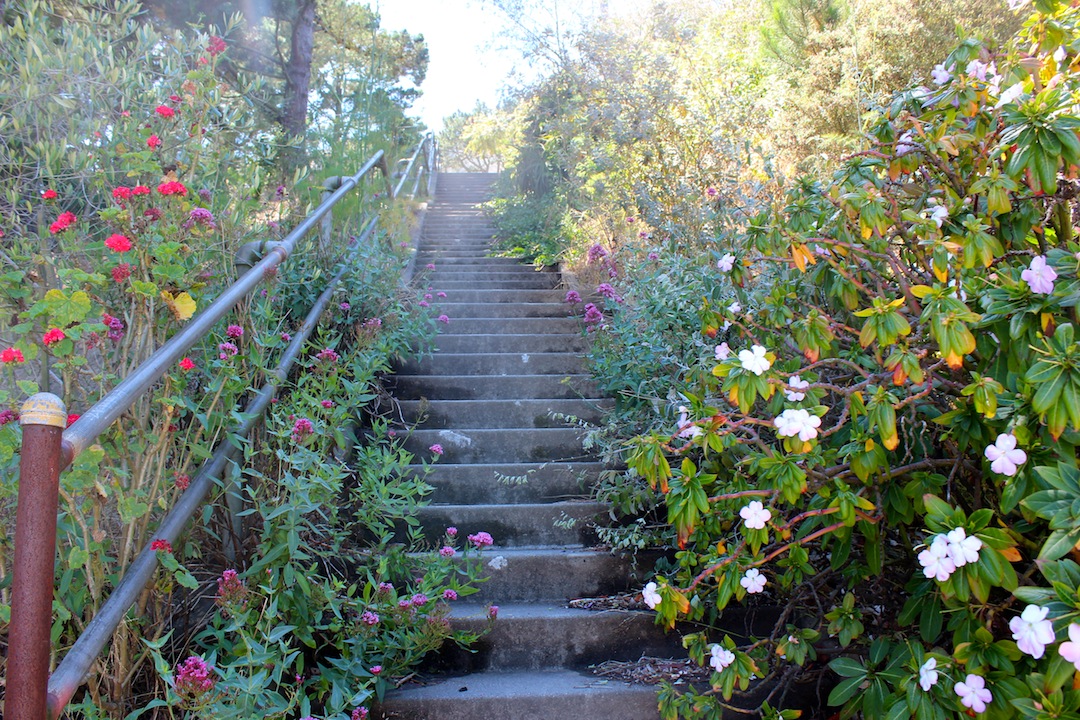
“Every front yard on Rosie’s street had one or two coastal redwoods, native trees that had been planted when the houses were built in the early 1900’s. None of the houses matched, but all looked cozy with open front porches; low-pitched gable roofs; and earth-toned sidings of wood, stone, or brick. The street, Hawthorne Terrace, was a tidy three-block stretch of narrow sidewalks, and, on the east side, a 43-step stone staircase that descended to Euclid Street where, her mother told her, a street car once stopped to take passengers to San Francisco.
“Rosie had spent the eight years of her life walking around the winding streets and staircases of her neighborhood with her mother. Now, she was in third grade, and every day when she walked from school to home, she paused on Buena Vista Way, at the top of a hill, where she could view San Francisco Bay—Oakland’s downtown, the Bay Bridge, San Francisco’s ever-changing skyline, the small and big islands in the crystal blue water, and the Golden Gate Bridge.
“But that day, she was lost in thought. Rosie had failed her math test.
“Failed.
“She couldn’t remember her multiplication tables. When she had stared at the test, the numbers got jumbled inside her head. She became confused and scared.
“Rosie turned right on Euclid as a tear dropped onto her cheek. She wiped it off quickly with her fingers and took a sharp left to ascend the 43 steps to Hawthorne Terrace. She grabbed the black wrought-iron railing and pulled each foot up the cement stairs one by one. Usually, she counted the stairs to make the trek easier, but, that day, she was worried about how to tell her mother she had failed.
“Suddenly, Rosie slipped. Her body twisted away from the rail like a flag whipped by wind around a pole. Hanging by one arm, she swung back and rammed into the railing’s vertical bars. Finally, she let go of the banister and fell hard onto a cement stair, her legs tangled beneath her.
“How did Mom climb the stairs without falling when she walked to the store or caught the bus on Euclid Way? Rosie always ran out of breath before she reached the top and, often, she fell and scraped a knee or grazed her hands.
“Mom was snipping the hydrangeas in the front yard when Rosie finally reached home. ‘Hey, buddy, how ya doin’?’ Mom said, standing up from her garden stool, her hands clutching a pair of shears. The hydrangea bushes bloomed with vibrant pink blossoms behind her—the flowers like ballerina pink tutus on a crowded stage. A pail of old blossoms stood next to the stool.
“Rosie looked down at her shoes, one untied, the shoe string dragging behind her.
“’What’s up?’ Mom laid her shears on the stool, stepped over to the stairs where Rosie stood, and put her arms around her. ‘Did something happen at school today?’ she asked, lines furrowing her brow.
“’You’re going to be disappointed,’ Rosie said, staring but not seeing anything.
“’Tell me anyway,’ Mom said. ‘Otherwise, I can’t help you.’
“Rosie sat down on the brick steps next to Mom. ‘I failed my math test. I can’t remember my multiplication tables’ she said, wringing her hands in her lap. ‘Not only that, when I was walking home, I fell, bloodied my leg, and scratched my arm.’ Rosie rubbed her hip and showed her mother her injuries.
“’Hmm,’ said her mother. ‘I have an idea. Let’s first have a snack and rest. Then, I’ll help you figure this out.’
“Rosie and her mom ate slices of apples and cheese while they sat on the front porch watching the bees flitting among the hydrangeas. Rosie described how she had painted a pink hydrangea with dots of watercolor paint during art time. ‘I can’t wait until you see it, Mom,’ Rosie said, her face lighting up as she spoke. ‘It’s really good. I used a leaf coated with green paint as a press to make the flower’s leaves.’
“Her mom put her arm around her shoulders and squeezed. ‘I can’t wait to see it. We’ll frame it when you bring it home.’ Her mother then rubbed her hands together and wiped them with a napkin. ‘Now, it’s time for your math lesson,’ she said. ‘Let’s take a walk.’
“’What?’ Rosie looked up at her mother with a question on her face.
“Rosie’s mom stood up and reached for Rosie’s hand. She pulled Rosie to her feet and they walked down the brick stairs together.
“’Where are we going, and what does a walk have to do with math?’
“’You’ll see,’ said Rosie’s mother. When they reached the narrow street sidewalk, they turned left and walked north where another set of stairs on the street rose up to Scenic Avenue. This staircase was made out of thick eight-foot-wide old railroad tie planks, each dark step set into the hill and secured with huge iron bolts. The stair rail was built out of redwood posts with a diagonal lattice in-between. Rosie’s mother sat down on the bottom step and gestured for Rosie to sit down next to her.
“’Aren’t we going to climb the stairs?’ Rosie asked, rubbing her forehead with the back of her right hand.
“’We will,’ said her mother. ‘When you’re ready.’
“Rosie sat down.
“’Multiplication tables are like addition which repeats itself,’ said Rosie’s mom. ‘We’re going to practice the two-times-table while sitting on this step.’
Rosie looked up at her mother out of the corner of one eye. ‘Hmmp!’ she said.
“Rosie’s mother held up two fingers. ’Two times one is just a single two. Two times two is two twos.’ She held up two fingers with her other hand. ‘If I count them—one, two, three, four, I find out that I’m just adding two—two times.’
“’That makes sense,’ said Rosie. She nodded her head and counted her mother’s fingers.
“’If I add two more, I have six,’ said her mother.
“Rosie felt a flutter in her chest. ‘And another two is eight. Another two is ten. Six-twos is twelve! This is easy!’
“Rosie and her mother sat on the bottom step while Rosie figured out how to multiply two from one to twelve. Her mother tested her several times and soon, she wasn’t making any mistakes.
“’Time to move,’ said Rosie’s mother. She inched herself up to the next big step. While they sat on the second step, Rosie practiced the three times table. Rosie used her fingers at the beginning, but pretty soon she was seeing the number three multiply in her head, and she soon memorized all the threes up to twelve.
“’Let’s go up,’ said Mom, scooting up one more stair.
“The breeze felt good on Rosie’s face and the velvety, seashell-shaped gardenias blooming on the bushes nearby filled the air with an exotic perfume. Rosie memorized the four times table in less time than she had learned the three times table.
“’One more up,’ said Mom, lifting herself with her arms to the next step.
“First, Rosie’s mom counted in fives. ‘5, 10, 15, 20, 25, 30, 35, 40, 45. Can you do that?’ She asked Rosie.
“’I don’t know,’ said Rosie, but she tried anyway. ‘5, 10, 15,’ counted Rosie all the way up to 60.
“’You just gave me the answers to all the five-time tables,’ said Rosie’s mom.
“Rosie’s eyes opened wide. She started with five times two and the rest were easy. Before her mom could even move, Rosie rolled herself up to the next step.
“Rosie worked hard learning the six-, seven-, eight-, nine-, and ten-times tables. Each time she completely memorized a number’s table, she and her mom moved up another step. After ten, they practiced the elevens. After the hard elevens, they practiced the twelves. By the time Rosie had memorized the twelves, her stomach was growling. It was almost dinner time.
“’The final challenge,’ said Rosie’s mom, rising to the next step. Rosie followed her.
“On each successive step, Rosie’s mom tested her with a time table from two to twelve. Rosie got all the answers right until she got to 11 times 11. Her mind went blank.
“Rosie’s mom smiled as if she didn’t have any worries at all. She worked with Rosie on the same step while Rosie reviewed all the answers for the 11 times table. Then, Rosie’s mom tested her again, ‘What’s 11 times 11?’ she asked.
“’121!’ shouted Rosie, clapping her hands together and raising them above her head like a champion.
“’Up to the last stair!’ said her mom. When her mom tested her with 12 times 7, Rosie got the right answer. ‘You’ve won the championship of the staircase times tables!’ her mom said, clapping wildly.
“Rosie shook her head in disbelief. Just a few hours ago, she had been crying about failing her math test, and, now, she knew she’d never fail a multiplication test again. ’How’d I do that, Mom?’
“’You did it by climbing one step at a time until you were ready for the next one,’ said Rosie’s mom. It is really that simple.’”
Grandpa folded his hands in his lap in the chair beside Rosie’s hospital bed.
Rosie looked into his hazel eyes. “I need to learn my multiplication tables, too.”
His eyes glittered like a green field wet with raindrops. “You won’t have any trouble at all. My imagination just showed you how to learn them.”
Grandpa put on his beret, stood up from his seat, bent over, and kissed Rosie on her forehead.
Rosie threw her arms around his neck. “Your imagination is a genius!”
“See you tomorrow,” he said.
After Grandpa left, Rosie looked out the window at the cloudless blue sky that rose upward into forever and ever. She imagined all kinds of staircases up there: wooden, cement, tile, and marble ones; ascending and descending stairs; steps with flowers growing through their cracks; stairs in the rain; stairways filled with people feeling joy and sadness; and steps full of families and friends. So many kinds.
But it didn’t matter how many stairs there were. She now knew how to climb them, one step at a time.