
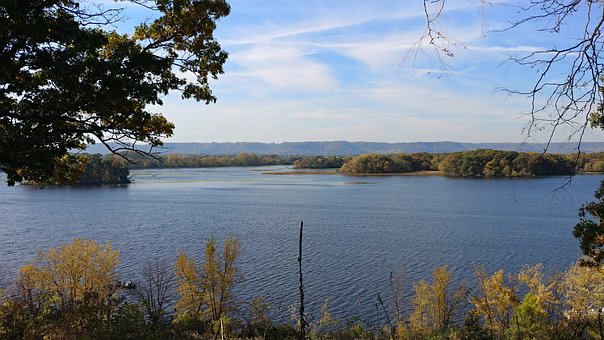
Armistice Day Duck Hunt, 1940

Armistice Day, 1940 is remembered as the day a fierce storm altered the lives of hundreds of families living near the Mississippi River in Winona, Minnesota.

The ducks hadn’t flown down from Canada as they usually did each fall, flocking to the soggy islands and inlets of the Mississippi on their way south to avoid the bitter cold of the north. After weekends rowing their skiffs in vain through the currents of the river, hunters came home empty-handed. Instead of golden-breasted ducks for Sunday dinners, wives substituted farm hens or smoked sausages from the icebox.

There was talk, though, that on Armistice Day, the ducks were coming. Leon heard it from his friends at the Brom Foundry. After church on Sunday, it was the main topic of conversation.

The night before November 11, Leon cleaned his shotgun and packed a lunch of three bologna and cheese sandwiches and a thermos of coffee.  The next morning, he dragged his skiff away from the dock of his boathouse at Minnesota City and paddled over to an island near Twin Creeks before the sun slit the horizon.

Hundreds of other men joined him. They wedged their canvas-protected bodies in sand pits and damp gullies. Gusts of wind and promises of the ducks’ imminent arrival blew in from the south and west.

About eleven that morning, the ducks came, their forms propelled by the wind as they soared over the hunters’ heads. Thousands covered the sky like a swarm of disturbed bees.

The men pointed their shotguns at the flocks, took aim, and fired repeatedly.  They hardly contained their joy as masses of plumage fell to the ground. Leon was so preoccupied, he didn’t notice, at first, how fierce and cold the winds had become.

By early afternoon, his hands were so stiff, he couldn’t hold his rifle, much less point the barrel and shoot. He started to pick up the dozens of ducks around him, but lost interest as the winds threw him to the ground and curled down his neck into his bones.

Within hours, temperatures dropped more than 50 degrees and winds reached 80 miles per hour. Water skated over the great river like sheets of glass and soaked Leon and other hunters on the unprotected island. Angry waves beat the men’s canvased bodies and gripped them with a hurtful cold. Their fingers numbed; their noses and cheeks became frost-bitten.

Leon, his friend, Gerald, and three other men used their boats as shields against the wind. They squatted behind the tin defenses, ducking their heads and scrubbing their gloves together. Leon shouted out to Gerald about lighting a fire. Gerald shook his head, his eyes filled with fear.

Finally, Leon poked his head over the rim of his upturned boat, awkwardly aimed his gun, poked a numb finger in the trigger, stiffly pulled it back, and shot at the branches of a dogwood tree. Again and again, he volleyed until a branch fell, lifted by the gale on the way down. At first Gerald watched, then he aimed and shot, too, and after about twenty minutes, several more branches had collapsed to the ground.

Leon and Gerald gathered the branches while the other men huddled behind their boats. Leon waved to instruct the men to create a circle with their boats, the open sides facing inside. Leon and Gerald then arranged the branches in the center of the circle and lit a fire, Gerald using the lid of an ice chest to buffer the lit match against the wind.

Outside the circle of boats, winds blew snow into steep drifts as the daylight waned. Between the trunks of trees and knives of rain, Leon saw other hunters crouched near the ground, their arms crossed against their chests, their heads bent so low that their necks looked broken. One man was layingh with his back against a stump, his head thrown back, his mouth open. His hair was stiff in the rain. His eyes were closed.

The sky darkened quickly. Leon no longer could see the men among the trees. The rain turned colder and hit his face like steel pins. Even the darkness felt frozen.

Between slices of rain, Leon saw shadows crawling on their hands and knees toward the black river. They moved like crabs, their arms and legs clumsily dragging across the mushy ground and one by one tumbling over the banks into the gloomy abyss of water.

Leon’s group of men huddled around the fire inside the circle of skiffs, beating their hands until they were bruised and blue. They lost feeling in their limbs. Sometime in the middle of the night, they pulled the boats closer together for more protection and waited in bleak darkness.

The hours of fear and oblivion dragged on and on, and, when Leon could barely stand the cold, he howled into the wind like a wolf. His voice, unheard by his companions, warmed his chest. He squatted, then sat, then laid inside the rim of the boat, hoping that movement would keep his blood from freezing. When he could focus his thoughts, he pictured his wife—Lily’s face as she peeled cucumbers over the sink, her farm apron hitched around her thick waist. He imagined the blonde heads of his five children. Their faces bobbed in his mind like balloons, and then they were lost again.

Finally, daylight touched the eastern side of the river like a glimmer of hope. As the sky brightened, the icy rain unfroze. The gale-force winds relaxed, and the men felt their bodies unthaw like slabs of beef. They let the rain put out the fire, then crawled out of their makeshift hut of skiffs and started for home.

As soon as the sun came up along the Mississippi River, relatives gathered at boat docks for news of their men. Planes droned overhead searching for life and dropping packages of sandwiches, whiskey and matches where they found it. Parties of men in boats with broken motors paddled with difficulty out to the islands. They returned with chilled and shriveled hunters, breathing, but frozen with dreams of death.

Leon rowed up to the Minnesota City boat dock by himself. From the riverbank, his eleven-year-old son, Paul, watched him guide a strange boat alongside the pier, stiffly throw its rope around the post, and crawl onto the ledge. Once safe, Leon laid face up on the wood, his arms and legs askew. He didn’t move for a full five minutes.

Finally, Paul ran down the bank and down the pier until he reached his father. “Dad, Mom was scared. She prayed the rosary all night. Us kids fell asleep, but when I woke this morning, she was still sitting in her rocking chair, praying.”

Leon looked up at Paul’s face. His blonde hair was covered by a wool cap. He wore a parka and gloves. His cheeks and nose were red. Even dressed for winter, he was skinny.

Slowly, Leon positioned himself on his hands and knees. He put one boot down, and stood up by pushing himself up, first on his elbows, then his hands, then knees, and finally to his feet.

When he put his arms around Paul’s 11-year-old body, his heart thawed.

He had made it home.

The Kashubian Warriors of Winona

Even the sweetest human being contains a little bit of wickedness, and the most awful person possesses at least a little goodness.  This is because each person is made from a complex collection of DNA that has been blended over and over again, generation after countless generation; furthermore, these durable genes have survived a variety of political systems, religions, geographic locations, war, peace, cruelty, and kindness—all of the experiences of their ancestors. 

One day, when I visited the Polish Museum in Winona, Minnesota, I saw a photograph of one of my ancestors, Lawrence Bronk.  I thought I was looking at a photograph of my father—a man of fine build, blonde hair, and handsome face; however, Lawrence was the brother of my Great-great-grandfather Ignatius, and he immigrated to Winona, not from Poland, but from Kashubia, a place that bordered the Baltic Sea. This man inspired me to find out just who these Kashubians were and what made them Kashubian instead of Polish.

Not only did I research the immigration of the Kashubians to North America, but I also investigated how the Kashubians settled in Kashubia.  What I found out was that I was related to people who had lived complex lives of peace, aggression, oppression, and chaos throughout the centuries.  This is their story.

After the Roman Empire dissolved in the 6th Century, Slavic tribes from the East, mainly from the Ukraine area, migrated north into Russia, west into what is now known as Germany and Poland and the Czech Republic, and south into the Adriatic Region.  These were distinct from the Germanic tribes that had migrated from Scandinavia into the Roman Empire starting in the 4th Century.

The Kashubians were a Slavic tribe that settled in Eastern Europe on the coast of the Baltic Sea at that time.  Specifically, they claimed a region of land that was south of Sweden, north of Poland, east of the German homeland, and west of Lithuania.   Their ancient territory stretches from the Kashubian capital city of Gdansk to as far as the German Capital of Berlin. It lies between the Odra River to the west and the Vistula River to the east. The whole north side borders the Baltic Sea.

During the migration, the Slavs became a nuisance to the Byzantine Empire, which was really the eastern part of the Roman Empire that lasted for a thousand years after the fall of the western Roman Empire.  Since Slavs were an adaptable species, they learned how to use the weapons of those they conquered and attacked cities instead of trade routes. 

These pillaging Slavs believed in nature, and they had adopted a mythology consisting of a pantheon of gods.  Their shamans were known for telling great tales about their gods, and the Slavs traditions and way of life were developed from these tales.  

The Byzantine rulers wished to calm these robust terrorists, so they ordered two scholars and brothers, Cyril and Methodius, to educate the Slavs in the Glagolitic alphabet, which was closely connected to the teachings of Christianity.  This is how Kashubians and other Slavs became Roman Catholics. 

When the Byzantine Empire ended, the Slavs created Slavic kingdoms across Eastern Europe, effectively squelching the influence of the Mongol tribes who wished to spread their Muslim religion. 

The Kashubs were also called Pomeranians, which translates to “the people by the sea”. When they settled by the Baltic Sea, they spent many years isolated from other Slavs and peoples.  This allowed them to develop their unique Kashubian dialect and create their own traditions, folklore, music, dance and cuisine. Their access to land induced them to become an agricultural people, farmers who worked the land to provide for their families.  They organized their smallest community structure into Catholic parishes, and their lives centered around their religion. 

Eventually, the German Empire encroached upon the independence of the Kashubian people, and Kashubia became part of Prussia.  Their German rulers forced priests to say Mass in German instead of the native Kashubian language, and the Kashubians strongly resented this.  Farmers had large families so that children could help work the land, but when these broods of children grew into adulthood, there wasn’t enough farmland for them to farm; therefore, the German government offered Kashubians free or cheap travel to North America where homesteads and land were abundant.

On May 14, 1859, three sailing ships left Hamburg, Germany for Quebec, Canada, carrying a host of Kashubian families.  The names of the ships were the Laura, Donau, and Elbe.  The river that connects Hamburg to the Baltic Sea is the Elbe, so the ship named Elba was likely named after this river, a common German practice for naming ships.

On board the Elbe were families with the surnames of von Bronk, Galewski, Kistowski, Konkel, Libera, Piekarski, Platowna, Rzenszewicz (Runsavage), Walinski, who knew each other in their homeland.  The records of the ship were posted in German using Prussia as the land of origin; however, Kashubians never did consider themselves German. 

My ancestors on the Elbe consisted of the Joseph and Francisca von Bronk family, including their five sons—Johann, Ignatz, Vincent, Lorenz, and Jacob.  Von is a German preposition meaning “from,” so this label indicates they came from a place called “Bronk.”  In the Kashubian region, there is a forest known as “Bronki” so they may have originated from that specific place.  All of the passengers listed on this ship were classified as “Landsmann,” indicating that they were farmers. 

Joseph von Bronk is my Great-great-great grandfather.  His son Ignatz, who changed the spelling of his name to Ignatius, is my Great-great grandfather mentioned above.  The family left Quebec and traveled south, eventually arriving in the Winona area before the end of 1859.  Many of the families who traveled across the Atlantic with them also settled in the Winona area.  Others stayed in Canada and founded another Kashubian town known as Wilno. 

The Winona area was a lot like their home in Kashubia where there were plentiful forests, abundant water and fishing, and land for farming.  At first, the Kashubians settled on the east side of what is now known as Winona where they established a Kashubian village.  In 1886 after his second wife died, Ignatius bought land in Pine Creek, Wisconsin.  This property is owned by my Uncle David and Aunt Linda today. 

Artifacts in the Polish Museum in Winona revealed that the Kashubians were a literary and creative people.  Many of their descendants have continued the strong story-telling and writing traditions of the culture, including me, for instance.  Their colorful embroidery and distinctive pottery are world-renowned, and their flag and national symbols are celebrated today, not only in Kashubia, but now in the Kashubian communities all over North America. 

Today, in Winona and in the surrounding farms, the Kashubian descendants live in harmony with Polish, German, and Swedish peoples.  They work in each other’s businesses, attend each other’s weddings and baptisms, and share the same merry-go-rounds. 

This is the Kashubian story.  Now this is my advice.  If you have a Kashubian neighbor, laugh at their jokes, never insult them, keep the peace.  A Kashubian is a warrior.  Behind that friendly gleam in his eye, behind her engaging smile is a constitution of ferocity.  Those DNA have migrated over mountains, through valleys, into war, across water, and have survived. 

References:

  1. Larry Reski.  Poland to Pine Creek, Wisconsinhttps://polandpinecreek.blogspot.com/2014/02/elbe-departing-from-hamburg-14-may-1859.html.
  2. Haden Chakra.  The Great Migration and Early Slavic Historyhttps://about-history.com/the-great-migration-and-early-slavic-history/.
  3. Welcome to Wilno. Wilno.com.