
Donkey Lessons

By Tess Perko, author of LEARNING TO WHISTLE, a Winner for Women’s Fiction in the 2026 International Book Awards

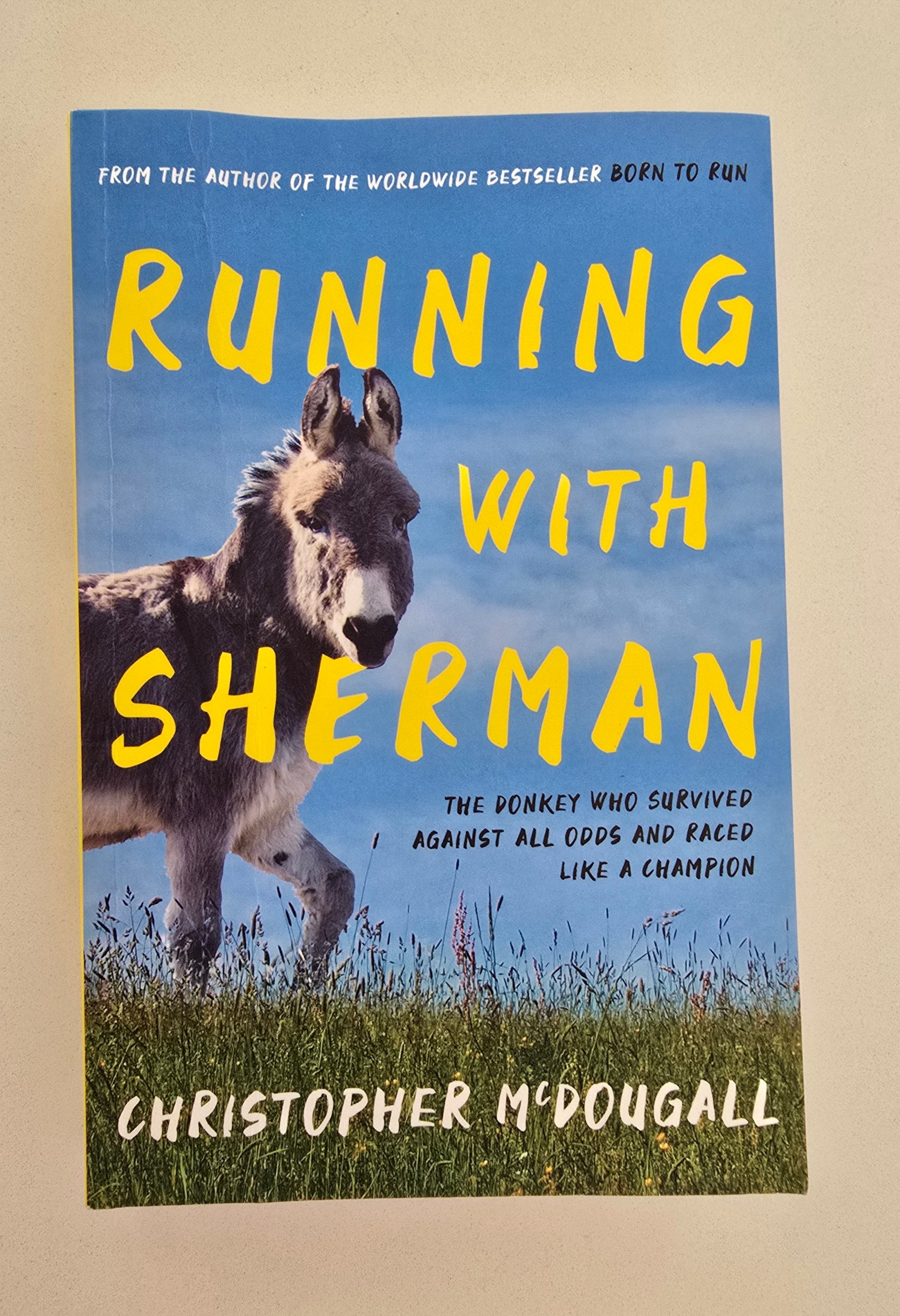
Running with Sherman by Christopher McDougall is the story of a donkey, Sherman, that McDougall and his family rescue from an abusive home. The author recounts Sherman’s liberation, the donkey’s trauma and fear, and his eventual healing as he, his wife, and their community help Sherman build a new life. McDougall, a former war correspondent for the Associated Press, uses narration and journalism expertise in his chronicle of Sherman’s tale. He includes stories about the lives of his Amish neighbors and the various individuals who inspire him as he nurses Sherman back to health. Sherman is adorable. MacDougall is big-hearted and persistent. The story is heart-warming and satisfying, but it also is much more than a story about a rescued donkey. By the time readers turn the last page, they are enthralled in the effort to heal Sherman and wiser about how to improve their own lives. Read further to discover just five of the lessons readers can glean from Sherman’s tale.

Abuse Creates Profound Mistrust and Fear

The story begins with Sherman’s rescue. A hoarder of animals has kept Sherman tied up in a dark and tiny cell inside a muddy broken-down barn, a space so small the donkey can barely move. His legs are mired in mud. When Sherman is brought to MacDougall’s farm, he has grossly overgrown hooves, filthy matted fur, intestinal parasites, and impaired digestion. The donkey is in severe pain and could possibly die. When the author puts Sherman in a pasture, he hangs his head and barely moves. Even after MacDougall arranges for the trimming of the donkey’s hooves, the shearing of his fur, and daily nutritious food, Sherman remains motionless and withdrawn. Finally, Lawrence, one of MacDougall’s chummy goats adopts Sherman as his new friend, and the donkey begins to trust other animals. It takes months, however, until he builds up enough courage to trust the new humans in his life.

Every Life Needs a Purpose

One of MacDougall’s friends, Tanya, a lover of donkeys, suggests that Sherman needs a purpose to help him overcome his abuse. Donkeys have no use on a farm, so MacDougal uses his imagination. He once had participated in a burro race in Leadville, Colorado, but had failed to get his donkey, Blue Note, to run the whole course. Eventually, he aborted the race and accepted that he was inept at donkey-racing. Nevertheless, with a bit of over-confidence, MacDougal, a runner himself, decides to train Sherman to race. As he endeavors to train the donkey, readers realize it isn’t important whether he ever gets Sherman to run in an actual race. Once he has a purpose, the donkey’s days are filled with nutritious food, healthcare, the companionship of two other donkeys, three humans, and hours of stimulating training.   

Animals Feel and Think, Too

Humans have the tendency to believe that animals lack feelings and the ability to think. Sherman’s story, however, is filled with instances that prove animals have feelings, do think, and adjust their behavior accordingly. For example, when Lawrence, the goat, first meets Sherman, he takes time to sniff Sherman’s body, evaluating his needs and condition. After his thoughtful sniffing, Lawrence lies down next to the donkey and stays with him all night. Lawrence recognizes that Sherman needs nurturing.

All of the donkeys in the story prove that they can feel and think. One day, MacDougall and his wife try to take Sherman and another donkey, Matilda, out for a run without the third donkey, Flower. When they leave Flower behind in the pasture, she wails in utter despair. Sherman and Matilda try to turn around repeatedly to return to the pasture with Flower, and the day’s training is a disaster.

Humans Benefit from their Animal Friends

One of the most satisfying aspects of this story is when readers realize that MacDougall and his friends benefit from their relationships with the animals as much as the animals benefit from them. One of MacDougall’s neighbors has a son, Zeke, who quits attending college after he attempts to commit suicide. MacDougall recruits him to run with the donkeys. Zeke spends hours training with Sherman and the two develop good communication and trust.  The training sessions improve both of their lives, providing them with purpose and a distraction from their individual traumas. Later, Zeke breaks his foot and can’t participate in the Colorado burro race, but he still goes to the race and supports Sherman before and after the event.

Relationships Are More Valuable than Getting Rich

In one chapter, MacDougall discusses the values of the Amish culture, which are health, happiness, and security. A man he knows, Sam, tells him about his uncle who started making money by fixing buggy carriages. His reputation grew so much that he was hired to fix carriages for Disney and the Smithsonian. These jobs made him lots of money, but took him away from his family and community. Instead of his life improving, he was no longer happy and content. Finally, he gave his business to his nephews and moved his family to a small farm. Why?  To devote himself to his family and community and to regain his health, happiness, and security.

The lessons of Sherman’s story are profound. Have compassion for people and animals who experience trauma. A purpose can enrich the life of anyone, even if its ultimate goal is never achieved. Humans can improve the lives of animals, and animals can enhance human lives. And finally, the most precious aspect of life are the connections we make with other people and other living beings.

Tess Perko is the author of LEARNING TO WHISTLE, published in 2026 by She Writes Press and distributed by Simon & Schuster, a Winner for Women’s Fiction in the 2026 International Book Awards.

I Was My Own Best Student

I worked as an English professor for sixteen years. My average class size was 30 students and I usually taught four classes per semester. If you add up those statistics, I taught approximately 3,840 students over my career.

I remember so many of them.

Wilma smelled like marijuana when she entered the classroom at 8:00 a.m. every morning, and when it was her turn to answer a question, she looked up at me with glassy eyes. Once, when she came into my office to get some help on an essay, she told me that she didn’t vote because she could never make a difference, even though she cared deeply about global warming. She took two of my classes—fall and spring.  By the time she finished the second semester, she had given up smoking marijuana and had registered to vote for the upcoming presidential election.

Andrew was a hard-working football player and a lackadaisical English student. One day at football practice, he broke his ankle so badly that his football career was ended. He couldn’t drive to school because his leg was in a cast. He couldn’t take the bus to school because he couldn’t walk to the bus, get on the bus, or walk from the bus to his classrooms. No one in his family could help him since they were so financially strapped that they all had to work. He dropped my class. I emailed him to find out why, and then I told him not to give up. Football wasn’t everything; he had a lot more options. The next fall, he came back to class, worked hard, and told me he was going to transfer to a four-year college in a year to major in business. I gave him hope, he said.

But even though I have so many stories like this in my memories, none of these students were my best. My best student, by far, was myself. I was so invested in teaching writing, literature, and critical thinking to these students, that I spent thousands of hours researching and preparing for my lessons, and then I taught them. My students asked me questions that I didn’t anticipate, and I found out the answers. They came to class unprepared in skills and homework, and I worked hard to fix this. Here’s some of what I—my best student—learned.

Learning Takes Nothing Less Than Commitment

A teacher can present the most wonderful lectures or plan the most engaging activities, but students who are not committed to learning, still will not learn. If students don’t understand the benefits of what they’re learning, they won’t exert the effort. They’ll skip the reading, write their essays at the last minute with no planning or revision, and ignore the details that produce strong thinking and writing skills. I began identifying the students who were not committed to learning and worked to get them engaged. I learned that there are many reasons that a student is not committed including homelessness, hunger, thirst, anxiety, depression, trauma, or pain. Getting them support to mitigate these problems can transform their lives.

Success in Anything Takes Several Steps

Some students came into the classroom wanting an “A,” but not wanting to do the work necessary to get an excellent grade. Somewhere along the way, they had been taught that grades were more important than actual learning, and they didn’t understand that learning was a process, not the result of talent. As the teacher of an essential college skill like writing, I had to figure out how to change this misconception. I used the analogy of a staircase, and told them that if they wanted to get to the top of the staircase, the best way was to take each step, one at a time; otherwise, they would either get injured if they leapt to the top and miss the lessons of each step. Now, I’m using every stair on my own staircase.

Reading, Writing, Speaking, Listening, and Thinking Are Intrinsically Connected

Early in my life, I had been a good reader, but I hadn’t understood the intimate connection between reading and writing. While I was teaching English-As-A-Second-Language students, I learned that the most successful students engaged in reading, writing, speaking, listening, and thinking in English. Later, I took this concept into my transfer-level writing and literature classes and taught it to my students. We analyzed readings for figures of speech, and then we practiced using them in writing. We scrutinized words for exact meanings in readings and then tried to use the best words in writing. We stood in front of the class and explained what poetry meant, and then used our speeches for essays. We learned that thinking is not the same as writing. Thoughts don’t come out of the brain in clear sentences, but they do provide incredible ideas for development.

Critical Thinking Can Be Learned and Understood

When I first was assigned to teach a critical thinking class, I had to try to define it for myself, but I didn’t truly understand what it was until I developed lessons for teaching it. Most students, I found out, didn’t understand it at all, and they had no idea why it was important. Finally, I developed a lesson which required students to evaluated websites based on criteria, and the students found out that not all websites were honest or credible. Their surprised faces showed their understanding of why a healthy skepticism was essential to navigating today’s unscrupulous society. Every time someone tries to scam me or sell me a product, I use this skill.

Writing Is a Slow Journey, not a Talent

Many of my students came into the classroom with a variety of writing skills, often deficient ones. My professorial pride would not let me pass students who wrote poorly, so I had to devise lessons to teach them strong writing practices. As I prepared and taught those lessons, I honed my own writing skills at the same time. I learned the importance of using consistent verb tense, active verbs, specific nouns, and focused verbs. To forgo adjectives for better nouns and adverbs for better verbs. To memorize the purpose of each part of speech and how their careful utilization strengthened my sentences. I learned how to deftly include quotations in my writing to improve my credibility, and, in class, my students and I practiced this until we were all much better. Oftentimes, students brought back stories of conversations at home where their parents noticed their improved vocabulary and speech.

Now I’m retired, and I’m writing a blog, short stories, and a novel. Fortunately, I was the best student in my classes for the last sixteen years and it’s paying off. I’m more productive in my writing than I ever have been, and I recently realized another lesson that I learned.

Happiness is a key ingredient to success. I’m certainly that.