
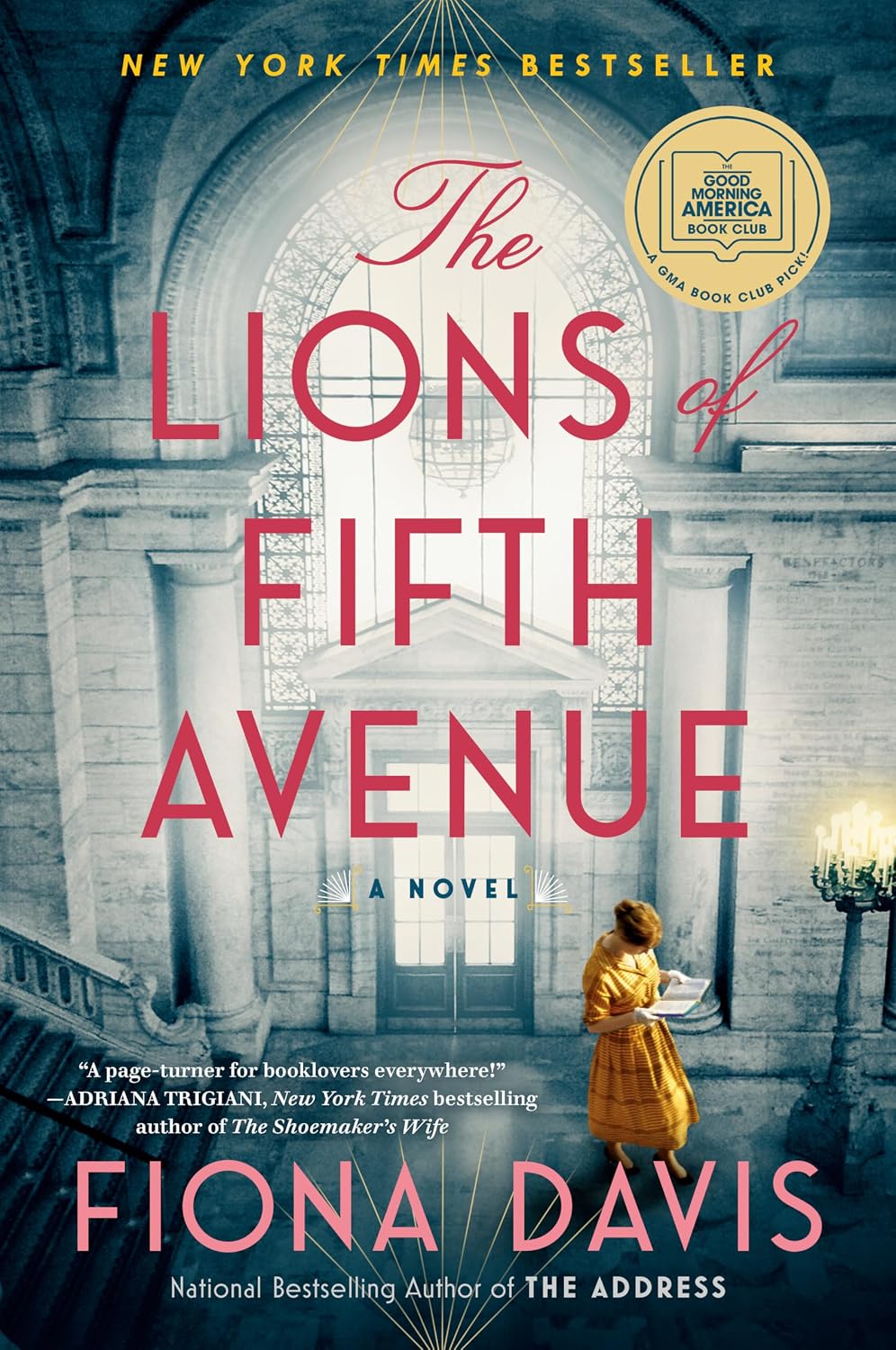
BOOK REVIEW: The Lions of Fifth Avenue by Fiona Davis

Any avid reader will fall in love with this charming novel—a story of a family that lives inside The New York Public Library in the early 1900’s and a quest of a young librarian at the same library in the 1900’s. Here are some of the reasons I read this book from cover to cover, night after night, all the way through its heart-breaking climax and fulfilling conclusion.

  • The story includes detailed description of the Beaux Art architecture of the New York Public Library building on Fifth Avenue in New York, between 40th and 42nd Streets, which was built from the wealth of the Astor, Lenox, and other families of the Gilded Age. Two lions, named Patience and Fortitude, flank the building’s entrance. Another notable feature is the Main Reading Room on an upper floor, which has a 52-foot-high ceiling.
  • Jack Lyons, the superintendent of the library in the novel, and his family live in an apartment in the interior of the library. In the Author’s Note, Davis confides that this 7-room apartment once did exist and housed the family of John H. Fedeler Sr., a library superintendent, for thirty years. The inclusion of this space in Davis’ story enhances the mystery of the building. Inside the apartment is a dumbwaiter that plays a major role in the story’s plot.
  • As the story progresses, the reader learns about all the treasures that the library contains such a one of Shakespeare’s First Folios, The Gutenberg Bible, and the original manuscripts of the Berg Collection. At one point in the story, Davis points out that the imperfect manuscripts included in the Berg Collection—which include corrections and revisions—allow people to witness the process of writing by such famous authors as Dickens, Thoreau, and Virginia Woolf.
  • Laura Lyons is the protagonist of the early 1900 half of the story. She’s a dedicated wife and mother, yet yearns to have her own pursuits like her writer husband does. Her journey introduces her to her future female lover and involves her in the meetings of the Heterodoxy Club in Greenwich Village, a group that discusses feminists’ issues. As she struggles to fulfill her traditional life duties while, at the same time, satisfy her deepest dreams, the reader discovers what life was like for many early century women and how the struggles of women then continue to this day.  
  • Sadie Donovan is the main character of the 1990 part of the story. She buys her clothes at thrift stores and prefers reading a book rather than talking to people. She has a degree in library science from Rutgers and gets her thrills by answering questions at the research desk in the library. My kind of gal—sets her own fashion statement; spends hours between the pages of imaginary worlds; and acquires knowledge by helping others find what they need.

Who else is fascinated by historical fiction? Do you have a book recommendation for me?
Glitter, Gloss & Human Dignity

Last Saturday, I attended the San Francisco Gay Men’s Holiday Spectacular at the Sydney Goldstein Theater in San Francisco for the first time. Oh! What a night!

When my daughter and I arrived, a quiet but eager crowd was gathered around the theater’s entrance. We donned our required Covid masks and presented our tickets to a friendly usher who pointed to the stairs. Above, another smiling usher led us to our excellent seats and we sat down—only two in a theater filled with Christmas sweaters and holiday cheer. Excited voices murmured throughout the cavernous room.

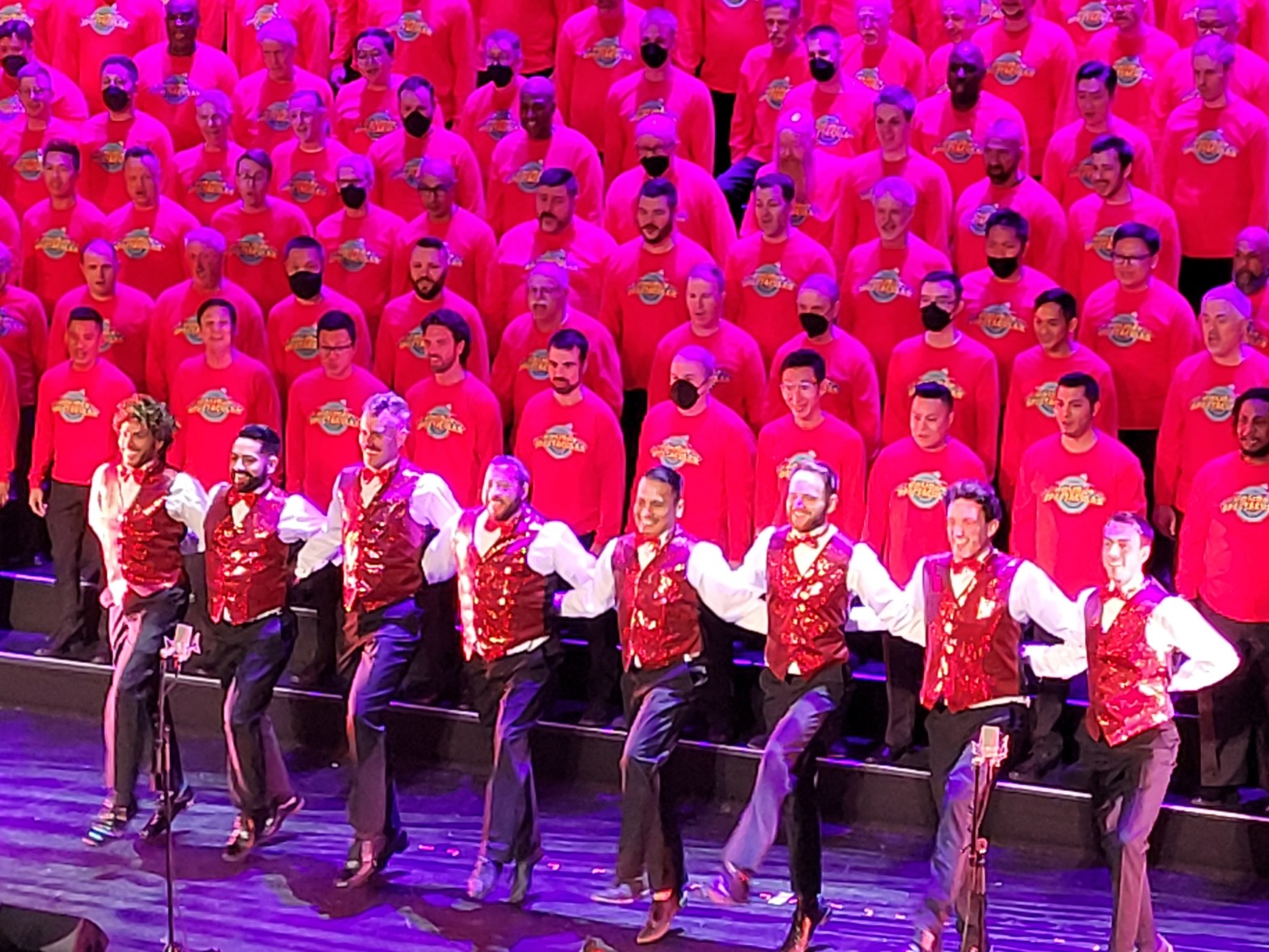
The stage curtain was lit up with the title of the chorus in capitalized red letters, and, a few minutes later, the curtain opened to reveal the silhouette of risers brimming with over 200 singers. The lights came on, and the audience suddenly saw ten rows of men dressed in long-sleeved red T-shirts and black bottoms on a staircase of risers. The orchestra began, the conductor raised his arms, and the men began to sing.

Young men, gray-haired men, bald men, men with beards, men wearing skirts, men with canes, and men sitting on stools all crowded the risers and faced the music conductor with professionalism and purpose. No one read lyrics from a song sheet. All of them sang by memory.

The chorus sang “On this Shining Night” by Morten Lauredsen, a song I had sung with the Blackhawk Chorus a few years ago. The men’s voices were rich, on tune, piano and forte. I fell in love with their sound.

After each song, several chorus members quietly exited from the risers and went back stage. As the next song began, these members came back on stage as dancers in various costumes to complement the chorus. Some stood at microphones at the front of the stage to sing solos.

In the middle of the performance, the chorus sang a long rendition of “Jingle Bells” that got the audience toe-tapping and clapping. They sang many verses in a variety of styles that became more exuberant all the way to the song’s finale.

The song that sent shivers up my spine was “Huddled Masses” by Shaina Taub, a song about the plight of immigrants and our moral duty to support them. The conductor explained to the audience that, although this wasn’t a Christmas song, it promoted the spirit of Christmas, which is love.

On the right side of the stage, in front of a glowing Christmas tree, was a sign-language interpreter who signed the words of each song. His hands gracefully moved as the singers slowed their tempo and stretched the lyrics over a series of beats.

One of the last songs was “Silent Night.” The orchestra began the introduction and then the chorus, instead of singing, signed the first verse silently. When it was time for the second verse, the orchestra stopped, and the chorus continued to sign the verse as the audience watched in silent wonder. In the quiet of the moment, my heart filled with so much gratitude to the chorus for expressing what a deaf person hears and how silence can evoke wonder and awe.

Later in the program, the chorus held a moment of silence for the five LGBTQ persons recently gunned down in Colorado Springs. For two hours, without an intermission, and with energy and vitality, the chorus recited lyrics of peace and promoted love in both prose and lyrics. This was a night filled with joy despite life’s hardships and disappointments.

I left the theater with happiness in my heart—contentment that I live near San Francisco, a city filled with respect and love for the LGBTQ community—because I know, that a culture that treats all persons with dignity is the cheeriest place on earth.