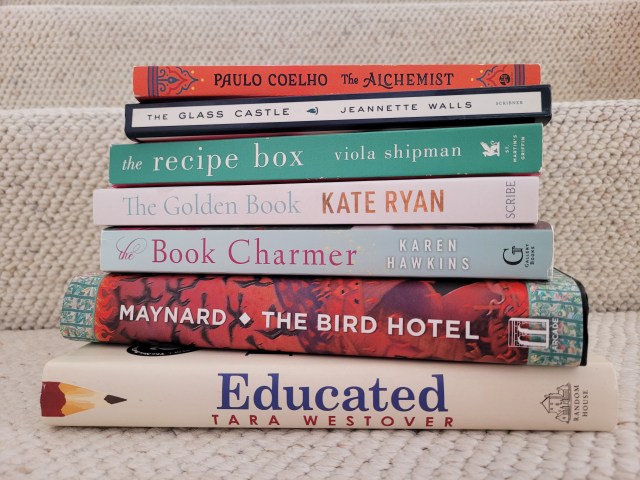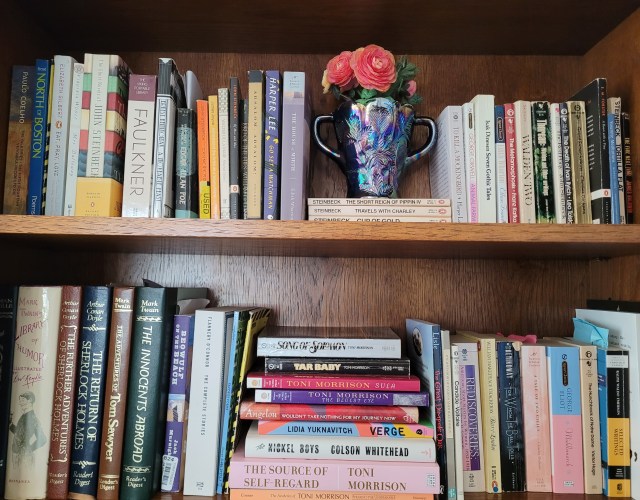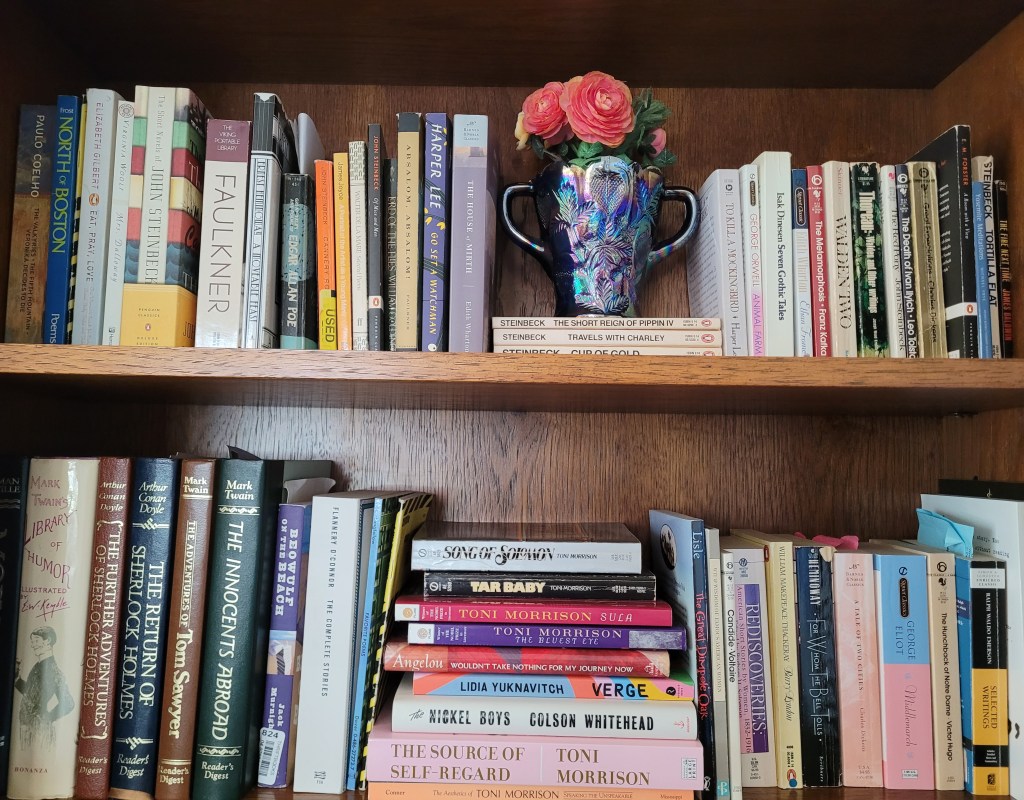
James: Tom Sawyer’s Literate Companion

I recently read James, Percival Everett’s story about the runaway slave, Jim, who accompanied Tom Sawyer down the Mississippi River. The story is told from the slave’s perspective which gives Everett many opportunities to reveal the slave’s character.

The most remarkable thing about this story is how Everett portrays Jim as a well-read and highly literate man, not mentally bound by the psychological chains of slavery. Instead of being illiterate, he is able to effectively communicate ideas, can understand complicated information, and is capable of critical thinking.

Ability to Read and to Understand Complicated Subjects

Early on in the story, the reader learns that Jim has taught himself to read by studying the books in Judge Thatcher’s library. In addition to learning how to read, however, he also has developed the ability to think about complicated subjects such as civil liberties and how the morality of religion conflicts with the concept of slavery. He has read the literature of philosophers such as Voltaire who advocated for civil liberties through freedom of speech and freedom of religion and has seen texts by John Stuart Mill who wrote about individual liberties. We also learn that he knows of the works of Rousseau and John Locke, both of whom influenced the French and American Revolutions. Jim proves his literacy and ability to think about complicated subjects by contemplating the differences between being enslaved or possessing individual rights.

Awareness of the Effects of Various Language Skills

Before Jim runs away,he teaches his daughter and other slave children the difference in speaking like a slave and speaking like a literate human being. He cautions them to never make eye contact with a white person, never speak first, or ever to broach a subject directly with another slave since these are the behaviors of someone who is confident about their opinions. In fact, he teaches them not to express opinions of any kind and to let the whites identify any problems that come up.

He coaches them on using poor pronunciation, incorrect spelling. The goal is to make the whites think that blacks are stupid and that they can’t express themselves clearly. This puts the whites in the position of feeling superior and protects the blacks from being blamed for trouble. What is made abundantly clear, however, is that Jim and the children he teaches are capable of distinguishing between the language that keeps a person subservient and a language that empowers them.

Ability to Write

At one point in the story, Jim asks a slave to get him a pencil so he can write. Young George steals a pencil from his owner, gives it to James, and eventually loses his life because of his “crime.”  However, James keeps the pencil in his pocket, the safest place he can find to avoid losing it. The pencil represents his ability to write down his own ideas, one of the most empowering aspects of being a literate person.

Use of Literacy to Make Better Decisions

Jim’s literacy allows him to make better decisions about how to survive. At one point, since he knows he’s being searched for under the name of “Jim,” he tells a white man, Norman, to call him February, but to say that he was born in June. If he hadn’t been able to read, he’d not have known the order of the months or how to manipulate them to help save his own life. When he returns to Judge Thatcher’s library, he forces Thatcher to show him how to use the map to find the farm where his wife and daughter are living.

Jim wouldn’t have been successful at escaping slavery without his literate skills. His literacy allows him to communicate with people he meets, analyze his predicaments, and form judgments about how to survive. In the end, when the sheriff asks him if he is Nigger Jim, he elevates his name to the more formal version, James. After all, he is no longer the slave that was once given the name of Jim.
Five Ways to Read Like a Writer

Photo by Michael Satterfield on Unsplash

When I was a child, I sat in a corner on the floor, reading fairy tales and getting lost in the dreamy and, sometimes, cruel, plots. I wasn’t yet a writer.

Now that I AM a writer, I read differently. I give myself permission to stop anywhere to observe the author’s craft. Here are five things I do.

Make Notes in the Book

I read books on my Kindle and via paper. The reason I use a Kindle is that it’s easy to hold while reading in bed. But, if I find an author whose writing I want to analyze, such as Barbara Kingsolver’s Demon Copperhead, I buy the paper version, and I write notes in it. Notes are better than highlighting since they help me remember why I marked a particular sentence. I’m not going to give the book away since I know I’ll come back to it over and over again to think about Kingsolver’s wording, sentence placement, or plot twists.

Look Up Words

Building vocabulary is a lifetime endeavor. I’m always finding new words while I read, especially when I read authors from other countries such as England and Australia. Different cultures seem to emphasize different vocabulary. For example, the other day, I came across the word “palaver” which means a prolonged and idle discussion. I look these words up, but I don’t take the paper dictionary off the bookshelf to do this. I’ll either use the dictionary feature on my Kindle or a dictionary app on my phone to make the task more efficient. Then, I’ll think about how the word fits into the author’s sentence and also how I might use it in my own writing.

Think about Word Choice

In Demon Copperhead, Barbara Kingsolver begins Chapter 40 with this sentence: “One look at her and I was gone” (319). The word that caught in my throat was “gone.” When I read it, I couldn’t wait to read the rest of the chapter. I had to find out what she meant by it.

That’s how powerful one word can be. I want to be the kind of writer that can use words to grip a reader, make her heart pump, send pulses through her body, and keep her reading. The only way for me to become better at this is to read how other writer’s do it. Which word does she choose? Where does she put it?

Evaluate How a Sentence is Structured

Believe it or not, sentence structure can make an action more compelling. Short sentences or phrases create tension or drama. Long sentences can paint a picture. Here’s a sentence from Demon Copperhead: “In my high-water jeans and the old-man shoes Mr. Peg had loaned me at Christmas, I joined the tribe of way-back country kids with no indoor plumbing and the Pentecostals that think any style clothes invented since Bible times is a sin.” This sentence not only describes what Demon was wearing, but it also says something about the two types of kids that he hung out with. In other words, it packs a punch.

Think about How an Author Uses Dialogue to Create Character

People don’t use the same words, have similar accents, or form identical sentences. Writers can say a lot about a character by creating dialogue that is unique to him or her. For example, in The Great Alone by Kristin Hannah, Large Marge says, “’Sit down or I’ll knock you down” (162). Large Marge is a big woman who is not afraid to threaten a man and her words illustrate this. If she was small or complacent, she would’ve said something completely different.

The Close

I can’t think of any better way to become a mature writer than to read voraciously. The true writer that gets excited about great prose.

What Really Makes Me Tick (Happy)

Wouldn’t it be a better world if everyone knew what they needed to be happy? I’m retired, and I loved my teaching job; however, now that I don’t have to commute to work five days a week or grade college essays on the weekends, I just want to do things that make me happy. Here they are.

Admiring Flowers

Stopping to smell a rose may seem like an unimportant action, but, when I do it, it brings me joy. I have rose bushes in my front yard and back yard, and every morning, I wander outside to inspect every bush to see the new blooms. I sniff and stare and smile to my heart’s content.

I remember the flowers of my childhood, too. In January, crocuses poked out of the soil in the flower beds in the front yard. In February, the daffodils came. Tulips arrived in March, and Irises after them.  By the time Lent was over, Easter Lilies grew like sophisticated ladies in white hats in our back yard. And in May, the meadows were carpeted with Bluebells.

For four years of my childhood, I lived in England with my family, and I was impressed by the colorful blooms of summer that thrived in the temperate climate. Rambling roses climbed up cottage walls. Cosmos waved their rainbow heads in the breezes like pretty bonnets. Hydrangeas brightened shady nooks of gardens with their puffy burst of blue and pink. I was entranced by their beauty.

At Christmas, my mother bought at least one Poinsettia to decorate the house. She bought red poinsettias, white poinsettias, and ones with white flowers with red stripes. Sometimes, she had an amaryllis bulb growing in a pot. Every day, I’d inspect it to see whether it was blooming or not. I was in more of a hurry than it was.

Making a Stew or Pot of Soup

Whenever my dad cooked, he made “water” soup. He added pieces of beef and vegetables to a pot of water to create soup. Ugh. We kids would cringe when we saw him taking out a pot. His were the worst soups I’ve ever tasted.

Maybe that’s why I love making delicious soups.

I own an old Dutch oven that is the perfect size for making one-pot meals. Some mornings even before I change out of my pajamas, I scour the refrigerator and pantry for the ingredients for a minestrone—onions, celery, carrots, zucchini, chick peas, barley, chicken broth, chopped tomatoes, oregano, salt, and pepper. Sometimes I add cooked shredded chicken. Often, I don’t.

Or I find the fixings for chicken noodle soup for a recipe from a William’s Sonoma Soups book that I bought a long time ago. While I’m chopping the carrots and celery for this soup and simmering the chicken breasts in the broth, I think back when I made this for my two children who loved it. I see their little faces above their steaming bowls, their hands holding spoons, their mouths filled with savory egg noodles.

On one European trip, I bought cookbooks in the Czech Republic and Austria, so when I want to make goulash, I search for recipes from those books. My favorite goulash is a beef, onion, and smoked paprika concoction that is topped with cornmeal dumplings. I first ate cornmeal dumplings at the restaurant at the Belvedere Palace Museum in Vienna. I’m still practicing to make mine taste as good as those were.

Reading Inside When It’s Cold Outside

To me, the essence of decadence is waking up in the morning, seeing that it’s cold and rainy outside, then reaching for a novel and reading it in bed. To take all the time in the world to read a story, then stopping and thinking about it is heaven on earth.

Reading when its cold outside reminds me of when I read as a child. I had time to sit on the floor in a corner of the house with a treasured book of fairy tales and get lost in another world. When my mother took me to the open-air market, I found the bookstore, walked to the back shelves, pulled out a tome, and read it while sitting on the floor. I was always afraid that the shop owner would find me and kick me out, but he never did.

Decorating My Home

When I was a child, we never had an expensive home, but that didn’t keep us from making it beautiful. In the spring and summer, I picked flowers in the meadows, poked them into vases and brightened every table and dresser in the house. In the fall, I cut branches of colored leaves for the mantel in the living room. For winter, my mother and I found pine cones and spray-painted them silver and gold for Christmas. We added holly and pine branch garlands in-between them.

Today, when a new season comes, I still have the irresistible urge to celebrate it with seasonal décor. Right now, I have a collection of pumpkins on my front porch accompanied by a little witch. I also have put pumpkins on the table on the back patio so we can feel the season when we go outside in the afternoons. Every time I pass these decorations, I feel like celebrating.

Writing

I wrote my first poem when I was nine years old, and I’ve been writing ever since. Sometimes, I use writing to help me sort out a problem. Currently, I’m the chair of a scholarship committee for a charitable organization. When I’m planning the meeting agendas, I write them to organize my thoughts. When I’m thinking about how to improve my author’s platform, I write my thoughts down. I write down daily affirmations and New Year’s Eve resolutions. I write every day.

Even when I’m traveling, I have a journal that I use to take notes or write a spontaneous poem. I remember one vacation that I took by myself to Boston. After I toured Paul Revere’s tomb and all of Boston’s historic sites, I drove north up the Atlantic coast. I stopped in Salem and visited another graveyard where a huge oak tree that had gotten so big over the centuries that tombstones were poking out of its bark halfway up. There was so much to write about. Finally, I stopped the car at the edge of the road near a beach. As I sat in the sand and gazed over the surging navy-blue sea, I wrote a poem about the peace that I felt.  

When I visited Sorrento, Italy, I stayed in the Grand Hotel Excelsior Vittoria. Our room had a large terrace that overlooked the Sorrento Harbor. Across the Bay of Naples with its slate-blue ripples, we could see Mount Vesuvius. Every day, I sat at the patio table on this terrace with my journal to write about the gorgeous scenery or about my excursions into the town of Sorrento or its nearby attractions. I wrote how my husband had to scrunch down going into the Blue Grotto Cave in Capri. I described the ceramic factories that we toured in Almalfi. With words, I wondered what it was like to be a citizen of Pompeii in 79 AD when Mount Vesuvius spewed its lava all over the populated city.

Now that I think about it, I’ve been doing these happy things my whole life. Naturally. Now, though, I have more time to do them. What joy.

Why This Writer Reads Stories: Reasons 6 & 7

I became a better reader when I started teaching college-level English courses in writing, literature and critical thinking. Since I had to lead discussions relating to literature, I studied authors who were renowned for their literary prowess such as John Milton who wrote Paradise Lost and Paulo Coelho who wrote The Alchemist. I read books on how to develop plot, build characters, use a setting to strengthen a story, and employ figures of speech to heighten meaning.

Today, through reading, I’m still studying all of these topics in great detail. Here are two more specific writing techniques I’ve studied recently from reading other author’s stories.

Reason 6: How to develop characters with different speech patterns and thoughts

The best stories have memorable characters, and memorable characters are unique people who have a distinct voice, extraordinary thoughts, and notable physical characteristics.

In my novel, my main character, Leonie, is from San Francisco. Her companion on the hike to Machu Picchu, Luna, is a woman from Argentina. These two women meet many people on their journey—a winery owner, a young woman who seeks love, a tango instructor, a fortune teller, and tourists who are visiting South America from all over the world. Each of these characters must be distinctive in order to effectively contribute to the story.

In West with Giraffes, Lynda Rutledge does a fantastic job at creating likable characters that entice the reader to stay with the story until the final curtain. In this story, an old man has the task of transporting two giraffes from New York to the San Diego Zoo by truck. One giraffe is wounded, so he must take great care not to injure the giraffe further and to provide it with enough comfort to heal.

The old man is rather gruff with his first driver when the driver drinks too much and threatens the giraffes’ safety, but he is gentle with the giraffes, as gentle as a mother soothing a baby. Rutledge develops his personality by creating dialogue in which he shouts at the driver and threatens him. Immediately afterwards, she describes how the old man climbs up to the giraffes and speaks to them until they are calmed down. In other words, the author develops the old man’s character with careful dialogue and action to show that he can be impatient with people who are irresponsible, but also kind with creatures under his care. These are two techniques that I can use to develop the characters of my story.

Reason 7: How to connect the setting to the plot of the story

From real life, writers learn that setting is intricately linked to the plot of a story since characters’ choices are strongly influenced by where they live, travel, or wish to go.

In my novel, my two main characters decide to take a four-day hike to Machu Picchu in Peru. The hike is strenuous, risky, and uncomfortable. For example, some of the elevation on the trail is steep and the hikers must either do everything they can to endure it or choose to give up.  Some of the hike is at 12,000 feet elevation and some hikers are not conditioned for such altitudes. In addition, no showers are available at the camps until day 3, so the hikers must decide what to do for hygiene. All of these conditions greatly influence the choices that characters make.

In The Alchemist by Paulo Coelho, Santiago goes to Tangier, a dangerous port city, where he is robbed of all of his money. He had wanted to use that money to go to Egypt. Because he is now destitute, the boy takes a job in a glass shop where he learns patience, business skills, and a new language–skills he needs to travel to Egypt.  As he learns the skills, he also learns not to give up on his dream. The setting of the dangerous city shows the boy that he is naïve and must decide whether to give up or to persevere. The setting gives the author the opportunity to show that the boy is strong and determined to achieve his goal.

If the purpose of stories are to help humans learn how to navigate through their own lives, then stories must imitate life realistically enough to be instructive. Human lives are challenged by their environments on a daily basis—riches, poverty, war, traffic jams, noise, isolation, abuse, and advantage all impact what people can or can’t do.

A good author puts a character into a challenging setting and shows the reader what a strong character does with it.      

Why This Writer Reads Stories: Reasons 4 & 5

I read books even before I became a writer. Dr. Seuss stories, Dick and Jane readers, Aesop’s fables, Old English fairy tales like Jack & the Beanstalk, Perrault fairy tales such as Bluebeard, and Grimm stories like The Pied Piper of Hamelin. In high school I read J.R.R. Tolkien’s novels, all of Steinbeck’s stories, Mark Twain, Harper Lee and Shakespeare. When I earned my degree in English, I read and analyzed a new world of authors including Lady Mary Wroth, Phillis Wheatley, and Mary Shelley.

I’m so grateful for storytellers. David L. Ulin, a contributing writer to the Los Angeles Times Opinion writes that “countless studies have reinforced what many recognize from experience: Literature encourages compassion.” I agree. Through my reading, I’ve learned to empathize with people who are not even remotely similar to me, and I believe that this makes me a better writer.

Here are two more specific writing techniques I’ve studied recently from reading other author’s stories.

Reason 4: How to write about what a character is thinking

The best novels are ones in which the protagonist learns something profound. In order for a reader to witness the growth of a character, however, the reader must have access to what a character is thinking throughout the story.

In my current novel, a young woman graduates from college and decides to travel across South America for a year and a half to discover her purpose in life. She meets a variety of people who share their lives with her, but in order for my reader to see how these people affect her growth, I discovered that I needed to include her thoughts about these people and the ideas they inspire. My struggle was how to transition from dialogue with them to her thoughts about them.

I read Fellowship Point by Alice Elliott Dark, a story about two distinctly different elderly women who have known each other their whole lives. They experience lost love, death, and disappointment in the story, and Elliott Dark shows how each of them react to these experiences by revealing their personal thoughts.

One way the author accomplishes this is by including letters that Agnes writes to her deceased sister Elspeth. In these letters, Agnes describes her love for the little girl who lives next door and her horror at the girl’s accident. She also tells her sister about her daily writing goals and about philosophical predicaments she has: “It’s . . . hard after only writing fiction to tell the exact truth. I find myself embellishing [the past].” Through these letters, which will actually never be read, Agnes reveals her most intimate feelings, views, and perspectives. The reader gets a deep understanding of who Agnes is and how her past has shaped her personality.

The other main character, Polly, has three grown sons. The reader learns a lot about how she thinks when, in Chapter 32, she is having a conversation with her son James. In between the dialogue, Elliott Dark includes whole paragraphs about Polly’s reaction to James’s comments about his brother. The reader sees that Polly feels tense and that her impulse is to confess what she is thinking. Then, as the paragraph continues, the reader finds out that Polly has learned that she no longer has to reveal all her thoughts. She has devised a method of counting to three before answering her son’s question.

Without the exposure to these characters’ innermost thoughts, the reader couldn’t stay connected to the story.

Reason 5: How to use long sentences to inspire a reader

In English class, students learn about dependent and independent clauses, and simple, complex, and compound sentences. But in writing fiction, the best writers break formal grammar rules in order to help the reader focus on ideas or feelings instead of structure.

One of the writing techniques I’ve been practicing over the last few years is the long sentence, a sentence that can take the reader on a journey, reveal a character’s ambivalent thoughts, expose a character’s emotions, or share a uplifting moment. Long sentences can contain energy, propelling readers from the beginning to the end. In my current novel, when my main character and her hiking group climb a mountain and look down upon Machu Picchu, an Inca paradise high in the Andes Mountains, I want the reader to feel the hikers’ contemplative and emotional states.

To study how to write a long sentence that emphasized one idea with clarity, I searched my library to find some. Here’s one that I read in Stuart Little by E. B. B. White.

“In the loveliest town of all, where the houses were white and high and the elm trees were green and higher than the houses, where the front yards were wide and pleasant and the back yards were bushy and worth finding out about, where the streets sloped down to the stream and the stream flowed quietly under the bridge, where the lawns ended in orchards and the orchards ended in fields and the fields ended in pastures and the pastures climbed the hill and disappeared over the top toward the wonderful wide sky, in this loveliest of all towns Stuart stopped to get a drink of sarsaparilla.”

Wow. This single sentence gives a reader not only a panorama of the town, but also a feeling of both peace and intrigue, a great invitation to the story.

Now here’s the one I included in my novel: “The hikers sat in silence for a long while, thinking over the last four days, their pilgrimage to this place that would never leave them, their growth in learning that the pilgrimage was all important, every moment of it, every hour of hiking, every relic of human existence, every conversation between them, with their guide, in gratitude for their porters and cooks, every new realization about themselves, their lives, other people they knew, the places they’ve been, the people they loved and lost, the understanding about the mistakes they made in the past, the gaffs made on the pilgrimage, their insecurities, their overconfidence, their lack of confidence, their lack of empathy, their absorption of other people’s energies and what that felt like, their worries, their frustrations, their selfishness, their judgments about others, their changes of heart, their letting go of things they couldn’t change, their memories of pain, their attempts to forgive people who hurt them, their new concept of who they had become and where they sat now looking at a heaven made by people who lived long ago.” My sentence conveys that the hikers understand their journey to Machu Picchu is more important than the destination itself.

I hope to continue writing long sentences to make my readers relaxed, inspired or merely breathless.

The point is, however, that my reading is an essential component of my writing. I spend my days anticipating what I will learn when I sit down to read a novel, and then I practice that skill with enthusiasm. Ah, the writer’s life.

Why This Writer Reads Stories: Reasons 1, 2, & 3

I have 257 novels marked “read” on my Kindle and I also read books on paper. My six-foot-tall bookcases in my home library contain over 300 books, plus I have some on the shelf underneath my television, on my coffee table, and inside drawers next to my bed. I read every day—in bed, on the couch, in the doctor’s office, at the hair salon, in the rocking chair in the back yard, and at the dining room table. Everywhere, whenever I can.

I became a writer when I was nine years old and wrote my first poem. Since then, I’ve written more poems, short stories, articles, websites, blogs, recipes and essays. Now, since I’m retired and have more free brain power, I’m writing a novel and loving my increased writing time. 

But I read more than I write. I devour stories like they’re chocolate sundaes, loving every bite of their plots, characters, settings, and figures of speech. I read voraciously because I’m a writer; I love language, the power it has to convey information, emotion, and empathy. In addition to loving other writer’s stories, I read to improve my writing.

Here are three specific writing techniques I’ve studied recently from reading other author’s stories.

Reason 1: How to indicate who is talking without using “he/she said”

Dialogue is a dynamic technique to use to create action in a story, but a writer must make it clear which character is speaking. I’ve read stories where authors use tags such as “he said” or “she said,” and sometimes these tags create wordiness and take impact away from the dialogue; therefore, one day I chose to study how an author can use effective dialogue between two characters without including these repetitive tags. By reading The Tobacco Wives by Adele Myers, I learned to identify the speaker of dialogue by describing what a character does right before she starts talking. Maybe she steps closer to the person to whom she is speaking and then she speaks. Another technique that Myers uses is to describe what a character thinks about the person with whom they’re talking right after she speaks; for example, she might imagine him playing a sport or eating spaghetti.

Reason 2: The effect of strong vocabulary on a reader

One thing I love about my Kindle is that I can underline a vocabulary word and get a definition for it immediately. I’m always looking up words, even familiar ones. I ponder about why the author might have chosen this word instead of its synonym. Is it a more accurate choice?

Or the word might be one I’ve never heard of before. This happens more often when I read authors who were educated in countries other than the United States. Recently, when I read Turn Right at Machu Picchu by Mark Adams, I learned another word for altitude sickness, soroche. Discovering a new word feels a little bit like having a new baby. It’s a treasure and an opening to a bigger world.

Reason 3: How to move characters from one geographic location to another

In my current novel, my two main characters are traveling in South America. I was struggling with how to move my story from one scene to another. Should I describe what they can see outside the train window? Should I create a scene about how they pass the time on the train? Maybe one of the characters could be lost in thought as she crosses the border between Argentina and Chile.

Luckily, I began to read West with Giraffes: A Novel by Lynda Rutledge, a story about a destitute young man from Texas and an old man who must transport two giraffes from New York to San Diego.

Rutledge uses many techniques to move her story across the United States. The young man first steals a motorcycle and follows the giraffes’ truck. He watches the old man and his first driver as they argue. He notices a woman in red pants following behind them. He listens to the noises the giraffes make, and finally, when his motorcycle runs out of gas, he convinces the old man that he can drive the truck for him after the other driver quits. By the time he starts driving the giraffe’s truck, he knows the old man’s routine. While he’s driving the giraffe’s truck, he watches what the giraffes are doing in his rear-view mirror, he feels how their movements destabilize the vehicle, he talks to the old man, and he thinks about his childhood.

After observing how other writers use specific techniques, I then experiment with the same methods to develop my own novel. I can’t think of a better way to learn the craft of writing than to study writers—one technique at a time.

My Selfish and Rewarding Writing Strategies

I’ve had writer’s block, and I always get over it. The way I do this is by acting like an extremely selfish writer. I follow the following writing strategies; all of them continually boost my writing self-esteem and fuel my passion to become the best writer than only I can be.

I Read What I Want to Write

I know, I know. You’ve heard this before, but let me explain how I read because my selfishness makes a difference.

Right now, I’m writing a novel about a young woman who has graduated from college and who decides to travel to find her life’s purpose. I want the story to move as she develops courage and clarity, so I search for stories of other young people who are on a similar quest. I also examine stories that are driven more by character than by plot to learn the techniques of character building. When I’m reading, I pause and think about the way authors incorporate the settings into their story and how the settings affect their character.

For example, in The Alchemist by Paulo Coelho, Santiago is a shepherd who has never traveled. His lust for seeing new places inspires him to leave his family home. He’s young and he makes mistakes, so when he’s in Tariq, a thief steals all of his money, and he has to work in order to continue on his dream.

I keep a little stack of books next to my writing desk; their paper-clipped pages have sticky notes inserted in them to mark passages that I want to emulate.

I Have Fun

The best writers obviously don’t sit at their desks all day because, if they did, they wouldn’t have enough life experience to fuel their writing. I’ve come to realize that my life is a canvas for my writing.

In my daily life, I engage in a variety of activities, including those that I’m not comfortable with at first: yoga, attending live basketball games, eating with new people at new places, taking Spanish classes, or hiking all day next to the Pacific Ocean where I can explore tidepools, meet people from all over the world, and hear sea lions bark.

Not only do my adventures keep me healthy, but they help me maintain a positive outlook, and all writer’s need that to overcome writer’s block, the struggle for clarity, and the never-ending learning curve.

I Maintain Friendships with Other Writers

To be a good dolphin, you need to swim with other dolphins. The same with writing. Being friends with writers is like taking a class in writing except it’s more fun. When I walk with my writing friends, they tell me about how they struggle with their editors. They also reveal where some of their writing ideas are generated, and they always come from the writer just living his or her life.

One of my longest writing friends is a children’s book writer, but she’s now writing a book for adults about relationships. For the last year, she’s shared how she has to collaborate with the other inexperienced writer of the book, careful not to bruise her ego but continually striving to maintain a style that will keep their readers engaged.

Some writers join groups where they take turns reading their stories. Other writer’s create roundtables through email. Others, still, have writer therapy sessions where they share and hash out their frustrations and receive advice.

I, on the other hand, just have a group of writing friends. I walk or go out to lunch with them. We have other interests besides our writing. Sometimes, I only email them once in a while, but I keep a connection. Others, I see when I pursue other interests like raising money for scholarships for college students.

I Study Writing Like I’m Hungry

I study writing like a hungry person would search for a bag of potato chips.

I stop in the middle of reading novels, newspaper articles, essays, emails, or blogs. I think about how writers say things. How they found out about World War II when they didn’t live during that time. How they researched about a character’s life when she lived a hundred years ago.

I also study the writing style of writers whose style makes me stop after particularly good phrases or sentences. I think about their use of vocabular and figures of speech, and I think about how the same techniques might improve my own writing.

Yesterday, in fact, I read a newspaper article about the Golden Stare Warrior’s basketball player Klay Thompson. The title of the article used a literary reference to Elizabeth Barrett Browning’s famous poem “How Do I Love Thee.” I was struck at how effective it was to associate such a poem to a current sport’s icon.

I Keep an Idea Journal

“Jot That Down” is embossed on the front of my gold writing idea journal. I have no rules when it comes to saving ideas. I wake up at one o’clock in the middle of the night and write down an idea that just popped into my head.

My journal is messy. Words are scratched out. Ideas are saved in phrases, outlines, paragraphs, or whatever I need to keep my idea safe until I can use it.

The journal is small enough to take anywhere–doctor’s offices, trips to National Parks, and weekends away with friends–because I never know when an idea will strike me, and if I don’t write it down, I forget it.

I Only Make Promises to Myself

I said that I was a selfish writer, and I’m extremely egotistic when it comes to writing promises. I may never publish another short story or poem, essay or article. When people find out that I’m writing a novel, they want to know when it will be published. Some people want to read it.

My answer is this. My novel’s going extremely well. I don’t know when I’ll be finished. I don’t know if I’ll ever publish it, but I’m having a fabulous time writing it right now.

It took me a lifetime to find the confidence to be this selfish. Halleluiah.