Turning Ordinary Events into Writing

I used to think that my life was too ordinary for fostering ideas for writing. But finally, I realized that the best story-telling is about human nature itself. That’s when I started looking for writing ideas everywhere and every day.

In this blog post, I share five ordinary life events that I turned into stories or posts.

The Pancake Contest

When I was five years old, I competed against my brother Don in a pancake contest. The contest happened at home at breakfast time. My mother made as many pancakes as we could eat. My brother lost the contest and I won by one pancake.

Fifty years later, I turned this ordinary childhood event into a funny story with descriptions of my brother groaning in pain and of me raising my arms in victory.

A Picture of a Road Bike

One day at 5 p.m., my son sent me a picture of the handlebars of his new trail bike. By 6 p.m., it was dark outside, and I started to wonder if he was biking out in the hills in darkness. Luckily, he wasn’t.

I wondered what it would be like if a bicyclist did get caught in the middle of the hills in the dark. I wrote a story about a girl who starts her bike ride at dusk and gets distracted when she finds a tarantula. She ends up in a valley at nightfall and has to find her way back to the deserted parking lot while the night wildlife threatens her safety.

Taking a Stuffed Bear to a Cemetery

A week after my mother died, my brother texted me and my siblings to tell me that he took a stuffed bear with him to visit her grave. The bear was created from clothes that my mother once wore.

I invented a story about this visit, which I titled Rain. The story describes a man driving a truck to the cemetery to see his mother as it rains. When he arrives, the rain stops. He thinks about how his siblings have connected via text messages since his mother died. He puts the bear next to her tombstone and says a prayer. As he drives away, the rain starts again.

A Hike in San Francisco

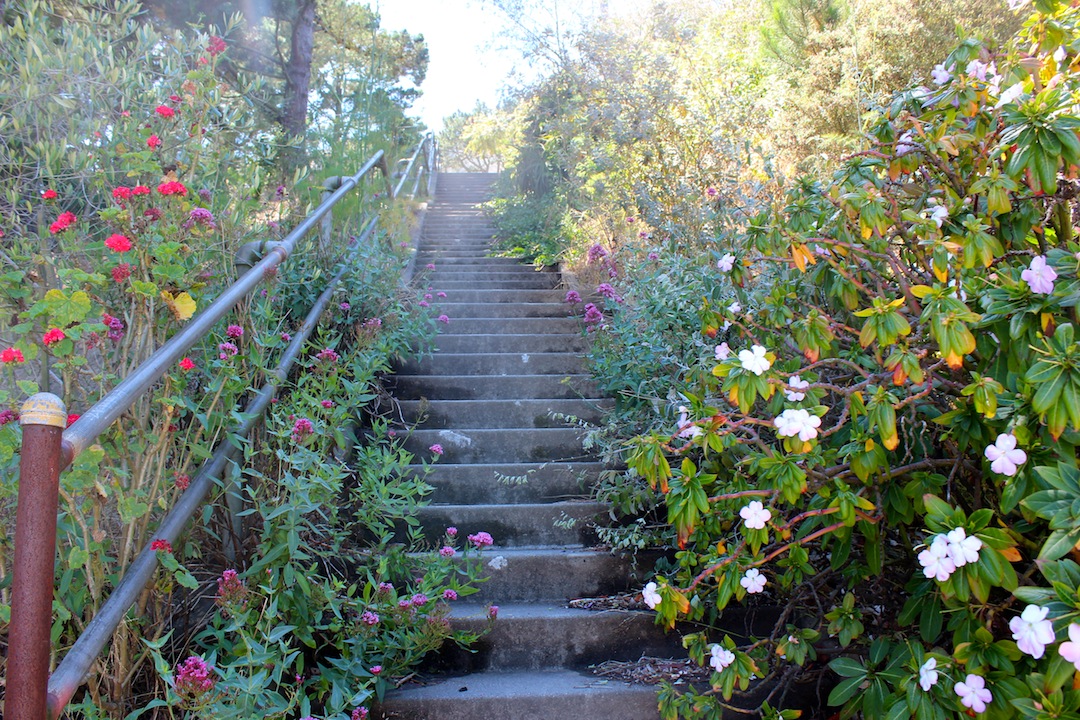
A few years ago, I joined a Meetup group that hosted walks all over San Francisco. One walk started at the Embarcadero and crossed the city from east to west for seven miles until we reached Land’s End. Another hike circled the exclusive neighborhoods of Twin Peaks and climbed up to the Sutro Tower, one of the highest points in the city.

When I was writing my novel Whistle, I used these hiking experiences in one chapter to help my protagonist escape the sorrow of her home after her mother dies. She walks along the ocean to Golden Gate Park.

Filbert Street Steps and Graffiti

When my friend came to town, I met her in San Francisco to climb the Filbert Street Steps. This staircase covers three ascending blocks from Sansome Street to Coit Tower and includes well over two hundred steps. On my way to the city in Oakland, I saw some graffiti on an overpass that said “Resist Authority.”

I turned the staircase and graffiti experiences into a short commentary about how I like to read graffiti so I can hear what the needs of people are. This post received a lot of attention on my blog. It seems like many people identified with it.

Now, I have a fertile writing attitude. My whole life is a garden of ideas, waiting for my creativity to take them from a personal experience into the world.

Leona’s Tacos

Photo by Jeswin Thomas on Unsplash

My friend Leona taught me how to make tacos when I was in my early twenties. She was the grandmother of one of my college friends, and I stayed with her for two weeks when I first moved to Los Angeles. Leona was fifty years older than me, but we developed a deep friendship.

Leona lived on Verde Street, on a hill in East Los Angeles in a house built by hand by her late husband. All the houses on the street looked homemade, each one like a small collection of shoe boxes glued together on tiny lots overlooking the San Bernadino freeway.

When Leona made tacos, she browned ground beef in one pan. She didn’t add any spices, not even salt and pepper. In another pan, she fried tortillas in vegetable oil until they were golden on each side, then flipped one half over the other to make a half-moon. With a spatula, she tossed the slightly crispy tortillas on a plate, using paper towels between each one to soak up the oil. She put grated cheddar cheese and a jar of mild salsa on the tiny chrome and Formica kitchen table.

When everything was ready, we sat down and combined the simple ingredients to make our own tacos while we looked out the window. From our eagle’s perch, we could watch the freeway as automobiles, trucks, and police cars lit up the night like Christmas. We also talked about the people in our lives, her children, her grandchildren, my friends, and each other. This is when I learned that the best lives are simple ones, no drama, no difficult entanglements, easy to manage. Those were the first tacos I had ever eaten, and I loved them.

While raising my two kids, I made tacos all the time. My dad was an avid fisherman, yet he didn’t like to eat fish; therefore, he brought freezer chests full of frozen fish to my house for us to eat. From his bounty, I made fish tacos—long before they became popular in restaurants. I invented sturgeon tacos with lettuce, sour cream, cilantro, and salsa. I created salmon tacos with fresh guacamole, basil leaves, shredded lettuce, and salsa. When we ran out of grandpa’s fish, I made tacos with shrimp, ground turkey, left-over steak, and pork chops. My kids loved them and, at the end of every taco meal, the serving plates were empty. In between bites, my kids told me about what had happened at school that day, what their friends were doing, and how they had to write papers for English and history class. As their mother, I learned to listen to them carefully before jumping in with advice and was thrilled they were confiding in me.

Now my kids are grown, and they have to feed themselves. My son is a taco specialist. For two years, he lived off of rice and bean tacos with shredded carrots, lettuce and salsa. It was his way of eating healthy and saving money at the same time.

The other day, I stopped at a farmer’s market on my way home from Sacramento. I bought red onions, peaches, cilantro and peach salsa. At home, I had some leftover roasted leg of lamb and spinach tortillas, and had decided I was going to make tacos for dinner.

Like Leona taught me, I fried the tortillas on each side until they were golden and then flipped one half over the other to make a half-moon. I transferred each one to a plate with paper towels to soak up the oil, even though I was using olive oil instead of vegetable oil.

I chopped up some red onion, cilantro and peaches, then sliced the lamb in finger-sized pieces and warmed it up in the same skillet that I had used for the tortillas. When everything was ready, I assembled the tacos: roast lamb, chopped red onion, chopped peaches, cilantro leaves, and peach salsa. I arranged two tacos on each of two dinner plates and called my husband to supper. Before we started eating, we expressed our gratitude for each other and the life we had built together. From listening to my husband’s prayer, I have learned that he is most grateful for having me in his life.

Leona and I were friends until she died at the age of ninety-five. We drove together from Los Angeles to Sacramento to visit our respective families. We stopped to taste olives and almonds. We visited missions. We ate lunch at Bob’s Big Boy and Denny’s. She made quilts while watching movies, and I made needlepoint pillows.

Leona taught me that life was a journey, and that every stop along the way was just one sojourn in a series of manageable experiences. Simply, Leona was a precious friend. I still love her, and am most grateful that she taught me how to make tacos. From that first day when she made them for me until today when I make them for my husband, I’ve learned that the relationships in my life are my most important possessions.

Dying Words

Rose Marie could feel it. Life slipping away.

For years, the Macular Degeneration in her eyes had slowly darkened her vision. The blindness had started in the middle of her eyes and took over more and more of her sight as it covered her vision like a dark blanket. At the lunch table, her friend Ruth read the menu to her.

Last year, her doctor had diagnosed her with Alzheimer’s. She had called each of her ten children with the news. They didn’t know how to react, and she didn’t either. She didn’t think her memory was bad. She still knew her children’s and friends’ names and the address where she had lived for sixty years.  

Her apartment was on the second floor overlooking the front garden of the assisted-living facility. When she had moved in, she could see the roses blooming and the branches of the sycamore trees swaying in the breeze. Now, she knew the roses and trees were outside the window, but she had to turn her head to see them from the perimeter of her eyes. Sometimes, she didn’t bother. She just let the circle of light enter her mind without trying to focus on any details.

She had gone down to the dining room for breakfast. Ruth didn’t have to read the breakfast menu to her since the server knew that she ate the same thing every morning: a piece of bacon, toast with jam, and a full glass of milk. Sometimes, her daughter Margaret brought her some homemade jam that she stored in the refrigerator in her studio apartment. Strawberry-rhubarb was her favorite. She would carry the small jar of jam down to the dining room and ask the server to spread it on her toast.

She found her way around her studio by reaching out to touch the furniture as she walked to the bathroom, the bed, or her recliner. To get down to the dining room, she found the knob on her front door, twisted the door open, scooted her body around it, closed it behind her, took the apartment key that she hung on a lanyard around her neck, and locked the door by finding the keyhole with her left fingers.

Once she got outside of her studio into the second-floor hallway, she reached out to touch the armchairs, side tables, lamps that led her to the elevator. Since her studio was at the end of the hallway and the farthest from the elevator, she passed many other apartments along the way. She could discern from her perimeter vision that some had wreaths on the doors. She knew when she was passing Nellie’s door since she could hear her chihuahua barking.

Lately, she’d noticed that she had trouble talking to her friends at the dining room table. She knew what she wanted to say, but it seemed hard to get the actual words out. The same thing happened to her when she phoned her children. In fact, it was exhausting to talk for any amount of time.

“Wait a minute,” she would say as she struggled to express herself. They waited so patiently, much more patient than she had been as their mother. Then, slowly and deliberately, she would answer their question with a complete sentence.

Since she had moved into the assisted-living facility, two of her long-time friends had died. Jim had severe back pain for a week before her passed away. She and her husband had known him and his wife for sixty years. They attended the same church. Their kids went to the same schools.

Patty passed away in her sleep one night. When her daughter came to clean out her studio, Rose Marie asked if she could have Patty’s tiny cabinet desk. The handyman had moved it into her apartment, and she kept her calendar and pens in it now. When she opened it, the wood felt warm, like Patty’s arms.

Rose Marie had always told her children that death was part of life. This time, however, the death that was coming was her own. Throughout the day, more and more of her life was transitioning to a new place with which she was unfamiliar. She couldn’t play Solitaire anymore at her desk because she couldn’t see, so she sat in her recliner and let the window’s light stimulate her thinking.

She was afraid. What would happen to her children when she died? Would they still be a family? Who would her sons talk to when they had problems to discuss? Who would need her when they got a divorce or lost a baby?

When she had first moved into the facility, her friend Morgan had picked her up every Sunday and drove her to Mass. She didn’t come anymore since Rose Marie no longer felt safe enough to walk around a place where she hadn’t memorized the placement of the furniture. Now on Sundays, she went down to the chapel when the priest came to bring Communion for the Catholics.

“I don’t know how to die,” she said one day. She could see him put his hands in his lap before he answered her. “I’m fully aware that I will die soon, but what should I be doing right now, before it happens.”

Father Moyer took a deep breath through his nose, and let the air out like a sigh before responding. “Well,” he said. “You don’t need to worry about dying. Just spend your days loving your family and friends. That’s all that matters.”

“So simple,” she said. She heard Father take another calm breath. When he exhaled, she was reminded of the ocean. She thought his answer would have involved praying, repenting, forgiving, or philosophical discussions. “I’m afraid of what will happen to my children when I’m gone. I’m the matriarch of the family. I keep them together. Shouldn’t I talk to them about these things?”

“No. They won’t remember anything like that, but they’ll remember how you love them.” He breathed in and out like the ocean again. It sounded so beautiful and relaxing to her.

Later, when Rose Marie went back to her apartment, she sat down in her recliner and picked up her cell phone. She pushed “1” which would dial her oldest daughter’s phone number automatically.

They only talked for two minutes. It was so hard to get out the words she wished to say. At the end of the phone call, Rose Marie said, “I love you.”

“I love you, too, Mom,” Celia said. “So much.” Rose Marie hung up.

Then she pushed “2” so she could talk to her second child. Then “3,” then “4,” then “5.” Her fifth child Ron didn’t answer. She’d have to call him later. By the time she had talked to the rest of her children, she could tell that the sun was setting between the branches of the sycamore trees outside her window. Soon, she’d have to walk down for dinner. She dialed “5” again, and Ronald picked up.

“I just wanted to say I love you,” she told him. She took a long slow breath and exhaled. The ocean flowed through her lungs.

Cousin Love

No one ever talks about their cousins, except my family. I have 44 first cousins that live all over the United States and beyond. I have friended many of them on Facebook. Many receive Christmas cards from me, and I visited many in Wisconsin and Minnesota this last year. I feel as close to my cousins as I do my own siblings.

My parents assured us that we would enjoy being from a large family since we’d always have friends. They were right. Even though I don’t see my cousins on a daily basis, they bring me so much joy and satisfaction.

My cousin Tim lives in Montana. He recently retired as the Superintendent of a tiny school district. Since I was a college professor, our careers were focused on helping students and improving education. We also comforted each other when we went through our divorces by sitting in a car in San Diego in the middle of the night and sharing stories after his brother’s wedding.

My cousin Roslyn is a high-school history teacher in Michigan. We both believe that students are better off when they learn history from more than one perspective and understand the difference between equity and equality since we worked with those concepts in the classroom. Roslyn is my philosophical partner in our extended family.

Carolyn lives in Winona, Minnesota. She raised her son as a happy single parent and now has two grandchildren. Yesterday, she posted a picture of her front yard packed with snow where she had painted flowers on the three-foot snow walls beside the path to her front door. What a creative spirit!

Cousin Dan lives in Japan with his wife and two pretty daughters. He works for the United States Navy and leaves his family for months at a time while stationed on the U.S.S. Reagan. I love his mustache and fun-loving family, who spend their afternoons searching for pottery on the beaches and artistic manhole covers in the towns.

My cousin Arlie is a handsome devil who has worn his once-dark-but-now-gray curly hair both long and short over the years. Once he drove a truck full of Wisconsin cheese to my parent’s house in California. We ate cheddar for weeks. Now, Arlie rides horses with his wife and works at an auto store. Even though we have little in common, at every reunion, we share heart-felt cousin hugs.

Patty lives in Boston and is married to Steve, who completely adores her. They go to baseball games and concerts on date nights, and inspire the rest of us not to give up on love. Patty sure knows how to pick a good partner.

Diane lives with her husband Matt in Minnesota. Now this is a fun girl. If you want to kayak in the Winona Lake, she’ll do it. She knows all the best restaurants in town and will even accompany you to the local spice and Polish museums for an afternoon. If you’re up for it after dinner, she’ll go with you to a bar for a beer and sit outside with the mosquitoes. One year, I watched on Facebook as she and Matt took their motorcycle on a cross-country trip through Minnesota, South Dakota, and Montana. Wow, what a woman!

Scott, a happy tall guy with a strong build, owns a dairy farm in Minnesota where he produces thousands of gallons of milk per day for American milk-drinking consumers. If you ask, he’ll take you on a tour of the farm and you’ll see where the calves are raised, cows are milked by machine, statistics are collected for each animal, and cow manure is recycled. Even a town-girl like me learns something every time I visit his farm.

I could go on talking about Lisa in Florida, Marilyn in Ohio, Marjorie in Minnesota, Randy in Minnesota, Karen in Wisconsin, Dewey, Joanne, Debbie, Denise, Renee, Kathy, Scott, Jim, and more, more, more, but you get the idea. I have interesting cousins in my life, and I interact with them frequently enough to maintain vibrant relationships.

Thank you, Mom and Dad, for maintaining such close family ties over the years. My cousins are an essential part of my happiness. I love them.

Chemotherapy Christmas

The room was large, windowless, and sterile. Blinding florescent lights. Beige linoleum floors. Twelve green reclining chairs placed with their backs against the walls around the room. Each chair accompanied by a metal stand hung with bags of fluid and tubes.

The woman sitting in one of the chairs wore a scarf around her head. I looked for wisps of hair, but couldn’t see any. Her body filled up the chair like of sack of potatoes, lumps everywhere. She wasn’t smiling like the nurse who stood next to her, hooking up a tube to a port embedded in her upper chest.

A man whose body disappeared within his baggy shirt and trousers sat in a recliner in a corner. His scrawny hands hung over the chair’s arms like shriveled leaves caught on the edge of a forgotten lawn chair in the fall. His bald head shone in the florescent lights like a bare bulb. His face was gaunt, lined, and dry, and his eyes were closed. A young woman sat in a chair in front of him reading the Bible.

I watched the room’s activity with a lump in my throat as I stood behind my mother and brother by the door. A woman with a cane was led to another recliner in the room. The male nurse helped her sit into the chair, gently pushed her back, and lifted the foot rest. The nurse lifted a matching green blanket from a small chair nearby and laid it over the woman’s body, tucking the edges around her snugly. Then he efficiently began hanging the bags of chemicals on a metal stand and hooking up the bags with the tubes.

This was my mother’s chemotherapy room. Mom’s last chemotherapy session was scheduled for December 24, Christmas Eve. She had asked my brother Zach and me to accompany her to the appointment. My brother had flown home from college in Southern California for Christmas, and I was home from college too. The only thing my mother wanted for Christmas was to finish chemotherapy with her children around her.

A female nurse wearing an ugly, plain, blue smock and pants led my mother to a chair on the emptier side of the room. Zach helped Mom take off her coat and climb into the chair. She looked small, dressed in her pink cotton beanie, pink V-neck sweater, and jeans. How pale her pretty face was. Mom nodded when the nurse asked if she wanted a blanket, and Zach took it from the nurse and covered her gently like he was placing a precious jewel into a new setting.

This was not how I wanted to spend my Christmas. Wasn’t college supposed to be one of the happiest times of my life? I was too young to worry about my mother dying or even being too sick to visit me at school.

The nurse pulled two straight-back chairs close to my mother’s recliner, and invited us to sit down. I took the chair farther away and leaned back as if my mother was contagious. My brother pulled his chair closer to Mom and took hold of her left hand. When she smiled at him, her eyes watered like green pearls.

Before long, Mom was hooked up to the tubes that would feed chemicals into her body. I could tell that she was putting on a brave face because, underneath her smile, she looked tired and weak.

I didn’t want to think about her being that way. Instead, I wanted her to jump out of her chair, hug me tight around the waist, and ask me about college. I wanted to tell her about Jasmine’s new boyfriend, Sara’s job offers, and David’s article in the college newspaper.

Her smile withered away as the chemicals dripped into her veins. She gave up trying to hold a conversation with my brother, who was bent towards her in his chair, his chocolate eyes full of concern. She looked at me several times, but I retreated away from her with a grimace on my face.  I didn’t want to be here.

Once in a while, Mom opened her eyes and looked up at the bag hanging beside her as if gaging how long she had to endure the procedure, but, for the most part, she kept her eyes closed, and we sat in front of her fidgeting in our chairs, biting our lips, and staring at each other with worried eyes.

Three hours later, the nurse in the blue smock and pants pulled the catheter out of my mother’s port, gathered up the tubes, and rolled away the metal stand with the empty bags.

A young woman with brunette hair and rosy cheeks pushed a wheel chair up to our station.  She asked my brother to move his chair, then maneuvered the wheel chair as close to my mother’s chair as she could.

“I’ll help you,” she said kindly. She took ahold of my mother’s upper arm and guided her from the recliner into the wheel chair.

My mother let out a whimper as she moved. Zach helped her put on her coat as she sat in the wheel chair, wrapped her pink scarf around her neck, and gave her a wool cap to pull over her pink beanie. Still, she shivered when the nurse wheeled her outside to the car.

Zach drove us home, and the next day was Christmas.

Glitter, Gloss & Human Dignity

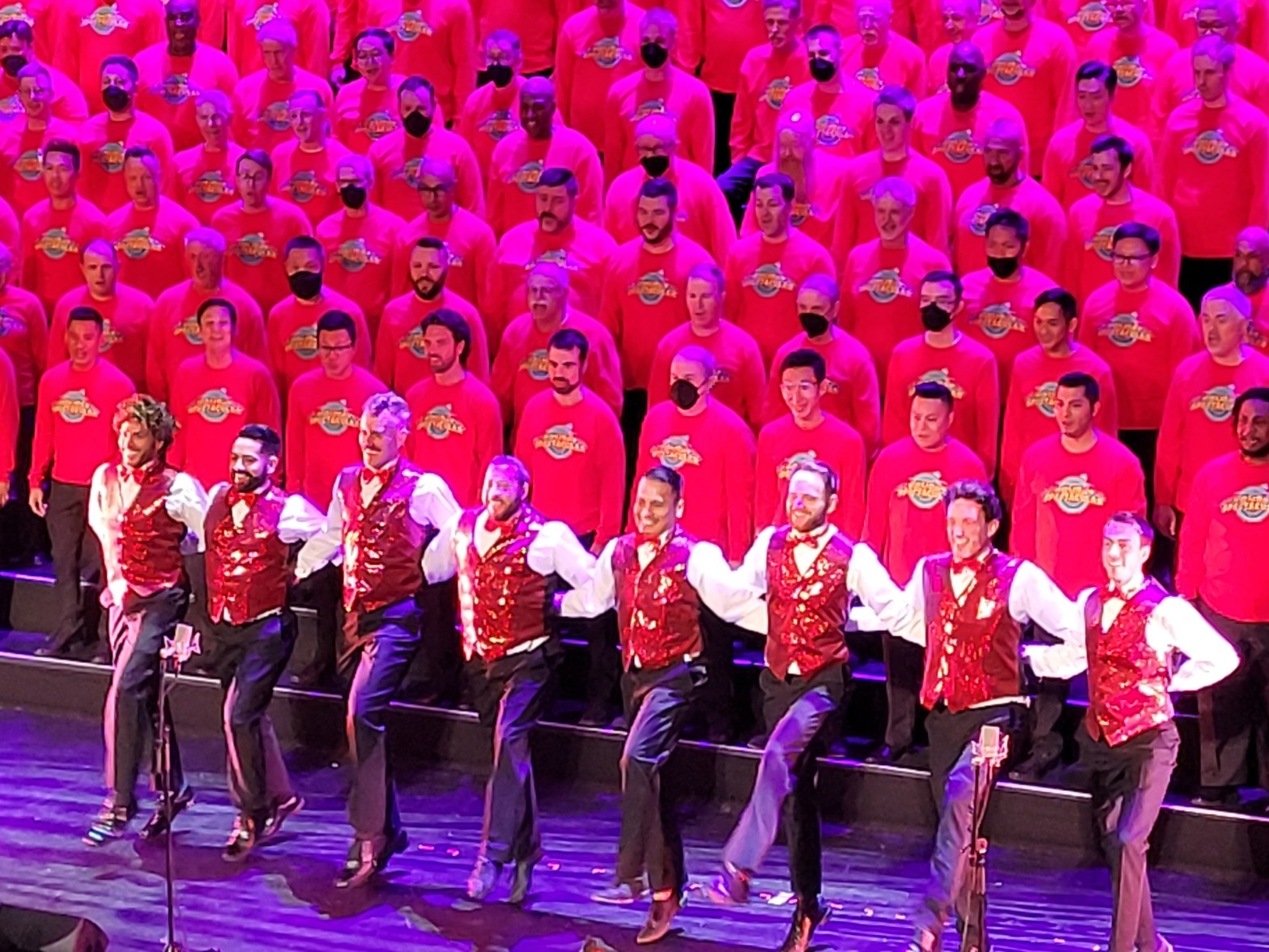
Last Saturday, I attended the San Francisco Gay Men’s Holiday Spectacular at the Sydney Goldstein Theater in San Francisco for the first time. Oh! What a night!

When my daughter and I arrived, a quiet but eager crowd was gathered around the theater’s entrance. We donned our required Covid masks and presented our tickets to a friendly usher who pointed to the stairs. Above, another smiling usher led us to our excellent seats and we sat down—only two in a theater filled with Christmas sweaters and holiday cheer. Excited voices murmured throughout the cavernous room.

The stage curtain was lit up with the title of the chorus in capitalized red letters, and, a few minutes later, the curtain opened to reveal the silhouette of risers brimming with over 200 singers. The lights came on, and the audience suddenly saw ten rows of men dressed in long-sleeved red T-shirts and black bottoms on a staircase of risers. The orchestra began, the conductor raised his arms, and the men began to sing.

Young men, gray-haired men, bald men, men with beards, men wearing skirts, men with canes, and men sitting on stools all crowded the risers and faced the music conductor with professionalism and purpose. No one read lyrics from a song sheet. All of them sang by memory.

The chorus sang “On this Shining Night” by Morten Lauredsen, a song I had sung with the Blackhawk Chorus a few years ago. The men’s voices were rich, on tune, piano and forte. I fell in love with their sound.

After each song, several chorus members quietly exited from the risers and went back stage. As the next song began, these members came back on stage as dancers in various costumes to complement the chorus. Some stood at microphones at the front of the stage to sing solos.

In the middle of the performance, the chorus sang a long rendition of “Jingle Bells” that got the audience toe-tapping and clapping. They sang many verses in a variety of styles that became more exuberant all the way to the song’s finale.

The song that sent shivers up my spine was “Huddled Masses” by Shaina Taub, a song about the plight of immigrants and our moral duty to support them. The conductor explained to the audience that, although this wasn’t a Christmas song, it promoted the spirit of Christmas, which is love.

On the right side of the stage, in front of a glowing Christmas tree, was a sign-language interpreter who signed the words of each song. His hands gracefully moved as the singers slowed their tempo and stretched the lyrics over a series of beats.

One of the last songs was “Silent Night.” The orchestra began the introduction and then the chorus, instead of singing, signed the first verse silently. When it was time for the second verse, the orchestra stopped, and the chorus continued to sign the verse as the audience watched in silent wonder. In the quiet of the moment, my heart filled with so much gratitude to the chorus for expressing what a deaf person hears and how silence can evoke wonder and awe.

Later in the program, the chorus held a moment of silence for the five LGBTQ persons recently gunned down in Colorado Springs. For two hours, without an intermission, and with energy and vitality, the chorus recited lyrics of peace and promoted love in both prose and lyrics. This was a night filled with joy despite life’s hardships and disappointments.

I left the theater with happiness in my heart—contentment that I live near San Francisco, a city filled with respect and love for the LGBTQ community—because I know, that a culture that treats all persons with dignity is the cheeriest place on earth.

Rain

Photo by Ahmed Zayad on Unsplash

When Don woke up, it was raining.  The water that he ran in the tub sounded like rain chortling out of a storm pipe.  The water that streamed from the kitchen faucet for his tea beat into the kettle like rain on a wheelbarrow left out in the yard.  Rain. Rain. Rain.  It had rained for months.

Don’s mother had died at 10:05 a.m. on the same morning that Don worked his last day.  He was looking forward to retirement, and one thing he would do more was spend time with his mother—playing Scrabble, going out for hamburgers for lunch, driving her past her old house where prolific flowers signaled the change of seasons. 

At 10:06 on the day she died, the rain started.  He had kissed her on the forehead as she lay quiet in her hospital bed, checked to see if she was safe, and slipped out of the room to live the rest of his life without her. 

Claire had managed the funeral and service arrangements which were beautiful.  On the day Mom was buried, the sun came out for a couple hours—just enough time for Mom’s ten children to say their prayers and lay red roses on her casket.  When the casket was lowed into the ground and the earth filled in her vacancy, the grounds men laid the large spray of red roses over the dirt.

Then the rain began again.  It rained while they cleaned out Mom’s room at the assisted living home.  Maddy took all their mother’s clothes home in garbage bags.  A few weeks later, she knocked on Don’s door and handed him a teddy bear.  The bear was blue and green and peach and red, made from pieces of Mom’s shirts, pants, and dresses.  It looked both happy and sad as Don sat it on the couch in his living room.

Soon, the group texts began.  Don shared memories of his mother with his nine siblings every day.  Old memories.  Vague memories.  Disputed memories.  Sunny memories.  Rainy memories. 

Some people in the text posted pictures of what they made for breakfast.  Don posted pictures of his new seedlings and old pumpkins.  He talked about his clocks inherited from Mom and Dad.  Claire posted perfect plates of salmon dinners.  Rita identified the birds that Maddy found in her garden by looking them up in her bird bible.  Beatrice posted old photos of Mom from her twenties when she was thin, before she had ten children. 

The siblings discovered each other again.  Most of them had moved out of town since their childhood, and their communication had been through Mom for the most part.  Through their texts, they found out that Don had the best green thumb, Claire grew flowers but not vegetables, Rita was a bird and owl watcher, Maddie loved wine and dessert most of all, Beatrice was just starting a walking routine, Minnie continuously created new jam recipes, Jim was the handyman at his job, Carol had learned how to play guitar, Ron still told the best jokes, and Geo wrote poetry in his spare time. 

The texts started usually around 7 a.m. in the morning and lasted until the last sibling drifted off to bed.  Good mornings.  Breakfast recipes. Descriptions of walks.  Flower postings.  Loaves of bread.  Jars of jam.  Bowls of soup.  Directions to parks.  Comments on the news.  Revelations about hobbies.  Progress on quilts, puzzles, and charity projects.  Movie recommendations and dinner plans.  All these subjects and pictures streamed between the ten children that Mom left behind.

A few months later, the rain stopped.  The sun came out like a herald of good news, and Don woke up to the birds chirping outside his bedroom window. 

When he wandered out into his living room, he saw his colorful teddy bear leaning over on its side and bent down to sit it upright, and, as he did, the sun blazed through the window and lit up the bear in a shaft of light.

“Let’s go visit Mom, today,” Don said to his bear.  “The sun is out and I know she’ll be happy to see us.”

Half an hour later, after an oatmeal breakfast and coffee with chocolate, Don put the bear in the passenger seat of his blue truck, and drove to the cemetery.

When he got there, the sun streamed like yellow curtains through the oak trees whose branches spread over the graves like kind arms.  The green grass, which covered the shallow hills and valleys, glistened with diamonds of left-over rain. 

Don drove his truck onto the center road and stopped it in front of his parents’ graves.  There they were—lying side by side like happy campers in sleeping bags.  Their gravestone rose from the top of their plots like a crown, and Don noticed that one of his siblings had stuck some colorful plastic flowers into the metal vase in front of the headstone. 

Don knelt down in the middle of his two parent’s plots, reached out, and placed his teddy bear on his mother’s side of the stone near the flowers.

He paused for a few minutes, furrowed his brow, then recited the Hail Mary prayer, and his words wafted through the cemetery like a low whisper.  When he finished praying, he looked up at his teddy sitting quietly.

“You can’t stay here,” he said.  “We’re just visiting.  You and I have to go home and live some more.”

Don looked at the words of his mother’s name on the head stone and the dates of her birth and death.  92 years long.  Somehow, not long enough.

“Thank you for giving me life, Mom,” Don said, placing his hand on his heart gently. 

He reached over, lifted his teddy bear from the ledge beside the plastic flowers, and held the bear against his bent frame.

“I’m always here, Mom, for you, just as you were always here for me.”  Then Don slowly stood up from the ground, brushed the wet grass off his jeans, and walked back to his truck.

When he got into his seat, he checked his phone to see if any of his siblings had posted another message.  A few rain drops fell onto the windshield as he drove away. 

Limericks for Grandma

“Play a game with me, Grandma,” said Rachel.

“No, Rachel, I don’t feel like playing now,” said Grandma. “I miss Grandpa too much to play anything.”

Rachel missed Grandpa too. She missed sitting in front of the fireplace and listening to those
funny poems of his. What had he called them? Limericks, that’s right.

Rachel had started writing her own limericks too, just like Grandpa. It was fun to think of rhyming words and funny phrases.

Before he died, Grandpa had given Rachel his typewriter. If you want to write really funny
limericks, he said, use my typewriter. Some of my funniest limericks were punched out with these
keys. Rachel knew she would keep that old typewriter forever. It made her smile to see it on her desk. Why wasn’t Grandma happy to be surrounded by Grandpa’s things?

She had an idea. That night, she sat in front of Grandpa’s typewriter. T-h-e-r-e she typed.
Rachel noticed the “r” was lighter than the rest of the letters. She typed a limerick like one of
Grandpa’s, then folded her poem into an envelope. The next morning, she slipped it into Grandma’s
mailbox.

“Hi, Grandma,” said Rachel that afternoon after school.

“Look what I got today,” said Grandma. “A limerick. Like those funny poems Grandpa used to write. “This one is good too.” Grandma read the poem out loud:
There once was a girl named Dolly
Who felt so melancholy
She went for a walk
To the end of the block
And when she returned, she felt jolly.

“Why would anyone send you a limerick, Grandma?” asked Rachel, smiling.
“I don’t know. There’s no name on the page. Whoever it is must know Grandpa used to write limericks. Maybe this poet wants to help me remember him.”

“Let’s go for a walk too, Grandma. We can talk about Grandpa.”

“O.K.,” said Grandma. She rose slowly from her rocking chair. Rachel held her arm as they
descended the stairs and walked down the street. When they reached Rachel’s house, they turned and walked back.

“I feel better,” said Grandma as she sat down, but she didn’t look happy.

That night, Rachel typed out another limerick on Grandpa’s typewriter. Grandma found it in her mailbox and read it out loud to Rachel the next afternoon:
There once was a woman named Billy,
Who when she felt sad, she got silly,
She’d hop to her feet,
Dance a jig in the street,
“Til she felt just as fine as a filly.

“This poet sure knows how to rhyme,” said Grandma. “I wish Grandpa had met him.”
“Grandpa would act out his limericks,” said Rachel. “If he wrote this one, he’d have danced a jig for us.” Rachael jumped up in front of Grandma. She put her hands on her hips, twisted her
waist, kicked out her feet and turned around. She counted a beat. She stomped her feet. She turned and turned until she got dizzy and fell on the floor at Grandma’s feet. When she looked up,
Grandma’s foot was tapping on the floor. A slight smile brightened her face.

“There’s a little bit of Grandpa in you,” she said.

That night, Rachel typed out a third limerick. She tried even harder this time to make it funny. She wanted to hear Grandma laugh. She wanted so much for her to be happy again.

“I received another limerick from my secret poet, Rachel. I didn’t open it up yet. I wanted
you to hear it with me:”
There once was a woman named Jackie,
Who lived in a house that was tacky,
So she painted her plants,
And the bees and the ants,
“Til her garden became just as wacky.

Grandma leaned back in her rocker, raised her eyes to the roof and began to giggle. At first the giggle came from deep in her throat but as it rose higher, it grew into a laugh. She looked
straight at Rachel, put her wrinkled hands on both sides of her cheeks and heckled for a good long five minutes.

“Isn’t that funny,” she said, reaching for Rachel to come to her. She gave Rachel a big hug,
and laughed into her shoulder. “I have some bulbs in the garden shed. Help me plant them this
afternoon, will you?”

“Oh, yes, Grandma,” said Rachel. They planted tulips on each side on the stairs so Grandma
would see them from the porch when they bloomed.

Rachel was so tired that night that she forgot to write a limerick for Grandma. She woke up
late the next morning and rushed to get to school on time. When she got to Grandma’s house after school, there was a note on her rocking chair on the front porch:
I’m visiting your mom at your house today. Meet me there.
Love, Grandma

Rachel raced home. When she reached the mailbox, she noticed a letter stuck to its side with her name typed on the envelope. The “R” was lighter than the rest of the letters. “Mmmm,” she said. She opened the paper and began to read:
Most Grandkids think Grandpas are funny,
And Grandmas are just sweet as honey,
But I’m funny too,
Quite as funny as you.
Thanks for making my afternoons sunny.

Rachel ran through the front gate, up the path to the porch, skipped up the stairs, dashed to the screen door, opened it and yelled, “Oh, Grandma! How’d you know?”

Putin’s History Lesson

Putin does not know history.

Great leaders

Do not build empires of bombed out cities,

Where water doesn’t flow and electricity doesn’t heat,

Where theaters are hollow since the drama lives outside,

Where churches are empty because praying goes underground,

Where store shelves are filled with dust instead of bread,

Where people shiver in subways and flee from shrapnel,

Where men must wear helmets and babies wear unwashed diapers,

Where lines form for water, blankets, evacuations,

Where graveyards echo with tragedy.

No, Putin.  Great leaders

Help people build their own cities,

Municipal happy places,

Where growing leaders

Have opportunities to taste love,

And learn how to spread it.

My Christmas Story

I had a fabulous Christmas with my husband and family. My spouse’s eyes lit up like candles when he kissed me and said, “Merry Christmas.” My two-and-a-half year old granddaughter spent two hours drawing on the paper tablecloth with me at Christmas Eve lunch. Her impish smile radiated up as she labeled her squiggly circle as a “rock.” These moments made me happy, but my Christmas blazed with joy on December 20 when I helped Youth Homes organize a holiday party for their former foster young adults at Clayton Valley Bowl in Concord.

Youth Homes is a non-profit organization that provides homes for youth who have grown too old to be housed in foster care, but who don’t have enough experience or financial means to live on their own. Most of their youth take daily medication to help regulate anxiety or other emotional conditions resulting from their troubled pasts. Some have been sexually abused. Others are victims of physical violence. Some have experienced homelessness under cold freeway overpasses, and others have lost parents to prison or untimely death.

With my partner from the Alamo Women’s Club, I arrived at Clayton Valley Bowl at 2 p.m. with boxes of gifts and envelopes of gift cards. We wore double masks to ward off any Covid viruses that might be floating around in such a public place and carried the heavy boxes through the glass doors of the building, across the tattered carpet to the back of the dull, cavernous room.

My friend is a miniature five-foot-tall, sixty-five-year-old woman, but she and I pulled ten foot folding tables out of the side hallway and set them up against the dirty white walls to display our gifts. I wet a paper towel in the nearby restroom to clean sticky patches off of two round tables.

On one long table, we arranged knit hats made by the knitting group of our club; they came in every color imaginable, knitted by hand and by looms by senior women who felt good sharing their talents with people who needed them. Next to the hats, we lined up pillow cases made from floral, Christmas, cowboy, leaves, patchwork and other fabric designs. Each youth would get to take home two of these. Beside the pillow cases, we spread out rows of brightly colored placemats, also made by talented women, generous with their money and time. Each youth could choose two of these.

On the second table, we set up an assortment of prizes, such as a George Forman burger grill, little purses, cozy socks, hand knit scarves, gift bags of candies, and make-up kits. Each youth could trade in his or her raffle ticket for one of these.

The manager of Youth Homes arrived just before 3 p.m. and he greeted us with sparkling eyes, a Christmas mask that wrinkled when he smiled, and knuckle handshakes. Slowly, one by one and two by two, the youth arrived with shy faces and quiet demeanors.

Most of the youth seemed to be about eighteen to twenty two years old. They were tall, small, skinny, overweight, light-skinned, dark-skinned, male, female, happy, and sad.

One girl, taller and larger than me, with dark skin and a head of long, black braids, had taken great care with her outfit. She wore fashionably-torn blue jeans, a plain white Tshirt, and a pretty turquoise, brushed-cotton plaid, long-sleeved shirt. I complimented her immediately and guided her to the two round tables so she could first sign the thank you cards for the donors of all the gifts. When she got to the raffle prize table, she chose the George Forman hamburger grill so she could cook hamburgers in her bedroom.

One young man, about five-feet, six-inches tall, messy dark curly hair, and a warm voice chose all of his presents with his mother in mind. For her, he chose a flowered placemat, a pink pillowcase, and a pink hat with a large tassel. The light in his eyes was soft and tender as he picked up a gift bag of candy for Mom at the raffle-prize table.

Another youth showed my partner and I her artistic eye make-up and proudly proclaimed that she was now working as an event planner. “My job requires a lot of creativity,” she said. She signed the donor thank you cards with a large, flamboyant signature.

Also arriving one-by-one, came the counselors, who worked with these youth, guiding them in their daily living and helping them overcome emotional handicaps and the lack of family support. Ed wore blue jeans and a bright blue shirt; his jolly, outgoing, gregarious personality made us feel appreciated and welcome.

Cheyenne remembered me from two of the online college success workshops that she had conducted for the youth from the interior of her car. During these workshops, I taught the youth how college differed from high school and gave them tips for being successful in college. When she recognized me, I really felt part of the Youth Homes family.

Later, I found out that these counselors would have dinner with the youth on Christmas Day and then take them out for a movie so that none of them would be alone on the holiday. I knew I would be spending Christmas with my family, but part of me wanted to tag along with them, doing what I could to show them how much I wished for them to be happy.

For two hours, we guided the young adults through the gift lines, ensuring that they all received hand-made presents. We gave them $50 gift cards from Target or Kohl’s, and we watched the counselors set up bowling teams, bring out boxes of pizza and jugs of soda, and circle among the youth like they were the best of friends.

Finally, we boxed up the remaining beanie hats, pillowcases, placemats, and raffle prizes for the manager to take back to the office for any youth who couldn’t make it. We tucked the left-over gift certificates into the envelope and handed them over for safe keeping. New youth came into the program at any time, and they all needed clothes, personal items, and financial support.

The counselors masks wrinkled into beaming smiles as they wished us a happy holiday. Some of the youth looked up with big eyes from their pizza as we passed by their tables. Others shouted “thank you” and waved. Two of the larger youth continued playing a competitive bowling game, so when both of them bowled a strike back to back, I raised my firsts and yelled, “Alright!”

Christmas was still a few days away, but, this day, this afternoon that I spent in a dim-lighted bowling alley with no manger scene, no Santa Claus, no reindeer, no twinkling lights, became my favorite day of Christmas 2021.

Wisdom of the Trees: Chapter 4

Chapter 4 – Willow

Friday was the last day of class, and Profesora Casti lead her students to Almagro, the part of the city known for its flower vendors.  First, the group wandered among the flower stalls on Acuňa de Figueroa where baskets of roses filled the air with intense fragrances.  Leonie bent over the bunches to breathe in their perfume, and she took turns saying their names out loud with her classmates.  They chatted with the vendors who told them where they grew their flowers and how they worked from early in the morning until late at night planting seeds, hand-watering, and pruning in order to produce the most beautiful flowers. 

The vendors smiled when they talked about Mother’s Day, weddings, and baptisms for which they sold the most flowers.  Some vendors stayed open 24 hours a day.  The best time to buy flowers—late at night or early in the morning.

Then, the class meandered to Calle Sarmiento where even more vendors had their shops.  One shop was filled with tuberose and jasmine, which filled the shop and the air outside its door with heady perfume.  Inside, the vendor was busy wrapping flower bouquets in cellophane paper for a woman and her two daughters. 

Leonie wandered away from the group to admire the lilies of another vendor.  While she was reaching out to touch a petal, a woman dressed in a green apron came out to greet her. 

“Your lilies are gorgeous,” exclaimed Leonie.

“Thank you.  My grandfather used to sell flowers on the streets of Buenos Aires.  My father sold flowers in the old market in stall 8, and, now, I rent this shop here to continue our family tradition.”

Leonie moved under the shade of the willow tree that grew right in front of the storefront.  “I love flowers,” she said.

“I love flowers, too,” replied the vendor.  “I’m sure I’ll sell flowers until I’m old and frail.”

Leonie paused in thought, running the woman’s response through her mind.  Forever was a long time to do just one thing.  Leonie didn’t know that she would ever find something that she wanted to do for so long.

“So,” Leonie asked, “You don’t ever wish that you could do anything else?”

The woman smoothed down the front of her green apron with hands that were crusted with dirt and chapped from years of working with plants.  “No, I never wish to do anything else,” she finally said.  “I feel that each day in my flower shop is another day where I get to express my creativity, and doing that gives me intense joy.  Besides, I know that I like to be around beautiful things, and what could be more beautiful than a shop full of flowers.”

“You seem so contented,” said Leonie.

“You see this willow tree that’s giving you shade?  A willow tree symbolizes fulfilling wishes of the heart.  It also symbolizes inner vision.  I’m lucky to know what fulfills my life.  That knowledge is my inner wisdom.”

The vendor showed Leonie around her tiny shop, identifying the names of all the flowers and inviting her to smell their fragrances.  Leonie told the vendor that she was about to take a trip to search for her life’s purpose.  As the woman listened to her story, her eyes glistened and a whisper of a smile set upon her lips.

Before Leonie left, she held out a yellow rose.  “This rose symbolizes our new friendship,” she said.  “Friends are one of the most precious treasures of your life.  From now one, you and I are lifelong friends.  I wish you success on your trip and hope that you find your version of life fulfillment. 

That night, just before Leonie went to bed, she sat at her desk to write in her journal.  I know what fulfills me, she wrote.  After setting down her pen, she felt anxious.  But I don’t know what fulfills me, she worried.  I don’t know what I want to do with the rest of my life.  I don’t know what makes me happy day after day after day. 

As she sat, she thought about the vendor in the green apron and how she had found fulfillment.  She remembered how gently the woman had picked up each flower and described its characteristics.  She had moved among her flowers with grace, touching each blossom with respect and admiration; her movements were filled with love. 

Now Leonie knew.  The woman had been a messenger from her own soul to teach her how to find her own purpose.  Love was an integral part of finding fulfillment.  When she found out what she loved, she would find her contentment. 

Wisdom of the Trees: Chapter 1

Photo by DARIAN PRO on Unsplash

From ancient times, trees have symbolized physical and spiritual nourishment, transformation and liberation.

Chapter 1 – Oak

One more week and she was done.  Graduated with a double major.  College over.  More educated than most of the people on earth. 

And you know what?  She wasn’t going back home, even when this class was over.  Her father had paid for a round trip ticket to Buenos Aires, but she was going to cash it in and stay.

This was her chance to really be independent, to find out what her values were without her father’s advice about this job or that apartment, this guy or that outfit. 

She missed her mother though, but her mother wasn’t at home anyway.  When Leonie was supposed to be having the time of her life in college, her mother had contracted breast cancer.  After three surgeries, six months of chemotherapy that sapped her effervescent energy, and twelve weeks of radiation that burned her skin red, the cancer came back. 

Just before she passed away, Leonie and her mother had sat under the oak tree in the back yard, the shadows of its branches spreading like arms across the grass. 

“I can’t lose you, Mom.”  She had wept beside her mom, the shade of the giant tree darkening her tears like black pearls.

“You won’t feel the same, but you’ll never lose me.  You’ll just have to learn how to live with me differently.” 

Leonie had felt so confused.  She stared at her mother’s face so that she could remember it—her gray-blue eyes, silky skin, a mouth that always held the hint of a smile.  She stared deep into her eyes, holding on, wishing for more time.

“I’ll be with you,” said her mother.  “I’ll guide you from a new place, a place you cannot see, but that is nevertheless powerful.  You’ll feel me.”

Leonie clutched her mother’s hand.

“I want you to find your inner strength.  Emulate this oak tree.  Every time you feel weak or lost, visualize yourself as an oak tree, rising strong, spreading wide, enduring challenge and finding the sun.  You won’t be alone because I’ll be beside you, breathing my love into your heart.”

“But I won’t see you.  You’re my inspiration.  I’ll be lost without you.”

“My love will remain here.  When you can no longer physically see me, you can find other women to inspire you.  Choose many, in fact.  One to follow for leadership skills, another to learn the art of love, and another to learn how to live with joy.  She may be one of your professors, a co-worker, a girl friend, a friend’s mother, or a woman you meet only one time in your life. Whatever you wish to be, you can find a woman to inspire you.”

“How can you be so strong?  You’re dying!”

“I’m content because I know that I will continue my life in another form.  My spirit is not dying.  My soul will continue, and I’ll grow from its future experiences.  I have many things to look forward to.”

Leonie remembered this conversation as she held her mother’s ashes six months later, secured in a pearlescent urn shaped like a heart.  Leonie kissed the top of the urn before placing it in the niche at the cemetery.   “Enjoy your journey, Mom,” she whispered.

Later, as she sat in the back yard next to her mother’s chair, Leonie thought she heard her mother’s voice.  No, maybe it was the breeze rustling the limbs of the oak tree instead. 

“My journey will be right alongside you,” said the breeze.

Staying focused on her studies was impossible after her mother’s death, but her girl friends had helped, and then Leonie decided to go overseas for a change of scenery—a much needed distraction that she needed to survive.

So now, she was in Buenos Aires and hungry.  She lived in a shabby dorm room in the basement of the university and tutored students in English to make money, but it wasn’t enough. 

Leonie searched through her backpack for something to eat: an empty plastic juice bottle, a paper envelope from the bocadillo she had for lunch.  She poked her fingers deeper.  Something waxy.  She grabbed at it and pulled out an apple, a little bruised, but it was food.

The next morning, Leonie woke up with a growling stomach and the sound of traffic.  Engines racing, horns blaring, and brakes squealing invaded her tiny room through the high window that wasn’t even big enough for her to crawl through.  Leonie grabbed her shampoo and towel, opened the door, and paced to the single shower room. 

Whew!  It was empty.  The water felt refreshing on her wet head, rinsing off the humidity and sweat of her body from the sweltering night.

Today, she was going to meet a friend that she had met in her Spanish class.  Clarissa was a native Argentinian and Leonie wanted to ask her about traveling throughout the country. 

Upstairs in the dormitory lobby, a canister of coffee stood on a table next to a large blue box of sweet pastries.  Leonie poured the thick, viscous liquid into her own mug, stuck a pastry between her teeth, and whisked out the door.

Clarissa was sitting at a table in the corner of the café with her laptop open when she arrived.  A cup of mate steamed to the right of her computer, Clarissa wildly typing on the keyboard.

“Hey, how’s it going?” asked Leonie, grabbing the back of the chair opposite her, scraping it across the floor, flinging her backpack over a post, and sitting down.

“Hey,” murmured Clarissa, finishing a sentence.

“You know, this Spanish class is my last college class, and I’ve got to figure out what to do with the rest of my life.  I feel lost without my mother, and I don’t want to go home without a plan.  I don’t even know if I want to live there anymore.”

Clarissa picked up her mate, sipped it, and looked up at Leonie. “I suggest that you travel and meet as many people as possible.  They’ll give you new ideas, and you’ll learn that you have endless options,” said Clarissa.

“That does sound good,” said Leonie.  “How should I start?”

“Just go,” said Clarissa. “Don’t think too much.  Don’t plan too much, but be ready to make your trip work each step of the way.  I’m emailing my sister.  She works at the Belmond Hotel, a few miles from Iguazu Falls.  Maybe she can get you a free room.  Iguazu Falls is one place you should go!”

“Oh, I’m so nervous about traveling by myself.  Maybe I’ll just stay here,” responded Leonie.

“Oh, no you won’t,” said Clarissa. “You’re going, and that’s that.”

“We’ll see,” said Leonie.  I have a whole week of classes left.”

“Yes, a whole week to build up your courage and begin your new life.”

Hidden

Photo by Anton Darius on Unsplash

Sylvia had a secret.  One that rolled around in her stomach like a marble in a maze, bashing against the walls until they bruised, swirling her energy into anxiety.

Sylvia’s friend Ruth told detailed stories about how her mother psychologically abused her during her teenage years.  When they were cleaning out her grandmother’s house after her death, Susan had wanted her grandmother’s wooden chest full of yarn.  Her mother refused to let her have it, and, instead, gave it to Susan’s older sister who didn’t even knit.  Susan wondered for decades why she wasn’t good enough to have such a treasured keepsake and why her mother had favored her sister over her.  Ruth told everyone about the hurts in her background, but she still walked around like a broken doll, permanently damaged, as if nothing could ever erase the scars she had suffered.

When Ruth talked about her feelings, Sylvia flashed her own memories across her mind about how her father had favored her sister over her.  “Isn’t she beautiful,” she remembered he had said.  Sylvia had looked in the mirror countless times wondering why no one ever called her beautiful.  She had clear skin, thick hair, blazing green eyes.  Weren’t green eyes as pretty as blue ones? 

Her friend Paul had told her about how his father was never around.  He never played sports with him, never sat with him on the couch for a game of chess, never even got to his high-school graduation until Paul had already walked across the stage and waved to his mother who was frantically waving back with both hands, as if she was waving for two.  Even today, Paul’s father didn’t act like a father, but like a distant friend who sent him an article once in awhile about a topic that never related to Paul’s life.  Paul had worked hard to build self-confidence, but struggling with a narcissistic father made that an up-and-down journey.

Sylvia’s friend Jen talked about her childhood, too.  She told Sylvia how a sixteen-year-old neighbor boy had raped her when she was eleven, luring her into his backyard shed one afternoon and slowly removing her clothes while he talked to her about the different birds in the garden.  Jen said that it was therapeutic to talk about it after so many years of keeping it hidden.  At first, she was embarrassed that it had happened to her.  What did she do to encourage that boy anyway?  Why did she let him get her into the shed by herself?  Didn’t she know better?  Sylvia didn’t see how Jen had let go of the trauma if she still had all these questions in her mind.

When Jen talked, Sylvia nodded empathetically: “It wasn’t your fault.  He took advantage of you.  He was stronger, and you couldn’t have stopped him.”  Inside her chest, however, Sylvia carefully drew a curtain in front of her own heart, shielding it from the memory of her own secret, stopping her from the minute-by-minute re-enactment of the scene, her shame, her acquiescence, her fear of exposure. 

Sylvia didn’t want her friends to know she had suffered so much, had been irreparably violated.  Maybe someone would use the information about her secret as revenge if they ever got angry at her.  They would expose her in front of people she didn’t trust, and she would endure more embarrassment than she could handle. 

Sylvia had spent years searching for her own self-esteem, her worthiness to be loved, her value as a treasured friend, her worth as an employee, her right to be happy at all.  She thought that she should go talk to someone about her secret so that she could get it off her chest.  Would that even work? 

Finally, she made an appointment with a female minister at a church she did not attend.  She told the woman about her secret, and asked her what she should do to heal from it.  

“First, ask God for forgiveness.  God will forgive anyone, even if you can’t forgive.  Once, you’re comfortable that God has forgiven you, then forgive yourself and anyone else involved.”

Sylvia had worked on forgiving herself and the other person involved for years.  Nevertheless, the memories, surfaced again and again like a nightmare when she least expected them.  Sometimes, she even invited them into her thoughts as if she could purge them out of existence by focusing on them one last final time. 

Nothing stopped the nightmares.  They came while she was sleeping in a vivid stream, and her fear rose incrementally during the dream until she would awaken all of a sudden, gasping for breath like she had been under water the whole time.  Her forehead was drenched with sweat, her heart tight with shame.

Sylvia did feel the pain of her friends, and because she did, she could listen to their stories and offer some solace just by suffering with them.  She also understood the pain that her students told her about. 

Samantha was a student in Sylvia’s college composition class.  Samantha’s mother had kicked her and her three-year-old daughter out of the house, and, now Samantha experienced anxiety that interfered with her performance at school.  Sylvia had counseled Samantha through several episodes of anxiety, and she had passed her English class in spite of her mother.

Van suffered from post-traumatic-stress-syndrome ever since he returned from Iraq, and his significant other left him right in the middle of the semester.  Since Sylvia knew what anxiety and poor self esteem felt like, she coached Van step by step until he, too, passed his writing class.

So many of her community college students needed emotional support in order to pass their classes.  Owen’s father beat him.  Misty lived with five family members in a noisy, two-bedroom apartment.  Monica’s parents wanted her to get married like a dutiful Islam daughter and give up going to school.  Randall had spent two weeks living out of his car during the semester until his uncle let him live in his garage. 

Sylvia knew that if she put in more effort to help these students, they could succeed and improve their lives through education and awareness of other opportunities.  Yet, sometimes, as Sylvia sat beside one student or another, she felt like a broken human being trying to help another broken soul.    

Was it true that people who never felt loved died of heart attacks?  Most mornings, she woke up with a tight chest.  She lay in bed breathing in and out of her nose until her chest relaxed a little, but the tightness never fully went away. 

Most people had a secret, didn’t they?  Weren’t most people walking around, hiding their secrets underneath their shirts, their polite manners, their rudeness, their abusive characters, their anxiety, their bullying, their surrender, and their repeated attempts at survival?

Yes, they were, Sylvia knew.  She was, too.  She had endured so many scars and affronts to her character, yet here she was, carrying her secret around like a satchel of wisdom.

Really, she thought she deserved a medal.

An Old Rose

She was worried about her mother who seemed to struggle to stay present, something pulling her focus away or inward.  Some days she sat in the arm chair by the window, staring straight ahead, her gray-blue eyes lost in deep thoughts. 

When Sestina tried to talk to her, her mother struggled to respond.  “Wait a minute,” she would say, then, with a determined set to her mouth, she’d squeeze her eyes shut for a brief moment, open them wide, and glare at Sestina while she slowly made a lucid response. 

Her mother woke up early every morning, took a spit-bath at the sink in her bathroom, put on her clothes, and combed her golden white curls until she looked neat and ready for an outing.  After breakfast—not a big one mind you—just a piece of bacon and half a piece of toast with butter and strawberry jam—she sat down in the chair by the window and disappeared into her private thoughts.  Her breathing was labored, and she raised her shoulders every time she inhaled, her chest rising slowly, and she exhaled by opening her mouth and releasing a small burst of air.

On Wednesday, while her mother was sitting in her arm chair, Sestina went out to prune the old roses off the rose bushes.  She knew her mother not only loved flowers, but she loved roses most of all, and Sestina wanted the roses to look perfect when her mother looked out the window.   Eight tea rose bushes grew in the redwood planter, a raised bed so that the roses bloomed at the same height as the window.  The planter was about six feet from the window so when her mother looked out, she could see the stems wave gently in the breeze and glow in the sun. 

The yellow rose bush was the heartiest with big blossoms that bloomed like cabbages.  One bush grew lavender roses, medium in size with delicate petals and a hue that took Sestina’s breath away.  Four of the bushes bloomed with various versions of red flowers, each a unique shade of red and shaped petals.  The two white bushes bloomed with the most flowers, always producing plenty of blossoms so that Sestina could cut some and bring them in the house.

Sestina held the kitchen shears in her right hand and pulled back a single stem from a rose bush, looking for the perfect compound leaf of five leaflets so she could prune the dead rose at just the right angle and place to encourage more growth. 

As she made the cut, the daylight intensified into a blaze of light all around her.  Insects’ voices grew loud into a hum like a Gregorian chant, and she heard the wind rush under the wings of a swallowtail butterfly who hovered over a rosebush nearby.  The butterfly glided toward her, waved its wings close to her nose, and she thought that she heard it whisper, it’s time for her, time for her.   Its black face smiled, and its eyes looked deep into hers, speaking wordlessly of love.  She heard the breath of the breeze travel through the petals of each rose, and the scissors snapped the rose’s stem like a clap of thunder.  She heard the leaves of the lemon tree give birth to new cells and buds of fruit.  Then, suddenly, the breaths of the insects and flying creatures, echoes of the growing plants, and pneuma of the wind were silent, and the garden was still.

When Sestina got back to the cottage, she found that her mother had died.   Her face was turned toward the open window and her hands were folded over each other like a final prayer.

Child of Light

That child of mine. 

She was like the black sheep of the family, but that didn’t mean there was anything wrong with her.  On the contrary.  Ever since she was a little girl, she walked like she was floating on air—her feet swishing out from beneath her, her body gliding like a spirit, her head held up and her eyes cast high like she was watching a movie in the sky. 

Little Beth had a heart-shaped face, her blue eyes spaced perfectly apart and framed with blonde eyebrows, her pale rosy cheeks glowing like pink pearls, her plump cherub mouth, and soft chin.  But she was a shy creature and shunned the limelight, so most people didn’t notice her as she peeked into the room around a wall, hid in a corner on a stool, or swung on the swing outside, alone, when the rest of the kids were in the house. 

After Beth turned seven and received her Holy Communion, I walked up behind her to Communion at one Sunday Mass.  When Beth reached the priest, his eyes opened wide as he looked into her face, his hand paused with the wafer above the chalice.  After a frozen moment in time, he said, “The face of God.”

What did he mean?

My daughter stood there with her hands joined together, her fingers pointing to the ceiling like dove wings.  Finally, the priest fluttered his eyes, seeming to compose himself and said, “The body of Christ.”

“Amen,” said Beth, her voice rising like a musical whisper.  She stuck out her tongue and the priest placed the wafer there, then she circled around so I could see her. 

And then I knew.  A spotlight from the ceiling lit up her face, and I saw a glow in her eyes like the sun breaking through the clouds after a rain, radiant globes of love.  A warmth filled my body as she passed me, and I knew from then on that I was extraordinarily blessed to have her in my life. 

The priest’s eyes followed her as she left, and, because he was preoccupied, I also turned around and watched her glide down the aisle like a sail on the breeze.   Quickly, I faced the altar again, but still had to wait for him to recover and remember that more people waited in line for Holy Communion. 

***

My husband and I asked Beth to be the executor of our will.  We asked her because she studied finances in college and we thought she’d be qualified to deal with the mechanics of disbursing our assets. 

Peter died young so he wasn’t around when I started to go blind and I couldn’t write checks, cook on the stove, or drive my car anymore.

Beth told me that it was time that she took care of me.  She helped me move into an assisted living place where three of my friends already lived.  She helped me sort through the sixty years of belongings in my house, found charities to pick up unwanted furniture, hired a gardener to keep the lawn cut until the house could be sold, worked with my realtor, accepted a great offer on the house, and filled my bank account with the money. 

“You have enough money to live for 35 more years,” she told me.  “You saved and scrimped, and now, I’m going to make sure you are treated like a queen.”

I couldn’t see very well, but Beth knew that I could still smell the roses, so every time she came to visit, she brought a dozen roses, a chrysanthemum plant, Easter lilies, Gerber daisies, or an African violet to put on my windowsill. 

I died on a December morning instead of a January afternoon because Beth was beside me in the hospital, making sure that the medical professionals didn’t exceed their zeal in pointlessly extending my life with hoses down my throat, catheters in my neck, and countless blood transfusions. 

She ordered a giant spray of red roses to cover my coffin at the viewing and to decorate my grave after I was buried.  Red roses signify eternal love. 

That child of light of mine. 

The Imagination Grandpa Story 3: The Multiplication Staircase

 Grandpa walked into Rosie’s hospital room with a handful of daisies.

“I brought you some flowers today, Rosie,” he said.  He grabbed one of Rosie’s tall water cups from her side table and put the flowers right into the water left in the cup.

Rosie smiled.  She was so happy to talk to someone who wasn’t a nurse or a doctor. 

“I used my imagination this morning to make up a new story for you,” said Grandpa.

“I’m ready to hear it!” replied Rosie.

So Grandpa began.


The Multiplication Staircase

Rosie lived in a house that was older than her grandmother.  Her family’s Berkeley home was a cottage really, a tiny home with a brick staircase leading up from the street.  On both sides of the stairs, hydrangeas grew in the spring and summer under the shade of the ancient redwood trees that stood like giant sentinels on each side of the steps. 

Every front yard on Rosie’s street had one or two coastal redwood trees, natives that had been planted when the houses were built in the early 1900’s.  None of the houses matched, but each of them looked cozy with their open front porches; low-pitched gable roofs; and earth-tone sidings of wood, stone, or brick.   The street was a tidy three-block stretch of narrow sidewalks, and, on the east side, a 43-step stone staircase descended to Euclid Street where, her mother told her, a street car once stopped to take passengers to San Francisco.    

Rosie was born on this street–Hawthorne Terrace, and had spent her eight years of life walking around all the winding streets and staircases with her mother.  Now, she was in third grade, and every day when she walked from school to home, she paused on Buena Vista Way, a hilly street, where she could see a staggering view of the San Francisco Bay—Oakland, the Bay Bridge, San Francisco’s ever-changing skyline, the small and big islands in the Bay, and the Golden Gate Bridge. 

But today, when she reached the section of Buena Vista where she could get the best view, she was lost in thought.  Today, Rosie had failed her math test.

Failed. 

She just couldn’t memorize her multiplication tables.  The numbers got all jumbled up inside her head, and when she sat at her desk staring at the test, the numbers filled her mind with fear and confusion. 

Rosie turned right on Euclid while a tear dropped onto her cheek.  She wiped it off quickly with her fingers and took a sharp left to ascend the 43 steps to Hawthorne Terrace.  Rosie grabbed the black wrought-iron bannister and pulled each foot up the cement stairs, one by one.  Usually, she counted the stairs to make the trek easier, but, today, she thought about how she had to tell her mother that she had failed her test. 

Rosie slipped on one of the stairs, her body twisting around the arm that held onto the bannister, like a flag being whipped by a cruel wind around a flag pole.  She rammed into the bannister as she fell, hitting her hip hard on the vertical bars.  She let go of the bannister and plopped onto a cement stair, her legs crossed beneath her. 

How did Mom climb these stairs without falling when she walked to the store or caught the bus on Euclid Way?  Every day that Rosie had to climb them, she ran out of breath before she reached the top and, often, she fell and scraped a knee or grazed her hands. 

Mom was snipping the hydrangeas in the front yard when Rosie finally reached home.  “Hey, buddy, how ya doin’?” Mom said, standing up from her garden stool, her hands clutching her shears.  A pail of old blossoms stood next to her stool.  The hydrangea bushes were bursting with vibrant pink blossoms behind her—each flower bursting like a ballerina’s dancing tutu on a crowded stage of dancers. 

Rosie looked down at her shoes, one of which was untied and dragging behind her.

“What’s up?” Mom laid her shears on the stool, stepped over to the stairs where Rosie was standing, and put her arms around her.  “Did something happen at school today?” she asked, lines furrowing her brow.

“Well, you’re going to be disappointed,” Rosie said, staring but not seeing anything.

“You must tell me anyway,” Mom said.  “Otherwise, I can’t help you.”

Finally, Rosie sat down on the brick steps next to Mom and told her about the test.  “I just can’t remember them,” she said, wringing her hands in her lap.  “Not only that, when I was climbing the stairs today, I fell and hurt my hip, bloodied my leg, and scratched my arm.”  Rosie rubbed her hip and showed her mother her injuries.

“Hmm,” said her mother.  “We’ll have to think about how to solve your problem, and I believe I have an idea.  Let’s first have a snack and rest, then, we’ll figure this out.”

Rosie and her mom ate slices of apples and cheese while they sat on the front porch watching the bees flitting among the hydrangeas.  Rosie told Mom about how she had painted a pink hydrangea with dots of watercolor paint during art time.   “I can’t wait until you see it, Mom,” Rosie said, her face lighting up as she spoke.  “I think it’s really good.  After I used pink dots to make the flower, I used a leaf coated with bright green paint as a press to make the flower’s leaves.” 

Her mom put her arm around her.  “I can’t wait to see it.  Maybe we’ll have to frame it when you bring it home.  Well, it’s time for your math lesson,” she said.  “Let’s take a walk.”

“What?” Rosie looked up at her mother with a question on her face. 

Rosie’s mom stood up and reached for Rosie’s hand.  She pulled Rosie to her feet and they walked down the brick stairs together. 

“Where are we going, and what does a walk have to do with math?”

“You’ll see,” said Rosie’s mother.  When they reached the narrow street sidewalk, they turned left and walked north where another set of stairs on the street rose up to Scenic Avenue.  This staircase was made out of thick eight-foot wide old railroad tie planks, each dark step set into the hill and secured with large, iron bolts.  The bannister was built out of redwood posts with a diagonal lattice in-between.

Rosie’s mother sat down on the bottom step and gestured for Rosie to sit down next to her.

“Aren’t we going to climb the stairs?” Rosie asked, rubbing her forehead with the back of her right hand.

“We will,” said her mother.  “When you’re ready.” 

Rosie sat down.

“Multiplication tables are like addition which repeats itself,” said Rosie’s mom.  “We’re going to practice the two-times-table while sitting on this step.”

Rosie looked up at her mother out of the corner of one eye.  “Hmmp!” she said.

“Two times one is just a single two.  Two times two is two 2s.  If I hold up two 2s with my fingers and count them—one, two, three, four, I find out that I’m just adding two—two times.”

“That makes sense,” said Rosie.  She nodded her head and counted her mother’s fingers.

“If I add another two, then I have four plus six,” said her mother.

“And another two is eight.  Another two is ten.  Six twos is twelve!  This is easy,” said Rosie. 

Rosie and her mother sat on the bottom step while Rosie figured out how to multiply two from one to twelve.  Her mother tested her several times and soon, she wasn’t making any mistakes. 

“Time to move,” said Rosie’s mother.  She inched herself up to the next big step.  While Rosie and her mother sat on the second step, Rosie practiced the three times table.  She used her fingers at the beginning, but pretty soon she was seeing the number three multiply in her head and she soon memorized all the threes up to twelve.

“Let’s go up,” said Mom, scooting up one more stair.

Rosie memorized the four times table in less time than she had memorized the three times table.  The breeze felt good on her face and the velvety, seashell-shaped gardenias blooming on the bushes nearby filled the air with a heavy perfume.

“One more up,” said Mom, lifting herself with her arms to the next step.

First, Rosie’s mom counted in fives, “5, 10, 15, 20, 25, 30, 35, 40, 45. Can you do that?” She asked Rosie.

“I don’t know,” said Rosie, but she tried anyway.  “5, 10, 15,” counted Rosie all the way up to 60.

“You just gave me the answers to all the five-time tables,” said Rosie’s mom. 

Rosie’s eyes opened wide.  She started with five times two and the rest were easy.  Before her mom could even move, Rosie rolled herself up to the next step. 

Rosie worked hard memorizing the six-, seven-, eight-, nine-, and ten-times tables.  Each time she completely memorized a number’s multiplication table, Rosie and her mom moved up another step.  After ten, they practiced the elevens.  After the hard elevens, they practiced the twelves. 

By the time Rosie had memorized from the twos to the twelves, Rosie’s stomach was growling.  It was almost dinner time.

“The final challenge,” said Rosie’s mom, rising to the next step.  Rosie followed her. 

On each step, Rosie’s mom tested her with a time table from two to twelve.  Each time Rosie got the right answer, until, just before the top of the stairs, she got the answer wrong for 11 times 11. 

Rosie’s mom wasn’t worried at all.  She just worked with Rosie on the same step while Rosie reviewed all the answers for the 11 times table.   Then, Rosie’s mom tested her again, “What’s 11 times 11?” she asked.

“121!” shouted Rosie, clapping her hands together and raising them above her head like a champion.

“Up to the last stair!” said her mom.  “You’ve won the championship of the Staircase Multiplication Tables!” she said, clapping wildly. 

Rosie shook her head in disbelief.  Just a few hours ago, she had been crying about failing her math test, and, now, she knew she’d never fail a multiplication test again.

“How’d I do that, Mom?” 

“You just climbed one step at a time until you were ready for the next one,” said Rosie’s mom.

Rosie looked up at the cloudless, azure blue sky that rose upward into forever and ever.  She imagined all kinds of staircases up there: wooden, cement, tile, and marble stairs; ascending and descending stairs; stairs with flowers growing through their cracks; stairs in the rain; stairs with tears of joy and sadness; and stairs full of families and friends.

Rosie wrinkled her brow and stared down the stairs for a minute, reaching out for her mother’s hand.  She knew that she would always have to climb staircases, but, now she knew how—one step at a time.


“Wow,” said Rosie, looking up from her bed at Grandpa who was now sitting in a chair beside her bed.  “I need to learn my multiplication tables, too.”

“You won’t have any trouble at all,” said Grandpa.  My imagination just showed you the best way to learn them.”

Grandpa put on his beret, stood up from his seat, and bent over to kiss Rosie on her forehead.

“Your imagination is a genius!” said Rosie, her eyes glistening like diamonds. 

Rosie’s Blooms

My mother’s name was Rose Marie—most appropriate for when she attended church, sitting at the end of the third row, her mouth pursed into a straight line and her eyes staring obediently at the altar.  Yet, one of her male friends called her “Rosie,” which, most of the time, suited her better.  She was feisty, knew how to get you to do what she wanted, and a woman with the most interesting hobbies.  One of her favorite hobbies was her appreciation of flowers. 

It’s not surprising, then, that I’ve loved flowers since I was a little girl.  When I was four years old, playing house with my younger brother, my mother grew calla lilies in a corner of the back yard.  I admired heir smooth, white bell-shaped flowers and bright, yellow pistils, and my mother called them “resurrection” flowers because they bloomed around Easter time when Jesus rises from the dead. 

My mother cut the lilies and took them indoors to decorate our dining room table.  I loved their intoxicating scent–a comforting aroma of clover mixed with a lemony fragrance.  Their creamy-textured petals exuded luxury, and they lasted longer than most other cut flowers.

When we lived in Air Force base housing for four years in England, my mother planted bulbs in the rectangular planting beds under the windows in the front yard.  After the snow melted in late January, daffodils poked their green shoots out of the brown soil.  Day by day, I watched them grow bigger and taller.  The flower knobs soon formed, and, slowly, pastel yellow flowers peeked out from the green stalks until one day they brightened our simple front yard with happy yellow fringed trumpets. 

After the daffodils lost their blaze, the tulips came up behind them like copycats—rising like slender dolls out of the earth until, in a few weeks, their red cups of petals swayed in the light breezes of March.  My mother told me to never pick a tulip because they represented perfect love, and she wanted them to bloom for as long as possible to bring good luck to our home. The variety of tulips that she grew were just right—not too showy, not too dramatic, not overly romantic.  When they were blooming, our front yard felt comfortable and stable.

Across the street from this house on Shepherd’s Way was a forest where bluebells bloomed in mass profusion every April and May.  English bluebells are associated with fairies, those miniature creatures that cause mischief for humans.  I had a wistful imagination, and I spent hours walking amongst these bluebells with their sticky stems, watching for fairies and feeling grateful for the experience of being lost in a sea of blossoms. 

My mother let me take a bucket out to the forest and fill it full of bluebells.  I brought them home and arranged them in as many vases I could find, and when the vases were full, I used Mason jars for the rest of the flowers.  I placed vases and jars full of the humble bluebells on bookcases, tables, dressers, and night stands, and my mother’s blue eyes lit up when she saw them.

My high school years were dominated by carnations.  Homecomings, proms, dances, and balls called for corsages, and corsages always came as carnations.  After the dances, I saved each corsage by sticking its stem into a tiny vase of water.   Later, I dried it out on a saucer on my dresser, and, often, lifted it to my nose to inhale its floral and peppery scent. My mother didn’t like them because their scent reminded her of funerals and sadness.

When I was seventeen, my mother and I visited The Berkeley Rose Garden, a colorful display built into the hills of Berkeley comprised of hundreds of varieties of roses and thousands of individual rose bushes.  The rose beds were terraced on the hills into the shape of an amphitheater and separated by flagstone paths. 

My mother taught me the differences between polyantha roses, floribunda roses, and tea roses, and she explained how new roses were developed by cross-breeding every year.  I liked the polyantha buses for their smaller heights and tightly packed blooms.  I liked the floribunda bushes for their profusion of blossoms on branching stems, especially the varieties that produced variegated blooms like “purple tiger”—roses with streaks of purple, lavender, and white in each flower.  These showy bushes had other dramatic names, too, like Celestial Night, Scentimental, Sweet Madame Blue, and Forever Amber. 

Most of all, I adored the tea roses—their thick stems punctuated by large thorns and leaves that grew in patterns of five, with the stems ending in large graceful blooms of circling petals.   The names for these sophisticated blooms were grandiose—Double Delight, Mister Lincoln, Chantilly Cream, Love Song, and Oympiad.

Arbors held the climbing roses like the orange Top of the World, the pink Pearly Gates, and the lavender Long Song varieties.  Shrub roses and tree roses filled in every nook and cranny so that the whole garden produced a cacophony of colors for our eyes.

Together, we read the names of as many varieties as we could, pausing at the ones that were the most fragrant or dazzling.  I nestled my nose into the blooms as deep as I dared, trying to memorize the smells forever.  Never before had I been in the midst of such splendor, unrivaled beauty, and mesmerizing fragrances.

According to Mother, each color of rose had its own meaning and the number of roses given has a significance as well.  Yellow roses are for friendship and red roses show love.  Six roses means a growing affection and a dozen roses demonstrates complete love. 

The Berkeley Rose Garden also possessed an incomparable backdrop for our mother-daughter conversation.  As we walked together between the rows, we wondered at the vast view of the San Francisco Bay where the Golden Gate Bridge spread across the Bay’s exit like the arms of a graceful goddess.  The water changed from denim to indigo to periwinkle to cerulean to navy to slate depending on how the surrounding hills cast their shadows, the currents massaged its surface, and the sun penetrated into the prisms of the ocean’s molecules. 

Back at home, around the perimeter of my mother’s Sacramento patio grew dozens of camellia bushes under the shade of a giant mulberry tree.  From November to April, these glossy green overgrown bushes produced hundreds of curly, pink blossoms.  Mother told her children that camellias mean “young sons and daughters,” which seemed so fitting for my mother’s house since she had ten children who were easily outnumbered by the profusions of camellias in her garden.

When my mother moved into an assisted living apartment, she made sure that she had a vase in her cupboard for flowers.  This vase was about 8 inches high and made out of white milk glass; any type of flower would look beautiful in it.   

She had developed macular degeneration in both eyes, so she couldn’t read or, sometimes, even find the food on her dinner plate; she could, however, always sense when you held a bouquet of flowers in your hands to give her.  A smile that matched the petals of a pink rose would light up her face as she took them from you. 

She asked you to put them in her vase or find a place for them on her desk or window sill.  Every few days, she called and told you how they looked or smelled, or how many blooms were still perky or drooping, until one day, she called and told you that she was cleaning out the vase.  I gave her lilies at Easter, red roses during the summer, chrysanthemums during the fall, and a poinsettia at Christmastime.  Her favorite were always the roses because, after all, she was named after them.

I ordered the flowers for my mother’s casket when she died.  The funeral representative recommended a spray of red roses and red carnations, but I knew better.  Never would I allow carnations to come near my dear mom.  I ordered the largest spray of red roses I could because I knew that nothing less would make her happier.

The officiate at the gravesite told us that red roses were such an appropriate choice.  “Red roses symbolize eternal love,” he said.  We placed our spray of eternal love over her gravesite after the service, and their blooms thrived for weeks in the chilly California air of December and January. 

Two months later, my husband bought me a dozen deep red roses for Valentine’s Day.  I carefully extracted them, one by one, from the brown wrapping paper, snipped each stem with a pair of sharp pruning scissors by about one inch, and arranged them in a tall, clear crystal vase filled with fresh water and rose food.  Then, I ceremoniously placed the vase of love on the coffee table in the living room—a place visible from most places in our house during the day. 

One day, as he sat in an arm chair in front of these red roses, he told me how wonderful he felt looking at their beauty.  “I’ve never thought about how beautiful flowers looked before,” he said, with joy filling his eyes.  “I want to sit here forever.”

I realized then, that my mother’s appreciation of flowers was so strong that its influence had passed from her to me, and through me, to my husband.  My love for flowers also positively influences my son, my daughter, my friends, and even people I don’t know with the optimistic power of beauty. 

My mother—my Rosie knew that the delicate blooms of flowers—so ethereal in their form and beauty—are most extraordinary at communicating the powerful, yet intangible nature of love.

The Imagination Grandpa Story 1: The Clock Man’s Wise Clocks

Photo by Ella de Kross on Unsplash

Instead of going to Third Grade, Rosie was in a hospital bed with tubes connected all over her body.  Rosie’s heart had a problem and the doctors took her into an operating room one day to fix it.  Now, she had to lie down in bed all the time, and she couldn’t play.

The day after the operation, Grandpa Joy came in to visit Rosie.  He wore his blue jean jacket that had lots of pockets.  When he came in the door, he took off his beret and placed it on the table beside Rosie’s bed. 

“Should I tell you a story?” he asked.

“O.K.” said Rosie.  She was so bored just lying in bed. 

Grandpa started his story. 


Once upon a time, an old man owned a clock shop.  The shop was a huge room, and clocks covered every inch of the four walls.  He had clocks with black hands, silver hands, gold hands, and bronze hands.  Some clocks had round faces with 12 birds to mark the numbers.  Some clocks were carved out of wood with long pendulums hanging from the clock faces all the way to the bottom of the cases.  On one wall, a whole line of coocoo clocks hung silently, their birds frozen in various stages of entering or leaving through the coocoo doors. 

In the middle of the great room, large trunks were propped on their sides, and, against these great boxes, grandfather and grandmother clocks leaned silently.  No ticking escaped from their chambers because all the them were broken. 

In fact, all of the clocks in the whole store were broken and quiet.  The only noise in the vast room was the scratching from a mouse family that lived inside one of the walls and came out whenever the old man dropped crumbs and bits of cheese from his sandwiches.

One day, a young man came in to buy a clock.  He smiled at the old clock seller when he opened the creaking door and walked right up to the counter.  This young man wanted a clock to give to his wife for her birthday

“What kind of clock should I buy for my wife?” the young man asked. 

“Well, a grandmother clock might be nice,” said the old man.  I have several of them leaning against these big trunks.  Which one do you like?”

The young man hemmed and hawed.  He tucked his first under his chin and looked at the clocks with big eyes.  He peered into the clocks’ faces, and inspected inside the glass doors that held the pendulums. 

“I like this one,” the smiling man said.  “but it doesn’t seem to be working.”

“All of these clocks are broken,” said the old man.  “I get them from people who no longer want to fix them, and I save them until someone new comes along that will appreciate them.  Some of these clocks are over a hundred years old.  When someone wants to buy one, I fix it until it works perfectly again.”

“Is an old clock be better than a new one?” asked the young man.

“I’d say so,” said the clock man.  “Old clocks have seen so many years go by.  They’ve watched girls and boys fall in love, lovers get married, babies being born, Christmases and Easters and Passovers celebrated.  And as they’ve watched these stories, they’ve saved these memories as wisdom to pass onto their next owners.  A new clock is just a metal face or a wooden box, but an old clock is a treasure chest of life.”

The smiling man stood in thought for a long minute, and then looked straight into the clock man’s face.  “Well, someday my wife and I would like to have a family, and we’re going to need a lot of wisdom when we do.” 

He peered again into the Grandmother clock standing next to him.  Her face shone like mother-of-pearl and the numerals glistened in the tiny spotlights that hung from the ceiling.  The face was set into a rosewood box and the rose-bronze pendulum matched the numerals.

“I’ll take this one,” said the smiling man.  “My wife will not only love how beautiful it is, but she’ll also love the stories that come with it.”

So the clock man fixed the clock.  He bought new wheels and whirs and inserted them behind the face so that the hands of the clock started moving and the pendulum swung gently from side to side.  He rubbed the face until it shone like a pearl and the rosewood until it gleamed like a shiny chestnut, and he cleaned and dusted every part inside and out.  One week later, the clock was ready.

The next day, the smiling man came into the shop.  With him, he brought a pile of blankets.  He looked around for his clock and his eyes found it standing under a single spotlight, glistening like a mermaid in the sun.

“My wife is going to be so happy,” the smiling man said.  “I can’t wait to get this home.”

The two men helped each other wrap a small blanket around the pendulum inside the clock case.  They covered the outside of the clock with more blankets and tucked the blankets securely so the clock wouldn’t get broken.  Then the smiling man paid for the clock and carried it out the door, his eyes shining like buttons. 

For a whole year, the clock man ate his sandwiches inside his clock shop where only his silent clocks kept him company.  Every day, he dropped crumbs and cheese bits from his sandwiches, and the mouse family darted into the room to pick them up, then rushed back to the hole in the wall. 

People came in to give him their old clocks, and other people came in to buy one of the broken clocks.  The man worked hard to make the clock customers happy, but he was lonely.

Then one day, the smiling man opened the creaking door and stood back.  Inside walked a young smiling woman holding a baby in her arms.  The smiling man walked in behind her.

“I want you to meet my family,” said the smiling man.  “This is my wife Sharon and my new daughter Rosie.”

The old man was so surprised that, at first, he couldn’t speak.  He just stood by the counter and opened and closed his mouth like a goldfish for several long seconds.

“I’m so happy to meet you,” he finally uttered.  “Did you like your birthday present?”

“Oh, yes!” replied Sharon.  “My birthday clock is so beautiful that it inspired me to name our new daughter Rosie, like the beautiful rosewood and the mother-of-pearl face.”

The clock man beamed like a shiny copper penny.

“You were right about old clocks,” said the smiling man.  “Sharon’s clock not only inspired us to name our daughter, but it also reminds us to sing every hour, and that makes us happy.”

The old man’s face lit up like a flashlight.

“Would you mind if we visited you once a week so that Rosie gets to know you and learns about your shop of wise clocks.

The clock man looked around his clock shop as if he had never really looked at it before. These clocks were all potential friends, he thought. Then he looked back at the rosewood clock family and knew then that he’d never feel lonely again.


Grandpa was finished with his story, and Rosie looked up at him with shining eyes.

“That was a wonderful story, Grandpa,” she said.  “That baby had the same name as me?  Was it a true story?”

“No, Rosie.  I used my imagination to make it up.  Of course, the idea for the story is true.”

“What do you mean Grandpa?”

“Well, I wanted to tell you a story that started with you, and so I told my imagination to use your name to invent one.”

“Oh, I like that Grandpa.  That makes me happy.”

The Grandpa kissed Rosie’s cheek and tucked her blankets around her.  “When I come back tomorrow, I’ll tell you another story,” he said.  “Meanwhile, you can use your imagination to keep you company until your next visitor comes.”

“O.K. Grandpa.”  Rosie snuggled into her blankets and feel asleep a few minutes later, her face glowing . . .

Retirement Richness: Project Self

Photo by Sherise VD on Unsplash

For about a year before I retired, I kept asking everyone for ideas about what I should do to keep busy, to stay active, to find purpose during retirement.  I thought about working for the local food bank, reading with children in Oakland schools, or volunteering to work at one of the county libraries. 

Many people think they need to fill their retirement with activities.  One retired nurse I know still rushes through her day trying to fill up every minute.  She volunteers at the local hospital for three hours a week, sews quilts and activity blankets for seniors, takes walks, and feeds the birds.  Yet, whenever she gets tired of these activities, she searches hectically to figure out what to do next. 

For those who truly loved their careers, like many teachers and nurses I know, retirement is an especially challenging transition.  I taught English to college students for 16 years.  I’m proud of my growth as a reading, writing, and critical thinking professor and of my unique ability to inspire and educate students of all backgrounds and skills.  My job gave me tremendous purpose and fulfillment. 

To retire is to rest from the frenetic pace which a career often requires.  Engaging in activities just to stay busy defeats its purpose.  Instead, retirement’s purpose can blossom from the time available to reflect and explore new life paths. 

After thinking long and hard about what my retirement purpose could be and by consulting advice from a variety of sources, I am now content in what my purpose for retirement will be; my primary purpose is now ME.

This goal may sound a little selfish to those who have strong feelings about doing charity work or participating in volunteer activities.  Many people judge their own worth mostly by how much they give to others; however, if people ignore their own psychological well-being, they can’t offer their best self to others.  Their volunteer work will be marred by feelings of stress and anxiety.  Instead of leaving those they serve with better peace, they could even raise the anxiety levels of the people whose lives they hope to improve. 

Focusing on the Process

Since my retirement is a brand-new phase of my life, I knew that I had to treat it as a process of discovery instead of expecting to know right away how to spend my retirement years.  If I had assumed that my retirement would just “happen,” I would have been sorely disappointed.   

The first thing I had to do was to avoid filling my days with busyness.  Each day, I chose to do projects that make me happy.  My own happiness is my primary goal since I know that, if I am happy, I will naturally share this joy with my family and community. 

Thinking of retirement as a process gives me permission to be patient and to let my life unfold in a natural progression.  It also gives me freedom to try new activities that I hadn’t previously thought of because I was so tenaciously focused on trying to be “retired with purpose.”

Viewing retirement as a process empowers me.  Because I don’t assume I have to know how I will spend the rest of my life, I don’t stress about not having all the answers.  I don’t expect to know what comes after today.  I only know that what I do today will lead me to more knowledge about what I value and more opportunities; every day, I achieve personal growth and this growth teaches me what is possible next.  I take confidence in my baby steps and know that my staircase has no last stair. 

Re-evaluating Values

I’ve discovered that the voices in my head that drove my career and previous life are no longer all relevant.  My new role in life, focusing on myself, encourages me to discard old “rules” that were given to me by my parents or previous bosses.  Why?  Some of those old rules don’t allow me to explore my true potential.  I know retired people who have adopted a new spiritual focus by discarding the religion taught to them by their parents.  Others have become creative for the first time by learning how to arrange flowers or paint in watercolors, activities far different than their careers.  I am re-evaluating everything, and I feel great. 

For example, I have decided to write short stories because I love fiction and think that it is one of the highest forms of creativity.  I also walk and perform yoga which both help me feel healthy.  When I finish one activity, I sit down and carefully choose my next one so that I don’t get caught up in mindless activity.  I focus on the present with each activity, knowing it is enough and is leading me to a greater, happier self.

Releasing Negativity

I don’t want to be a crabby old lady who chases people away with her bitterness and narrow mindedness.  I don’t want to act like a nasty old man that can find nothing positive in what others do because he can’t find his own joy.  I want to cultivate joy within myself that will naturally touch others.

Sometimes, in order to build self-joy, a person must eliminate the negative energy of others or of negative activities that threatens to usurp their joy.  I’ve chosen to to gradually eliminate anything or anyone that negatively affects my life.  Since I don’t want to injure my knees or ankles, I only walk for as long as I am comfortable, and I never compete with others.  I also set firm boundaries to prevent negative people from affecting my growth and joy.  I take no responsibility for their development, only mine.

Measuring Growth

Since my retirement project is a process, I’ve found ways to measure my growth to witness progress.  Here are some examples.  Whenever I walk, I use an app on my phone to measure my steps and distance.  I set rewarding goals for each day and observe how much I achieve per week.  In my writing, I post my short stories and articles on this blog to feel “published” and to keep track of my accumulated posts.  I also keep another blog for posting recipes that I create.  When I garden, I take time to admire new plantings or newly pruned hedges.  I observe and enjoy my growth on a daily basis or even several times a day.

Retirement truly is the gift of time to discover how life can be joyful, but a person must intentionally focus on achieving peace within themselves if they want to attain the greatest version of themselves.  What better way to do this than to make my biggest retirement project all about me.

Great Grandpa’s Copper Pennies

Some eye remind me of blue china plates. Some are as green as pine trees. Others are as dark as chocolate truffles with eyelashes resembling ruffled paper cups. But my great grandfather had eyes the color of copper pennies.

His name was Leon, and his eyes took on the glint of a new penny when he smiled–a smile that spread out wide like he was a grown-up pixie with a face full of childish adventure. His smiled possessed a spark of mischief for which everyone forgave him because his mischief was wrapped in an effervescence of charm.

My father drove Mom and us kids to Winona, Minnesota from California during the summer when I was four years old. That was the first time I ever met Great Grandfather even though my father had told us many stories about him as we sat at the foot of his brown arm chair, our arms propping us up from behind. Dad sat back in his chair, one foot perched on the other knee, his face hazy behind the smoke of his pipe.

In one story, Dad told us how he moved away from home when he was fourteen to live on Great Grandpa’s 761 acre farm, a collection of wet emerald hills and valleys, prime for alfalfa crops, acquired piecemeal through the years. After school each day and even on the weekends, my father drove the tractor, tilling the soil. “That’ll keep you outta trouble,” Great Grandpa had told him.

Dad described the big, rambling, clapboard house that Great Grandpa had built on the property. A porch, big enough for stacking up piles of firewood near the front door for the winter, spread across the whole front of the house. The house was two story, had running water and two inside toilets, modern conveniences for the time it was built. Built as the mansion for Great Grandpa’s plantation, it was nevertheless a humble abode, reflecting the unassuming personality of its owner. Furniture was utilitarian and sparse. The walls were hung with religious icons and little else.

In 1961, when Leon sold his farm to the State of Minnesota to be The Memorial Hardwood State Forest, vandals ransacked the house, trying to find the still Leon had built and used during Prohibition to produce liquor for himself and his friends. Sheetrock was slashed and kicked in, floorboards were pried up and cupboards were destroyed in the search for a secret chamber; the chamber and still were never found. My father believes that the still is buried in a hidden grave somewhere among the hills of the fields, rust and useless now.

Great Grandpa was one of the first babies to be born in the town of Winona. His father Ignacias founded the town with his four brothers during the 1850’s. An ideal location on the Mississippi to set up a sawmill and take advantage of the logging industry farther up north. By the time Leon began farming, he had passed his family sawmill obligations to the Brom family who later became his relatives when his son Leon Jr. married Lillian Brom, my grandmother.

Years before Prohibition, Leon took on the job as Winona’s first sheriff, but this too has passed by the time my father arrived on Great Grandpa’s farm in 1943. By then, Leon had earned a reputation as a respectable farmer and had contributed a significant amount of money to build Winona’s first Catholic church, St. Stanislaus.

Perhaps my father inherited Great Grandpa’s looks from being around him so much. All the men of my father’s family line bear an uncanny resemblance to each other. In pictures of them as toddlers, they have white-blonde hair and doughy-soft limbs. Later childhood pictures show how they grow into strong-limbed young boys, hardy-looking, and clear in complexion. As young men, they are debonair and tall. Eventually, they mature into handsome broad men with rounded edges, kind creases around their eyes, and erect, stocky frames. Their chests and arms provide strong hugs and they are masculine enough to accept love in return.

I have a picture of Great Grandpa Leon when he was 96 years old. He is standing, holding a fishing rod, his eyes cast down and his thumb resting on the handle of the reel. His wrinkles are life creases: the knob of his chin, slightly bulging jowls, cheeks puffed out as if they are storing nuts for the winter, and eyes recessed under a frown of concentration. His hair, thinned since youth, glows a lustrous white. His face and posture are regal like that of an older priest or religious man.

Leon lived until he was ninety-eight years old. Up until his last two years, he fished down at the family boathouse on the Mississippi or chopped wood for the fireplace. On Sundays, he spent an inordinate amount of time at church. The pastor was his friend, and he showed his friendship by spending time and money on the parish. Perhaps, Leon was playing all his cards carefully to reserve that scarce space for himself in heaven.

That summer when I was four and first visited Winona with my family, Great Grandpa Leon was already over eighty years old. My father drove our station wagon onto Grandma’s graveled driveway on a hot and sticky June afternoon. Us kids tumbled our of the station wagon and stretched the endless cross-country miles out of our crampy, gangly limbs. Giddy with excitement to explore the new town, we asked for permission to scout out the neighborhood. The three of us set out down Sixth Street toward downtown, striding under the sprawling shade of the great leafy high-arching cathedrals of elm trees that protected our blond heads from the hot sun.

We had barely walked a block when we met a man with the glint of a penny in his eyes. He looked at the three of us, and, slowly, a smile brightened up his face like a church candle lit at Mass on Easter Sunday. Stopping in front of us, he poked his hand into his pocket and pulled out a fist full of candy.

“There’s enough for all of you,” he said.

Shy at first, we were hesitant, but looking up into his glowing face and sparkling eyes, he looked trustworthy. Kind creases softened the skin under his eyes and the honey hue of his irises cast diamonds of light into the air.

“Thank you very much,” we repeated over and over again, clutching our tiny, wrapped packages of pleasure.

Running back to Grandma’s house, we found Dad and Mom sitting with Grandma around the metal kitchen table. “We met a very nice man who gave us this candy!” we exclaimed in unison like angels with new wings.

“Don’t you know who that was?” Dad asked, turning around from looking out of window. “That was your Great Grandpa.” Dad sat back in his chair and laughed, then leaned toward us and opened his eyes wide until we could see the copper pennies in his irises.