
Turning Ordinary Events into Writing

I used to think that my life was too ordinary for fostering ideas for writing. But finally, I realized that the best story-telling is about human nature itself. That’s when I started looking for writing ideas everywhere and every day.

In this blog post, I share five ordinary life events that I turned into stories or posts.

The Pancake Contest

When I was five years old, I competed against my brother Don in a pancake contest. The contest happened at home at breakfast time. My mother made as many pancakes as we could eat. My brother lost the contest and I won by one pancake.

Fifty years later, I turned this ordinary childhood event into a funny story with descriptions of my brother groaning in pain and of me raising my arms in victory.

A Picture of a Road Bike

One day at 5 p.m., my son sent me a picture of the handlebars of his new trail bike. By 6 p.m., it was dark outside, and I started to wonder if he was biking out in the hills in darkness. Luckily, he wasn’t.

I wondered what it would be like if a bicyclist did get caught in the middle of the hills in the dark. I wrote a story about a girl who starts her bike ride at dusk and gets distracted when she finds a tarantula. She ends up in a valley at nightfall and has to find her way back to the deserted parking lot while the night wildlife threatens her safety.

Taking a Stuffed Bear to a Cemetery

A week after my mother died, my brother texted me and my siblings to tell me that he took a stuffed bear with him to visit her grave. The bear was created from clothes that my mother once wore.

I invented a story about this visit, which I titled Rain. The story describes a man driving a truck to the cemetery to see his mother as it rains. When he arrives, the rain stops. He thinks about how his siblings have connected via text messages since his mother died. He puts the bear next to her tombstone and says a prayer. As he drives away, the rain starts again.

A Hike in San Francisco

A few years ago, I joined a Meetup group that hosted walks all over San Francisco. One walk started at the Embarcadero and crossed the city from east to west for seven miles until we reached Land’s End. Another hike circled the exclusive neighborhoods of Twin Peaks and climbed up to the Sutro Tower, one of the highest points in the city.

When I was writing my novel Whistle, I used these hiking experiences in one chapter to help my protagonist escape the sorrow of her home after her mother dies. She walks along the ocean to Golden Gate Park.

Filbert Street Steps and Graffiti

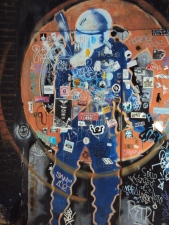
When my friend came to town, I met her in San Francisco to climb the Filbert Street Steps. This staircase covers three ascending blocks from Sansome Street to Coit Tower and includes well over two hundred steps. On my way to the city in Oakland, I saw some graffiti on an overpass that said “Resist Authority.”

I turned the staircase and graffiti experiences into a short commentary about how I like to read graffiti so I can hear what the needs of people are. This post received a lot of attention on my blog. It seems like many people identified with it.

Now, I have a fertile writing attitude. My whole life is a garden of ideas, waiting for my creativity to take them from a personal experience into the world.

Graffiti and Staircases

Today, I drove to Oakland.  On an overpass, across the highway, graffiti was sprawled across the cement. “Resist authority,” it said.

People in the suburbs don’t understand graffiti, but it’s been around for centuries—since Egyptian, Greece, and Roman times.  Graffiti is a word or a picture that is scribbled, scratched, or painted, usually illegally, in a public place.  Most often, the words express social or political views that defy authority or criticize the status quo.  These words are powerful expressions; they often infuriate conservatives into passions of criticism and revulsion.

DSC00112

In 1964 in his song “Sounds of Silence,” Paul Simon wrote, “’The words of the prophets are written on the subway walls and tenement halls.’”

I think Simon was telling society to pay attention.  We shouldn’t ignore graffiti; it foreshadows the protests of people who exert great effort to be heard.  Energy is pent up behind graffiti’s words, and until that power is spent, it continues to build until it can no longer be contained in the paint on a wall, across a bridge, or around a garbage can.  It represents the howl of people who don’t have a legitimized voice.

I listen to graffit.  I want to sit down with the graffiti artists to hear their whole story, not just the few words that are sprayed on a wall.  Why?  Because graffiti artists, although not formally voted into office, are the true representatives of their community.  They empathize with the story of their neighbors, and they have the courage to paint the pain of their friends over the arch of a highway.  They have nerve.  Audacity. In another word, courage.

Whenever I want to feel more understood and relevant, I tell my stories to somebody.  I cry that my mother died a few days before Christmas and that Christmas will never be the same again.  I talk about the ache from a break-up that has lasted for twenty years.  And I repeat my worries about money and love and job security and children and my dead aunt over and over again, until one day, I have talked enough, and I stop crying.

Every community consists of staircases.  In San Francisco, on Filbert Street, over two hundred stairs climb the hill to Coit Tower.  In Berkeley, 125 Oakridge steps ascend to a stunning view of San Francisco Bay and the City.  In Oakland, the Grand Lake and Trestle Glen neighborhood staircases guide residents away from the sidewalks among the blooms of spring and summer.

I’ve been climbing the staircases of these cities for years now.  I started right after I underwent chemotherapy.  I don’t mean to stir up any sympathy; I just want to demonstrate that I had a good reason for not being able to climb very far or very fast in the beginning.  I’d stare up at the wild ascent from the bottom like I was a finless salmon at the foot of a river.  The incline was daunting, and I panicked that I would never feel the heady rush of reaching the top.  I was afraid of being doomed to crawl back and forth on the first few stairs, feeling weak and powerless, without hope or optimism.

Then one day, I climbed past the first flight of stairs.  I rested on the landing like a panting dog, my torso leaning against the railing for support.  I scrambled up the second flight and sloughed across the next landing, gripping the rail with clenched claws, too winded to speak.

I scaled and mounted the steps like they were enemies.  I heaved and sighed, trudged and tripped.  I counted and lost count.  I ascended the steps while dots danced across my eyes and pins jabbed the center of my chest.  Then, when I was too weary to go any farther, a stranger grabbed me around the waist and pushed me up.  We climbed like one unit, in a slow march for a common purpose.   And I found the top of the stairs, my head in a fog, deficient of breath and oxygen, with a new friend beside me.

Not every stair can be climbed alone if you don’t have shoes, can’t afford a cane, or just don’t have the stamina.

DSC00113

This is why I want to listen to the graffiti.  Graffiti is the story of people who want to climb the stairs, but who are trapped at the bottom.  I want to listen to their stories and walk a few stairs with them until they can see their way to the top.  Along the way, I will make new friends.  I could use more.  While I listen to their stories and help them mount the stairs, I realize that I’ll be climbing higher, too.