Making a Plan to Have Fun

This is not my idea. I got it from my daughter who is the most entertaining person in our family. She’s an adult—thirty-three-years-old—who loves to have fun. What she did is to make a list of things she wanted to do during Fall to make her life more enjoyable. She downloaded a free template from Canva and made one column for the activity and another for checking it off when she completed it.

What did she include in the columns? Well, for one, nothing cost a lot of money. One thing she wrote was to buy paper Halloween cups to enjoy when she had coffee. She has a dog, so she walks a lot, and a holiday coffee cup would be a super conversation starter for all the other dog walkers in her neighborhood.

Here are some things I would write:

  • To make lamb stew
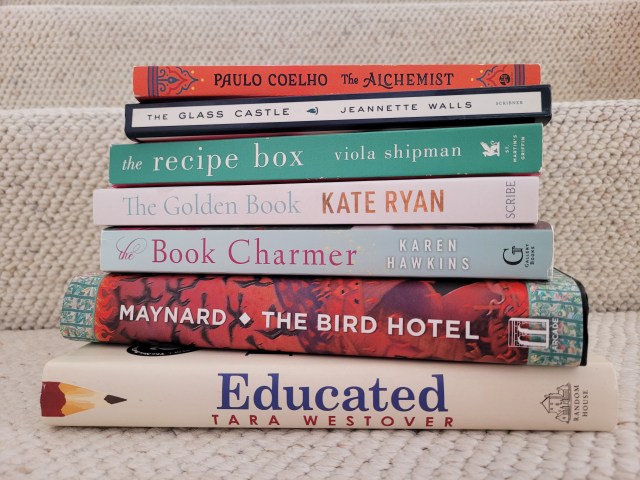
  • To read On Writing: A Memoir of the Craft by Stephen King
  • To watch a movie in a movie theater
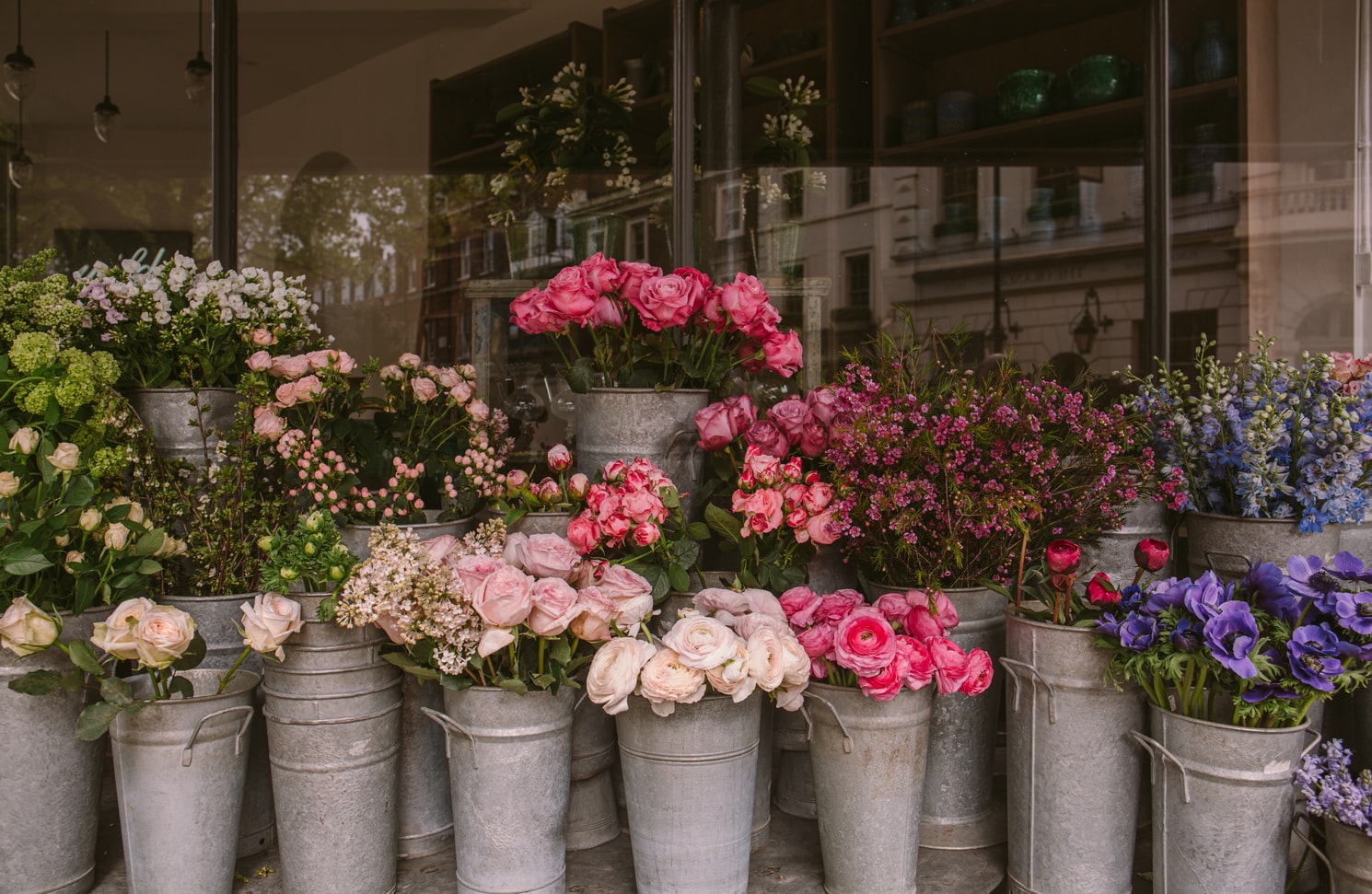
  • To take flowers to a friend that needs cheering up
  • To go to a craft fair with a friend
  • To take a hike to a natural labyrinth near my house
  • To visit my local library
  • To wander around in a large nursery
  • To prune my roses
  • To send my daughter a card for no reason except to say “I love you.”

What Really Makes Me Tick (Happy)

Wouldn’t it be a better world if everyone knew what they needed to be happy? I’m retired, and I loved my teaching job; however, now that I don’t have to commute to work five days a week or grade college essays on the weekends, I just want to do things that make me happy. Here they are.

Admiring Flowers

Stopping to smell a rose may seem like an unimportant action, but, when I do it, it brings me joy. I have rose bushes in my front yard and back yard, and every morning, I wander outside to inspect every bush to see the new blooms. I sniff and stare and smile to my heart’s content.

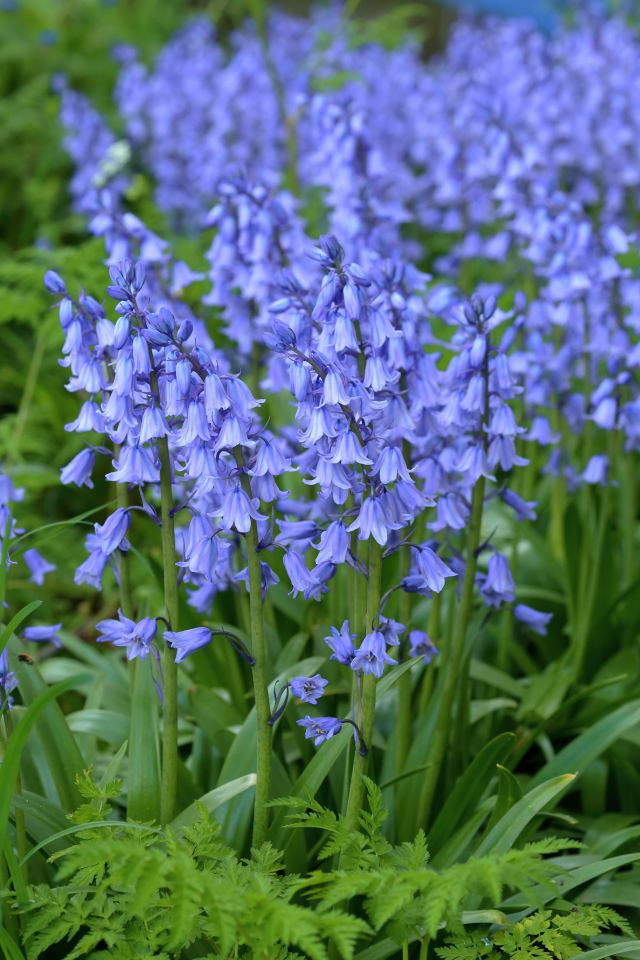
I remember the flowers of my childhood, too. In January, crocuses poked out of the soil in the flower beds in the front yard. In February, the daffodils came. Tulips arrived in March, and Irises after them.  By the time Lent was over, Easter Lilies grew like sophisticated ladies in white hats in our back yard. And in May, the meadows were carpeted with Bluebells.

For four years of my childhood, I lived in England with my family, and I was impressed by the colorful blooms of summer that thrived in the temperate climate. Rambling roses climbed up cottage walls. Cosmos waved their rainbow heads in the breezes like pretty bonnets. Hydrangeas brightened shady nooks of gardens with their puffy burst of blue and pink. I was entranced by their beauty.

At Christmas, my mother bought at least one Poinsettia to decorate the house. She bought red poinsettias, white poinsettias, and ones with white flowers with red stripes. Sometimes, she had an amaryllis bulb growing in a pot. Every day, I’d inspect it to see whether it was blooming or not. I was in more of a hurry than it was.

Making a Stew or Pot of Soup

Whenever my dad cooked, he made “water” soup. He added pieces of beef and vegetables to a pot of water to create soup. Ugh. We kids would cringe when we saw him taking out a pot. His were the worst soups I’ve ever tasted.

Maybe that’s why I love making delicious soups.

I own an old Dutch oven that is the perfect size for making one-pot meals. Some mornings even before I change out of my pajamas, I scour the refrigerator and pantry for the ingredients for a minestrone—onions, celery, carrots, zucchini, chick peas, barley, chicken broth, chopped tomatoes, oregano, salt, and pepper. Sometimes I add cooked shredded chicken. Often, I don’t.

Or I find the fixings for chicken noodle soup for a recipe from a William’s Sonoma Soups book that I bought a long time ago. While I’m chopping the carrots and celery for this soup and simmering the chicken breasts in the broth, I think back when I made this for my two children who loved it. I see their little faces above their steaming bowls, their hands holding spoons, their mouths filled with savory egg noodles.

On one European trip, I bought cookbooks in the Czech Republic and Austria, so when I want to make goulash, I search for recipes from those books. My favorite goulash is a beef, onion, and smoked paprika concoction that is topped with cornmeal dumplings. I first ate cornmeal dumplings at the restaurant at the Belvedere Palace Museum in Vienna. I’m still practicing to make mine taste as good as those were.

Reading Inside When It’s Cold Outside

To me, the essence of decadence is waking up in the morning, seeing that it’s cold and rainy outside, then reaching for a novel and reading it in bed. To take all the time in the world to read a story, then stopping and thinking about it is heaven on earth.

Reading when its cold outside reminds me of when I read as a child. I had time to sit on the floor in a corner of the house with a treasured book of fairy tales and get lost in another world. When my mother took me to the open-air market, I found the bookstore, walked to the back shelves, pulled out a tome, and read it while sitting on the floor. I was always afraid that the shop owner would find me and kick me out, but he never did.

Decorating My Home

When I was a child, we never had an expensive home, but that didn’t keep us from making it beautiful. In the spring and summer, I picked flowers in the meadows, poked them into vases and brightened every table and dresser in the house. In the fall, I cut branches of colored leaves for the mantel in the living room. For winter, my mother and I found pine cones and spray-painted them silver and gold for Christmas. We added holly and pine branch garlands in-between them.

Today, when a new season comes, I still have the irresistible urge to celebrate it with seasonal décor. Right now, I have a collection of pumpkins on my front porch accompanied by a little witch. I also have put pumpkins on the table on the back patio so we can feel the season when we go outside in the afternoons. Every time I pass these decorations, I feel like celebrating.

Writing

I wrote my first poem when I was nine years old, and I’ve been writing ever since. Sometimes, I use writing to help me sort out a problem. Currently, I’m the chair of a scholarship committee for a charitable organization. When I’m planning the meeting agendas, I write them to organize my thoughts. When I’m thinking about how to improve my author’s platform, I write my thoughts down. I write down daily affirmations and New Year’s Eve resolutions. I write every day.

Even when I’m traveling, I have a journal that I use to take notes or write a spontaneous poem. I remember one vacation that I took by myself to Boston. After I toured Paul Revere’s tomb and all of Boston’s historic sites, I drove north up the Atlantic coast. I stopped in Salem and visited another graveyard where a huge oak tree that had gotten so big over the centuries that tombstones were poking out of its bark halfway up. There was so much to write about. Finally, I stopped the car at the edge of the road near a beach. As I sat in the sand and gazed over the surging navy-blue sea, I wrote a poem about the peace that I felt.  

When I visited Sorrento, Italy, I stayed in the Grand Hotel Excelsior Vittoria. Our room had a large terrace that overlooked the Sorrento Harbor. Across the Bay of Naples with its slate-blue ripples, we could see Mount Vesuvius. Every day, I sat at the patio table on this terrace with my journal to write about the gorgeous scenery or about my excursions into the town of Sorrento or its nearby attractions. I wrote how my husband had to scrunch down going into the Blue Grotto Cave in Capri. I described the ceramic factories that we toured in Almalfi. With words, I wondered what it was like to be a citizen of Pompeii in 79 AD when Mount Vesuvius spewed its lava all over the populated city.

Now that I think about it, I’ve been doing these happy things my whole life. Naturally. Now, though, I have more time to do them. What joy.

Learning a Language for a Better Life in Retirement

Photo by Jon Tyson on Unsplash

I’ve been retired for two and a half years, and a month after I retired, I started taking Spanish lessons. I previously took French in high school and college and two years of Spanish in graduate school, but I hadn’t used either language much at all. Now, my goal is to be fluent in Spanish one day.

It turns out that taking Spanish during retirement is a great idea. It’s great for health and also enhances my social life. Here’s how.

Learning a Language Sharpens Memory

Because studying a new language involves absorbing new information and practice, it is good for retaining the brain’s memory capability. According to Carly Spence at Cambridge.org, “[language] students learn new words and grammatical constructs and spend time reviewing and building on their previous knowledge as part of the learning process. This . . . is . . . an effective brain workout and protects older learners against dementia and other degenerative neurological conditions.” My memory is just as sharp as it was thirty years ago, and I want to keep it that way, so I guess I’ll be studying Spanish for years to come.

Learning a Language Boosts Cognition

Learning a language can also make a person smarter or help her stay sharp as she ages. In The Sydney Morning Herald, Evelyn Lewin explained the positive effects of studying a new language as determined by a 2019 Italian study. The study “looked at the effects in adults aged between 59 and 79 and found that, after just four months, people learning a second language scored significantly better on two research-backed measures of brain health and acuity: global cognition (such as thinking, understanding and problem-solving) and functional connectivity.” Many elderly people take it for granted that they will lose their ability to think clearly or maintain their intelligence, but this isn’t true for people who continue to use the high-level functions of their brains such as in studying another language.

Learning a Language Makes Travel More Fun

I just traveled to France for almost a month, and everywhere I went, I had opportunities to speak French. A French friend suggested that I always greet a French person by saying Bonjour first as a polite gesture. This small habit helped me engage in many lovely conversations in which I learned about the area I was visiting and the wonderful people I was meeting. As I continued my trip, French phrases popped up in my brain from my old French classes so that I could extend my conversations in French more and more. I felt proud of my capability and had much more fun.

Learning a Language Improves Creativity

Studying a language promotes a student’s creative abilities. According to Carly Spence at Cambridge.org, “This could be the result of the thought processes involved in language learning. These include translation, language switching and disciplined study, along with a willingness to learn and adapt.” Learning a language takes courage and humility, which are two characteristics of a creative person as well. A language learner believes that it is possible to learn to speak and understand a new language, and a creative person believes in new thought processes or ideas, so learning Spanish and being creative are truly close companions.

One of my goals is to do something creative every day since creating makes me happy. I’m a writer, but I also cook, garden, and decorate my home and yard. When I retired, I started to write a novel, and now that novel is almost ready for publication. I’ve been amazed at my creative power during the last two-and-a-half years. I believe my study of Spanish has enhanced my ability to create in other areas.

Learning a Language Leads to New Friendships

I’ve been taking Spanish classes for two-and-a-half years now, and this fall, I’ll be in Spanish 4. Each of my classes has consisted of over twenty students, most of them being retired. Often, the teacher arranges students into small groups to practice verb tenses or other tasks. When students work in groups, conversations become more trusting and students learn about what they have in common with their classmates.

I’ve made two new good friends in my classes. One is a former chemist who is married to an Indian man and has adopted two Indian children. The other woman is a former physician assistant whose husband is also studying Spanish. In-between classes, I meet with these friends at a coffee shop or for lunch to practice conversational Spanish. We share favorite restaurants, talk about our vacations, and reminisce about our childhoods.

Studying a language is not only educational and fun; it makes retirement a happier and healthier time of life.

Why I Make New Year’s Resolutions

Every year, just before New Year’s, I take out my diary and write down New Year’s Resolutions. I don’t show them to anyone, not even my husband. They are only for me to see, only for me to enjoy. I hide my resolutions where no one can ever find them, and I look at them throughout the year and at the end of each year.

Some of my friends never make New Year’s resolutions. Maybe they don’t want to disappoint themselves. Maybe they don’t want to change their lives. I read once, though, that as long as a person continues to grow, she will feel young. I like to challenge myself to continue to grow in various ways. Resolutions help me do that, but here are more specific reasons why I make them every year.

New Year’s Resolutions Help Me Clarify My Goals

I am not always clear on how to accomplish my goals, but when I make a New Year’s resolution, I try to make it specific enough so that I know exactly how to succeed.

Let’s say that I want to pay off my mortgage early. A New Year’s resolution will help me decide exactly how to do that. For example, I could promise myself to pay an extra $500 a month for the whole year. This makes it easy for me to follow through on my promise.

Resolutions Help Me Grow

When I want to learn something major, I make it part of my New Year’s Resolutions, so I don’t forget about it.

For example, after I retired, I decided that I wanted to become fluent in Spanish. I realize that this is going to take me years to accomplish, but I’m not going to worry about that. I’m just going to practice until I achieve it. In order to do that, I made a resolution to practice Spanish for at least fifteen minutes every day. Along with this resolution, I am taking a two-hour Spanish class every Wednesday morning for which I complete homework. Nevertheless, outside of the class and homework, I still promise to practice fifteen minutes a day. This is not too long so that I become overwhelmed, but long enough for me to improve my speaking, listening, and vocabulary. I’ve been practicing Spanish for fifteen minutes a day for two years now, except for the three weeks I went to Italy. I can now speak in Spanish without have a brain freeze.

Resolutions Act Like a Measuring Stick

I love looking back on my resolutions from prior years and thinking about how they helped me accomplish something.

Last year, I resolved to write the first draft of my novel. By the end of October, I had finished it. Even if I hadn’t finished it, I would have written far more of it than if I had never made the resolution. I can always measure my progress against the promise I made. I don’t berate myself for not accomplishing my goal; instead, I’m happy of the progress I made.

I’ve made eight resolutions for 2023. One is about how I promise to exercise a certain amount each week. Another is about how I plan to write the second draft of my novel. Practicing Spanish is the third one, and the other five are for my own eyes only.

During 2023, I’ll look back on my personal promises, and coach myself to stay on track. I’ll be my own best, supportive friend.

Glitter, Gloss & Human Dignity

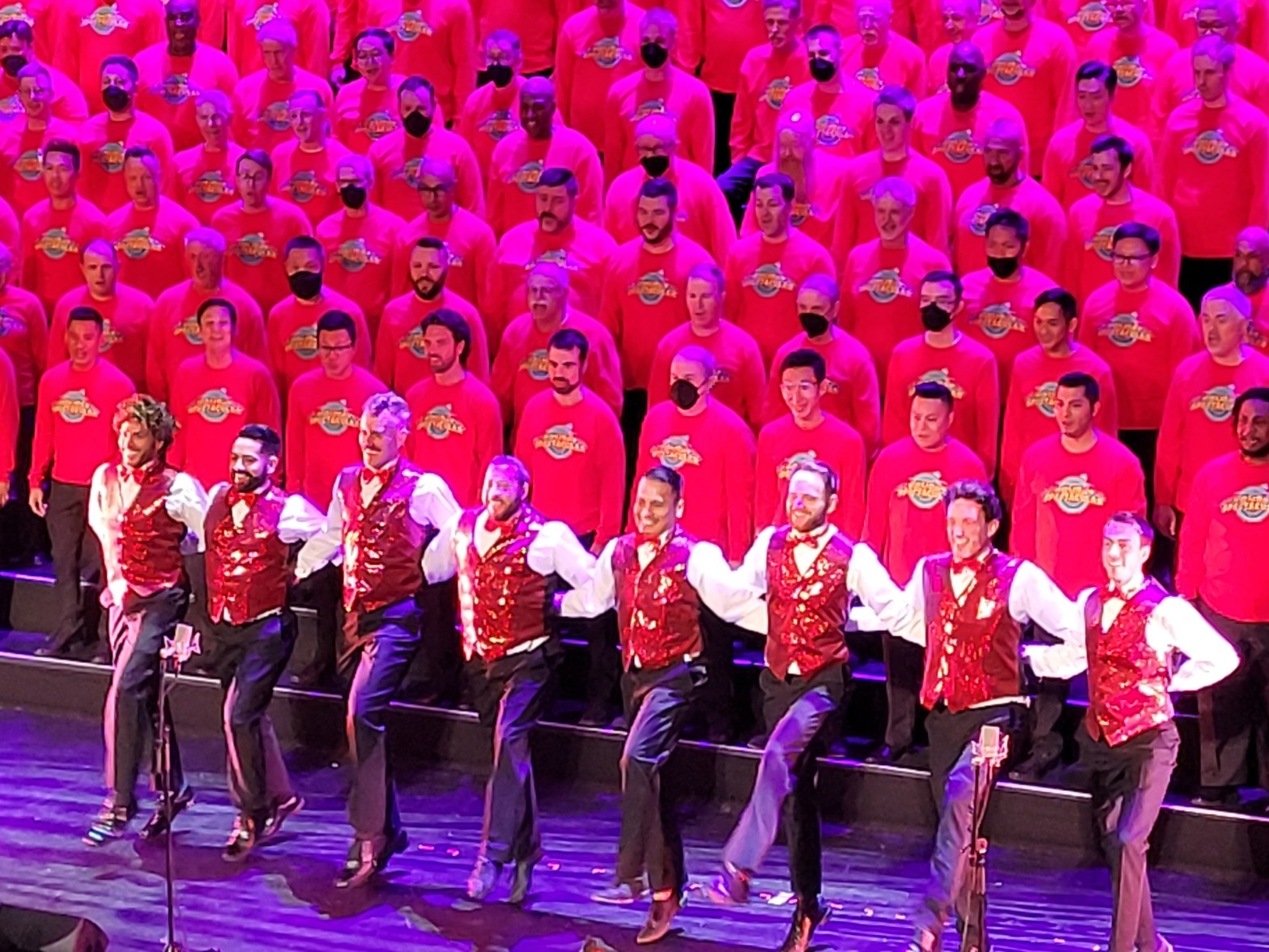
Last Saturday, I attended the San Francisco Gay Men’s Holiday Spectacular at the Sydney Goldstein Theater in San Francisco for the first time. Oh! What a night!

When my daughter and I arrived, a quiet but eager crowd was gathered around the theater’s entrance. We donned our required Covid masks and presented our tickets to a friendly usher who pointed to the stairs. Above, another smiling usher led us to our excellent seats and we sat down—only two in a theater filled with Christmas sweaters and holiday cheer. Excited voices murmured throughout the cavernous room.

The stage curtain was lit up with the title of the chorus in capitalized red letters, and, a few minutes later, the curtain opened to reveal the silhouette of risers brimming with over 200 singers. The lights came on, and the audience suddenly saw ten rows of men dressed in long-sleeved red T-shirts and black bottoms on a staircase of risers. The orchestra began, the conductor raised his arms, and the men began to sing.

Young men, gray-haired men, bald men, men with beards, men wearing skirts, men with canes, and men sitting on stools all crowded the risers and faced the music conductor with professionalism and purpose. No one read lyrics from a song sheet. All of them sang by memory.

The chorus sang “On this Shining Night” by Morten Lauredsen, a song I had sung with the Blackhawk Chorus a few years ago. The men’s voices were rich, on tune, piano and forte. I fell in love with their sound.

After each song, several chorus members quietly exited from the risers and went back stage. As the next song began, these members came back on stage as dancers in various costumes to complement the chorus. Some stood at microphones at the front of the stage to sing solos.

In the middle of the performance, the chorus sang a long rendition of “Jingle Bells” that got the audience toe-tapping and clapping. They sang many verses in a variety of styles that became more exuberant all the way to the song’s finale.

The song that sent shivers up my spine was “Huddled Masses” by Shaina Taub, a song about the plight of immigrants and our moral duty to support them. The conductor explained to the audience that, although this wasn’t a Christmas song, it promoted the spirit of Christmas, which is love.

On the right side of the stage, in front of a glowing Christmas tree, was a sign-language interpreter who signed the words of each song. His hands gracefully moved as the singers slowed their tempo and stretched the lyrics over a series of beats.

One of the last songs was “Silent Night.” The orchestra began the introduction and then the chorus, instead of singing, signed the first verse silently. When it was time for the second verse, the orchestra stopped, and the chorus continued to sign the verse as the audience watched in silent wonder. In the quiet of the moment, my heart filled with so much gratitude to the chorus for expressing what a deaf person hears and how silence can evoke wonder and awe.

Later in the program, the chorus held a moment of silence for the five LGBTQ persons recently gunned down in Colorado Springs. For two hours, without an intermission, and with energy and vitality, the chorus recited lyrics of peace and promoted love in both prose and lyrics. This was a night filled with joy despite life’s hardships and disappointments.

I left the theater with happiness in my heart—contentment that I live near San Francisco, a city filled with respect and love for the LGBTQ community—because I know, that a culture that treats all persons with dignity is the cheeriest place on earth.

Friendly Italians

A whole country full of friendly people. That’s Italy. Besides the beauty of the countryside and beaches, the outstanding history, the scrumptious food, the satisfying wine, the awe-inspiring architecture and art, the people of Italy are incredibly welcoming, social, hospitable, approachable, and responsive. I visited Italy last August and I can remember so many encounters with friendly Italians.

The Limoncello Merchant

First, there was the shop-owner in Sorrento, Gino, who sold limoncello and other liquors. He started a conversation with me as soon as I entered his shop. I learned that he had a family in Naples and he rode a scooter to work every day, even in the rain. He thought it might be time to buy a car.

As I wandered around his miniature shop, I enjoyed the brightly-colored bottles of limoncello, meloncello, and other treats. He kindly pointed out the advantages of each size of bottle. Some were small enough to tuck into carry-on luggage so they wouldn’t break. Some were sold in sets with one bottle of three different flavors. As we chatted about the liquors, I told him I was from San Francisco, and he said that he visited there with his family a few years back. They also went to Yosemite and loved the hiking. We talked about the different trails and the gorgeous views in the City.

Finally, I chose some bottles of cello, and he wrapped them up for me in brown paper to protect them. We smiled at each other when he was done, and then he reached out around my shoulders and gave me a hug.

“I can tell what a nice person you are,” he said. “I will never forget you.”

I know that I will never forget Gino.

The Florentine Woman with Beautiful Hair

Then there was the day in Florence when I got lost in the warren of cobblestone streets. I had started out from The Basilica of Santa Croce where I had visited the tombs of Michelangelo and Galileo, and walked north on Borgo Allegri, knowing that I’d have to turn left on a street in order to find the Mercato Centrale. I turned left onto Via Sant’Egigio and walked and walked until it turned into Via del Pucci. Unfortunately, Via del Pucci ended at Basilica de San Lorenzo, and I was lost. I couldn’t even tell the direction of the Arno River which would help me get back to my hotel. I walked, and turned, and walked, and turned, and finally stopped an elderly Italian woman to ask for directions.

This olive-skinned beauty with graying but lustrous hair wore a black pencil skirt, a maroon cardigan, and a white blouse. I was worried that she would be bothered by my question, but she smiled at me right away.

“The river is that way,” she pointed. “You’re not too far. Just keep following this street and you’ll see it in a few blocks.”

“Grazie, grazie,” I repeated to her, and her smile became even warmer. Her eyes twinkled in the shadow of the narrow street, and I felt so much better. We gave each other a lasting smile and she waved to me as I walked away, following her directions.

The Venetian Painter

I met a painter in Venice in front of my hotel, the Danieli, which was situated on the waterfront of the Canale di San Marco, right across from the island of San Giorgio Maggiore and a few steps away from the Doge’s Palace and Piazza San Marco.  His miniature pop-up stand stood in a row with the stands of two other painters, their paintings hung on every side of their stands’ frames and propped up on the sidewalk.

The old painter, with white hair, a scruffy T-shirt, and paint-splattered trousers, welcomed me when I stopped to look at one of his paintings—an impressionistic portrait of a café with colorful tablecloths and umbrellas that sat on an island between two canals. I loved the flashes of paint that let my imagination wonder about the details that were elusive to the eye. 

The old man gave me a tour of all his paintings. He described where they had been painted by pointing in all directions of Venice. Most of the paintings were realistic, and these took more time to finish, he said. The impressionistic one, the only one in his collection, took less time since the detail was left up to the viewer’s imagination. 

My eyes kept trailing back to the impressionist café, and I paid for it, but this painter wasn’t done with me. He held out the painting and made suggestions as to how to frame it, how to make the picture look like it continued beyond the canvas. We stood in the hot, September sun and discussed color and materials, technique and effect. Finally, the old painter rolled up my canvas, slid it into a thick, cardboard cube, and handed it to me with a bow. I walked away feeling that I had purchased not only a painting but a cherished memory.

Oh those Italian gente (people). They clearly believe that happiness is found in relationships most of all. I believe, they’re right. When I think back on my Italian trip, I remember the people I met more than anything else.

Postcards from Italy

You know that feeling you get when you’re incredibly happy? Like you have butterfly wings and have flown so high that the clouds kiss your face. Your chest is so open that you can blow a star across the sky. Your arms are so wide that you can wrap them around the moon.

That’s how I felt this last August when I was visiting Italy. When I opened the sliding door to the balcony in my Sorrento hotel room and looked down at the rows of boats in the harbor, the blue-green water of the Bay of Naples, and the rising cone of Mount Vesuvius across the Bay.

Italy makes everyone happy. It’s incredibly beautiful. I wish you could have been with me and my husband as we boarded a little row boat at the bottom of a cliff off Capri Island so we could duck into the opening of the Blue Grotto and experience the most heavenly crystal-blue water. My heart was filled with elation as I watched my husband gaze at the water, the boats, and the walls of the cave. My heart quickened as I listened to the deep masculine voice of a sailor who sang an opera in baritone that echoed off the cave walls.

The people of Italy believe in making beautiful objects. In Amalfi, the streets were lined with shops that sold brightly painted ceramic pots, plates, plaques, and wall sconces. The blue, red, green, and yellow fruits and leaves on the pottery enthralled me so much that I couldn’t pass a shop without walking inside.

The architects and artists of Italy have been so prolific over the centuries that not one town in Italy lacks a beautiful church or fountain. When we toured St. Peter’s in Rome, I fell in love with the numerous doves holding olive branches in their beaks that decorate the walls of this catholic cathedral. The face of Mary on Michelangelo’s Pieta is such a beautiful example of a mother’s love for her child that my heart expanded as I stared at it for twenty minutes.

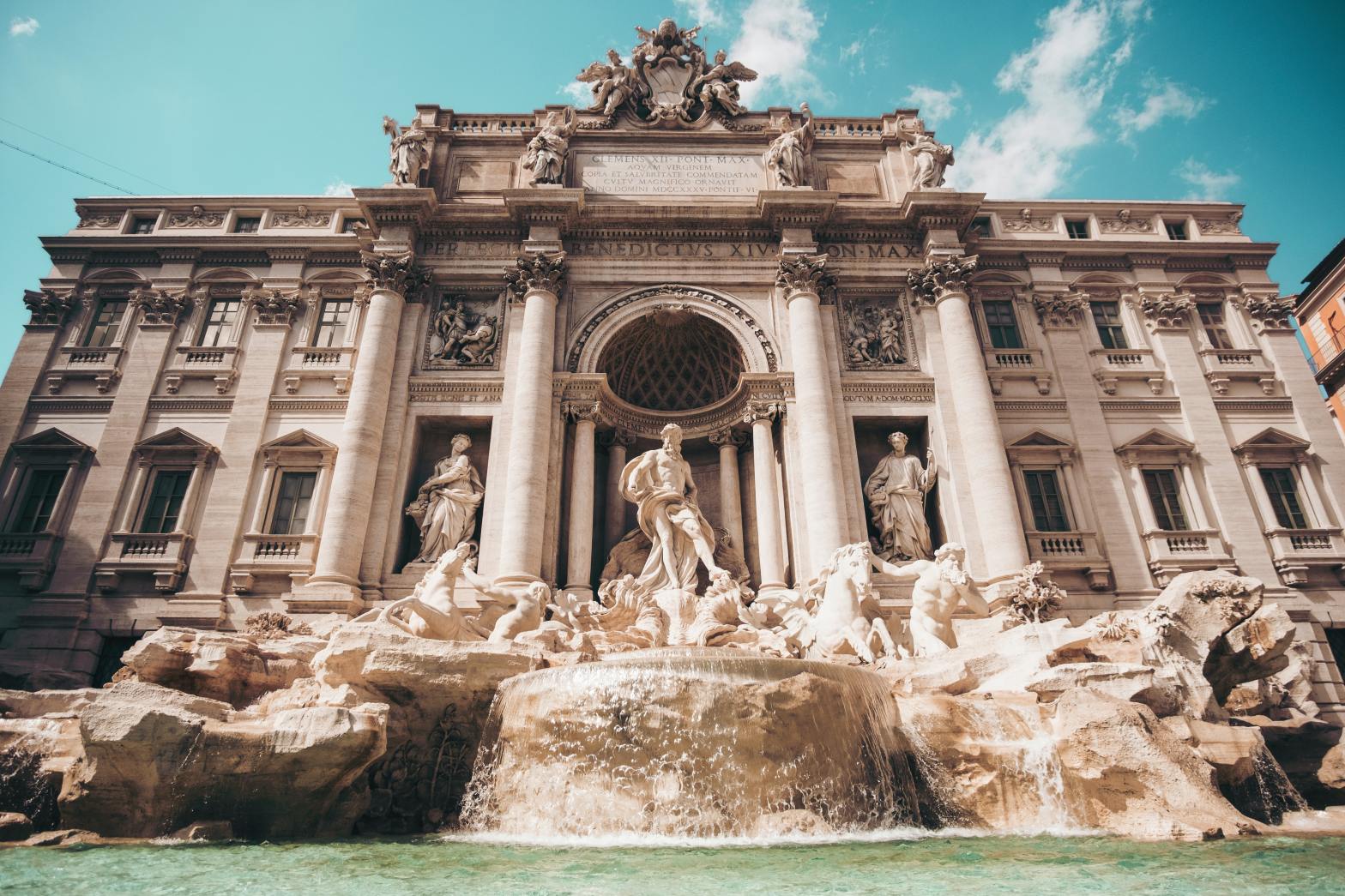
My husband had never been to Rome before, so when we visited the Trevi Fountain, I showed him how to toss his penny over his left shoulder so he would be sure to return. I took a photo of him in front of the colossal Baroque fountain, mostly made of travertine marble on the back of Palazzo Poli, with two-story Corinthian pilasters and a scene that conveys the taming of the waters. Through my camera lens, I could see Oceanus framed by a massive arch, with the goddess Abundance on one side and Salubrity, representing health, on the other. Below these immense statues, gigantic statues of titans guided a shell chariot, taming the sea-horse hippocamp. Above all of this marbleized action, I spied the story of the Roman aqueducts carved in bas relief. Tears filled my eyes before I had clicked the camera.

At one dinner during our tour, Theresa, our tour guide, gave me two post cards that she promised to mail for me after I filled them out. I wrote love letters to each of my children, addressed them, and gave the cards back to Theresa. After that, I promptly forgot about them since Italy had effectively mesmerized me.

When we weren’t gawking at architecture and charming alleys, we were eating. One day in Rome, I ordered a Napoli pizza with mozzarella and anchovies. The cheese was so light and creamy and the anchovies so fresh and sweet that I closed my eyes as I chewed—heaven on the lightest dough I’ve ever eaten. I sipped a bright Pino Grigio as I ate and my mouth had never been more fulfilled.

I’d never been to Umbria before, and so when we visited Orvietto, I was charmed by the quaint alleyways and stone staircases that led up to homes and shops. I was attracted by the beautiful mosaic cathedral dedicated to the Virgin Mary. When the sun hit the façade, the mosaics, gold, stain-glass windows, and bronze doors glowed like the entrance of paradise.

In Italy, charm is everywhere. We climbed countless steps in the town of Assisi, sailed along the coast from La Spezia to Cinque Terre, observed the Carrara marble quarries used by Michelangelo, and walked miles and miles on the cobblestone streets of Florence. We were enchanted by Ponte Vecchio in Florence which was lined with little huts last time I had visited. Now, it is filled with shops of glass windows to safely display the silver, gold, and gem jewelry for sale. One day, while walking to the Uffizi Gallery to see the colossal statue of David, we found an ancient window that had been used to sell cups of wine during medieval times.

Our last Italian stop was Venice, another place that my husband had never been. I dragged him across the city from our hotel, over one cobblestone bridge after another. Coming back, we found a piazza where an orchestra was playing music for tables outside. We sat down, ordered wine and listened to Gershwin and Beethoven for an hour, watching the sun change the shadows on the stones of the buildings as it trailed across the sky.

Italy filled me up with happiness. When I got home, I rushed out to visit my son at his studio a few miles away. When he let me inside, I noticed that he had tacked up the postcard I sent him from Italy on his refrigerator. My next stop was my daughter’s apartment. On her refrigerator, she had her postcard attached to her refrigerator too.

You know that feeling you get when you’re extremely happy? When you have wings and you fly high enough that the clouds can kiss you, you can blow the stars, and hug the moon with your arms? When I saw those postcards on my son’s and daughter’s refrigerators, I felt just like that.

Why I Like Old People

I recently came home from a vacation where I spent ten days touring Southern cities with twenty-four people over the age of sixty.  I had the time of my life with these people and the following reasons explain why.

1. They’ve Endured Hardships and Healed from Them

While sitting beside my new friends in a horse carriage or at several dinners, I learned about their lives.  One pretty, eighty-eight-year-old woman had raised two of her grandchildren after her daughter and son-in-law died.  When she smiled, her eyes lit up like stars.  Another woman, traveling alone, was married to a man who has suffered from Muscular Dystrophy for twenty years and is bedridden.   A tall, handsome mustached man experienced extreme pain one day when his gout acted up during a tour of a plantation when the tour required a lot of walking.  He was a sweet and endearing man, always kind to everyone.  A friendly woman walked with a cane, yet she was a fascinating conversationalist.  Despite having all of these trials in their lives, these individuals were traveling and living happy lives which indicates their strength of character and determination to be happy. 

2. They’ve Developed Long Careers

This group of travelers represented a broad range of careers.  One man, at seventy-seven-years old was still working as an ophthalmologist.  A blonde-haired woman, who was married to a former president of a silicone company, was a former cooking instructor.  Two women from Pennsylvania were realtors, and another was an English professor.  All of the travelers had decades of experience in working and lots of stories they could tell of their working years.  This made them interesting companions.

3. They Don’t Need to Impress You

No one had the need to impress anyone else.  No one was critical, either.  They accepted everyone, whether he or she used a cane, was shy, drank a little too much, or liked to be alone once in a while.  Perhaps, because they had lived through hardships and experienced numerous relationships with many different kinds of people, they didn’t feel they had to compete with anyone else’s achievements.  They had plenty of their own. 

4. They Love People and Relationships

This was an exceptionally friendly group of people, perhaps because they were old enough to understand that people and relationships bring the most joy into our lives.  The woman whose husband had Muscular Dystrophy made sure she dined with each and every person on the tour.  During every bus ride, we chatted together about our lives.  We took photographs of each other on beautiful, historic bridges.  We climbed to the rooftops of Revolutionary forts together.  We toasted glasses of wine, shared appetizers, discussed fish and steak, described our desserts.  So even though we were on a tour to visit the South, our emphasis was experiencing the country with new people and in developing new relationships.

5. They Can Relate to Your Experiences

After working for years in a profession, it certainly is rewarding for someone else to be able to identify with your years of working with students, clients, or patients.  If you spent years in human resources solving employee problems, it’s rewarding to tell someone else about your work and have them understand your accomplishments.  Since there were a few teachers on the tour, they easily appreciated the hard work of teaching.  The corporate attorneys and accountants could understand corporate work, and the medical professionals could share stories about special cases or patients.  People with different careers could appreciate each other since long careers all require hard work, problem-solving, and endurance. 

6. They Know How to Live in the Present

Old people know how short life is, and so they are better at focusing on the present moment instead of always thinking about the future.  Some mornings, my travelers took a walk on the beach at Hilton Head just to watch the sunrise over the bulging, grey Atlantic Ocean.  Sometimes, they put on their swimsuits and swam in the pool.  They sat in the hotel courtyard on warm afternoons to enjoy the balmy weather and blooming bougainvillea.  They lingered at dinner long after the dessert was served to talk with their new friends, and they asked each other to take pictures in the plantation gardens. 

Old people are a lot like good novels.  They have so much life to share.  After spending ten days with my over-sixty-year-old travelers, I’ve come home with much more than memories of places.  My life has been enriched with the strength, experience, confidence, humanity, empathy, and mindfulness of these incredible people. 

Putin’s History Lesson

Putin does not know history.

Great leaders

Do not build empires of bombed out cities,

Where water doesn’t flow and electricity doesn’t heat,

Where theaters are hollow since the drama lives outside,

Where churches are empty because praying goes underground,

Where store shelves are filled with dust instead of bread,

Where people shiver in subways and flee from shrapnel,

Where men must wear helmets and babies wear unwashed diapers,

Where lines form for water, blankets, evacuations,

Where graveyards echo with tragedy.

No, Putin.  Great leaders

Help people build their own cities,

Municipal happy places,

Where growing leaders

Have opportunities to taste love,

And learn how to spread it.

My Epiphany: I’m not Retired, I’m Now a Full-time Writer

Last year, I retired from my English professor job. Throughout the years, I had always claimed to be a writer. Heaven knows, I wrote countless essays, paragraphs, articles, and lesson plans for my courses, but I also wrote poetry, articles, and short stories whenever I found free time–in-between semesters or during the summer. What I never wrote was a novel. I’ve had ideas on the table for years. Scribblings in pretty journals. Scratchings in lined notebooks. Never a complete draft or a completely formed plot waiting to be expressed.

When I retired a year ago, I looked at my retirement as a time when I would fill my days with hobbies. I even developed a list of hobbies and stuck it on my little bulletin board next to my computer in my library. That’s where I write, and one of the hobbies on the list is writing. I also wrote gardening, cooking, learning Spanish, and, of course, writing. The list was for whenever I didn’t know what to do. I would just read the list, choose an activity and proceed.

I made such glorious dinners for my husband and me the first six months of my retirement: chicken and shrimp gumbo, mushroom risotto, marinated leg of lamb, and grilled flat iron steak. I created recipes for healthy versions of pumpkin bread and blueberry breakfast bars. I experimented with turmeric and cinnamon in oatmeal and developed personal breakfast egg sandwiches with tortillas and flat breads. I filled my recipe blog with over a hundred recipes and attracted followers from all over the globe. My culinary prowess was astounding until I decided that eating out looked like a lot less work.

By summer, my garden was cleaned of weeds, pruned, fertilized, swept, and raked. The flowers grew like happy children and the fruit trees hung heavy with lemons, blood oranges, and figs. My pots of herbs provided me with lush clippings of thyme, parsley, mint, chives, lavendar, oregano, and basil. By the time fall came, I had done such a remarkable job at sprucing up the front and back yards that there was little else to do except to sit outside and enjoy my beautiful environment.

I started studying Spanish, but in the summer, I started taking classes every Wednesday at a local adult education school. Now, after a whole year of practice, I’m conversing with my classmates in conversations that span paragraphs.

The most difficult activity that I started, however, was to write a novel. I now felt that I had an overall plot in mind. I didn’t have all the pieces, but I was just going to start and see what happens. To ward away writer’s block, I decided not to make any rules or promises. I would write a novel even if I never published it. I would write even when I didn’t know what to say. I would write even when the words came out stilted and awkward. Revision is so much easier than a first draft anyway.

What’s funny is that I’ve just had an epiphany after being retired for a year. Cooking is not that important to me. Gardening is fine, but my little yard will not require much of my time to keep up. Besides, Alfred comes once a week to cut the grass and clean up the leaves.

Spanish is so much fun, but I’ve found that writing is really where my passion lies.

The other day, Valarie from the Alamo Women’s Club called me to ask if I would run for an office for next year. I joined the club last year to help them raise money for scholarships for college students, and I’ve done that. But run for an office?

No. If I became an officer, I wouldn’t have enough time for writing.

I need time to stir up ideas, time to catch up on sleep when I’ve gotten up at 2:00 in the morning to write, time to outline scenes, and lots and lots of time to write.

Next time someone asks me what I do, I’m not going to say I’m retired. They’ll think I have time to fill.

My time is full–of writing.

The Yellow Rose

Friday was the last day of class, and Profesora Casti lead her students to Almagro, the part of Buenos Aires known for its flower vendors.  First, the group wandered among the flower stalls on Acuňa de Figueroa where baskets of roses filled the air with intense fragrances.  Leonie bent over the bunches to breathe in their perfume, and she took turns saying their names out loud with her classmates.  They chatted with the vendors who told them where they grew their flowers and how they worked from early in the morning until late at night planting seeds, hand-watering, and pruning in order to produce the most beautiful blooms. 

The vendors chatted about Mother’s Day, weddings, and baptisms for which they sold the most flowers.  Some stayed open 24 hours a day.  The best time to buy flowers, they said, was late at night or early in the morning.  These really were the most romantic times of the day anyway. 

The class meandered to Calle Sarmiento where even more vendors had their shops.  One shop, filled with tuberose and jasmine, perfumed the air outside its door with heady floral fragrances.  Inside, the vendor was wrapping flower bouquets in cellophane paper for a woman and her two daughters. 

Leonie wandered away from the group to admire the lilies of another vendor.  While she was reaching out to touch a petal, a woman dressed in a green apron came out to greet her. 

“Your lilies are gorgeous,” exclaimed Leonie.

“Thank you.  My grandfather used to sell flowers on the streets of Buenos Aires.  My father sold flowers in the old market in stall 8, and, now, I rent this shop here to continue our family tradition.”

Leonie moved under the shade of the willow tree that grew right in front of the storefront.  “I love flowers,” she said.

“I love flowers, too,” replied the vendor.  “I’ll sell them until I’m old and frail.”

Leonie paused in thought, running the woman’s response through her mind.  Forever was a long time to do just one thing.  Leonie didn’t know that she would ever find something that she wanted to do for so long.  The woman in the green apron smiled at her, her face flushed with the essence of intense happiness, her eyes like shining opals. 

“So,” Leonie asked, “You don’t ever wish that you could do anything else?”

The woman smoothed down the front of her green apron with hands crusted with dirt, chapped from years of digging and planting.  “No, never. I never wish to do anything else. Each day in my flower shop I get to express my creativity, and that gives me intense joy.  Besides, I know that I like to be around beautiful things, and what could be more beautiful than a shop full of flowers.”

“You seem so content.”

“You see this willow tree that’s giving you shade?  A willow tree symbolizes fulfilling wishes of the heart.  It also symbolizes inner vision.  I’m lucky to know what fulfills my life.  That knowledge is my inner wisdom.”

The vendor showed Leonie around her tiny shop, identifying the names of all the flowers and inviting her to smell their fragrances.  Leonie told the vendor that she was about to take a trip to search for her life’s purpose.  As the woman listened to her story, her eyes glistened and a whisper of a smile set upon her lips.

Before Leonie left, the woman held out a yellow rose.  “This rose symbolizes our new friendship,” she said.  “Friends are one of the most precious treasures of your life.  From now one, you and I are lifelong friends.  I wish you success on your trip and hope that you find your version of life fulfillment. 

That night, just before Leonie went to bed, she sat at her desk to write in her journal.  I know what fulfills me, she wrote.  After setting down her pen, she felt anxious.  But I don’t know what fulfills me, she worried.  I don’t know what I want to do with the rest of my life.  I don’t know what makes me happy day after day after day. 

Leonie looked at the yellow rose that the flower vendor had given her.  Its yellow petals brightened up the shadows of her room.  She remembered how gently the woman had picked up each flower and described its characteristics, moving among her flowers with grace, touching each blossom with respect and admiration; her movements were filled with love. 

Now Leonie knew.  The woman had been a messenger from her own soul to teach her how to find her own purpose.  Love was an integral part of finding fulfillment.  When she found out what she loved, she would find her contentment. 

Leonie touched the yellow rose, and her heart filled with joy when she remembered that the woman promised that they would be friends for life.  Friendship, she thought.  I have love already. 

Wisdom of the Trees: Chapter 2/3

Chapter 2 – Birch

During the last week of class, Profesora Casti took the class on field trips so the international students could experience the culture of Buenos Aires.

On Monday, the class walked to the Manzana de Las Luces.  Profesora Casti explained that this was the Block of Enlightenment and contained some of the oldest buildings in Buenos Aires, including the Baroque church of San Ignacio, a church built by the Jesuits between 1686 and 1722. 

The students listened as their instructor explained how the Jesuits also built a school, museum, and pharmacy on the site, and operated all of them until the Spanish came and suppressed the Jesuits.  Since then, the site has been transformed into a university, cathedral, and Argentina’s first medical college.  Later, the Spanish opened Buenos Aires’ first printing press and orphanage on the site, extending its colorful and diverse history. 

What most fascinated Leonie was the warren of tunnels underneath the street, once used to store ammunition during Argentina’s fight for independence.  The students followed each other single file through the narrow, brick tunnels, stooping their heads low under the arched ceilings.  Here and there, the tunnels stopped, the entryways blocked by dirt and rocks from centuries of neglect. Utility lights lit up the corridors, and the lights created shadows on the walls that walked with them. 

When they came outside again, the sunlight blinded Leonie, and she shielded her eyes with her arm, squinting and squeezing her eyes shut until they became adjusted to the brightness.  The students sat down on stone walls in the courtyard to rest.

Leonie sat next to an older woman who was wearing a straw hat and drinking out of a metal flask.   Beside the woman leaned a walking stick, hewn out of white wood marled with yellow scars.  Leonie had never seen a walking stick so beautiful and unusual.

“Are you wondering about my stick?” the woman asked suddenly.

Leonie looked down at the ground quickly, fluttering her eyelids.  “Yes, I am,” responded Leonie.  “It’s so unusual.  What kind of wood is that?”  She slowly raised her eyes to look at the stick and then noticed the woman’s smile.

“I carved this out of birch wood when I was about your age, a wood that signifies new beginnings.  I can see that you are about to start a long journey, one that will give you a new beginning and help you find out your life’s purpose.”

Leonie opened her eyes wide and stared into the woman’s face.  “How did you know that I was going on a journey?  How did you know I was searching for my purpose in life?”

“I am an old soul, and old souls can read energy.  From your energy, I can see that you have suffered a great loss, but this loss will help you gain wisdom and strength, and, in the end, the loss will become your constant companion.”

“My mother died, and I miss her terribly.”  Leonie sank onto the rock perch, remembering the last time she saw her mother’s face.  Her mother had been beautiful, even when she suffered from the cancer.  Her face always glowed with an even sunny complexion, and her smile lit up her eyes like emeralds under a jeweler’s lamp light. 

“The first thing you need to do is to write down your affirmations,” said the old woman, rustling her wide skirts as she turned more to face Leonie.  “Whatever you wish to have, write it down like your already have it.”

“I don’t know what you mean.”  Leonie scratched the back of her head.

“An affirmation is a positive assertion that claims something is true.  When you put forth a personal affirmation, all of creation conspires to help you attain it.” 

“That sounds very interesting,” said Leonie, “but my father wants me to go home right after I finish this Spanish class.  I keep thinking I should stay here longer so I can find out what to do with the rest of my life.”

“You must learn how to believe in yourself and not to rely on the opinions of anyone else.  Your father cares for you, but your life is not his.  You must follow your own heart, or you will feel like you are not living.”  The woman stuck one of her tanned hands into the folds of her skirt and took out a small book, about the size of Leonie’s cell phone. 

“This is a gift from me.  Inside this journal are blank pages.  Today, start writing down your affirmations, and then your life and fulfillment will begin.”  The woman smiled at Leonie just as the sun poked through the branches of an oak tree.  Leonie had to close her eyes it was so bright, and when she opened them, the woman with the birch walking stick was gone.

That night, Leonie sat up in bed, the journal opened before her, a pen in her hand.  She wrote—I want to make a difference.  No, that wasn’t right.  The old woman had told her to write as if what she wanted was already true.  She put a line through the sentence and tried again—I am making a difference, she wrote.

Pressing the journal to her chest, she leaned back to see if she felt better.  No.  She still felt like she hadn’t a clue of what to do or how she could contribute to the world. 

Contribute—a good word, she thought.  She wrote another sentence underneath the first one—I am contributing something positive to the world.  Now she felt a little better.  The way she would make a difference would be by contributing something positive.  She didn’t know what that was yet, but she was determined to find out. 

Leonie placed the journal and pen on her nightstand, turned out the lamp, laid her head on her pillow, and fell asleep with a feint smile on her face.

Chapter 3 – Myrtle

On Wednesday, Profesora Casti took the class to Iglesia de Santa Felicitas on Calle Isabel la Catolica in the Barracas District.  The students learned that this church was built in the early nineteenth century in honor of Felicia Antonia Guadalupe Guerrero, considered to be the most beautiful woman in Buenos Aires.  Her husband died from yellow fever, leaving her a widow.  Later, she was killed by her rejected suitor, Enrique Ocampo. 

Leonie walked through the eclectic gothic interior of the church, gazing into the faces of the marble statues of Felicitas and her son and husband.   Around the perimeter of the church, she paused in front of the stained-glass windows, looking into the faces of the saints and admiring the colors of the roses.  She was so intrigued by how the natural light lit up the panes of glass that she didn’t see the young girl until she bumped into her.

“I’m sorry, said Leonie.  I didn’t see you there.  I was so interested in these beautiful windows.”

The girl didn’t respond.  She seemed lost in thought and sad.

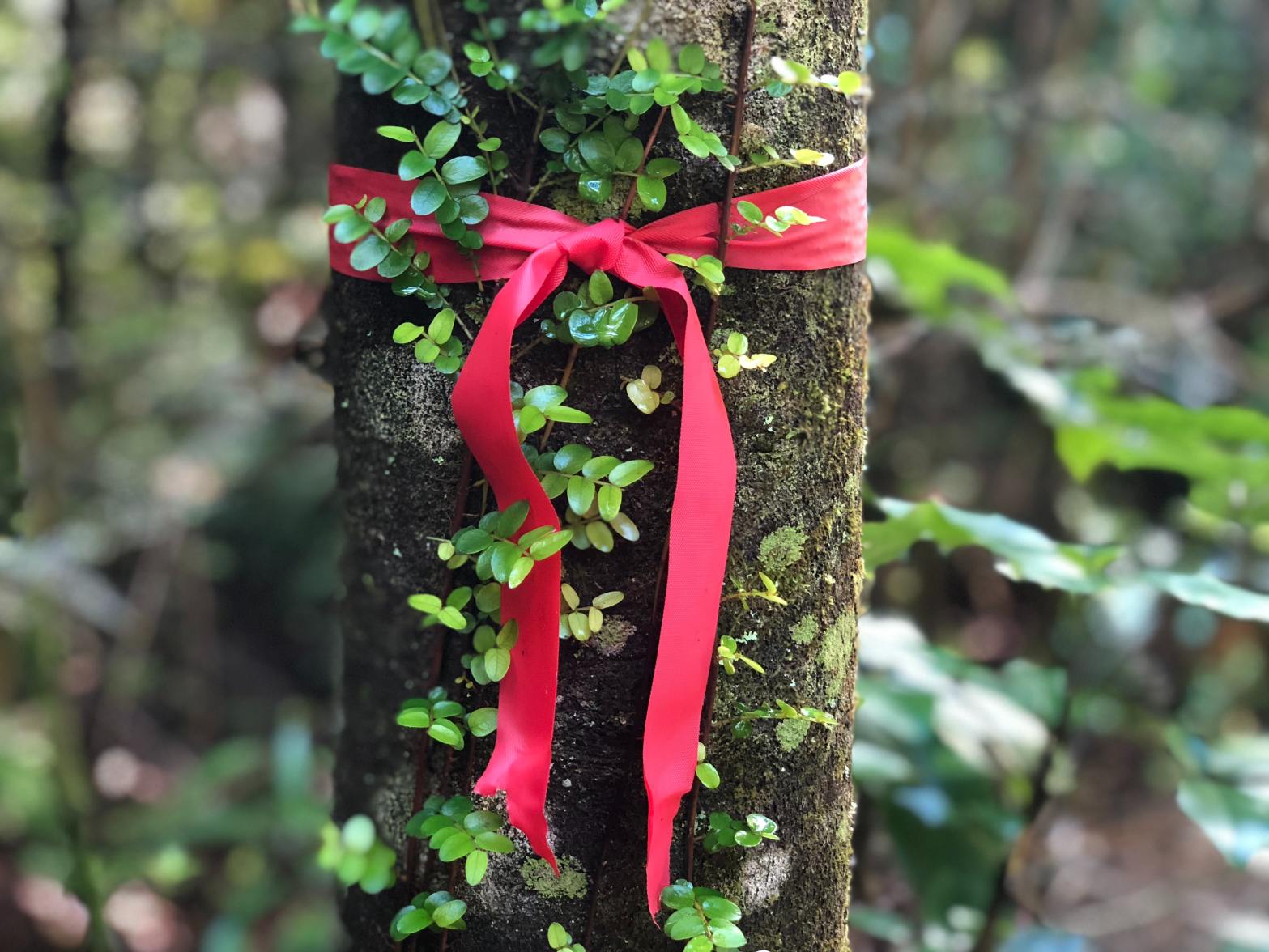
“Are you o.k.?” asked Leonie.  She gently touched the girl on her wrist, which she noticed was tied with a long, red ribbon.

The girl was about the same age as Leonie.  She had long brown hair, big brown eyes, full lashes, and a mouth that was wide and voluptuous.  Leonie thought she was beautiful. 

The girl looked at her.  “Oh, I was lost in thought.”  Her eyelashes scanned Leonie from head to toe, and then she smiled.  “Are you a student at the university?”

“Yes, I am.  I’m on a field trip with my Spanish professor.  This is the last week of classes, and we’re touring around Buenos Aires to learn more about the Argentine culture.  May I ask you why you are here?”

“I’m looking for love,” said the girl, waving her wrist in front of her. 

“I don’t understand,” responded Leonie.

“We have a tradition.  If a girl wants love, she comes to the cathedral and ties a ribbon on a branch of the myrtle tree in the garden, which symbolizes romantic and devoted love.  Soon, she will find a love that will be true and lasting.”

“What a nice tradition.”  Leonie smiled at the girl.

“Did your professor tell you that this church is haunted by its namesake?”

“No. What do you mean?”

“The woman for whom this church was built, Felicia, was murdered.  She was shot in the back by her suitor and died on January 30.  People say that on that day, a woman with a pale face and dark hair, dressed all in white, walks from the garden, opens the door to the church, proceeds down the aisle to the main altar and leaves a trail of tears behind her. 

“That’s such a sad story.”

“Now, Felicia brings love to all the women who request it by tying their ribbons on the myrtle tree.  She has turned her tragedy into positive deeds—bringing love to all women of her beloved city.”

“So, you are going to tie your ribbon on the gate?”

“Yes, to find my love.”

“May I help you?”

“I’d like that. Let’s go.”

The two girls walked out of the church together, smiling and chatting as they went.  Once they reached outside, they walked through the roses in the garden until they reached the myrtle tree.  The brown-eyed girl untied the ribbon from her wrist and, with Leonie’s help, tied it around one of the tree’s branches. 

“Thank you for helping me,” said the girl.  “I believe I will find my love even faster because of your kindness.”

“I was honored to share your dream,” said Leonie. 

“Let’s tie a ribbon on the tree so you can find your love.”

“Oh, I’m not ready for love,” said Leonie.

“That doesn’t matter.  Your love will arrive when you are ready.  Here, I have another ribbon.”  The girl pulled another red ribbon out of her pocket and handed it to Leonie.

Leonie raised her chin back and laughed which sounded like the rise and fall of a musical scale.  “I guess it won’t hurt.”  She chose another branch close to the girl’s ribbon and tied hers around it in a bow.

“I’m happy that you will find love too,” said the girl.  The girl smiled at Leonie, placed her hands on her shoulders, and kissed her lightly on each cheek.  Her eyes shone like topaz.

“I will never forget you,” said the girl, and she walked away, her skirts swishing gently from side to side. 

That night, before Leonie fell asleep, she wrote in her book of affirmations.  She wrote—I provide love to the world.  She looked at the words that she had written and thought about the girl with the full lashes who wanted to find love. 

I must first find out what I want, Leonie thought.  Until I know who I am and what my purpose is, I won’t attract the right kind of love. 

One thing I know.  I know I can provide love to others.  I’ll do this first and then, when the time is right, I’ll let someone love me. 

She turned out the light and dreamt about the myrtle tree and its red ribbons.

Wisdom of the Trees: Chapter 1

Photo by DARIAN PRO on Unsplash

From ancient times, trees have symbolized physical and spiritual nourishment, transformation and liberation.

Chapter 1 – Oak

One more week and she was done.  Graduated with a double major.  College over.  More educated than most of the people on earth. 

And you know what?  She wasn’t going back home, even when this class was over.  Her father had paid for a round trip ticket to Buenos Aires, but she was going to cash it in and stay.

This was her chance to really be independent, to find out what her values were without her father’s advice about this job or that apartment, this guy or that outfit. 

She missed her mother though, but her mother wasn’t at home anyway.  When Leonie was supposed to be having the time of her life in college, her mother had contracted breast cancer.  After three surgeries, six months of chemotherapy that sapped her effervescent energy, and twelve weeks of radiation that burned her skin red, the cancer came back. 

Just before she passed away, Leonie and her mother had sat under the oak tree in the back yard, the shadows of its branches spreading like arms across the grass. 

“I can’t lose you, Mom.”  She had wept beside her mom, the shade of the giant tree darkening her tears like black pearls.

“You won’t feel the same, but you’ll never lose me.  You’ll just have to learn how to live with me differently.” 

Leonie had felt so confused.  She stared at her mother’s face so that she could remember it—her gray-blue eyes, silky skin, a mouth that always held the hint of a smile.  She stared deep into her eyes, holding on, wishing for more time.

“I’ll be with you,” said her mother.  “I’ll guide you from a new place, a place you cannot see, but that is nevertheless powerful.  You’ll feel me.”

Leonie clutched her mother’s hand.

“I want you to find your inner strength.  Emulate this oak tree.  Every time you feel weak or lost, visualize yourself as an oak tree, rising strong, spreading wide, enduring challenge and finding the sun.  You won’t be alone because I’ll be beside you, breathing my love into your heart.”

“But I won’t see you.  You’re my inspiration.  I’ll be lost without you.”

“My love will remain here.  When you can no longer physically see me, you can find other women to inspire you.  Choose many, in fact.  One to follow for leadership skills, another to learn the art of love, and another to learn how to live with joy.  She may be one of your professors, a co-worker, a girl friend, a friend’s mother, or a woman you meet only one time in your life. Whatever you wish to be, you can find a woman to inspire you.”

“How can you be so strong?  You’re dying!”

“I’m content because I know that I will continue my life in another form.  My spirit is not dying.  My soul will continue, and I’ll grow from its future experiences.  I have many things to look forward to.”

Leonie remembered this conversation as she held her mother’s ashes six months later, secured in a pearlescent urn shaped like a heart.  Leonie kissed the top of the urn before placing it in the niche at the cemetery.   “Enjoy your journey, Mom,” she whispered.

Later, as she sat in the back yard next to her mother’s chair, Leonie thought she heard her mother’s voice.  No, maybe it was the breeze rustling the limbs of the oak tree instead. 

“My journey will be right alongside you,” said the breeze.

Staying focused on her studies was impossible after her mother’s death, but her girl friends had helped, and then Leonie decided to go overseas for a change of scenery—a much needed distraction that she needed to survive.

So now, she was in Buenos Aires and hungry.  She lived in a shabby dorm room in the basement of the university and tutored students in English to make money, but it wasn’t enough. 

Leonie searched through her backpack for something to eat: an empty plastic juice bottle, a paper envelope from the bocadillo she had for lunch.  She poked her fingers deeper.  Something waxy.  She grabbed at it and pulled out an apple, a little bruised, but it was food.

The next morning, Leonie woke up with a growling stomach and the sound of traffic.  Engines racing, horns blaring, and brakes squealing invaded her tiny room through the high window that wasn’t even big enough for her to crawl through.  Leonie grabbed her shampoo and towel, opened the door, and paced to the single shower room. 

Whew!  It was empty.  The water felt refreshing on her wet head, rinsing off the humidity and sweat of her body from the sweltering night.

Today, she was going to meet a friend that she had met in her Spanish class.  Clarissa was a native Argentinian and Leonie wanted to ask her about traveling throughout the country. 

Upstairs in the dormitory lobby, a canister of coffee stood on a table next to a large blue box of sweet pastries.  Leonie poured the thick, viscous liquid into her own mug, stuck a pastry between her teeth, and whisked out the door.

Clarissa was sitting at a table in the corner of the café with her laptop open when she arrived.  A cup of mate steamed to the right of her computer, Clarissa wildly typing on the keyboard.

“Hey, how’s it going?” asked Leonie, grabbing the back of the chair opposite her, scraping it across the floor, flinging her backpack over a post, and sitting down.

“Hey,” murmured Clarissa, finishing a sentence.

“You know, this Spanish class is my last college class, and I’ve got to figure out what to do with the rest of my life.  I feel lost without my mother, and I don’t want to go home without a plan.  I don’t even know if I want to live there anymore.”

Clarissa picked up her mate, sipped it, and looked up at Leonie. “I suggest that you travel and meet as many people as possible.  They’ll give you new ideas, and you’ll learn that you have endless options,” said Clarissa.

“That does sound good,” said Leonie.  “How should I start?”

“Just go,” said Clarissa. “Don’t think too much.  Don’t plan too much, but be ready to make your trip work each step of the way.  I’m emailing my sister.  She works at the Belmond Hotel, a few miles from Iguazu Falls.  Maybe she can get you a free room.  Iguazu Falls is one place you should go!”

“Oh, I’m so nervous about traveling by myself.  Maybe I’ll just stay here,” responded Leonie.

“Oh, no you won’t,” said Clarissa. “You’re going, and that’s that.”

“We’ll see,” said Leonie.  I have a whole week of classes left.”

“Yes, a whole week to build up your courage and begin your new life.”

Hidden

Photo by Anton Darius on Unsplash

Sylvia had a secret.  One that rolled around in her stomach like a marble in a maze, bashing against the walls until they bruised, swirling her energy into anxiety.

Sylvia’s friend Ruth told detailed stories about how her mother psychologically abused her during her teenage years.  When they were cleaning out her grandmother’s house after her death, Susan had wanted her grandmother’s wooden chest full of yarn.  Her mother refused to let her have it, and, instead, gave it to Susan’s older sister who didn’t even knit.  Susan wondered for decades why she wasn’t good enough to have such a treasured keepsake and why her mother had favored her sister over her.  Ruth told everyone about the hurts in her background, but she still walked around like a broken doll, permanently damaged, as if nothing could ever erase the scars she had suffered.

When Ruth talked about her feelings, Sylvia flashed her own memories across her mind about how her father had favored her sister over her.  “Isn’t she beautiful,” she remembered he had said.  Sylvia had looked in the mirror countless times wondering why no one ever called her beautiful.  She had clear skin, thick hair, blazing green eyes.  Weren’t green eyes as pretty as blue ones? 

Her friend Paul had told her about how his father was never around.  He never played sports with him, never sat with him on the couch for a game of chess, never even got to his high-school graduation until Paul had already walked across the stage and waved to his mother who was frantically waving back with both hands, as if she was waving for two.  Even today, Paul’s father didn’t act like a father, but like a distant friend who sent him an article once in awhile about a topic that never related to Paul’s life.  Paul had worked hard to build self-confidence, but struggling with a narcissistic father made that an up-and-down journey.

Sylvia’s friend Jen talked about her childhood, too.  She told Sylvia how a sixteen-year-old neighbor boy had raped her when she was eleven, luring her into his backyard shed one afternoon and slowly removing her clothes while he talked to her about the different birds in the garden.  Jen said that it was therapeutic to talk about it after so many years of keeping it hidden.  At first, she was embarrassed that it had happened to her.  What did she do to encourage that boy anyway?  Why did she let him get her into the shed by herself?  Didn’t she know better?  Sylvia didn’t see how Jen had let go of the trauma if she still had all these questions in her mind.

When Jen talked, Sylvia nodded empathetically: “It wasn’t your fault.  He took advantage of you.  He was stronger, and you couldn’t have stopped him.”  Inside her chest, however, Sylvia carefully drew a curtain in front of her own heart, shielding it from the memory of her own secret, stopping her from the minute-by-minute re-enactment of the scene, her shame, her acquiescence, her fear of exposure. 

Sylvia didn’t want her friends to know she had suffered so much, had been irreparably violated.  Maybe someone would use the information about her secret as revenge if they ever got angry at her.  They would expose her in front of people she didn’t trust, and she would endure more embarrassment than she could handle. 

Sylvia had spent years searching for her own self-esteem, her worthiness to be loved, her value as a treasured friend, her worth as an employee, her right to be happy at all.  She thought that she should go talk to someone about her secret so that she could get it off her chest.  Would that even work? 

Finally, she made an appointment with a female minister at a church she did not attend.  She told the woman about her secret, and asked her what she should do to heal from it.  

“First, ask God for forgiveness.  God will forgive anyone, even if you can’t forgive.  Once, you’re comfortable that God has forgiven you, then forgive yourself and anyone else involved.”

Sylvia had worked on forgiving herself and the other person involved for years.  Nevertheless, the memories, surfaced again and again like a nightmare when she least expected them.  Sometimes, she even invited them into her thoughts as if she could purge them out of existence by focusing on them one last final time. 

Nothing stopped the nightmares.  They came while she was sleeping in a vivid stream, and her fear rose incrementally during the dream until she would awaken all of a sudden, gasping for breath like she had been under water the whole time.  Her forehead was drenched with sweat, her heart tight with shame.

Sylvia did feel the pain of her friends, and because she did, she could listen to their stories and offer some solace just by suffering with them.  She also understood the pain that her students told her about. 

Samantha was a student in Sylvia’s college composition class.  Samantha’s mother had kicked her and her three-year-old daughter out of the house, and, now Samantha experienced anxiety that interfered with her performance at school.  Sylvia had counseled Samantha through several episodes of anxiety, and she had passed her English class in spite of her mother.

Van suffered from post-traumatic-stress-syndrome ever since he returned from Iraq, and his significant other left him right in the middle of the semester.  Since Sylvia knew what anxiety and poor self esteem felt like, she coached Van step by step until he, too, passed his writing class.

So many of her community college students needed emotional support in order to pass their classes.  Owen’s father beat him.  Misty lived with five family members in a noisy, two-bedroom apartment.  Monica’s parents wanted her to get married like a dutiful Islam daughter and give up going to school.  Randall had spent two weeks living out of his car during the semester until his uncle let him live in his garage. 

Sylvia knew that if she put in more effort to help these students, they could succeed and improve their lives through education and awareness of other opportunities.  Yet, sometimes, as Sylvia sat beside one student or another, she felt like a broken human being trying to help another broken soul.    

Was it true that people who never felt loved died of heart attacks?  Most mornings, she woke up with a tight chest.  She lay in bed breathing in and out of her nose until her chest relaxed a little, but the tightness never fully went away. 

Most people had a secret, didn’t they?  Weren’t most people walking around, hiding their secrets underneath their shirts, their polite manners, their rudeness, their abusive characters, their anxiety, their bullying, their surrender, and their repeated attempts at survival?

Yes, they were, Sylvia knew.  She was, too.  She had endured so many scars and affronts to her character, yet here she was, carrying her secret around like a satchel of wisdom.

Really, she thought she deserved a medal.

The Imagination Grandpa Story 1: The Clock Man’s Wise Clocks

Photo by Ella de Kross on Unsplash

Instead of going to Third Grade, Rosie was in a hospital bed with tubes connected all over her body.  Rosie’s heart had a problem and the doctors took her into an operating room one day to fix it.  Now, she had to lie down in bed all the time, and she couldn’t play.

The day after the operation, Grandpa Joy came in to visit Rosie.  He wore his blue jean jacket that had lots of pockets.  When he came in the door, he took off his beret and placed it on the table beside Rosie’s bed. 

“Should I tell you a story?” he asked.

“O.K.” said Rosie.  She was so bored just lying in bed. 

Grandpa started his story. 


Once upon a time, an old man owned a clock shop.  The shop was a huge room, and clocks covered every inch of the four walls.  He had clocks with black hands, silver hands, gold hands, and bronze hands.  Some clocks had round faces with 12 birds to mark the numbers.  Some clocks were carved out of wood with long pendulums hanging from the clock faces all the way to the bottom of the cases.  On one wall, a whole line of coocoo clocks hung silently, their birds frozen in various stages of entering or leaving through the coocoo doors. 

In the middle of the great room, large trunks were propped on their sides, and, against these great boxes, grandfather and grandmother clocks leaned silently.  No ticking escaped from their chambers because all the them were broken. 

In fact, all of the clocks in the whole store were broken and quiet.  The only noise in the vast room was the scratching from a mouse family that lived inside one of the walls and came out whenever the old man dropped crumbs and bits of cheese from his sandwiches.

One day, a young man came in to buy a clock.  He smiled at the old clock seller when he opened the creaking door and walked right up to the counter.  This young man wanted a clock to give to his wife for her birthday

“What kind of clock should I buy for my wife?” the young man asked. 

“Well, a grandmother clock might be nice,” said the old man.  I have several of them leaning against these big trunks.  Which one do you like?”

The young man hemmed and hawed.  He tucked his first under his chin and looked at the clocks with big eyes.  He peered into the clocks’ faces, and inspected inside the glass doors that held the pendulums. 

“I like this one,” the smiling man said.  “but it doesn’t seem to be working.”

“All of these clocks are broken,” said the old man.  “I get them from people who no longer want to fix them, and I save them until someone new comes along that will appreciate them.  Some of these clocks are over a hundred years old.  When someone wants to buy one, I fix it until it works perfectly again.”

“Is an old clock be better than a new one?” asked the young man.

“I’d say so,” said the clock man.  “Old clocks have seen so many years go by.  They’ve watched girls and boys fall in love, lovers get married, babies being born, Christmases and Easters and Passovers celebrated.  And as they’ve watched these stories, they’ve saved these memories as wisdom to pass onto their next owners.  A new clock is just a metal face or a wooden box, but an old clock is a treasure chest of life.”

The smiling man stood in thought for a long minute, and then looked straight into the clock man’s face.  “Well, someday my wife and I would like to have a family, and we’re going to need a lot of wisdom when we do.” 

He peered again into the Grandmother clock standing next to him.  Her face shone like mother-of-pearl and the numerals glistened in the tiny spotlights that hung from the ceiling.  The face was set into a rosewood box and the rose-bronze pendulum matched the numerals.

“I’ll take this one,” said the smiling man.  “My wife will not only love how beautiful it is, but she’ll also love the stories that come with it.”

So the clock man fixed the clock.  He bought new wheels and whirs and inserted them behind the face so that the hands of the clock started moving and the pendulum swung gently from side to side.  He rubbed the face until it shone like a pearl and the rosewood until it gleamed like a shiny chestnut, and he cleaned and dusted every part inside and out.  One week later, the clock was ready.

The next day, the smiling man came into the shop.  With him, he brought a pile of blankets.  He looked around for his clock and his eyes found it standing under a single spotlight, glistening like a mermaid in the sun.

“My wife is going to be so happy,” the smiling man said.  “I can’t wait to get this home.”

The two men helped each other wrap a small blanket around the pendulum inside the clock case.  They covered the outside of the clock with more blankets and tucked the blankets securely so the clock wouldn’t get broken.  Then the smiling man paid for the clock and carried it out the door, his eyes shining like buttons. 

For a whole year, the clock man ate his sandwiches inside his clock shop where only his silent clocks kept him company.  Every day, he dropped crumbs and cheese bits from his sandwiches, and the mouse family darted into the room to pick them up, then rushed back to the hole in the wall. 

People came in to give him their old clocks, and other people came in to buy one of the broken clocks.  The man worked hard to make the clock customers happy, but he was lonely.

Then one day, the smiling man opened the creaking door and stood back.  Inside walked a young smiling woman holding a baby in her arms.  The smiling man walked in behind her.

“I want you to meet my family,” said the smiling man.  “This is my wife Sharon and my new daughter Rosie.”

The old man was so surprised that, at first, he couldn’t speak.  He just stood by the counter and opened and closed his mouth like a goldfish for several long seconds.

“I’m so happy to meet you,” he finally uttered.  “Did you like your birthday present?”

“Oh, yes!” replied Sharon.  “My birthday clock is so beautiful that it inspired me to name our new daughter Rosie, like the beautiful rosewood and the mother-of-pearl face.”

The clock man beamed like a shiny copper penny.

“You were right about old clocks,” said the smiling man.  “Sharon’s clock not only inspired us to name our daughter, but it also reminds us to sing every hour, and that makes us happy.”

The old man’s face lit up like a flashlight.

“Would you mind if we visited you once a week so that Rosie gets to know you and learns about your shop of wise clocks.

The clock man looked around his clock shop as if he had never really looked at it before. These clocks were all potential friends, he thought. Then he looked back at the rosewood clock family and knew then that he’d never feel lonely again.


Grandpa was finished with his story, and Rosie looked up at him with shining eyes.

“That was a wonderful story, Grandpa,” she said.  “That baby had the same name as me?  Was it a true story?”

“No, Rosie.  I used my imagination to make it up.  Of course, the idea for the story is true.”

“What do you mean Grandpa?”

“Well, I wanted to tell you a story that started with you, and so I told my imagination to use your name to invent one.”

“Oh, I like that Grandpa.  That makes me happy.”

The Grandpa kissed Rosie’s cheek and tucked her blankets around her.  “When I come back tomorrow, I’ll tell you another story,” he said.  “Meanwhile, you can use your imagination to keep you company until your next visitor comes.”

“O.K. Grandpa.”  Rosie snuggled into her blankets and feel asleep a few minutes later, her face glowing . . .

Retirement Richness: Project Self

Photo by Sherise VD on Unsplash

For about a year before I retired, I kept asking everyone for ideas about what I should do to keep busy, to stay active, to find purpose during retirement.  I thought about working for the local food bank, reading with children in Oakland schools, or volunteering to work at one of the county libraries. 

Many people think they need to fill their retirement with activities.  One retired nurse I know still rushes through her day trying to fill up every minute.  She volunteers at the local hospital for three hours a week, sews quilts and activity blankets for seniors, takes walks, and feeds the birds.  Yet, whenever she gets tired of these activities, she searches hectically to figure out what to do next. 

For those who truly loved their careers, like many teachers and nurses I know, retirement is an especially challenging transition.  I taught English to college students for 16 years.  I’m proud of my growth as a reading, writing, and critical thinking professor and of my unique ability to inspire and educate students of all backgrounds and skills.  My job gave me tremendous purpose and fulfillment. 

To retire is to rest from the frenetic pace which a career often requires.  Engaging in activities just to stay busy defeats its purpose.  Instead, retirement’s purpose can blossom from the time available to reflect and explore new life paths. 

After thinking long and hard about what my retirement purpose could be and by consulting advice from a variety of sources, I am now content in what my purpose for retirement will be; my primary purpose is now ME.

This goal may sound a little selfish to those who have strong feelings about doing charity work or participating in volunteer activities.  Many people judge their own worth mostly by how much they give to others; however, if people ignore their own psychological well-being, they can’t offer their best self to others.  Their volunteer work will be marred by feelings of stress and anxiety.  Instead of leaving those they serve with better peace, they could even raise the anxiety levels of the people whose lives they hope to improve. 

Focusing on the Process

Since my retirement is a brand-new phase of my life, I knew that I had to treat it as a process of discovery instead of expecting to know right away how to spend my retirement years.  If I had assumed that my retirement would just “happen,” I would have been sorely disappointed.   

The first thing I had to do was to avoid filling my days with busyness.  Each day, I chose to do projects that make me happy.  My own happiness is my primary goal since I know that, if I am happy, I will naturally share this joy with my family and community. 

Thinking of retirement as a process gives me permission to be patient and to let my life unfold in a natural progression.  It also gives me freedom to try new activities that I hadn’t previously thought of because I was so tenaciously focused on trying to be “retired with purpose.”

Viewing retirement as a process empowers me.  Because I don’t assume I have to know how I will spend the rest of my life, I don’t stress about not having all the answers.  I don’t expect to know what comes after today.  I only know that what I do today will lead me to more knowledge about what I value and more opportunities; every day, I achieve personal growth and this growth teaches me what is possible next.  I take confidence in my baby steps and know that my staircase has no last stair. 

Re-evaluating Values

I’ve discovered that the voices in my head that drove my career and previous life are no longer all relevant.  My new role in life, focusing on myself, encourages me to discard old “rules” that were given to me by my parents or previous bosses.  Why?  Some of those old rules don’t allow me to explore my true potential.  I know retired people who have adopted a new spiritual focus by discarding the religion taught to them by their parents.  Others have become creative for the first time by learning how to arrange flowers or paint in watercolors, activities far different than their careers.  I am re-evaluating everything, and I feel great. 

For example, I have decided to write short stories because I love fiction and think that it is one of the highest forms of creativity.  I also walk and perform yoga which both help me feel healthy.  When I finish one activity, I sit down and carefully choose my next one so that I don’t get caught up in mindless activity.  I focus on the present with each activity, knowing it is enough and is leading me to a greater, happier self.

Releasing Negativity

I don’t want to be a crabby old lady who chases people away with her bitterness and narrow mindedness.  I don’t want to act like a nasty old man that can find nothing positive in what others do because he can’t find his own joy.  I want to cultivate joy within myself that will naturally touch others.

Sometimes, in order to build self-joy, a person must eliminate the negative energy of others or of negative activities that threatens to usurp their joy.  I’ve chosen to to gradually eliminate anything or anyone that negatively affects my life.  Since I don’t want to injure my knees or ankles, I only walk for as long as I am comfortable, and I never compete with others.  I also set firm boundaries to prevent negative people from affecting my growth and joy.  I take no responsibility for their development, only mine.

Measuring Growth

Since my retirement project is a process, I’ve found ways to measure my growth to witness progress.  Here are some examples.  Whenever I walk, I use an app on my phone to measure my steps and distance.  I set rewarding goals for each day and observe how much I achieve per week.  In my writing, I post my short stories and articles on this blog to feel “published” and to keep track of my accumulated posts.  I also keep another blog for posting recipes that I create.  When I garden, I take time to admire new plantings or newly pruned hedges.  I observe and enjoy my growth on a daily basis or even several times a day.

Retirement truly is the gift of time to discover how life can be joyful, but a person must intentionally focus on achieving peace within themselves if they want to attain the greatest version of themselves.  What better way to do this than to make my biggest retirement project all about me.