
Too Many Goulash Gourmets

About 40 minutes by bus from Budapest, Hungary is a colorful town named Szentendre. Situated right on the Danube River, this village is laid out over cobblestone streets where brightly painted storefronts and houses offer tourists charm and entertainment.

While we were visiting Szentendre, our tour took us to the Szabadtéri Néprajzi Muzeum (The Hungary Open Air Museum), established in 1967, to illustrate the typical country life of Hungarian folk.

When our group of about 30 people arrived, the museum’s guide gathered us around long wooden tables, arranged under a wooden pavilion outside. A tiny fire was burning in a pit near the front of the pavillion, and, on the flame, rested an old dented black cast iron pot.

A guide, dressed in old jeans and a button-down shirt with holes in the elbows, sauntered up in front of the group with his hands deep in his pockets. “My name is Taksony. I’m going to supervise you in cooking a pot of the national Hungarian dish known as goulash.” He took his hands out of his pockets, grabbed a thick gray potholder, lifted the cast iron pot off the fire, and set it on the dirt in front of him.

I hadn’t washed my hands when I got off the bus. No one had, and we were going to cook something? I wrinkled my nose.

“The word goulash,” he said, “comes from the ancient Hungarian word gulyás, which means herdsmen or cowboys. People out in the country made goulash from whatever beef, vegetables, and spices they had on hand. Since paprika is widely grown in Hungary, it became the favored spice for the dish.”

Each person had a knife on the table in front of them. Mine was a small paring knife with a worn wooden handle and dull blade. I thought about the sharp knives I had at home to slice, chop, mince, and quarter my vegetables. This frail little blade didn’t look too promising. I looked over at the knife in front of my husband. His was longer than mine, but so skinny that it didn’t seem to be useful either.

Girls in gathered skirts wandered around the long wooden tables and gave each of us a vegetable to chop. I was given a tomato and my husband was given a pepper, the likes of which I’d never seen at home. Our vegetables sat right on top of the wooden table tops, which contained knife marks from hundreds of lessons in making goulash. Was this sanitary?

By the time we all got our vegetables—onions, tomatoes, potatoes, or peppers—the guide was cutting off a piece of lard into the cast iron pot.

“I’m going to brown the beef first.” He put the pot back on top of the fire and the lard sizzled as it heated up.

“Who wants to be an assistant?” Taksony asked, and he pointed to a man from our group who was over six-feet tall and wore a grin that lit up his face. “What’s your name, sir?” Taksony asked him.

“Richard,” said the man with the bright grin.

“I need you to dump these cubes of beef in the lard and stir them until they get brown. Don’t let them burn!”

Taksony gave Richard a long-handled wooden spoon and the bowl of beef. We watched Richard dump the beef into the pot and jump back as the lard hissed and sputtered. He began to stir.

“What’s your name, miss?” Taksony asked a sixty-year-old woman in a yellow sun dress. He waved her up to the front next to Richard.

“Carol,” she said, biting her lip. Her hands were tightly clenched in front of her.

“Carol, here’s the garlic and paprika. Please count out six cloves of garlic and put them in the pot. Take the paprika and spoon in 4 heaping tablespoons.”

Carol bent over the bowl of garlic that Taksony was holding and counted. She tossed six heads into the pot. He handed her the canister of paprika and a measuring spoon. She pried off the lid, gave it to Taksony, then heaped the dark red powder onto the spoon four times and tipped it into the mixture.

“The meat is burning, Richard! Here, take it off the fire with this.” Taksony gave Richard the pot holder. Richard lifted the pot by its handle and placed it on the ground.

Taksony bent over the pot and whistled. “Saved it. Now keep stirring,” he said to Richard. “Carol, you can go back to your table.”

The guide looked out at all of us. “O.K. Cut your vegetables into slices.

I took my old paring knife into my right hand, the tomato in my left hand, and attempted to slice it. The blade barely made a mark in the tomato’s skin, it was so dull, but I persevered. Finally, after using the point of the knife to poke holes into the skin, I managed to create slices, the juice of the tomato oozing into the wood of the table top.

My right-handed husband was holding his knife in his left hand and staring at his four-inch yellow pepper as if it were a venomous snake. His giant basket-ball-sized hands floated in the air in front of his chest.

“Cut it,” I said.

“I don’t know how,” he said. “A deep furrow appeared between his eyebrows. “This is a knife. I only know how to use a microwave.”

“You can do it,” I replied as sweetly as I could manage while thinking what a complete idiot he was.

His hands kept floating in front of his chest like he was swimming the dog-paddle.

“No. You do it for me, honey. You’re so good at cooking.” He gave me his knife and rolled the pepper towards my tomato slices.

“Fine,” I said, looking quickly around to see what all the other men in our group were doing. I didn’t see anyone else handing his knife over to his wife. They were all bent over their tomatoes, onions, potatoes, and peppers and diligently stabbing their food with worn-out knives. Geez.

I admired the four-inch little pepper before attempting to cut it, and then used my husband’s skinny little knife to slice the pepper into several rounds. I didn’t remove the seeds since no one had mentioned anything about that. When I was done, I used the knife to push the pepper slices back over in front of my husband. Nobody seemed to notice that we cheated.

The girls in long, gathered skirts came to each of us and scraped our vegetables off the top of the wooden tables into large bowls. They took them over to Taksony who ladled them into the cast iron pot and placed it over the fire again. 

“Richard, keep stirring.” Richard bent his tall frame over the smoking fire and stirred the vegetables into the meat mixture. I could smell the toasty aroma of the paprika as he stirred while I thought about all the germs swirling around the spoon.

“This is going to take awhile to cook,” said Taksony, so you guys can go wander around the open-air museum to see what a country village in Hungary once looked like. Come back in forty-five minutes to eat lunch.” He waved his hands to shoo us out of the pavilion.

Wiping our hands with the little sanitary wipes we were given, we wandered out into the dirt roads to view the church, the mill, the knitting house, the store, the bakery, and the cottages where villagers lived. Since we were all hungry, however, in forty-five minutes, we were back in the pavilion ready to eat.

Taksony showed us into a room filled with newer wooden tables with benches. We sat down side by side and poured lemonade into our glasses from pitchers on the table. The girls in the swishing skirts brought baskets of coarse bread and placed them in the center of the long tables, one basket at about every two feet. Then they carried steaming bowls of goulash in flat bowls and placed them in front of each person. My mouth watered as I hoped that all the germs in the pot had evaporated in the heat. I squeezed my eyes shut.

Heat did kill germs, didn’t they? I hoped so. Nevertheless, I thought I’d ask a question.

Taksony was standing at the front of the room watching the girls bring out the bowls of goulash. I raised my hand. He nodded at me to indicate I had his attention.

“Are we eating the goulash that we made out in the pavilion?” I asked, trying not to wrinkle my nose. I glanced down at my bowl, trying to reassure myself that the cooking process had surely eliminated any dangerous microorganisms.

“Oh, no!” said Taksony, chuckling. “We gave that pot to the pigs.”

“Thank goodness,” I said, dipping my spoon into the delicious-smelling concoction in front of me. I immediately imagined the pigs eagerly scarfing up the national dish of Hungary. I bet they liked it.

The Kashubian Warriors of Winona

Even the sweetest human being contains a little bit of wickedness, and the most awful person possesses at least a little goodness.  This is because each person is made from a complex collection of DNA that has been blended over and over again, generation after countless generation; furthermore, these durable genes have survived a variety of political systems, religions, geographic locations, war, peace, cruelty, and kindness—all of the experiences of their ancestors. 

One day, when I visited the Polish Museum in Winona, Minnesota, I saw a photograph of one of my ancestors, Lawrence Bronk.  I thought I was looking at a photograph of my father—a man of fine build, blonde hair, and handsome face; however, Lawrence was the brother of my Great-great-grandfather Ignatius, and he immigrated to Winona, not from Poland, but from Kashubia, a place that bordered the Baltic Sea. This man inspired me to find out just who these Kashubians were and what made them Kashubian instead of Polish.

Not only did I research the immigration of the Kashubians to North America, but I also investigated how the Kashubians settled in Kashubia.  What I found out was that I was related to people who had lived complex lives of peace, aggression, oppression, and chaos throughout the centuries.  This is their story.

After the Roman Empire dissolved in the 6th Century, Slavic tribes from the East, mainly from the Ukraine area, migrated north into Russia, west into what is now known as Germany and Poland and the Czech Republic, and south into the Adriatic Region.  These were distinct from the Germanic tribes that had migrated from Scandinavia into the Roman Empire starting in the 4th Century.

The Kashubians were a Slavic tribe that settled in Eastern Europe on the coast of the Baltic Sea at that time.  Specifically, they claimed a region of land that was south of Sweden, north of Poland, east of the German homeland, and west of Lithuania.   Their ancient territory stretches from the Kashubian capital city of Gdansk to as far as the German Capital of Berlin. It lies between the Odra River to the west and the Vistula River to the east. The whole north side borders the Baltic Sea.

During the migration, the Slavs became a nuisance to the Byzantine Empire, which was really the eastern part of the Roman Empire that lasted for a thousand years after the fall of the western Roman Empire.  Since Slavs were an adaptable species, they learned how to use the weapons of those they conquered and attacked cities instead of trade routes. 

These pillaging Slavs believed in nature, and they had adopted a mythology consisting of a pantheon of gods.  Their shamans were known for telling great tales about their gods, and the Slavs traditions and way of life were developed from these tales.  

The Byzantine rulers wished to calm these robust terrorists, so they ordered two scholars and brothers, Cyril and Methodius, to educate the Slavs in the Glagolitic alphabet, which was closely connected to the teachings of Christianity.  This is how Kashubians and other Slavs became Roman Catholics. 

When the Byzantine Empire ended, the Slavs created Slavic kingdoms across Eastern Europe, effectively squelching the influence of the Mongol tribes who wished to spread their Muslim religion. 

The Kashubs were also called Pomeranians, which translates to “the people by the sea”. When they settled by the Baltic Sea, they spent many years isolated from other Slavs and peoples.  This allowed them to develop their unique Kashubian dialect and create their own traditions, folklore, music, dance and cuisine. Their access to land induced them to become an agricultural people, farmers who worked the land to provide for their families.  They organized their smallest community structure into Catholic parishes, and their lives centered around their religion. 

Eventually, the German Empire encroached upon the independence of the Kashubian people, and Kashubia became part of Prussia.  Their German rulers forced priests to say Mass in German instead of the native Kashubian language, and the Kashubians strongly resented this.  Farmers had large families so that children could help work the land, but when these broods of children grew into adulthood, there wasn’t enough farmland for them to farm; therefore, the German government offered Kashubians free or cheap travel to North America where homesteads and land were abundant.

On May 14, 1859, three sailing ships left Hamburg, Germany for Quebec, Canada, carrying a host of Kashubian families.  The names of the ships were the Laura, Donau, and Elbe.  The river that connects Hamburg to the Baltic Sea is the Elbe, so the ship named Elba was likely named after this river, a common German practice for naming ships.

On board the Elbe were families with the surnames of von Bronk, Galewski, Kistowski, Konkel, Libera, Piekarski, Platowna, Rzenszewicz (Runsavage), Walinski, who knew each other in their homeland.  The records of the ship were posted in German using Prussia as the land of origin; however, Kashubians never did consider themselves German. 

My ancestors on the Elbe consisted of the Joseph and Francisca von Bronk family, including their five sons—Johann, Ignatz, Vincent, Lorenz, and Jacob.  Von is a German preposition meaning “from,” so this label indicates they came from a place called “Bronk.”  In the Kashubian region, there is a forest known as “Bronki” so they may have originated from that specific place.  All of the passengers listed on this ship were classified as “Landsmann,” indicating that they were farmers. 

Joseph von Bronk is my Great-great-great grandfather.  His son Ignatz, who changed the spelling of his name to Ignatius, is my Great-great grandfather mentioned above.  The family left Quebec and traveled south, eventually arriving in the Winona area before the end of 1859.  Many of the families who traveled across the Atlantic with them also settled in the Winona area.  Others stayed in Canada and founded another Kashubian town known as Wilno. 

The Winona area was a lot like their home in Kashubia where there were plentiful forests, abundant water and fishing, and land for farming.  At first, the Kashubians settled on the east side of what is now known as Winona where they established a Kashubian village.  In 1886 after his second wife died, Ignatius bought land in Pine Creek, Wisconsin.  This property is owned by my Uncle David and Aunt Linda today. 

Artifacts in the Polish Museum in Winona revealed that the Kashubians were a literary and creative people.  Many of their descendants have continued the strong story-telling and writing traditions of the culture, including me, for instance.  Their colorful embroidery and distinctive pottery are world-renowned, and their flag and national symbols are celebrated today, not only in Kashubia, but now in the Kashubian communities all over North America. 

Today, in Winona and in the surrounding farms, the Kashubian descendants live in harmony with Polish, German, and Swedish peoples.  They work in each other’s businesses, attend each other’s weddings and baptisms, and share the same merry-go-rounds. 

This is the Kashubian story.  Now this is my advice.  If you have a Kashubian neighbor, laugh at their jokes, never insult them, keep the peace.  A Kashubian is a warrior.  Behind that friendly gleam in his eye, behind her engaging smile is a constitution of ferocity.  Those DNA have migrated over mountains, through valleys, into war, across water, and have survived. 

References:

  1. Larry Reski.  Poland to Pine Creek, Wisconsinhttps://polandpinecreek.blogspot.com/2014/02/elbe-departing-from-hamburg-14-may-1859.html.
  2. Haden Chakra.  The Great Migration and Early Slavic Historyhttps://about-history.com/the-great-migration-and-early-slavic-history/.
  3. Welcome to Wilno. Wilno.com.

A Town Girl on a Dairy Farm

I’m from a town—a suburbia in the San Francisco Bay Area–a place that is less densely populated than a city and bigger than a village.  My town has clean streets lined with sycamore and crepe myrtle trees, houses with front and back yards, barbecues, swimming pools, cabanas, patio sets, and walking mail carriers.  People walk their poodles and Labrador retrievers on neighborhood hiking paths and buy popsicles from the singing ice cream truck that meanders the streets on summer days. 

I own a tidy little home in my town.  Yards with manicured hedges, carefully pruned flower beds, edged lawns.  Clean and tidy. I sweep under my garbage cans each week when I take them out for collection.  My children are grown and have homes of their own, so my house is immaculate too.  I spray my shower down after each use.  I wipe the stove after each meal, and I own five vacuum cleaners, one for each type of vacuuming task.  You get the picture.  I’m a clean freak. 

I decided to visit my relatives in the country this last month.  They live on farms all around the city of Winona, Minnesota, in both Minnesota and Wisconsin. I also am lactose intolerant, and, when I was born, my parents bought a goat to feed me.  My mother grew up in Wisconsin, a state popular for milk and cheese.  Her whole life, she drank three tall glasses of cow’s milk a day, one at every meal.

I wasn’t one of those town kids that thought milk originated in the refrigerator case at the grocery store.  My mother told me where it came from.   After all, she grew up on a farm.  I’m smart enough to know that most milk at the grocery store comes from cows, not goats, almonds, coconut, or oats.  Sorry vegans.

When I visited my relatives in Minnesota and Wisconsin this month, my cousin Scott–a handsome man with a ready smile, who owns a 600-cow dairy farm near Altura, Minnesota, invited a bunch of us to visit his farm.  I didn’t mention to him that I was lactose intolerant since I didn’t want to feel ostracized.  I was confident, however, that his cows would like me just fine.  Really appreciate me, in fact. 

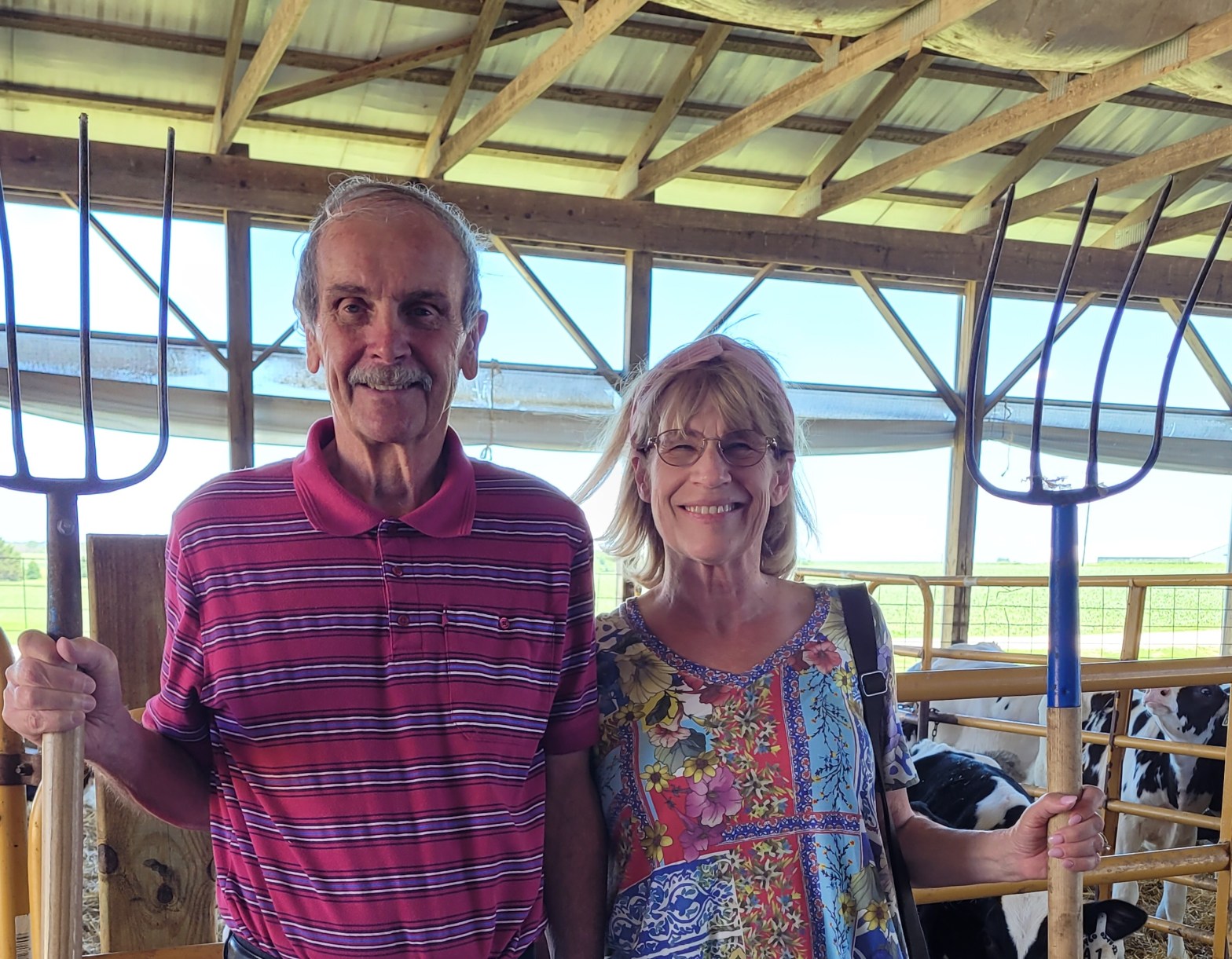
We got to the farm before Scott did, and his workers told us to wait outside.  As we walked through a barn full of teenage cows—some with the cutest faces, we found some pitchforks and posed for a picture like Grant Wood’s 1930 American Gothic painting, except both my husband Bob and I held a pitchfork since we believe in equality.  In Grant’s painting, the farmer’s daughter didn’t have a pitchfork in her hand.  I hate to think what Scott’s pitchforks were actually used for and what debris was on the handles that I touched, but I wasn’t going to pass up a great opportunity for a memorable photograph.

I was wearing a clean T-shirt and skort and a pair of running shoes, knowing that we’d be traipsing around in cow emissions of all kinds.  When Scott arrived, I gave him a cousin hug.  He recoiled away from me, and when I let go, I noticed that his Tshirt was full of dirt stains.  He didn’t want to get me all dirty, apparently.  He had already been at work on the farm the whole morning, and had had meetings with lots of females (cows) who never put on a suit or blouse.  That was a town-girl blunder.  I surreptitiously looked down at my T-shirt and skort to see if I was still presentable. 

I’m not at all a dumb person, but, living in a town, I spend more time thinking about the best hiking trails and restaurants than I do about the biology of animals.  This visit brought my knowledge of cows out of the back room of my brain into my frontal cortex.  I appreciated, too, that Scott was as informative as an agricultural professor at the University of California, Davis where they offer classes in dairy farming. 

The first thing people must understand about milking cows is that a cow has to have a baby before it produces milk; therefore, the process of milking cows takes patience and great skill.  Because the cows have to be impregnated, go through about a 280-day pregnancy, give birth, and then produce milk, a dairy farm is comprised of a fertilization lab, pregnancy dorm, maternity ward, nursery, elementary school, high school, milking station, and milk refrigeration tank. 

There’s a lot to learn about a cow’s life.  About half of the calves that are born are female and the rest are male.  I know this seems obvious, but Scott doesn’t need all those males so this statistic is unfortunate; he keeps a few males for breeding but sells off the rest to beef processing facilities.  What happens there is for another blog post, likely not written by me. 

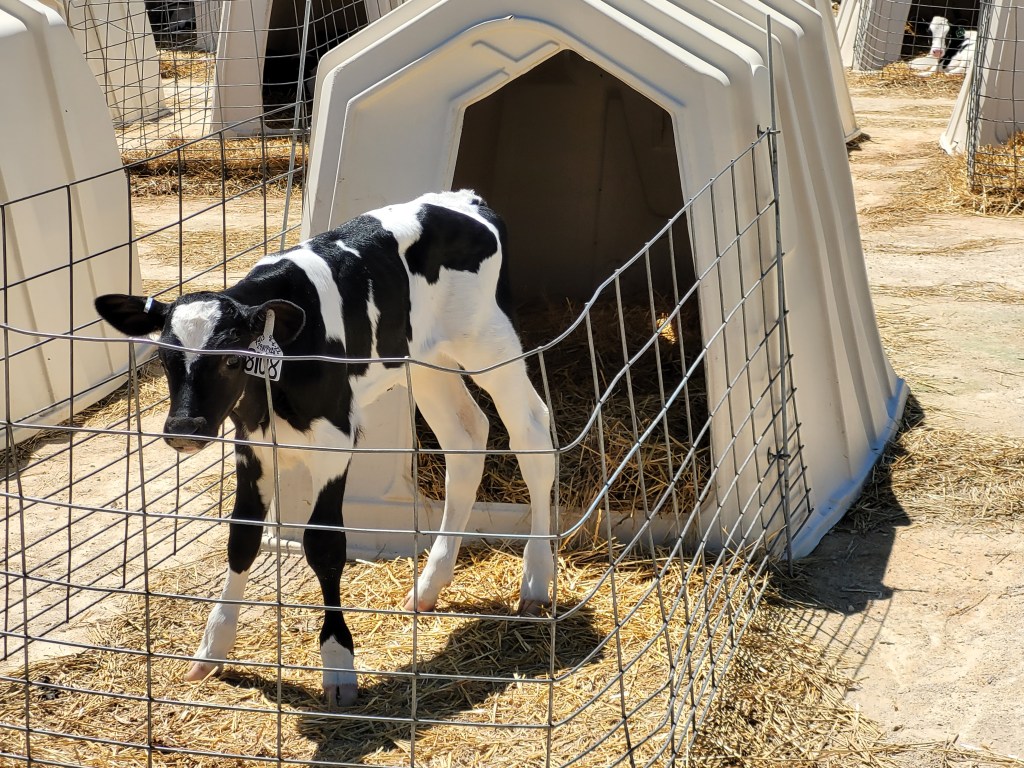
At the back of his property, Scott raises his calves in individual pens, each one living in a domed shelter with food and water.  When the calves get bigger, they live in a barn—organized like a college dormitory—which has an insulated roof and fans that blow constant breezes through the building to keep the cows cool.  The cows are encouraged to spend as much time in the field as they want. I was intrigued that they actually had a choice in this matter; Scott talked about them like they were his valued students.  Their rooms were also much cleaner than most college dorm rooms I’ve visited. 

Pregnant cows also live in a barn dormitory.  A long building that holds several dozens of cows, organized into three rows that run the length of the barn, each row is divided into individual pens filled with a soft bed of sand.  The two outside rows are where the cows stay when they’re inside.  They can either stand up or lay down in the soft sand.  They face out, having access to fresh water and hay.  Their backsides face into the center row through which a stream of water flows, sweeping up the cow manure and any sand that is soiled and discarded by the cow’s movement. 

The dirty water, filled with excrement and sand is processed through a filtering system near some manure holding reservoirs.  The clean water gets recycled back into the barn stream, and the excrements are deposited into the holding reservoir where it is treated and used for fertilizer to grow alfalfa or corn.  A well-thought-out system that truly impressed this town-girl.

So many problems can occur with milking cows.  They can get sick, dehydrated, infected, or overheated—all of these situations affecting their ability to produce high-quality milk.  We saw calves that had spikes put through their noses to prevent them from milking on other cows.  We learned that new babies were removed from their mothers so they wouldn’t milk, and they were given milk that was tested to ensure good health.   We witnessed testing tools, pages of testing data and production statistics.

In the milking shed, the cows are milked twice a day.  They are led into the stalls and encouraged to turn around so that the workers have access to their relevant body parts–teats.  Some milking sheds, Scott informed us, have turnstiles that turn the cows into the right position.  Scott doesn’t have those.  His milk hands push the cows into the correct position, clean each cow’s teats and attach the milking tubes which automatically milk the cows for an average of 20 minutes.  When the milk hand punches the cow’s serial number into the machine on her stall, the machine measures her milk output and adds it to the farm’s data system.  See why math classes are so important.  Everyone uses math. 

Cows are insanely fruitful.  One cow produces about 60 pounds of milk a day—that’s 90 glasses a day for people like my mother.  The milk travels through pipes into a stainless-steel cooling tank that looks a lot like the stainless-steel wine tanks in Napa, California that hold sauvignon blanc or chardonnay.  These dairy tanks are expensive—one can cost from $100,000-$140,000.  What struck me was that the purpose of the tank was not just to store the milk, but to also cool it.  The milk is warm when it comes out of the cow.  Again, I might have figured this out on my own, but, secretly, I was surprised to hear about it. 

I asked Scott whether his farm was considered a small, medium, or large dairy.  “It depends on who you ask,” he replied. “I’m only one of three dairy farms left in the immediate area.  Smaller farms are disappearing due to the rising costs of operation.”

Scott now has a female manager at his dairy.  I can’t remember her name, but let’s call her Laci.  “Laci likes to be in charge,” said Scott. “She also fell in love with my one-in-a-million cow hand, married him and now has a child.”  Scott’s calls this cow hand one-in-a-million because of his excellent work ethic.  Apparently, One-in-a-million is also supremely savvy; he married his boss.

By the time we had toured the whole process, my T-shirt and skort reeked of cow sweat, dust, and hay and the treads on my running shoes were caked with a smelly, nefarious, brown sludge.  I found myself holding my arms away from my body in a desperate attempt to feel cleaner.

Scott invited us into his office where his hound was waiting.  When we sat down, the dog plunked his muddy paws onto my lap and slobbered my skort with drool. First, I looked down in horror, but, then, I quickly composed myself and left the drool alone, trying very hard to adapt my cleanliness obsession into an acceptance of the natural dairy farm environment.

Scott opened his little refrigerator and offered us frozen chocolate treats and push-up ice cream popsicles.  They were certainly welcome after a hot tour of his cow quarters.  I hadn’t had a push-up popsicle for ages, and I tried hard not to drive the whole piece of ice cream out of the tube and onto the floor as I struggled with it. 

Turns out, Scott gave the last part of his popsicle to the hound who licked it up joyfully on the floor.  This helped me relax a little, and when I had just a little of my popsicle left, I shared the rest with Scott’s hound too.  This was a remarkable development, you see, because a town-girl would have never put her popsicle down on the floor for a dog to roll around and lick up. 

That day, on Scott’s dairy farm, I proved that even town-girls can leave the town behind and have a little fun in the country.