
Feeling Better about America after Visiting the South

I just completed a trip to Savannah, Hilton Head, and Charleston and, now, I feel better about the United States. 

During the last six years, the news has plagued viewers with stories about racism, some of which were unfortunately true and others which were sensationalized.  George Floyd was murdered by a police officer who knelt on his neck.  In two different instances, a police officer in my own town killed two men who had mental health problems.  There are numerous examples like this.  Hearing that my country is full of arrogant white supremists who belittle, offend, and abuse minorities does not make me a proud American.  

I wanted to tour these historic areas of the United States because I want to understand the history of this country, not just the white-washed stories that many books divulge, but the complete histories of even the disadvantaged human beings who lived here before the Puritans and the African Americans who were brought here to be slaves on plantations. 

My trip taught me about a different side of Americans.  I met numerous Whites and African Americans who extended great hospitality toward me and my co-travelers.  They helped me make hotel arrangements, dinner reservations, and late-night taxi calls.  One 6-foot, 6 inch African American man, who was dressed in a blue-and-white-striped seersucker suit and a colorful bowtie, drove me to an appointment one day.  On the way, he told me how he met his Russian wife years ago, and, how, they were now best of friends.  I’ll never forget his funny story of how he didn’t even like his wife when he first met her and how his eyes lit up like candles as he told me.

An elderly White woman led a group of us around the city of Charleston, showing us how the mansions had slave quarters attached in back.  She described the opulent lives of the mansion owners, some of whom were plantation owners who came into the city in order to avoid the mosquito-infested plantations during the summer.  She also explained how the slaves had to cook and clean outside in the back yards even during the sweltering summer months.  Her mission, she said, was to tell the history of Charleston so that the mistakes of the past were never repeated.

When we visited the Gullah Geechee Museum in Pin Point, Georgia, a Gullah woman taught us how to sing a Geechee song by stamping our feet, clapping our hands, and singing.  She also shared details about how her ancestors worked as slaves before the Emancipation and then lived and worked at Pin Point in oyster and crab processing plants.  She was confident in her story-telling and proud to share her culture with us.

When we visited the Magnolia Plantation where we viewed slave quarters and a magnificent plantation home, the White tour guide told us that she tells the story of the plantation and its slavery so our country can heal from its lurid past.  At another storied place, the Middleton Plantation, we saw how the family of the owners ate from silver platters while the slaves lived in unheated wooden shacks. 

Every Southerner we met had a story—a personal one or one that had been created from the South’s history—and they all told their stories with clarity and friendliness.  Every community we visited exuded harmony and graciousness.  Most notably, Whites were respectful of African Americans; African Americans were respectful of Whites. 

When people experience harmony and hospitality, their moods improve and they feel better.  I feel better now that I’ve experienced the warmth and kindness of the South. 

A Place for All of Us

Last week, I saw Steven Spielberg’s remake of West Side Story with Rachel Zegler as Maria and Ansel Elgort as Tony.  Rita Moreno, who played Anita in the 1961 version, played Valentina, the wife of Doc, who was the original owner of Valentina’s drugstore. 

This fabulous musical—which whips emotions into a frenzy with enthusiastic dancing and impassioned characters—was relevant back in 1961, a time when racism was high in the United States.  For goodness sakes, the Civil Rights Act wasn’t even passed until 1964, three years after this original musical. 

The Civil Rights Act outlawed discrimination based on race, color, religion, sex, national origin, and later sexual orientation and gender identity.  This act sought to establish equality for voter registrations, prohibited racial segregation in schools and public places, and outlawed discrimination in employment.

West Side Story, first written in 1957 by Jerome Robbins was inspired by Shakespeare’s Romeo and Juliet.  Remember, Romeo and Juliet came from two different feuding families in Verona.  Robbins wanted his lovers to come from two different religions in America—Maria was to be a Jewish girl and Tony was supposed to be from a Catholic family.

But when Laurents and Leonard Bernstein started collaborating on the musical, they drew inspiration from the Chicano riots in Los Angeles.  By the time the musical was complete, the setting had been moved to New York and the opposing gangs were represented by the Puerto Ricans and poor white communities of the city’s West Side.

The 2021 version is spectacular, and as relevant as ever.  The two opposing factions could be any community in America: men verses women, Whites verses Blacks, heterosexuals verses gays, Christians verses Muslims.  Even though the 1964 Civil Rights Act was supposed to establish equality for every person in the United States, it didn’t.   

People aren’t equal here, and diversity still seems to threaten our various cultures.  Women have not achieved equal pay for equal work, and, even when they work, they experience inequality at home when they are expected to bear most of the responsibility for raising children and doing housework. 

African American men are viewed as dangerous and irresponsible and too often become the targets of police officers or white vigilantes. Furthermore, African Americans are dehumanized for their dark skin and course and curly hair.   

Muslims are labeled as terrorists just because they share the same religion with terrorists on the other side of the world. 

When gay couples want to have children, they are criticized and ostracized.  Transgender individuals are the victims of rape and ridicule. 

American society is still a white supremist society, and most white people don’t understand how pervasive this damaging attitude is to the non-white cultures of our country.  So when two people from different cultures fall in love, their ability to sustain that love is fraught with hatred from their respective communities. 

In Steven Spielberg’s version of West Side Story, Rita Moreno sings the song that begins with “There’s a place for us, some where a place for us.”  She sings about a place with peace, quiet, and open air.  She sings about a time for togetherness, time for recreation, time for learning and caring. 

The poor and discriminated in the United States don’t live in places of peace and quiet.  They live in places filled with pollution, noise, and stress.  They don’t enjoy togetherness when families break down due to financial hardship and lack of opportunity.  They don’t have time to play.  Stress takes up their opportunities to learn, and they don’t feel like anyone cares. 

I cried in the dark theater as Rita Moreno sang this song. 

When will women ever feel as equal as men in American society?  When will their assertiveness and leadership be valued as much?  When will African Americans overcome the cavernous damages that slavery imposed upon them?  When will religions ever learn to respect every individual no matter their gender, sexual orientation, or creed? 

Rita Moreno sang about how, if we hold hands, we can be “halfway there.”  Holding hands requires empathy for one another.  We’re not practicing empathy too well these days.

Let’s really get into each other shoes.  Choose the people who are the most unlike you, and ask yourself, “How would I like to be treated?”  Maybe then, we can start holding hands and finding a place for all of us. 

Graffiti and Staircases

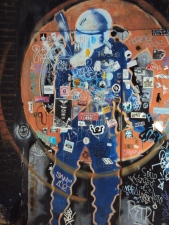
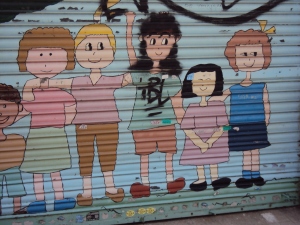
Today, I drove to Oakland.  On an overpass, across the highway, graffiti was sprawled across the cement. “Resist authority,” it said.

People in the suburbs don’t understand graffiti, but it’s been around for centuries—since Egyptian, Greece, and Roman times.  Graffiti is a word or a picture that is scribbled, scratched, or painted, usually illegally, in a public place.  Most often, the words express social or political views that defy authority or criticize the status quo.  These words are powerful expressions; they often infuriate conservatives into passions of criticism and revulsion.

DSC00112

In 1964 in his song “Sounds of Silence,” Paul Simon wrote, “’The words of the prophets are written on the subway walls and tenement halls.’”

I think Simon was telling society to pay attention.  We shouldn’t ignore graffiti; it foreshadows the protests of people who exert great effort to be heard.  Energy is pent up behind graffiti’s words, and until that power is spent, it continues to build until it can no longer be contained in the paint on a wall, across a bridge, or around a garbage can.  It represents the howl of people who don’t have a legitimized voice.

I listen to graffit.  I want to sit down with the graffiti artists to hear their whole story, not just the few words that are sprayed on a wall.  Why?  Because graffiti artists, although not formally voted into office, are the true representatives of their community.  They empathize with the story of their neighbors, and they have the courage to paint the pain of their friends over the arch of a highway.  They have nerve.  Audacity. In another word, courage.

Whenever I want to feel more understood and relevant, I tell my stories to somebody.  I cry that my mother died a few days before Christmas and that Christmas will never be the same again.  I talk about the ache from a break-up that has lasted for twenty years.  And I repeat my worries about money and love and job security and children and my dead aunt over and over again, until one day, I have talked enough, and I stop crying.

Every community consists of staircases.  In San Francisco, on Filbert Street, over two hundred stairs climb the hill to Coit Tower.  In Berkeley, 125 Oakridge steps ascend to a stunning view of San Francisco Bay and the City.  In Oakland, the Grand Lake and Trestle Glen neighborhood staircases guide residents away from the sidewalks among the blooms of spring and summer.

I’ve been climbing the staircases of these cities for years now.  I started right after I underwent chemotherapy.  I don’t mean to stir up any sympathy; I just want to demonstrate that I had a good reason for not being able to climb very far or very fast in the beginning.  I’d stare up at the wild ascent from the bottom like I was a finless salmon at the foot of a river.  The incline was daunting, and I panicked that I would never feel the heady rush of reaching the top.  I was afraid of being doomed to crawl back and forth on the first few stairs, feeling weak and powerless, without hope or optimism.

Then one day, I climbed past the first flight of stairs.  I rested on the landing like a panting dog, my torso leaning against the railing for support.  I scrambled up the second flight and sloughed across the next landing, gripping the rail with clenched claws, too winded to speak.

I scaled and mounted the steps like they were enemies.  I heaved and sighed, trudged and tripped.  I counted and lost count.  I ascended the steps while dots danced across my eyes and pins jabbed the center of my chest.  Then, when I was too weary to go any farther, a stranger grabbed me around the waist and pushed me up.  We climbed like one unit, in a slow march for a common purpose.   And I found the top of the stairs, my head in a fog, deficient of breath and oxygen, with a new friend beside me.

Not every stair can be climbed alone if you don’t have shoes, can’t afford a cane, or just don’t have the stamina.

DSC00113

This is why I want to listen to the graffiti.  Graffiti is the story of people who want to climb the stairs, but who are trapped at the bottom.  I want to listen to their stories and walk a few stairs with them until they can see their way to the top.  Along the way, I will make new friends.  I could use more.  While I listen to their stories and help them mount the stairs, I realize that I’ll be climbing higher, too.