The Imagination Grandpa Story 1: The Clock Man’s Wise Clocks

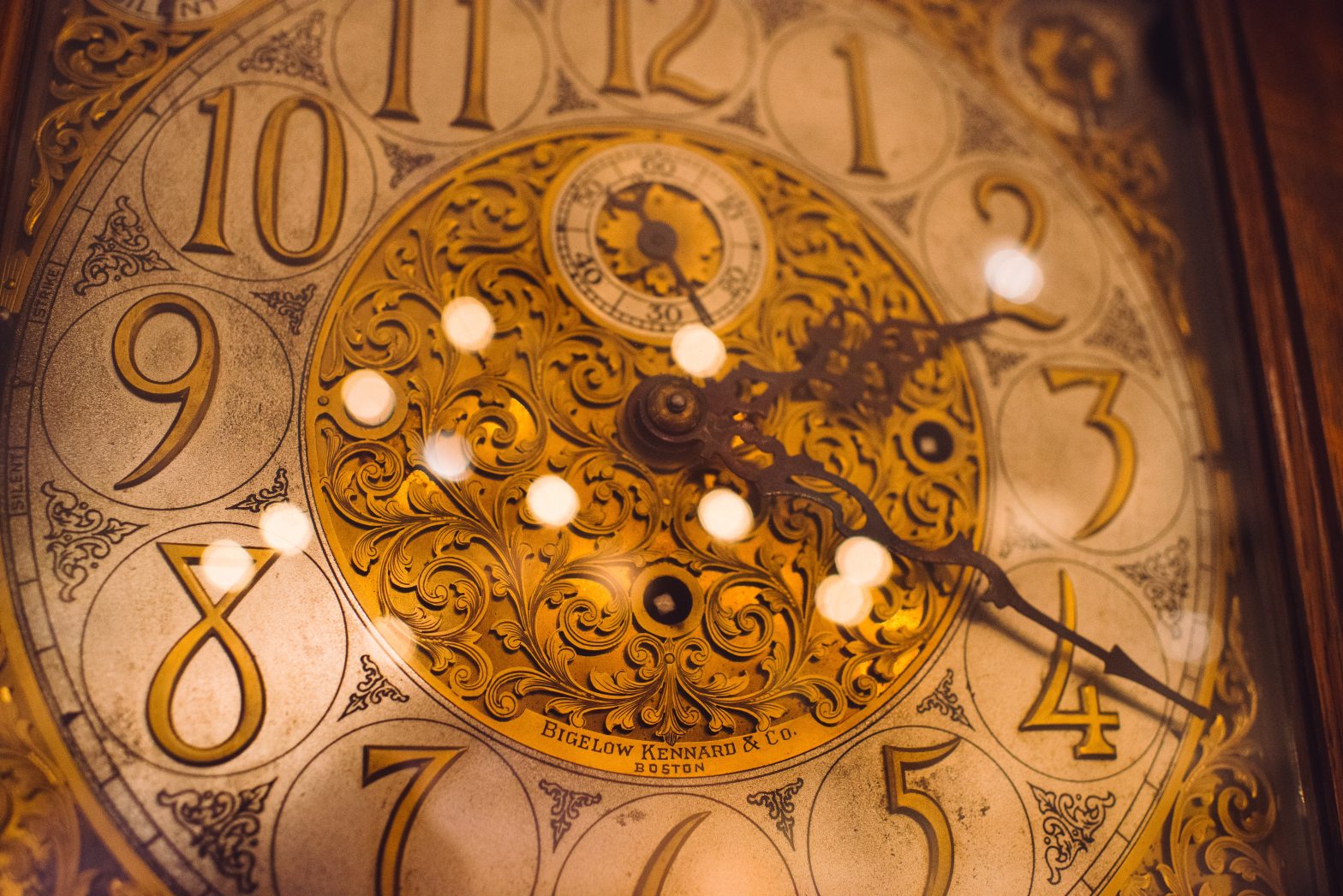
Photo by Ella de Kross on Unsplash

Instead of going to Third Grade, Rosie was in a hospital bed with tubes connected all over her body.  Rosie’s heart had a problem and the doctors took her into an operating room one day to fix it.  Now, she had to lie down in bed all the time, and she couldn’t play.

The day after the operation, Grandpa Joy came in to visit Rosie.  He wore his blue jean jacket that had lots of pockets.  When he came in the door, he took off his beret and placed it on the table beside Rosie’s bed. 

“Should I tell you a story?” he asked.

“O.K.” said Rosie.  She was so bored just lying in bed. 

Grandpa started his story. 


Once upon a time, an old man owned a clock shop.  The shop was a huge room, and clocks covered every inch of the four walls.  He had clocks with black hands, silver hands, gold hands, and bronze hands.  Some clocks had round faces with 12 birds to mark the numbers.  Some clocks were carved out of wood with long pendulums hanging from the clock faces all the way to the bottom of the cases.  On one wall, a whole line of coocoo clocks hung silently, their birds frozen in various stages of entering or leaving through the coocoo doors. 

In the middle of the great room, large trunks were propped on their sides, and, against these great boxes, grandfather and grandmother clocks leaned silently.  No ticking escaped from their chambers because all the them were broken. 

In fact, all of the clocks in the whole store were broken and quiet.  The only noise in the vast room was the scratching from a mouse family that lived inside one of the walls and came out whenever the old man dropped crumbs and bits of cheese from his sandwiches.

One day, a young man came in to buy a clock.  He smiled at the old clock seller when he opened the creaking door and walked right up to the counter.  This young man wanted a clock to give to his wife for her birthday

“What kind of clock should I buy for my wife?” the young man asked. 

“Well, a grandmother clock might be nice,” said the old man.  I have several of them leaning against these big trunks.  Which one do you like?”

The young man hemmed and hawed.  He tucked his first under his chin and looked at the clocks with big eyes.  He peered into the clocks’ faces, and inspected inside the glass doors that held the pendulums. 

“I like this one,” the smiling man said.  “but it doesn’t seem to be working.”

“All of these clocks are broken,” said the old man.  “I get them from people who no longer want to fix them, and I save them until someone new comes along that will appreciate them.  Some of these clocks are over a hundred years old.  When someone wants to buy one, I fix it until it works perfectly again.”

“Is an old clock be better than a new one?” asked the young man.

“I’d say so,” said the clock man.  “Old clocks have seen so many years go by.  They’ve watched girls and boys fall in love, lovers get married, babies being born, Christmases and Easters and Passovers celebrated.  And as they’ve watched these stories, they’ve saved these memories as wisdom to pass onto their next owners.  A new clock is just a metal face or a wooden box, but an old clock is a treasure chest of life.”

The smiling man stood in thought for a long minute, and then looked straight into the clock man’s face.  “Well, someday my wife and I would like to have a family, and we’re going to need a lot of wisdom when we do.” 

He peered again into the Grandmother clock standing next to him.  Her face shone like mother-of-pearl and the numerals glistened in the tiny spotlights that hung from the ceiling.  The face was set into a rosewood box and the rose-bronze pendulum matched the numerals.

“I’ll take this one,” said the smiling man.  “My wife will not only love how beautiful it is, but she’ll also love the stories that come with it.”

So the clock man fixed the clock.  He bought new wheels and whirs and inserted them behind the face so that the hands of the clock started moving and the pendulum swung gently from side to side.  He rubbed the face until it shone like a pearl and the rosewood until it gleamed like a shiny chestnut, and he cleaned and dusted every part inside and out.  One week later, the clock was ready.

The next day, the smiling man came into the shop.  With him, he brought a pile of blankets.  He looked around for his clock and his eyes found it standing under a single spotlight, glistening like a mermaid in the sun.

“My wife is going to be so happy,” the smiling man said.  “I can’t wait to get this home.”

The two men helped each other wrap a small blanket around the pendulum inside the clock case.  They covered the outside of the clock with more blankets and tucked the blankets securely so the clock wouldn’t get broken.  Then the smiling man paid for the clock and carried it out the door, his eyes shining like buttons. 

For a whole year, the clock man ate his sandwiches inside his clock shop where only his silent clocks kept him company.  Every day, he dropped crumbs and cheese bits from his sandwiches, and the mouse family darted into the room to pick them up, then rushed back to the hole in the wall. 

People came in to give him their old clocks, and other people came in to buy one of the broken clocks.  The man worked hard to make the clock customers happy, but he was lonely.

Then one day, the smiling man opened the creaking door and stood back.  Inside walked a young smiling woman holding a baby in her arms.  The smiling man walked in behind her.

“I want you to meet my family,” said the smiling man.  “This is my wife Sharon and my new daughter Rosie.”

The old man was so surprised that, at first, he couldn’t speak.  He just stood by the counter and opened and closed his mouth like a goldfish for several long seconds.

“I’m so happy to meet you,” he finally uttered.  “Did you like your birthday present?”

“Oh, yes!” replied Sharon.  “My birthday clock is so beautiful that it inspired me to name our new daughter Rosie, like the beautiful rosewood and the mother-of-pearl face.”

The clock man beamed like a shiny copper penny.

“You were right about old clocks,” said the smiling man.  “Sharon’s clock not only inspired us to name our daughter, but it also reminds us to sing every hour, and that makes us happy.”

The old man’s face lit up like a flashlight.

“Would you mind if we visited you once a week so that Rosie gets to know you and learns about your shop of wise clocks.

The clock man looked around his clock shop as if he had never really looked at it before. These clocks were all potential friends, he thought. Then he looked back at the rosewood clock family and knew then that he’d never feel lonely again.


Grandpa was finished with his story, and Rosie looked up at him with shining eyes.

“That was a wonderful story, Grandpa,” she said.  “That baby had the same name as me?  Was it a true story?”

“No, Rosie.  I used my imagination to make it up.  Of course, the idea for the story is true.”

“What do you mean Grandpa?”

“Well, I wanted to tell you a story that started with you, and so I told my imagination to use your name to invent one.”

“Oh, I like that Grandpa.  That makes me happy.”

The Grandpa kissed Rosie’s cheek and tucked her blankets around her.  “When I come back tomorrow, I’ll tell you another story,” he said.  “Meanwhile, you can use your imagination to keep you company until your next visitor comes.”

“O.K. Grandpa.”  Rosie snuggled into her blankets and feel asleep a few minutes later, her face glowing . . .

Taunting Mr. Kingsley

On Saturday, I went with my mother to Cornhill Market. We waited at the wooden bus stop for the red double-decker bus which arrived tardily after 8 a.m. Side by side, we sat for the forty minute ride to town, propping empty market baskets on our laps.

Up ahead in the old seats, I noticed a hat that looked familiar–a collard-green hat with a tuck on the top and a medium brim all the way around. The man wearing it wore a heavy wool coat. HIs big neck was lined with sagging skin and his hair was pewter gray. Mr. Kingsley, it was. I swallowed hard.

Mr. Kingsley was the man who monitored the children on the school bus. He was old, and when it was cold outside, he stomped his heavy, brown shoes on the metal floor in rhythm with the turning of the wheels on the bus. Every day, he wore a full length wool coat and beat his covered hands crossways against his chest to keep warm. Like a teapot, each blow on his chest released a burst of steam from his mouth.

As our market bus followed the rolling hills of farms and meadows, I watched the collard-green hat nod over the old man’s chest. Once in a while, I gazed out the window at the squares of empty fields covered in frost.

The children on the bus feared Mr. Kingsley. “Keep away from that door, you ragamuffins!” he yelled at the boys who wandered out of their seats.

We created stories about him. We told each other how he lived in a dark castle, dined alone at a long, wooden table, and ate the legs and arms of poor children for dinner. After dinner, he sat in a huge arm chair in front of a blazing fire, reading the gospel of Satan and blowing smoke rings with his pipe.

Soon, the frosty fields outside my window dissolved into the red brick factories and churches of the town Bury St. Edmunds. The bus would soon leave us off at the bus station near Cornhill Market.

I had never provoked Mr. Kingsley, but had laughed heartily at the boys who did. Some boys, those with a higher dose of daring, knocked off his hat when his back was turned, baring his baldness as if it were a hole in his armor. Kingsley would swirl around and swat at them while they tossed the dull hat from one seat to another.

Once, when his hat fell into my lap, Kingsley snapped it up and scowled into my face, “You’re naughty children, you are. Some day you’ll pay for this. Just you wait.”

The bus rolled into the station at the corner of Cornhill Market. In my haste to get off before Kinsley saw me, I dropped my basket in the aisle. I bent down, grabbed the basket’s handle, reached for my mittens which had fallen out, and hurried behind my mother to the exit.

“Meet me here at 11:30,” my mother said as she set out with both baskets towards the food stalls which filled the market. The stalls were covered in a kaleidoscope of colorful awnings which shaded slanted displays of farm vegetables, baskets of berries of all kinds, fish on ice, and jars of mincemeat, currant jellies, lemon curd, and pickles. I waved to my mother and rushed away before Mr. Kingsley appeared behind her.

First, I walked briskly to the shops surrounding the open market. In the chemist shop, I climbed the stairs to the second floor to smell the scents of the bath cubes lined up like tiny gifts. I closed my eyes and imagined gardens full of blooming flowers: violets, roses, sweet peas, and jasmine.

When I opened my eyes, I saw Mr. Kingsley coming up the stairs and heading my way. I dropped the bath cube I was holding and heard it crumble inside its wrapper. Some customers blocked his way, and I circled around several perfume aisles until I reached the stairs, skipped down the steps and out of the store.

My breath made puffs of smoke in the cold air. I must have left my scarf in my basket, so I swaddled my collar around my neck and looked for an escape. Curry’s Book Store was just around the corner of the market, so I decided to go there to hide and keep warm.

“Could you direct me to the young adult section, Sir?” I asked the man behind the counter.

“Yes, darlin’. It’s in the very back behind the dictionaries.”

I passed through the rows of best sellers with the big signs until I reached the very back of the store. Scanning the shelves, my eyes lit upon a section full of fairy tale volumes. Stooping down, I read the titles and slipped one out titled Old English Folk Tales. At the end of the bookcases was an empty space in the corner. I squatted up to it with my back and scrunched my body into its opening until I was hidden and began to read, raising the book to cover my face.

Every few minutes, I leaned out to see if Mr. Kingsley had followed me, but I seemed to have lost him. I read “Herne the Hunter,” a scary story about a ghost who haunts Windsor Park with a pack of hounds.

Suddenly, I heard Mr. Kingsley talking to the man at the front of the store. Soon, I heard his heavy shoes pacing toward the back, so I jumped up. Holding my breath and clenching my hands inside my pockets, I poked my head out, scooted, slipped behind the shelves of dictionaries, and crept along the rows at the edge of the store until I reached the door and escaped.

What would he do if he caught me? I imagined being stuffed into a black laundry bag, hurled over his shoulder, and carried on his back across open fields all the way to his black castle.

The market clock pointed to 10:30. Running into the stalls, I searched for my mother’s coat and ocean blue scarf. At every vendor, ladies in navy coats were selecting potatoes and turnips, tasting berries, and talking over codfish.

I dashed in a zigzag across the square to Moyses Hall, the town museum. Kingsley wouldn’t guess I was in there. Children never went to museums by themselves.

Moyses Hall, a massive flint and stone house, was the largest building surrounding the square. It was shaped like two huge but simple houses, connected by a thick stone pillar. At the base of the pillar was a smooth stone with the year 1180 carved into it. I had been inside during a school field trip and learned that it was once housed a Jewish family, and built as strong as a fortress. An air of mystery hid in its shadows as if the ghosts of the family were still there, witnessing the visitors who wandered in and around their former hearth.

I ran inside and caught my breath against the cold stone wall beside a life-sized suit of armor. After a few minutes, I wandered around the glass cases filled with cracked cups and bowls, fat statues of gnomes and dwarfs, hand shovels, coins, torture chains and screws. I read all the display descriptions waiting for the next hour to pass until I would meet my mother at Purdy’s, next to the bus station.

At 11:30, my mother was waiting. Two fat baskets leaned together on the ground next to her feet. I ran, anxious to hear the security of her voice. “Hi, Mom! Can we get some sausage rolls?”

“Claire, I already bought them from Purdy’s. Let’s hurry or we’ll miss the bus.” I didn’t tell her about Mr. Kingsley following me. She didn’t know how the children taunted him, and she wouldn’t like it. We boarded the bus and perched the heavy baskets on our laps.

Heavy shoes stomped up the back stairs. They sounded like Mr. Kingsley stamping his feet on the metal floor of the old school bus. I hunched my shoulders and bent my head down behind the basket on my lap.

A gruff voice bellowed right behind us: “At last, I’ve caught up with you.” Mr. Kingsley towered over me in the aisle. His eyebrow hairs stuck out like bent stickpins. Looking up, I saw the yellowness of his teeth and the gray hairs inside his nostrils, and I shivered as a chill swirled at the base of my neck and crept down the back of my coat.

“Mr. Kingsley?” my mother said with her eyes opening wide.

Mr. Kingsley thrust his gnarled hand into his oversized pocket. I squeezed my eyes shut. Seconds filled with silence. Cautiously opening my eyes, I saw that Mr. Kingsley was holding my red plaid scarf out to me. “Claire, I saw you leave the bus this morning. You dropped your scarf on your way out,” he said, a smile spreading beneath his salt and pepper mustache.

My mouth dropped open. I reached out a hand, took the scarf, and twisted it self-consciously around my hands. “Thank you.”

“Well, I have more shopping to do before I go home. I’d better get off this bus before it takes off. See you Monday, Claire.”

“Goodbye Mr. Kingsley. Stay warm,” said my mother.

The picture of Mr. Kingsley’s twinkling eyes lingered in my thoughts as I rolled the scarf around my neck.

“What a nice man Mr. Kingsley is,” my mother said. “and I’m glad he found your scarf. Get warm now.” My mother smiled and looked out the window.

The bus jerked into motion. Maybe Mr. Kingsley didn’t live in a black castle and eat children for dinner. Maybe he liked children instead and that was why he took care of us on the school bus.

The next time I saw him, I would smile and wish him a “Good morning.” Maybe those boys would get to like him, too.

Wet Cathedral

That night, they were down at the beach. The two couples had taken a long, slow walk, curving their footprints along the shore in a crescent until they reached the pier and turned back. Minnie and Katy were collecting shells for their children back home. Owen scanned the sand for bodies of sand crabs after each wave receded, and Efren walked silently, once in a while joining Owen to ogle over a group of crabs gathered around a shell for feeding. Midway back to the base of the cliff where they began, Katy scratched an image of a bear into the gravelly sand, took out her cell phone, and snapped a photo.

When they reached the top of the cliff, wooden picnic tables were strewn with their camping supplies. Owen took out long metal rods, marshmallows, bars of chocolates, and graham crackers. Katy stoked the dying fire and added some kindling until it was burning with life again. They roasted marshmallows, Minnie allowing hers to burn into a black crisp on the outside. She pressed it, ash and all, between the crackers and melted the chocolate around it.

Efren had retreated to the stone wall overlooking the beach to watch the sunset. He and Minnie lived in Colorado, and he couldn’t remove his eyes from this Pacific Ocean, which, to him, looked like an expanse of blankets being waved by strong-armed giants. As he gazed at the sun positioning itself on the horizon like orange lace, he spotted the seal.

“Come and see the seal, Minnie. Watch the sunset. It’s beautiful out there.”

Minnie, Katy, and Owen joined him to watch the seal bobbing in and out of the waves as if it was about to ask a question. Below them on the beach, a group of people was huddled around a fire, which lit the center of their circle like a gas burner. Two surfers in black wet suits frolicked in the waves far from the seal, their sleek bodies reflecting in the glowering light. As the sun settled lower, its dusky brightness deepened the lows and lightened the highs of the ocean swells.

Efren spied the cocked head of another seal, and, as the couples turned to see it, two shiny, long, black backs broke the surface of the waves. Whales.

The whales frisked and frolicked about twenty yards away from the surfers who seemed unaware as they acrobatted their boards toward shore again and again. The black backs arched above the surface and sprays of water gushed through the froth.

Then, two more backs glistened closer to the surfers now, cavorting and ignoring the humans on the beach who had lined up, fixated on them. The surfers saw them stare, looked behind at the waves a few times, then swam to shore, pulling their boards by the cords behind them. They shook their sleek bodies, then stood with the others on the rim of the watery stage.

As the sunlight deepened, hundreds and hundreds of black backs broke the darkening and undulating sea. Glossy bodies arched, bent, sprayed, thrust, thrashed, and crested the swells. The ocean was a playground of swimming children, unaware of how their antics amused the audience or how their magnificence inspired the human souls watching them from the sand.

Katy, Minnie, Efren, and Owen exchanged looks, their mouths paused in chewing and their eyes wide. The surfers and campfire friends smiled at each other until every human being watching the whales became part of a congregation, knit together by their admiration of the wet nature. The ocean waves sang like a choir, the voices echoing from the choir loft and reverberating from nooks and crannies on stone walls before descending into the nave and ears of the people. The beach, the ocean, the bobbing seals, the cavorting whales, and the silent humans shared a single energetic symphony as the sun dimmed its spotlight on the Pacific ‘s stage.

The tide moved in to accompany the oncoming darkness. In two’s, three’s, and four’s, the spectators on the beach snuffed their campfire and climbed the gravel path to stand with the two couples at the wall framing the cliff. Finally, the sky deepened into a mass of navy sheets and the dark backs of the whales and bobbing heads of the seals were no longer distinguishable from the folds of the water.

The waves crept steadily up the shoreline and, wave by crashing wave, erased the footprints which had earlier curved all the way to the pier.

To Mother

A stabbing pain awakes me, 
The beating of my heart,
The crying of my soul,
Signaling empty—that you are gone.
I never lost such love 
Until I lost yours. 
The dark was never so deep 
Until your light went out. 
You are gone, gone, gone, gone
And I can’t reach you
E’en though I stretch a wild hand
To find lonely fingers.
Your voice—its cadence 
In my ears. 
Your lovely charm and face 
A whisper of memory. 
Come back for only a breath 
And then another, another, 
So I never have to breathe 
Without the love you breathed into me.

Retirement Richness: Project Self

Photo by Sherise VD on Unsplash

For about a year before I retired, I kept asking everyone for ideas about what I should do to keep busy, to stay active, to find purpose during retirement.  I thought about working for the local food bank, reading with children in Oakland schools, or volunteering to work at one of the county libraries. 

Many people think they need to fill their retirement with activities.  One retired nurse I know still rushes through her day trying to fill up every minute.  She volunteers at the local hospital for three hours a week, sews quilts and activity blankets for seniors, takes walks, and feeds the birds.  Yet, whenever she gets tired of these activities, she searches hectically to figure out what to do next. 

For those who truly loved their careers, like many teachers and nurses I know, retirement is an especially challenging transition.  I taught English to college students for 16 years.  I’m proud of my growth as a reading, writing, and critical thinking professor and of my unique ability to inspire and educate students of all backgrounds and skills.  My job gave me tremendous purpose and fulfillment. 

To retire is to rest from the frenetic pace which a career often requires.  Engaging in activities just to stay busy defeats its purpose.  Instead, retirement’s purpose can blossom from the time available to reflect and explore new life paths. 

After thinking long and hard about what my retirement purpose could be and by consulting advice from a variety of sources, I am now content in what my purpose for retirement will be; my primary purpose is now ME.

This goal may sound a little selfish to those who have strong feelings about doing charity work or participating in volunteer activities.  Many people judge their own worth mostly by how much they give to others; however, if people ignore their own psychological well-being, they can’t offer their best self to others.  Their volunteer work will be marred by feelings of stress and anxiety.  Instead of leaving those they serve with better peace, they could even raise the anxiety levels of the people whose lives they hope to improve. 

Focusing on the Process

Since my retirement is a brand-new phase of my life, I knew that I had to treat it as a process of discovery instead of expecting to know right away how to spend my retirement years.  If I had assumed that my retirement would just “happen,” I would have been sorely disappointed.   

The first thing I had to do was to avoid filling my days with busyness.  Each day, I chose to do projects that make me happy.  My own happiness is my primary goal since I know that, if I am happy, I will naturally share this joy with my family and community. 

Thinking of retirement as a process gives me permission to be patient and to let my life unfold in a natural progression.  It also gives me freedom to try new activities that I hadn’t previously thought of because I was so tenaciously focused on trying to be “retired with purpose.”

Viewing retirement as a process empowers me.  Because I don’t assume I have to know how I will spend the rest of my life, I don’t stress about not having all the answers.  I don’t expect to know what comes after today.  I only know that what I do today will lead me to more knowledge about what I value and more opportunities; every day, I achieve personal growth and this growth teaches me what is possible next.  I take confidence in my baby steps and know that my staircase has no last stair. 

Re-evaluating Values

I’ve discovered that the voices in my head that drove my career and previous life are no longer all relevant.  My new role in life, focusing on myself, encourages me to discard old “rules” that were given to me by my parents or previous bosses.  Why?  Some of those old rules don’t allow me to explore my true potential.  I know retired people who have adopted a new spiritual focus by discarding the religion taught to them by their parents.  Others have become creative for the first time by learning how to arrange flowers or paint in watercolors, activities far different than their careers.  I am re-evaluating everything, and I feel great. 

For example, I have decided to write short stories because I love fiction and think that it is one of the highest forms of creativity.  I also walk and perform yoga which both help me feel healthy.  When I finish one activity, I sit down and carefully choose my next one so that I don’t get caught up in mindless activity.  I focus on the present with each activity, knowing it is enough and is leading me to a greater, happier self.

Releasing Negativity

I don’t want to be a crabby old lady who chases people away with her bitterness and narrow mindedness.  I don’t want to act like a nasty old man that can find nothing positive in what others do because he can’t find his own joy.  I want to cultivate joy within myself that will naturally touch others.

Sometimes, in order to build self-joy, a person must eliminate the negative energy of others or of negative activities that threatens to usurp their joy.  I’ve chosen to to gradually eliminate anything or anyone that negatively affects my life.  Since I don’t want to injure my knees or ankles, I only walk for as long as I am comfortable, and I never compete with others.  I also set firm boundaries to prevent negative people from affecting my growth and joy.  I take no responsibility for their development, only mine.

Measuring Growth

Since my retirement project is a process, I’ve found ways to measure my growth to witness progress.  Here are some examples.  Whenever I walk, I use an app on my phone to measure my steps and distance.  I set rewarding goals for each day and observe how much I achieve per week.  In my writing, I post my short stories and articles on this blog to feel “published” and to keep track of my accumulated posts.  I also keep another blog for posting recipes that I create.  When I garden, I take time to admire new plantings or newly pruned hedges.  I observe and enjoy my growth on a daily basis or even several times a day.

Retirement truly is the gift of time to discover how life can be joyful, but a person must intentionally focus on achieving peace within themselves if they want to attain the greatest version of themselves.  What better way to do this than to make my biggest retirement project all about me.

Retirement Richness: Nourishing Relationships

Photo by Ekaterina Shakharova on Unsplash

When people think about retirement, they often struggle to think about what activities they will do to fill their days.  Some take up golf.  Others start biking.  Others work for the local food bank.  Retired teachers go back and teach a single class, and retired nurses volunteer for essential posts at the local hospital.   

I have a suggestion about another way to think about retirement and a rewarding focus for this special opportunistic time in life. 

Relationships are key to our happiness, and during our working years, we often fail to nourish them due to time constraints or career responsibilities.  In retirement, however, people have more time and can be more flexible with it.  I suggest spending some of that time to renew old relationships and build fulfilling new ones. 

One of the most gratifying sources of happiness is a positive relationship with a significant other.  When I retired, my husband had already been retired for a few years and he was just waiting in the wings to spend more time with me.  After a few weeks, we settled into a flexible routine for our retirement days.  We both have individual activities, but we consciously set aside several times during our day to spend with each other.  For example, on most days, we eat lunch together.  We sit down at our dining room table with a bowl of homemade soup or some takeout from a local restaurant and we share 45 minutes feeling grateful for each other and for the wonderful food and food providers in our lives.  Before we start eating, we even express our gratification to make it formal.

Another way we spend time together each day is by sitting down to talk at 4 p.m. until we eat dinner at 6.  Part of that time, we may sit outside if the weather is fine or make dinner in the kitchen.  We talk about foods we love, friends we talked with during the day, and what is happening in our extended family.  What makes this time so special is that we are both committed to being present with each other.

If you have been blessed with grandchildren by the time you retire, you can spend more time with them to enrich not only their lives, but also your own.  One retired couple that I know visit their grandchildren three afternoons a week after school to help them with their homework or to play games.  They interact with their grandchildren before the parents come home from work and they don’t stay for dinner.  They are not babysitting since the children’s nanny is there too.  The focus is on developing meaningful and loving relationships.

Retirement is also a wonderful time to spend more time with your own children.  By this time, they will be busy in their own careers, but retirement gives you the flexibility to meet them during times when they’re available and to participate in the development of their lives.  For example, one morning at 9:00 a.m., I helped my daughter practice for a future interview for a new job using Google Meetups.  Throughout the day, I play chess with my son using an app on my computer.  When they are free, we go for walks together.  I babysit my daughter’s dog while she gets her hair cut which keeps me in tune with her interests.  The key is to participate in their lives so they have time for you and feel comfortable sharing their life with you.

Perhaps you have retired and your parents are still living out the twilights of their lives.  Retirement gives you extra time to spend with them, too.  One person I know cuts his mother’s lawn every two weeks.  A woman whose mother lives in an assisted living facility visits her once a week to play games, help her with her tax return, make crafts, or eat a meal together.  I know from personal experience that this late-in-life time with a parent can prove to be the most cherished of all.

One extremely rewarding opportunity in retirement is renewing the relationships with siblings.  I come from a large family and have nine siblings.  Recently, my siblings and I have started keeping group chats going throughout each day.  We discuss family history, our goals, our exercise activity, problems. And more. I recently helped one of my brothers write his will and apply for retirement.  I helped another brother buy cremation services, and I got help from one of my sisters to plan a memorial service for someone.  This renewal of our relationships takes me back to the carefree days of my childhood when we played in the backyard until dark.  Only now, we are seasoned and more diverse in our experiences which makes our conversations so much more interesting.

Even relationships with extended family can blossom into beautiful connections.  As soon as I retired, one of my nephews asked me to read the novel he was writing and provide him with feedback.  I jumped at the chance and carved out a space in my schedule to achieve this.  From our connection, we have become much closer, I have helped him form a writer’s network, and we converse all the time. 

One of my mother’s sisters is a prolific letter writer, so I’ve decided to write her letters back and enjoy hers, too. Sometimes, instead of writing letters, I send her a short story that I’ve written about my mother or some other family member. She loves the connection, and writing letters helps me slow down and enjoy my connection with her, and through her, with my late mother.

When I was teaching English at a community college, I rarely had time to meet with my girlfriends, and, now that the pandemic has curbed my activity as well, I’m still not seeing them enough, yet I still am refreshing my friendships with my treasured women friends in a variety of ways.  One friend and I share our blog postings with each other, providing support and inspiration.  With another friend, I share new recipes, wine ideas, and plans for future travel.  Another friend and I go for socially-distanced walks and enjoy our spiritual connection with nature all around us. 

I’ve noticed that my husband works hard at nourishing his guy friendships as well.  He plays golf about once a week, not for the purpose of playing a great game, but for the opportunity to spend time with three of his favorite buddies.  They talk about travel, the news, sports, and their family lives.  One of his childhood friends keeps him in contact with friends from grade school, high school, and college.  They share pictures of their former sports’ teams and provide financial support for old friends who fall upon hard times.  On golf days, he comes home rested and happy, and, with his old friends, he and I share lots of laughter.

In retirement, our lives take on a new perspective.  We aren’t teachers, managers, salespersons, congressmen and women, cashiers, hairdressers, or waiters anymore, but the summation of those deep and diverse experiences that our careers have created; we, then, also may wish to develop new friends to accompany us in our new pursuits.

A few years ago, I joined a chorus comprised of mostly retired singers.  I only sang with them for three and a half years, but when I quit the chorus, I didn’t quit those cherished friendships.  Now, I attend their concerts as a listener instead of a performer.  I support their individual singing events, and I’ve made even more friends through my association with them.  I share their joys, witness their talents, and happily rejoice in their accomplishments.  And through all of these musical experiences, I nourish my own love of music.

Retirement is a new beginning—a time to rediscover the people who make us bigger than ourselves, better with company, and happier with connection. 

Patrice’s Spanish Lesson

photo by 🇸🇮 Janko Ferlič on Unsplash

Every day after dinner, Mama sat with me at the dining room table to teach me Spanish. I didn’t like it. I didn’t want to say “hola” instead of “hello,” “adios?” instead of “goodbye” or “Me llamo Patrice. Tengo ocho años.”

“Why do I have to learn Spanish?” I asked Mama.

“Grandpa lives in Guadalajara, Mexico, and we’re going to visit him this winter. You can speak Spanish with Grandpa when you see him.

Reading English was hard enough. Learning Spanish words only confused me more. Besides, it was silly to learn words that meant the same thing as the words I already knew. I wanted to play jump rope, not learn Spanish.


Mama taught me more Spanish words every day. She taught me how to say the colors of the rainbow. She told me that, in Mexico, children went to una escuela instead of a school, and they counted uno, dos, tres instead of one, two, three.

One day, Mama said she had a surprise. “Today, I’m going to teach you Spanish words for your favorite games,” she said. “‘¿Quieres saltar la comba?” means ‘Do you want to jump rope?'”

I loved jumping rope. If I had to learn Spanish, at least I could think about something I liked to do. Later, as I jumped rope outside, I made a song of the new words: “¿Quieres saltar la comba? ¿Quieres saltar la comba?”


When Grandpa met Mama and me at the Guadalajara airport, he gave us big hugs. “Hola,” he said. “Como estan?”

“Hola!” said Mama. “I missed you.” I just smiled and said nothing.

“I thought you were learning Spanish, chica,” said Grandpa.

“I don’t need Spanish. You speak English, Grandpa. I can talk to you in English.”

“I like speaking Spanish, Patrice,” said Grandpa. “That’s what people speak in Mexico.”

“It’s silly, Grandpa, and I feel silly doing it,” I said. I took Grandpa’s hand and told him all about the airplane trip on the way to the car.


Grandpa’s house was beautiful. It was surrounded by high walls, but inside, all the rooms opened onto a central courtyard filled with brightly, colored flowers. A yellow-tiled water fountain made into a fish and seashells trickled into a blue-tiled basin.

I stood with Grandpa on the steps to the garden. “I’ve never seen a house so pretty,” I said, looking at all the pots of flowers.

“In Mexico, you’ll see and learn many new things,” said Grandpa. “Come, let me show you your bedroom before my friends arrive for dinner.”

Soon, Grandpa’s friends arrived. In the dining room, Grandpa introduced Mama to the grownups, Ricardo and Mari. Beside Mari stood a girl with a long black braid and big brown eyes. “Patrice, this is Anana. She is eight years old, too,” said Grandpa.

Anana took a few steps away and leaned into her mother’s skirt. Her dark eyes opened wide as she looked at me. Grandpa smiled, said something in Spanish, and the grownups walked into the kitchen.

I felt small standing in the middle of the room with Anana and her big eyes. “Do you want to play hide and seek?” I asked nervously. Anana just opened her brown eyes wider.

“Do you want to play with puppets?” I asked. “I brought some with me from my home.” Anana inched around the other side of a pillar and hid one eye against its plaster.

This isn’t any fun, I thought. Grandpa invites friends over for me to play with and they don’t even talk to me. I looked at Anana hiding behind the pillar, then ran to my bedroom.

My jump rope was lying on top of the bedspread. I crawled onto the bed, wound the rope around my hands, and thought about Anana. What big eyes she had, so dark compared to my blue ones. Anana’s black hair was longer than mine, too. I wished my hair was long enough to braid like hers.

Things in Mexico were different than at home. Anana wore a fancy dress with ruffles and ribbons. I looked down at my shorts and Tshirt. Why did she get so dressed up to play, I wondered.

There was no one to play with and strange things to get used to. All my friends were far away.

I crawled off the bed with the jump rope in my hand. The brown tiled floor was perfect for jumping, so I swung the rope over my head and began to sing, “¿Quieres saltar la comba? ¿Quieres saltar la comba?” like Mama taught me. On the third jump, I stopped singing and slowly lowered the rope in front of me.

“¿Quieres saltar la comba?” I repeated slowly, over and over again. I opened the bedroom door just enough to peek through the crack. Anana was still out in the courtyard, leaning on the pillar. I inched my body through the door and slowly walked out to her.

When she turned toward me, I held out the jump rope and asked, “¿Quieres saltar la comba?”

The brown eyes smiled. “Si, si, yo quiero saltar la comba!” She reached out, took the rope from my hand, walked out to the patio, and started jumping. I followed her into the sun and sat down on a step to wait my turn.

The sun felt good on my face. Remembering the Spanish numbers Mama taught me, I began counting out loud in rhythm with Anana’s skips, “Uno, dos, tres . . .”

Squirrel Art

One summer day, Curly and Twirly waddled up to the school. They flatterned their round bodies, took a deep breath, and inched their way under the art room door.

“What a wonderful place to live!” exclaimed Curly. A large bookshelf held piles of colored paper. The faucet over the wide, deep sink dripped drops of water.

Using his tail, Curly opened a cupboard door. Stacked on the bottom shelf were bags of beans and flour. Using his strong teeth and paws, he dragged a sack of beans off the shelf and tore it open. Twirly kicked a bag of flour. It teetered over the edge and fell onto the floor. The cupboard’s latch tore a whole in the side.

Flour, flour, flour flew everywhere. It dusted the chairs and low table like a frosting of snow. The squirrels nibbled some flour. They cracked some beans in their jaws. They jumped up to the chairs and slid across the table. As they hurried back and forth, their paws made prints in the flour.

Curly noticed the footprints first. He stood up on his hind legs and turned all around for a better look. “Look, Twirly, our footprints make a design!” he said.

Curly stepped into the flour with both feet and made a four leaf clover. Twirly used his big toe to trace a footprint daisy. They drew straight lines and wiggly lines. They outlined pictures of all the animals that lived in the forest beside the school. They danced, they pounced, they skated all over the floor. Finally, they grew tied and fell asleep under the table.


The next morning, Curly and Twirly awoke; their back were stiff from lying on the hard floor.

“We need beds,” said Curly.

“Let’s make pretty beds, said Twirly. They chose green construction paperr that reminded them of unripe nuts in the spring. They ripped up yellow paper that looked like buttercups. The red paper was as deep as the poppies they had seen in the fields. The blue paper looked like the summer sky. Soon, inside the corner of the cupboard, they each had a rainbow-colored bed of construction paper.

The squirrels spent every day exploring the art room. One morning, Twirly reached for the handle of another cupboard and swung on it until it opened. On the top shelves, he saw row of colored liquid in jars. Inside them was the most beautiful thick dew Twirly had ever seen.

“Look Curly, delicious dew!” said Twirly. Twirly crawled onto the bottom shelf, pulled himself up onto boxes until he reached the jars of dew. His paws were too small to turn the wide, white covers. He squirmed in behind a bottle and pushed it with his two feet. It landed on the floor with a crack. Thick, yellow dew oozed from its side.

Curly climbed up and inched his body behind a red bottle and pushed. Twirly squirmed behind a green bottle and pushed. The green bottle hit the side of the table on its way to the floor and splattered green-colored dew from one end of the room to the other.

The squirrels climbed down to taste. Twirly dipped his paw into green dew, stuck it into his mouth, and slurped. “Yuck, it tastes like dirt!”

“It makes the sides of my mouth stick together,” grimaced Curly, who was trying to wipe paint off his tongue. He waved his paws in the air, flicking it off his furry paws. A pattern of dots settle all over the floor.

“Whee!” exclaimed Curly. “Wow!” yelled Twirly when they saw the dots on the floor. Curly thought hard for a minute. “The children don’t drink this dew,” he said. “They decorate with it.”

“Let’s do that, too,” replied Twirly.

Curly and Twirly spent the rest of the summer decorating their new home with colored dew, paper, and flour. Curly painted dots on the cupboard doors. Twirly created a carpet of patterns with flour and footprints. They had never been happier.


One morning, when the squirrels were still fast asleep inside their bedroom cupboard, a key turned in the lock.

“What happened here?” a lady’s voice exclaimed. Curly and Twirly rubbed their eyes and knelt behind a crack in the cupboard door to see who it was. A woman, wearing an artist’s apron, stood in the doorway. A group of children ran in behind her.

“Are you teaching us art today?” one child asked, her eyes bright and shining.

The woman didn’t answer. Her eyes opened wide as she gazed around the room. The children’s eyes glistened as they, too, noticed all of Curly’s and Twirly’s art work.

“It must have taken someone all summer,” said another little girl, “to make the art room look so beautiful.”

Curly and Twirly smiled, then hid behind a cardboard box until everyone left.

The squirrels knew they ahd to leave their comfortable home now that the children were back. They had to find new beds and more food.

As Curly and Twirly slipped under the art room door, they grinned at each other. This time, they didn’t have to leave everything behind. Curly now knew how to paint dots anywhere he lived. Twirly would always remember how to make a footprint carpet.

“I’ll paint lines on our pillow,” said Curly.

“I’ll draw zigzags on our blankets,” Twirly exclaimed.

By the time they reach the flagpole, they had thought of dozens of new ways to decorate their new home. What a beautiful home it would be.

Great Grandpa’s Copper Pennies

Some eye remind me of blue china plates. Some are as green as pine trees. Others are as dark as chocolate truffles with eyelashes resembling ruffled paper cups. But my great grandfather had eyes the color of copper pennies.

His name was Leon, and his eyes took on the glint of a new penny when he smiled–a smile that spread out wide like he was a grown-up pixie with a face full of childish adventure. His smiled possessed a spark of mischief for which everyone forgave him because his mischief was wrapped in an effervescence of charm.

My father drove Mom and us kids to Winona, Minnesota from California during the summer when I was four years old. That was the first time I ever met Great Grandfather even though my father had told us many stories about him as we sat at the foot of his brown arm chair, our arms propping us up from behind. Dad sat back in his chair, one foot perched on the other knee, his face hazy behind the smoke of his pipe.

In one story, Dad told us how he moved away from home when he was fourteen to live on Great Grandpa’s 761 acre farm, a collection of wet emerald hills and valleys, prime for alfalfa crops, acquired piecemeal through the years. After school each day and even on the weekends, my father drove the tractor, tilling the soil. “That’ll keep you outta trouble,” Great Grandpa had told him.

Dad described the big, rambling, clapboard house that Great Grandpa had built on the property. A porch, big enough for stacking up piles of firewood near the front door for the winter, spread across the whole front of the house. The house was two story, had running water and two inside toilets, modern conveniences for the time it was built. Built as the mansion for Great Grandpa’s plantation, it was nevertheless a humble abode, reflecting the unassuming personality of its owner. Furniture was utilitarian and sparse. The walls were hung with religious icons and little else.

In 1961, when Leon sold his farm to the State of Minnesota to be The Memorial Hardwood State Forest, vandals ransacked the house, trying to find the still Leon had built and used during Prohibition to produce liquor for himself and his friends. Sheetrock was slashed and kicked in, floorboards were pried up and cupboards were destroyed in the search for a secret chamber; the chamber and still were never found. My father believes that the still is buried in a hidden grave somewhere among the hills of the fields, rust and useless now.

Great Grandpa was one of the first babies to be born in the town of Winona. His father Ignacias founded the town with his four brothers during the 1850’s. An ideal location on the Mississippi to set up a sawmill and take advantage of the logging industry farther up north. By the time Leon began farming, he had passed his family sawmill obligations to the Brom family who later became his relatives when his son Leon Jr. married Lillian Brom, my grandmother.

Years before Prohibition, Leon took on the job as Winona’s first sheriff, but this too has passed by the time my father arrived on Great Grandpa’s farm in 1943. By then, Leon had earned a reputation as a respectable farmer and had contributed a significant amount of money to build Winona’s first Catholic church, St. Stanislaus.

Perhaps my father inherited Great Grandpa’s looks from being around him so much. All the men of my father’s family line bear an uncanny resemblance to each other. In pictures of them as toddlers, they have white-blonde hair and doughy-soft limbs. Later childhood pictures show how they grow into strong-limbed young boys, hardy-looking, and clear in complexion. As young men, they are debonair and tall. Eventually, they mature into handsome broad men with rounded edges, kind creases around their eyes, and erect, stocky frames. Their chests and arms provide strong hugs and they are masculine enough to accept love in return.

I have a picture of Great Grandpa Leon when he was 96 years old. He is standing, holding a fishing rod, his eyes cast down and his thumb resting on the handle of the reel. His wrinkles are life creases: the knob of his chin, slightly bulging jowls, cheeks puffed out as if they are storing nuts for the winter, and eyes recessed under a frown of concentration. His hair, thinned since youth, glows a lustrous white. His face and posture are regal like that of an older priest or religious man.

Leon lived until he was ninety-eight years old. Up until his last two years, he fished down at the family boathouse on the Mississippi or chopped wood for the fireplace. On Sundays, he spent an inordinate amount of time at church. The pastor was his friend, and he showed his friendship by spending time and money on the parish. Perhaps, Leon was playing all his cards carefully to reserve that scarce space for himself in heaven.

That summer when I was four and first visited Winona with my family, Great Grandpa Leon was already over eighty years old. My father drove our station wagon onto Grandma’s graveled driveway on a hot and sticky June afternoon. Us kids tumbled our of the station wagon and stretched the endless cross-country miles out of our crampy, gangly limbs. Giddy with excitement to explore the new town, we asked for permission to scout out the neighborhood. The three of us set out down Sixth Street toward downtown, striding under the sprawling shade of the great leafy high-arching cathedrals of elm trees that protected our blond heads from the hot sun.

We had barely walked a block when we met a man with the glint of a penny in his eyes. He looked at the three of us, and, slowly, a smile brightened up his face like a church candle lit at Mass on Easter Sunday. Stopping in front of us, he poked his hand into his pocket and pulled out a fist full of candy.

“There’s enough for all of you,” he said.

Shy at first, we were hesitant, but looking up into his glowing face and sparkling eyes, he looked trustworthy. Kind creases softened the skin under his eyes and the honey hue of his irises cast diamonds of light into the air.

“Thank you very much,” we repeated over and over again, clutching our tiny, wrapped packages of pleasure.

Running back to Grandma’s house, we found Dad and Mom sitting with Grandma around the metal kitchen table. “We met a very nice man who gave us this candy!” we exclaimed in unison like angels with new wings.

“Don’t you know who that was?” Dad asked, turning around from looking out of window. “That was your Great Grandpa.” Dad sat back in his chair and laughed, then leaned toward us and opened his eyes wide until we could see the copper pennies in his irises.

Jumping Four Eyes

Ginger swung her jump rope over her head, under her feet, and tripped on it.

“What a dunce!” said Natasha who was skipping by. “You’re just a four-eyed freak.” Natasha’s chestnut braids fell over her shoulders as she glared at Ginger. Her hair was almost the same color as Ginger’s, not carrot red, not brown–a shade in-between. Ginger thought it shone like the cedar chest in Grandma’s hallway after it was polished.

“That’s not a nice thing to say, Natasha,” said Ginger as she poked her glasses behind her ears and back up her nose.

“Well, it’s true.” Natasha grinned, flicked back her braids, and skipped away.

“She is so pretty and smart, thought Ginger. I wish she liked me.

The next day, Kimmie, who also wore glasses, walked up to Ginger holding a jump rope. “Do you want to jump together?” she asked.

“Sure,” said Ginger. “Can you do this?” Ginger swung her rope over her head, crossed her arms in front of her and jumped through the rope.

“I’ll try,” said Kimmie. “Let’s do it together.”

The two girls jumped. Just as they crossed their arms, Natasha walked by. Ginger tripped on her rope, and Kimmie’s left foot got caught up in hers.

“Now I see two four-eyed freaks,” said Natasha.

“There’s nothing wrong with wearing glasses,” said Ginger.

“Except you can’t see anything,” answered Natasha. “You can’t see even as far as your own feet.”

“We can see just fine,” said Ginger. “Come one, Kimmie, let’s go somewhere else.

That night while Ginger lay in bed, she thought about Natasha. Why did she tease her about her glasses? She was just as fun to play with, just as talented and smart. Last week, she and Natasha both got one-hundred percent on their math tests.

If I’m teased about my glasses, thought Ginger, other kids might be, too, so she decided to do something about it.

The next morning, Ginger searched through her bookcase to find her book about jump rope rhymes. At recess, she asked Mrs. Humphrey if she could borrow a long jump rope from the P.E. equipment. With the rope in her hands, she invited Kimmie and her friend Austin to jump with her.

“If we practice, we’ll be the jump rope experts on the playground,” said Ginger. We can use my rhyme book, but we must agree to some rules first. When anyone makes a mistake, the rest of us can only say something kind, like “Good try.”

“Great idea,” said Austin, adjusting his glasses.

Kimmie and Austin took the rope handles and beat out a rhythm on the asphalt.

“I’ll start out jumping and see how far I can go,” said Ginger. She jumped into the swinging rope. At the count of seven, she tripped on her shoelace.

“Hey, four-eyes, I knew you couldn’t see as far as your feet,” yelled Natasha from the monkey bars. Ginger sighed, then squatted down to tie her shoelace.

“Good start,” said Kimmie. “Natasha doesn’t know what she’s talking about.” Kimmie chose a rhyme and started to jump:

Candy, candy in a dish
How many pieces do you wish?
One, two, three, four, five . . . 

Kimmie jumped to twenty. As she counted through the twenties and thirties, dozens of kids gathered around to count with her. They counted to fifty. They continued to sixty and seventy, clapping in rhythm with the rope. “Seventy-six, sevety-seven, seventy-EIGHT!” breathed Kimmie, dropping to the ground holding her side.

“Wow!” exclaimed Ginger. “You did great , Kimmie. Austin, you’re next.”

“I plan to get a little fancy,” said Austin. “Just watch.”

Benjamin Franklin went to France
To teach the ladies how to dance.
First the heel, then the toe,
Spin around and out you go.

As he sang, Austin placed his heel on the ground, then jumped. He pointed his toe. On the last line, he twisted himself around in the air, skipped over the rope, and ran out to the side. Squeals of delight erupted from the crowd. Everyone cheered and clapped.

Day after day in the playground, Ginger, Kimmie, and Austin sang rhymes from Ginger’s book. More kids joined them. Austin jumped as the girls raised the rope higher and higher.

Ginger practiced after school. She tied one end of the rope to a ladder rung on the swing set in her back yard and asked her brother Ron to turn the other end. Finally, one day while Natasha watched from the bars, Austin sang a rhyme from the book about the face of a clock. Two new jumpers, Holly and Henry turned the rope ends, Kimmie skipped in the middle of the rope while Ginger skipped all around her. She didn’t trip even once.

Boys and girls clapped in rhythm with them, laughed when they heard their rhymes, and complimented them on what good jumpers they were.

The next Monday, while Ginger was jumping to a tune about the Mississippi, she missed a beat. The rope hit her in the nose and her glasses fell off. Tears filled her eyes and trailed down her sweaty cheeks. She pressed her nose with her fingers to stop the pain.

“Good try, Ginger,” said Kimmie as she picked up her glasses and patted her on the back.

Ginger checked to make sure her glasses weren’t broken, then put them on. She noticed Natasha walking up to her, so she turned around and walked away. She didn’t feel like being insulted, again.

Someone lightly tapped Ginger on the shoulder. She stopped, wiped her face, and turned around. Natasha was staring at her only two feet away. “I’m sorry you got hurt,” she said, taking in a deep breath. “You guys are really good. Could I jump with you?”

Ginger stared at Natasha’s braids for a minute. Each one was tied with a bright, yellow ribbon. “I thought you didn’t want to play with people who wore glasses.”

“I was wrong,” said Natasha. “It doesn’t matter if someone wears glasses or not. You guys are having so much fun. I really want to play with you.”

“I want to play with you, too,” said Ginger, grinning. She started running back to Kimmie, Austin, and the others. “Come on, you’ve got a lot to learn about jumping!”

Coffee with Felicity

Felicity died three years ago, and Paul buried her next to her parents in the beautiful old Sacramento Cemetery.  Next to her, an empty plot waited for him because he belonged nowhere else more than with her.

Paul remembered Felicity sitting at the kitchen table after she had been diagnosed with cancer.

“I love you dearly, Paul.  After I’m gone, don’t be afraid to love again.”  In front of her, Paul had bowed his head and cried.

“You ready for a second cup?” the waitress asked, one hand on her hip.  Paul looked up from his paper into the woman’s brown eyes, the color of dark honey.  As always when he looked at her, a quiver entered his chest and buried itself deep in his center.  Gena was beautiful, a beauty that emanated from the calmness of her eyes and her relaxed smile.

“I’m ready,” he said, his mouth turning up on one side, his face flushing.

Paul was perched at the counter of the Owl Café, where he came every morning after he walked around the lake for his daily constitution.  He had woken up at the first beep of the 7 o’clock alarm on his cell phone that was plugged in on the counter right outside his bedroom door.  He had stretched out his arms and legs into familiar yoga positions and pulled on his sweats.  Looking into the mirror, he’d combed his steel-gray hair back with his fingers. 

Sixty-six years old, and he still had a full head while all his golf buddies were carefully combing their strands of white across a bald center. 

Paul had begun his walk toward the lake with a strong stride and covered the three-mile circumference in forty-five minutes.  Not bad for an old geezer.  Then he had joined the Tai-chi performers in the block-sized park, stretching his arms up and around in a circle, breathing new life into his chest and separating the vertebra in his back.  At the end, he’d inhaled and exhaled widely and deeply. 

Afterwards, he had walked briskly to the Owl Café.

Gena’s coffee reminded him of relaxed breakfasts overlooking the garden where he had lived with Felicity.  He thought of the spring mornings when he had planted inpatients under the mulberry trees in the back yard.  Felicity had brought such richness to his life with her strength and vibrancy. 

He read his paper contently as if she was sitting right beside him. 

Only Gena reminded him that Felicity wasn’t there.

“I’m retiring,” Gena said.  “You wouldn’t believe it, but I’m now a senior citizen and eligible for Social Security.”  She winked a brown eye and sparkles appeared in her irises. 

All of a sudden, Paul’s chest tightened.  His heart pumped so hard that he thought everyone would see his chest moving, so he covered it with his open newspaper.  His face felt warm.  He raked his fingers through his hair to compose himself. 

“What will you do?” he asked.

“I have a little cottage in East Oakland.  Have lived there for thirty years, when my husband was alive up to now.  Mortgage is paid off.  I’m going to spend mornings pruning flowers in my garden, afternoons reading on the porch.  Since I started working here eight years ago, I haven’t done much gardening or reading.”

He would miss Gena when she left.  All of a sudden, he realized that he came to the cafe every day just to see her.  To smell her coffee.  To feel her calmness. 

Now, she was turning the wheel of her life in a new direction, one that he didn’t share.  A lump formed in his throat.  He swallowed and asked, “Will you travel?”

“Maybe I’ll visit my daughter Maria in Colleyville, Texas.  I haven’t been there for eight years either.”  Gena walked away when the bell from the kitchen rang.

Paul mused.  Gena’s complexion looked as smooth as an unwrapped toffee.  Felicity had had a beautiful completion, too.  He still remembered how he felt on their first date over forty years ago.  He was sweating when he arrived at her front door.

“Are you O.K.?” Felicity had asked.

“I’m so nervous.”

“Whatever for?”

“Being on a date with such a beautiful woman,” he had told her.

She had laughed at him and looked even more beautiful; when she laughed, her face lit up like a lit candle.  He had loved her from that moment on.

They had made love on the lawn in the backyard of Felicity’s rented duplex on beach towels laid over the spent needles of the pine trees.  He remembered the curves of her breasts, the way they swelled over her taut ribcage—the tightness of her buttocks.  When they made love, he felt like he was wrapped up in a warm blanket, snug and comforted.

Gena was serving big plates of bacon, eggs, and hash browns to the people at the counter next to him.  She laughed at something he didn’t hear, and her laugh tinkled through the café like notes hammered out quickly on a xylophone. 

Was this her last day at work? His hands felt clammy and his chest tightened, again.  He raised the newspaper to hide his flushed face.

“Are you going to sit there all morning?”

He lowered the paper so just his eyes could see her.  He had been sitting there for over an hour, dawdling with the newspaper, eating his breakfast in stages, and now wondering how to find out when her last day was.  His hash browns were cold. 

He felt a sharp pang of loss envelope him again.  Thinking of Felicity.  Wanting Felicity to be sitting next to him so Gena didn’t matter.  Imagining Felicity’s breath on his arm, her arms around his shoulders as he read.  Slowly he lowered his newspaper to the counter.

That smile.  One of Gena’s hands was poised on her hip, while she held the coffee pot in the other.  “Well, how long do you plan to bother me about this coffee?” she asked.

“I’d like to invite you out to dinner,” he whispered more than spoke, crushing the edges of the newspaper in his hands. 

A flicker of light appeared in Gena’s eyes.  Her smiled brightened.  “I’d like that,” she whispered back to him, leaning so close that he could smell her perfume.  Honeysuckle in a breeze.

Silently, Paul spoke to Felicity.  He repeated her last sentence as they had sat together at that kitchen table.  “Don’t be afraid to love again.”

Raising only his eyes to look up at Gena, Paul smiled and asked, “How about tonight?”

Five Features of a Perfect Democracy

Ever since the pilgrims landed on the North American Continent, Americans have struggled with freedom. 

On January 7, 2021, Darren Walker, President of the Ford Foundation made this statement in the Foundation’s Equals Change Blog: “Our founding aspirations were just that: aspirations.”  What he means is that the freedom which we aspire to in the Declaration of Independence, the Constitution, and the Bill of Rights has not yet been achieved.  In fact, Walker admits that these aspirations were a “founding contradiction.”  When white settlers took control and settled across what is now the United States, they took away the rights of the natives who had previously lived on the land.  As white plantation owners built tobacco, rice, and cotton empires, they enslaved human beings from Africa to serve like cattle in the muddy fields under sweltering sun.

On January 6, 2021, a mob of white supremists stormed the capital, our citadel of democracy.  This event horrified most American citizens and made them realize how fragile our democracy really is. 

Yet, some good came from this insurrection toward our government.  It signifies that we have not achieved the freedom that we strive for; we have not reached the level of a true democratic government.  This violent, but sad act against our government makes the brokenness of our democracy blatantly clear, and that is what is good.  We have clarity that we must act to improve our democratic dream.

In his blog post, Walker makes it clear that “inequality is the greatest threat to justice—and, the corollary, that white supremacy is the greatest threat to democracy.”  As long as people exist who do not seek equality for all peoples, our democracy is flawed. 

What is a true democratic freedom?  I mused over this question for days, and my mind constantly wandered back to Aristotle’s rhetorical philosophy practiced in the original democracy of Greece which solved community issues, not with force, but with respectful dialogue. 

I wondered about how a citizen should act or what a person should be in order to promote democratic freedom.  I’m not a specialist, but I do have aspirations to promote democratic freedom for every person in the United States.  As I mused about what qualities would promote freedom for all peoples, I came up with five overlapping features that must exist in the populace for a truly democratic community: openness, self-discipline, moral courage, empathy, and respect.

Openness

The United States is a diverse country, and, therefore, in order for us to achieve to true democracy, different types of people with dissimilar customs and cultures must live together without criticism or conflict.  This requires citizens to adopt an openness to customs and cultures that are diverse, even when those practices are against what citizens may choose for their own lives. 

To be open means to be imaginative, curious, and ready to learn about the lives of other people, no matter how unlike they are to oneself.  Being open means to be receptive to new ideas without feeling threatened.  It means to be attentive to all people no matter what their background is.  It means to be transparent in action, acknowledging what is new, but accepting it anyway. 

Here are some examples of openness.  A heterosexual couple willingly accepts the lifestyle of a homosexual couple who moves into the apartment next door to them.  They treat this couple as a respected neighbor and do not make judgments about them just because they are homosexual.  A pedestrian encounters a peaceful demonstration while he is walking down the street.  Instead of prejudging the participants, he reads their signs and engages in a conversation with one of them to hear their point of view.  A manager who is hiring a new employee does not discriminate when an applicant comes into an interview wearing a turban on his head. 

Self-discipline

Most humans work on improving their self-discipline throughout their whole lives.  In a truly-perfected democracy, self-discipline is important since one person must never infringe upon the freedom of another for any reason.  Whites cannot take away the freedom of Blacks or Hispanics.  The rich cannot take away the freedom of the poor.  City dwellers cannot erode the freedom of rural dwellers.

Self-discipline is the ability to control personal feelings and overcome personal weaknesses. It is the aptitude to pursue what is right despite temptations or any private fears.  Self-discipline involves acceptance, willpower, commitment, hard work, and persistence. 

Acceptance requires that people look at reality accurately and acknowledge it.  For example, the reality is that Whites have greater privileges in American society than other races; however, even today, many Whites don’t understand this.  They don’t understand what White privilege really is. 

The “willpower” part of self-discipline helps individuals set a course of action and start on it.  They set an objective, create a plan, and then execute their plan.  For example, I wanted to become a professor whose African American students succeeded in my classes.  That was my objective.  My plan was to use more African American authors in my course readings and more visuals of African Americans in my online course.  My plan also included in improving my own knowledge about African American history that was never taught in school; through study, I would better understand African American history and, through their history, my students’ current needs and feelings.  Then, I executed my plan, and my courses became more inclusive, I became more knowledgeable, and my students became more successful and happier.  Even I became happier in my growth and their success.

Commitment cannot be underestimated.  To be committed means putting in the time to whatever goal you have in order to achieve it.  For my goal of improving the success of my African students, I committed to reading numerous books on the African American experience even when reading those books took time away from more pleasurable activities.  I read every day.  When I finished one book, I started another right away.  If I wasn’t committed, I often would have chosen to read a light-hearted mystery or go outside to do some gardening in the sunny weather. 

Self-discipline also requires hard work.  I had to read challenging books even when I was tired after a long day teaching.  I had to look up new vocabulary words, reread certain paragraphs until I understood them, and take continuing education courses that complemented my newfound knowledge. 

Finally, nothing of value is accomplished without perseverance.  I started my quest to learn more about my African American students over five years ago, and now, I have accumulated a lot of understanding of the African American history.  This knowledge has allowed me a greater understanding of the current political issues today such as the George Floyd murder and the Black Lives Matter protests.  If I hadn’t persevered in my growth, I would never be able to comprehend the complicated issues America faces today.  And now, I’m at a new level of citizenship, ready to make new goals.

Moral Courage

Moral Courage is integrity.  People with moral courage are honest, true to their word, do the best they can, and own up to their shortcomings.  They do not make excuses or blame others for their actions or faults.  They do not try to cover up their mistakes.   They try to make others feel better, and they do the right thing even when it is difficult. 

Here are some examples.  Travis intervenes when Roger bullies Mario on the playground.  When Sarah goes for a walk, she takes a plastic bag so she can pick up litter on the street.  Ivan completes his chores without being reminded by his father.  Killian pays for the college tuition for his nephew without telling anyone.  Recently, Vice-President Pence refused to block the electoral vote in Congress even though it would have been easier to submit to President Trump’s aggressive demands. 

Practicing moral courage is hard, but our country needs citizens who possess it.  People can draw inspiration from people who have demonstrated great courage such as John Lewis, the former Georgia Congressman who helped Martin Luther King, Jr. demonstrate against prejudice and then worked in Congress for decades to continue King’s work. 

Another way to strengthen moral courage is to practice acts that require courage and to avoid actions that lack courage.  People can compliment those who treat them badly, and consciously can avoid gossiping.  They can think of new acts of courage on a daily basis so that acting with courage becomes a habit. 

Empathy

To help America attain a perfect democracy, people must possess an empathy for their fellow citizens.  The type of empathy required is a compassionate empathy where a person’s logic and emotion are balanced.  Compassionate empathy is a combination of logic and emotion—a concern that leads someone to act for the betterment of another. 

When someone intervenes for a bully victim, they feel compassion for the victim and they are able to stop the bullying from taking place because of their intervention.  When a professor feels compassion for a Hispanic student who lacks the technology necessary to pass her course, she uses her resources to provide technological resources to that student.  The effect of the action is to improve the lives of those for whom you feel compassion, thus enhancing their freedom—to live without fear, to attain an education, to secure decent housing, to acquire a job that pays adequate wages, or to be able to vote in an election.

Respect

 Of course, in a perfect democracy, citizens must respect each other.  We must treat each other with dignity, with regard for each other’s feelings, wishes, rights, traditions, and needs.  Citizens must treat each other with kindness and politeness, hold each other in high esteem, and exude a positive attitude toward one another.

Citizens show respect when they discuss mistakes with kindness instead of hatred or criticism, when they make decisions based on what is right rather than whom they like.  Respectful citizens listen and hear one another and honor physical boundaries.  They treat each other’s property with care and they never violate or intrude to cause physical or psychological harm. 

Respect means never making assumptions about people just because they are poor or transgenders, or because they live in Oakland, wear a turban, or attend a synagogue or a Catholic church every weekend. 

We have many blemished citizens in our country, and this is why our democracy is flawed.  Maybe we will never achieve the perfect democracy where every human being is treated with equality, but we can do better than we are doing today.

Walker has not lost hope.  He says, “while much remains to be done, and undone, I believe we can emerge—and are emerging—a more unified, more equal, more just, more American America.”

It’s time to start talking about the qualities that will help us fulfill our democratic dream again.  Now that we have been awakened by the riots in our capital, we can use our new awareness to upgrade ourselves, fight against privilege that demeans others, and make plans to spread freedom to more people and to grow closer to a perfect democracy.

A Belly of Snow

Where I live it never snows.  Hardly ever rains.  Winter starts and finishes with fog huddling close to the ground like a damp layer of dust coating a glass tabletop.  The one day it did snow, I was stuck inside.

“You have to stay in the house, Carlota,” said Mama, tucking the blanket around me in my wheelchair.  She was always so careful with me.  “The ramp to the yard is icy and dangerous.” 

Usually I liked Mama’s special attention, but sometimes it got in the way.  Like now.  I wanted to feel that snow, ball it up in my hands to see if it stuck.  It would be fun to make a snowman.  I thought about how I’d carve the cheekbones and eyebrows on the head.  Javier, my little brother, would help find bark and sticks for the eyes, nose, and happy mouth.  I’d wrap my red scarf around its neck.

I pressed my face against the window, the glass feeling like a jar of chilis just taken from the refrigerator.   The yard was all white, the trees draped with snow lace doilies.  I watched Arnoldo, my older brother, Maria, my sister, and Javier playing in the yard.  They were lying back in the snow, swooshing their arms up and down to make angels.

Mama carried baby Jessie to his bedroom.  As soon as she was down the hall, I wheeled myself over to the door, opened it, and rolled out onto the patio.   The air gripped me like the draft from the freezer, chilling and exciting. 

“Carlota, what are you doing out here?” Maria asked.  “Mama told you to stay inside.”

“I’m just coming out for a little while, to see what it’s like. Mama won’t mind.”  I turned to the ramp and stopped at the top.   The cement looked slick and glossy like a mirror, reflecting the snaking branches of the mulberry tree.

With my hands gripping the rims of the wheels, I inched down the ramp, braking, almost going nowhere.

“Careful, Carlota. It’s really slippery there,” Arnoldo said.  He dropped a fistful of snow.  Javier gawked at me.  Maria’s mouth opened.  I couldn’t tell if their faces showed fear or admiration.

The chair twisted on the ice, and I lost hold of the other wheel.  The chair slid across the glassy surface, crashing into the rail, thrusting my chest and head over the side like I a floppy, rag doll.  My rib muscles throbbed. 

Maria, screeching, ran to me, grabbed my collar, and folded me back into the chair.  Arnoldo gripped the wheelchair’s handles, braced himself against the opposite rail, and pushed me back up to the patio.

“Are you all right?” Maria asked, hunching down and peering into my face.

“My chest hurts .  .  .  where I hit the rail,” I said, breathing hard.  I rubbed where the wood had stopped me, feeling to see if my ribs were broken.  “I’m O.K.”

“You almost killed yourself, you fool!” Maria said.  “Does Mama know you’re out here?”

I didn’t answer.  I looked down at my legs and noticed that my shoes were jammed behind the footpads.  Javier lifted my feet and placed them on the pads.

“Let’s cart you back in there before Mama finds out what you did,” Maria said.       Javier held open the screen door as Arnoldo drove me back into the house.  Long before Mama came out of baby Jessie’s bedroom, I was back, looking out the window.

I leaned my arms on the sill and breathed mouthfuls of fog onto the glass.  Arnoldo was shaking his head as Maria squawked at him and flapped her arms. 

After a while when she calmed down, Maria walked out into the yard under the naked walnut trees with Arnoldo and Javier following behind.  As I looked at the sky through the craggy branches of those trees, a tear drizzled down my cheek onto my lips.

Stupid wheelchair!   I wanted to be outside.   I wanted to play in the snow with everyone else.   It wasn’t fun being cooped up in here with nothing to do.

I was surprised Maria didn’t tell Mama what I’d done.  Instead, she told Arnoldo to get the red wagon from the patio and pull it out under the trees where the snow was smooth and thick.      

My brothers and sister filled the wagon with a mountain of snow.  I watched as they packed it in, patting it with the palms of their mittens, building it higher than even the wooden slats on the wagon’s sides.  Arnoldo dragged the wagon up the yard to the side of the house out of my view, everyone trailing behind him.

I sighed, turned my chair away from the window, and rolled over to the desk where I laid my head on my folded arms.  I had nothing to do, and, now,  couldn’t even watch Maria and the others playing.   Was Maria still mad at me for scaring her?   Is that why they went to play where I couldn’t see them?

“Carlota, go to the garage. Maria is asking for you,” Mama said from the kitchen.  I could hear the chopping of her knife on the cutting board. 

As I turned my chair around towards the garage door, I felt a flutter in my chest, a lump in my throat.  Would Maria tell Mama what I had done?

I opened the door and rolled down the ramp.  Maria, Arnoldo, and Javier stood in the middle of the garage floor, next to the snow-filled wagon.  They were all smiling with big, toothy grins.  Arnoldo patted the snow like it was a big belly.  Javier laughed so big that I could see the spaces where his two teeth were missing.

I squeezed my eyes shut.  Something good was about to happen.  Something warm and comfortable and happy just the way I liked it.  Like when I woke up in the morning and smelled fresh tortillas.  Like when Mama gave me her ribbons and sewing kit to decorate my doll clothes, or when Daddy wrote poems to me on the back of my birthday cards.  This something would be like that. 

“Now you can have snow, too,” Maria said. 

I wheeled over and braked abruptly in front of the wagon. “Help me build a snowman!” I shouted as I dug a hand into the cold, white mound.

Outside the garage window, sunshine peeked through a gray cloud.  The snow would be melting soon.  Daffodils would poke their heads through the dirt liked it hadn’t been cold at all.

It never snows where I live. It hardly ever even rains.  

Beyond the Tidepools

DSC01774

As soon as I arrive at the beach house in Pacific Grove, I tuck my suitcase inside the front door and find the path to the beach.

During rainy season, the path is muddy, but today dust kicks up around my shoes and melts into the ocean breeze wafting up from the beach.  Tufts of grass poke out of the dirt like uncombed hair, and around a tiny pink house, birds perch on the rails of a wooden fence.  The sun is not yet up, but it’s light enough for me to see a doe lying in the dry grass beside a single sun flower.

In only five minutes, I reach the beach, cross the two lane highway, and climb onto the sandy trail that follows the dark coastline.

In the crags of the beach, I find a few tide pools bathing in foam, partially hidden by necklaces of seaweed, and I squat down to inspect them.  The seaweed smells like fish, a stench so powerful that my nostrils flare in defense.

I trace a figure eight on the surface of one tide pool and suddenly notice a starfish stranded on the pond’s bank, drying out like beef jerky in the sun.  Red scales scar its parched skin like bloody tattoos.  Blistering white pockmarks cover its body and legs. Its tentacles jerk slightly as it hopelessly reaches for the tide pool’s wetness.  It dies.

A sadness pummels me like grief and I shriek soundlessly, bending my head into my knees, blacking out the sand, the ocean, and the tide pool.  I mourn.

DSC01894

A crack startles me out of my imposed darkness.  I look up so fast that I see only dots in front of my eyes for a few seconds, searching.

On a rock, about four feet away, a stout seagull grips a crab in its beak, and knocks it on a rock.  Crack, crack.  The crab’s shell fractures, splits, and splinters.  A few legs fly off and land in the sand, still squirming.

Crack, crack.  The seagull slaps the crab onto a flat piece of rock and jabs its beak into the body.  It pulls bits of white flesh out from under the crushed shell, shifts it down its throat, and swallows.  Motionless, I watch the murder over and over again until the crustacean stops quivering and lies broken, mashed, and still.

My chest tightens.  I inhale and hold.

My beach is fear and death.  Hopelessness.  Nothing is forever; life is worthless since everyone dies anyway.  Bad people hurt good people, and I can’t do anything about it.  I lie my head back down on my knees and let my tears run down my bare legs like rivers of pain.  Great sobs echo in the darkness, and I fold my arms over my head to protect myself from the dangerous pictures in my mind.

A long time passes.  Finally, the sea’s music wipes my tears.

A whiff of breeze sails through a window between my knees and kisses my face.  I look up—across the dark sand, over the crawling shore, beyond the undulating navy cobalt marine to the horizon. 

Whales. The backs of dozens and dozens of gray whales.  They cavort and blur the horizon, ruffle the surface of the sea, blowing spouts of steam.

The sea billows like a blanket in the wind; in its creases, lines of white bubbles flirt with the shore, ever closer, ever bigger, until the bubbles splash onto the sand like happy cartoon characters, and pop!

Rocks, as massive as houses, glisten in the dawn, black and craggy.  There, sea lions lie and roll over like lazy teenagers out of school.  They yelp for food.  Herons float over the lions like white fans, circling, gliding, dipping.  Their pleated wings wave.

As the sleepy sun rises like a yellow pearl in the morning sky, I fill up with a new essence–beach, ocean, wideness, greatness.  I change my position and sit Buddha-legged on the dark sand and become what I see. The whales salute me with their blows.   I am one of them, swimming and diving in a wet heaven.  The waves roll toward me like wide smiles, and the sand sticks to my feet like stars.

The swell of the water fills me with hope.  I search the line of the crooked horizon and find peace.

DSC01778

Graffiti and Staircases

Today, I drove to Oakland.  On an overpass, across the highway, graffiti was sprawled across the cement. “Resist authority,” it said.

People in the suburbs don’t understand graffiti, but it’s been around for centuries—since Egyptian, Greece, and Roman times.  Graffiti is a word or a picture that is scribbled, scratched, or painted, usually illegally, in a public place.  Most often, the words express social or political views that defy authority or criticize the status quo.  These words are powerful expressions; they often infuriate conservatives into passions of criticism and revulsion.

DSC00112

In 1964 in his song “Sounds of Silence,” Paul Simon wrote, “’The words of the prophets are written on the subway walls and tenement halls.’”

I think Simon was telling society to pay attention.  We shouldn’t ignore graffiti; it foreshadows the protests of people who exert great effort to be heard.  Energy is pent up behind graffiti’s words, and until that power is spent, it continues to build until it can no longer be contained in the paint on a wall, across a bridge, or around a garbage can.  It represents the howl of people who don’t have a legitimized voice.

I listen to graffit.  I want to sit down with the graffiti artists to hear their whole story, not just the few words that are sprayed on a wall.  Why?  Because graffiti artists, although not formally voted into office, are the true representatives of their community.  They empathize with the story of their neighbors, and they have the courage to paint the pain of their friends over the arch of a highway.  They have nerve.  Audacity. In another word, courage.

Whenever I want to feel more understood and relevant, I tell my stories to somebody.  I cry that my mother died a few days before Christmas and that Christmas will never be the same again.  I talk about the ache from a break-up that has lasted for twenty years.  And I repeat my worries about money and love and job security and children and my dead aunt over and over again, until one day, I have talked enough, and I stop crying.

Every community consists of staircases.  In San Francisco, on Filbert Street, over two hundred stairs climb the hill to Coit Tower.  In Berkeley, 125 Oakridge steps ascend to a stunning view of San Francisco Bay and the City.  In Oakland, the Grand Lake and Trestle Glen neighborhood staircases guide residents away from the sidewalks among the blooms of spring and summer.

I’ve been climbing the staircases of these cities for years now.  I started right after I underwent chemotherapy.  I don’t mean to stir up any sympathy; I just want to demonstrate that I had a good reason for not being able to climb very far or very fast in the beginning.  I’d stare up at the wild ascent from the bottom like I was a finless salmon at the foot of a river.  The incline was daunting, and I panicked that I would never feel the heady rush of reaching the top.  I was afraid of being doomed to crawl back and forth on the first few stairs, feeling weak and powerless, without hope or optimism.

Then one day, I climbed past the first flight of stairs.  I rested on the landing like a panting dog, my torso leaning against the railing for support.  I scrambled up the second flight and sloughed across the next landing, gripping the rail with clenched claws, too winded to speak.

I scaled and mounted the steps like they were enemies.  I heaved and sighed, trudged and tripped.  I counted and lost count.  I ascended the steps while dots danced across my eyes and pins jabbed the center of my chest.  Then, when I was too weary to go any farther, a stranger grabbed me around the waist and pushed me up.  We climbed like one unit, in a slow march for a common purpose.   And I found the top of the stairs, my head in a fog, deficient of breath and oxygen, with a new friend beside me.

Not every stair can be climbed alone if you don’t have shoes, can’t afford a cane, or just don’t have the stamina.

DSC00113

This is why I want to listen to the graffiti.  Graffiti is the story of people who want to climb the stairs, but who are trapped at the bottom.  I want to listen to their stories and walk a few stairs with them until they can see their way to the top.  Along the way, I will make new friends.  I could use more.  While I listen to their stories and help them mount the stairs, I realize that I’ll be climbing higher, too.

Where the Spirit Is

Photo by nine koepfer on Unsplash

Ten years ago, the twenty-two-year-old son of a dear friend of mine died.  He was a junior at U.C. Davis and had just attended dance lessons the night before he died.  Alex also was intelligent, kind, and thoughtful, and full of an essence that made his face glow.

Six years ago, I went to a memorial for the twenty-five-year-old son some other dear friends of mine.  Max died while he was teaching English in Cambodia.  He was a spiritual, thoughtful, charitable, and intelligent young man.  On his last day, he had helped some friends rebuild their house after a storm.

What sense can be found in these losses?  How can such young people die before they have lived long enough to have children of their own?  How can parents endure the loss of a child?  It seems impossible to figure out the meaning of life when some lives end so early and abruptly.

At church one day, the priest told the congregation that the Hebrew word for spirit “ruach” also means “breath.”  When I heard this, I first thought that it meant that the spirit was alive as long as a person was breathing.  When the breath stopped, the spirit ceased.

But I kept thinking about this.  I know people that have died.  My dad died nine years ago and he is still alive in my life.  I breath thoughts about him or like him or with him at least once a week.  My friend Leona died even longer ago, and I still laugh every time I get lost because she and I got lost all the time.  We never worried because it was so much fun and we were too busy laughing.

My friend Henry died ten years ago.  Henry had lung cancer but he had also a heart attack while walking down the street.  When they put him on life support in the hospital, he registered as brain dead, and eventually died from organ failure.  As I sat next to him in the hospital for three weeks, I slowly realized that it was his time to go and nothing was going to stop him.

DSC06056

Now Henry lives for me in the pearly gold sunshine that bathes the granite face of Half Dome in Yosemite.  On spring afternoons, he walks with me up the mountain path behind my house where the wild flowers meet the even blue sky.  He fills my eyes with memories as I plant new flowers in my back yard.

My mother died last month. I remember her reading to me when I was a tiny, little girl. We sat on the edge of my bed, and her voice brought words to my life for the first time. She bought me pastries when I took the bus with her to the market on Saturdays. I still feel the greasy warmth of these pastries in my hands, and I think of those moments whenever I eat pastries today. During the last year before she died, she called me at least once a week to tell me she loved both me and my husband, Bob. I wondered, at the time, if she had experienced a spiritual enlightenment that instructed her to end her legacy of motherhood with the three most important words a mother could ever say to a child. In fact, the last three words she said to me were “I love you.”

These days, my mother doesn’t appear to me like a bird or a butterfly. I just feel the brush of her arm alongside mine as I go about my daily tasks and find out how to live a life without her pillar in the background. I turn to my phone to call her, and, then, I remember that her new phone number is “unlisted.”

So, what about these young people?  Will they live on like my dad, mom, Leona, and Henry, but come back in a different form?  Has their spirit been transformed from “breath” into something else?

I think these souls have something new to do.  I suspect that they were more evolved than I am and they had already achieved all they needed on this level of existence.  And if this is true, then I am happy that they got promoted.  Nothing is worse than being stuck in a dead-end job where you can already perform every task both forwards and backwards, and you’re yearning for a new experience.

Maybe the meaning of life is that life does have meaning.  Maybe it’s not important that we know where the spirit goes after life, but that we think about where the spirit is while we’re here, while we can sense the “ruach” through every breath.

Surely, the breath is tangible evidence and a good enough reminder that our spirit is alive and well.  I’m grateful for this because I often get caught up in less important details that don’t matter to anyone or anything, except to me for a brief, particular moment.  I need a reminder, like the habitual ticking of a clock or the consistent in and out of my breath to keep me balanced and focused.

But the souls that have stopped breathing don’t need the practice of yoga or any other rituals.  They don’t need the same constant reminders to stay focused on the essential essence of their purpose.  Now, I bet they’re working with a higher form of contemplation.

They make me a little jealous, and a lot inspired.

What should I do? Just what I now am doing. Focus on my “ruach” and make sure that my life has meaning. I’m not alone, after all. I have all of my beloved spirits brushing my arm.

The Miracle of Perspective

When the air turns slightly crispy and the California sun dresses the land in a lustrous golden skirt, autumn comes to the ridges and folds of Mount Diablo.  The mountain looms over the East San Francisco Bay like an ancient mother who has seen oceans lap at her sides, Indians forage in her curves, and suburbs grab at her ankles.  She stands against a pale blue sky, adorned in antique oak trees and Manzanita brush.  I ache to climb her.

To get to the South Gate of Mount Diablo State Park, I have to drive through the roads of the old town of Diablo where oak trees cast shadows like huge canopies and stately homes hide behind mechanical iron gates.  The road winds slowly past rows of oleander hedges and stone columns until the mountain comes into view around the last suburban curve.  I feel like Dorothy opening the door to Oz.

Houses sink lower on my right and the mountain swells on the left—a pregnant belly planted with gold and dusty green children that dance in the breeze.  But no breezes break the tranquility and the stillness today.  Instead, big leaf maples poise on the landscape like jewels in red and green.   Poison oak gleams like branches of garnets in the sun.

The whole world holds its breath as I climb into the solitude, as I scan the view for recognizable landmarks, as I marvel at the preciousness of being alone to see a perspective that is not broken by company.

Several miles up, Rock City is like a neighborhood of boulders.   Teenagers have written graffiti on several, large stones but the squirrels and insects don’t seem to mind.  The critters climb in and out of the dark, small caves like hurried waitresses in a cavernous San Francisco restaurant carrying acorn shells, pine nuts, bits of leaves, and grains.

DSC01980

Nearby, a furry tarantula slowly crawls through the dirt on the way to find a mate.  He plods carefully like a rover scaling a planet, placing his legs down cautiously with each step as if feeling the earth for signs of life.  A few yards away, I spot a hole curtained off by tightly-woven, white, silk threads.  This is the door of a female tarantula’s nest and the poor bachelor, who is now only a few feet away, is out of luck.  This female has already mated and is now settling down in her new home.  But this he doesn’t know yet.  He is close to the ground and can’t enjoy the perspective I have until he reaches the silk door and finds it closed. 

For those close to the ground, life is like that.

DSC02028

Livermore Valley Overlook is only several yards up the road from Rock City.  From this lookout point, I can see for miles.  Brushy Peak out in Livermore sits on the valley like an upside-down cupcake.  The 580 freeway draws a blurry line on the earth and the campus of Lawrence Livermore Lab on Greenville Road lays out like a rectangle filled in with wooden blocks of different sizes.

As I search the Livermore landscape for wineries and vineyards, I feel empowered, like the tallest person in a crowd who can see over the heads of hundreds of people.  I can see the stage, clear and unobstructed.  I’m getting a lot for my money, and, because I can see more, my lungs fill up with air and every cell in my body grows stronger, healthier, and happier.

DSC01985

With fortitude, I climb the winding road ever higher until I reach 2,900 feet at an outlook on the other side of the mountain called the Diablo Valley Overlook.  The San Francisco Bay paints the view with a silky, light blue ink, and I seek out the numerous landmarks that poke up into the San Francisco skyline—the Oakland Port, Oakland Bay Bridge, Angel Island, and the Golden Gate Bridge.

This is a fourth dimensional view.  Not only have I see the valleys of the East Bay from the other side of the mountain, but I can see clearly for miles and miles beyond the corporate stairs of the City; over the artists’ loft studios; and even farther than where crab sailors deftly navigate the fierce currents of the Bay.  I recognize earth and water, good and bad energy.  The cells in my body grow more vibrant and vigor courses through my muscles and veins.  I am renewed, and even though I am alone, I feel connected to all the people filling the spaces in front of me

So I climb now with gusto, feeling like a bird that soars over the majestic oak and buckeye trees of the mountain’s grassy elevations.  I feel strong and joyful, playful and beautiful.   Finally, at 3,849 feet, I reach the summit, where even mere mortals can sometimes discover immortal perceptions.

DSC02010

To the southeast, Mount Hamilton rises like a brother.  To the south, Mount Loma Prieta marks the crest of the Santa Cruz range.  To the East, I follow the meandering arms of the San Joaquin and Sacramento Rivers as they twist into the watery mazes of the Delta.  To the north, I see the massive shoulders of Mount St. Helen and Mount Lassen.  And finally to the West, beyond the orange cables of the Golden Gate Bridge, the Farallon Islands lie like giant seals floating on the gray Pacific Ocean.  The view is clear and unambiguous like the perspective of the fifth dimension where every thought is bathed in light and love.

Perspective is everything.  At the bottom of the mountain I could only see as far as the wandering tarantula.  My perception was limited.  The higher I climb, the more I see.  The more I see, the better I understand my environment and my potential.  The better I understand, the more peace I feel.

While I stand at the balcony of this fifth dimensional perspective, I don’t feel the need to be anywhere else.  To do anything else.  To finish any tasks, solve any problems, acquire any more things.  All I clearly need is the miracle I can see.

DSC02019

The Power of Helpfulness

My father didn’t want me to go to college.  It’s not that he wanted me to fail.  He just didn’t understand the value of a higher education.  He couldn’t appreciate my yearning to think smarter and be independent.  He thought that a woman’s role was to get married and have kids.  She didn’t need a college education for that.

My three best friends—Laura, Theresa, and Patrice—were all going.  Laura went to a private San Francisco nursing college.  Theresa went to a state college, and Patrice, well, she got a full scholarship to U.C.L.A.  When I heard about Patrice’s good fortune, my stomach fell.  My grades were better than hers, and I wasn’t going anywhere.

I registered at American River Community College since my dad wouldn’t pay tuition, and it was all I could afford from my job at the ice-cream shop. I also moved out of my parents’ house so I could concentrate on school instead of babysitting my little brothers and sisters.

My budget was poverty-level.

I worried about paying my rent and my tuition, stressed about my car breaking down, and ate frugally.  My parents let me take vegetables and fruit from their garden, so I lived on cheap colas and fresh produce, with an occasional slice of cheese and boiled egg.   What I never skimped on was school books and supplies.

When one day I visited a college counselor to plan my next schedule of classes, I must have looked hungry.  Mrs. Strol recommended that I apply for a Basic Educational Opportunity Grant to supplement my income. So, I did.  I filled out the form carefully and slipped it into a mailbox.  Six weeks later, the college notified me that a check was waiting for me at the Financial Aid office.

I needed to fill my car with gas, so I went to pick up the check the next day.  Once on campus, I walked up to the Financial Aid window and gave my name.  The assistant smiled at me, flipped through a file, and pulled out a business-sized envelope.  She was so friendly that I felt like lingering, but I thanked her and left instead.

When I got back to my car, I ripped open the envelope and took out an over-sized check.  Wow. The amount was high enough to pay my tuition for two semesters and my rent for six months.  Wow.

No. . . Wow.

Someone cared enough about my college success that they gave me money, and lots of it.  I hugged the check close to my chest and reflected on my good fortune.  I could do it.  I could go to college and someone would think that it was the right thing to do.

This government assistance was the gesture of kindness that I needed to climb over the wall between me and my personal success.  This single act of charity gave me more hope than I had ever dreamed of.  I felt appreciated.  This act of benevolence erased the chains of anguish that held me down and stifled my optimism.   It was empowerment, realization, strength, determination, liberty, and direction all rolled into one.

Here I am, decades later, teaching college students.  I have received numerous checks from various people since then, but this was the most important check of my life. Within its paper and ink was a life-time of support and approval—a lifetimes worth of support for my personal growth and success.

I look around me today and I don’t see anyone who succeeds alone.  Children learn how to walk and run and say “Please” by listening to their mothers.  Young workers get advice from mentors about how to get and keep a job.  Athletes receive guidance from personal trainers and game strategy from coaches.  Cancer patients survive with assistance from doctors.  Presidents are voted into office.

Both private and public support is important, even critical. No one succeeds alone.  But those who receive assistance can and often do learn how to give it to someone else.

They grow, they succeed, and they become the next generation of givers.  The practice of helpfulness originates from a true understanding of the power of generosity.

Helpfulness begets success, and I’m an example. My dreams came true because someone once believed in them more than I dared to dream.

Kindergarten Sandwich

I fall asleep when it’s dark outside the half-open blinds, when the twilight is burned by the golden street lamps.  First, I search for the oversized moon, whose light beams through the slats, and then close my eyes.

When I fall asleep, my dreams are fears about my mother.  I tell her that she needs to move to an assisted living facility so someone can help her shower.  She says she’s fine.  My brothers and sisters can take turns helping her shower, cleaning her house, and cutting the lawn.  She’ll pay them $10 an hour.

In the next scene, I’m sitting at my desk, looking at the application for Sunrise Assisted Living and Memory Care.  I see one of her doctor’s bills and remember that she needs a TB shot to move into assisted living.  I call Mom and ask her to tell her doctor to give her the shot.  “I don’t want it,” she says.

I turn over on my other side in bed, and, as I do, I feel my shoulders tense up.  My jaw tightens, too, and I fall back asleep.

In the next dream, Mom is sitting in her recliner with the massage pad that she uses to alleviate the pain running down her right leg.  I ask her what she wants for lunch.  “I’m not hungry,” she says.

“I’m having a peanut butter and jelly sandwich,” I say.  I toast two pieces of the whole grain bread that I have brought her, spread one piece with peanut butter and the other one with strawberry jelly.

“Cut me a quarter,” she says.  I cut the sandwich into four pieces like she did for me when I got home from Kindergarten.  When I was five, it took me half an hour to eat those little four pieces, and my mother prompted me over and over again until they were gone.

Mom takes the little quarter sandwich that I hand her and nibbles on it in her chair.  Nibbles.  By the time I have eaten my part of the sandwich, a banana, and a bottle of water, she has finished her single quarter and is licking her fingers.

I flip over onto my other side.  The pillow that I have bunched up beside me on this side is a little firmer and feels better between my knees. 

My mother says, “I need to take my pills.”

“You just took them ten minutes ago,” I reply, wondering what happens when I am not watching her.  The pill bottles cluster like condiments in the middle of her round dining room table.

Dawn peeks through the blinds, and I think about my mother as the light grows brighter over the distant mountains.  I know she’s scared to go to sleep in her empty house.  She won’t use the stove because she can’t read the numbers on the dials anymore; instead, she buys packaged meals high in sodium and low in nutrients to warm up in the microwave.  Or, she doesn’t eat because she says it’s not fun to eat alone.

My brother Joe cuts her lawn every week on his day off.  Don blows the millions of leaves into piles and puts them into the two big garbage cans on Saturdays.  Margaret sorts her pills into daily am and pm doses on Sundays after she has graded papers for her second-grade class.  And somebody has to scrub the floors, clean the bathrooms, put the washed sheets back on her bed, make sure she has groceries in the house.  I live two hours away.

Twenty years ago, she asked me to take over if she couldn’t make decisions.  Now, she asks, “Who gave you the right to run my life?”

I swallow hard, looking around for the back door. “You did, Mom.  Look, you took good care of your children for years, and now it’s my turn to take care of you.”

“I don’t want to leave my house and be cooped up in a home.”

“I get that, Mom.  But, if you live at Sunrise, you can still go to church, go shopping, see your friends, do anything you want.  You won’t have to cook or worry about when to take your pills.  Also, three of your friends live there.  You can see them every day.”  How do I get my mother from living alone in her big house to feeling safe and happy at a place where someone can take care of her? 

Back in bed, I swing my legs off the side, grab my robe, and scour my memory.  What did my mother say to get me to eat that Kindergarten sandwich, one small quarter at a time?

Bluebells

            When my mother was rested and happy, her eyes were the color of bluebells.  During late March in England, bluebells carpeted the forest and unfarmed hillsides.  Each blossom was a bell, a delicate invested cup the color of a late summer sky, rolling over acres of mature cornfields.  A sky on a day after the rains have stopped, unadorned and simple in beauty.  Their petals are the color of periwinkle, like cold water lapping over a pool of shallow rocks beside a shore of snow.  The blue of smooth silk dresses and spring tablecloths.  In full bloom, these blue cups tilt toward the sky hiding the earth with a shimmer of sapphire sheen.

            When I was eleven, I stood at the edge of the bluebell meadows, feasting on their color.  Running back to the house, I grabbed the bucket used for scrubbing to carry the bluebells that I wanted to take home. 

            My mother’s home was lacking in softness; beauty took a back seat to the basic necessities involved in caring for her ten children.

            Then, in my mother’s life, the day included no time for picking and arranging flowers.  She woke up children, fried bacon and eggs, supervised the wearing of school uniforms, matching socks, coats, and hats.  In the mornings, she gathered piles of laundry, washed it, ironed shirts, smoothed tablecloths, swept floors, and made beds.  Dinner was such a tremendous feat to accomplish that its beginnings were initiated right after breakfast.  My mother’s daily crowning achievement was sending her children to school with clean hands and clothes and feeding them a hearty dinner each night. 

            The bluebells started at the edge of the trees.  As I entered the woods, my legs became tangled in the cluster of their stalks.  Crouching into the sea of blue, I found the base of each flower, gently bent its stalk, and twisted it loose.  Milky nectar oozed over my fingers and down my forearms like pancake syrup, sticky and viscous. I held the flowers close to my face to inspect the little bells as they shook in the breeze like bells around the necks of cows walking through a pasture.  Then, carefully to prevent crushing them, I placed each long stem into the bucket so the blossoms poked out of the top. 

            On the way to a full bucket, I examined the hairy moss on the barks of trees and the other gifts that the woods offered.  In-between picking the bluebells, I cradled fallen chestnuts from under the greening trees, cracking their hulls and rubbing the shiny boot-brown nut underneath with my sticky hands.  In the hollows between the trees, I found walls built with old dead tree branches, scattered rocks, and other debris from the forest floor.

            Eventually, the bucket was full, and I skipped home with it swinging from my arm like the milk maids that I read about in fairy tales who carried pails full of milk from the barn to the house every morning. 

            I took out my mother’s two empty vases and filled them with flowers for the dining room table and the bookcase in the living room.  After these were arranged, I stooped down to the cupboard where my mother kept empty jars, jars used for everything from leftover dinner vegetables to fish bowls for the brown fish we caught in the pond on the other side of the woods.   I picked fat jars with large openings.  When I tucked the bluebells inside them, they were transformed into wide-mouthed jars of crystal.  The stalks showed straight and strong through the sides of the jars, and the bursts of bell blossoms sprayed over the ridges, bursting with profusions of blue so intense that, as I admired them, I felt like my feet rose off the floor and my heart fluttered like the wings of a hummingbird. 

            Once the bucket was emptied, every room in the house was accented by a bouquet of bluebells . . . on a dresser here, table there, or a windowsill. 

            My mother passed me as I stood back to appreciate their beauty.  Her eyes creased into jewels, and, at that moment, her irises were the same hue as the petals of the bluebells, even though she wasn’t rested and had a whole list of things to do that day.