
The term “white elephant” originated in Southeast Asia. Monarchs possessed white elephants to convey that they ruled justly, and that their kingdoms enjoyed peace and prosperity.
The white elephant was considered sacred, so it couldn’t be used for labor; it was an animal that did not contribute to a household, but had to be fed and sheltered.
Expensive for an elephant.
The gift of a white elephant from a monarch also was troublesome. On the one hand, a recipient had the monarch’s favor, but on the other hand, the elephant could not be given away and was costly to keep.
A white elephant is, accordingly, something whose value does not equal its cost to maintain. Today, a white elephant is a “used” item that’s no longer wanted by its owner.
Two friends and I went to the Oakland Museum’s White Elephant Sale yesterday. Lily had purchased our $5 tickets at the beginning of January, and yesterday was the first $5 day for the sale. If we wanted to pay $40, we could’ve gone last Sunday. Our goal, however, was to get the best deal possible, so a $40 ticket didn’t qualify for that.
We wanted to find a white elephant that we could transform into a treasured object.
The Oakland Museum’s White Elephant Sale is sponsored by the Oakland Museum Women’s Board, an organization of just over 100 members. However, this group of women recruit thousands of volunteers who work all year long collecting used items for their annual White Elephant Sale which is held each January to March. This year, 2024, is the 65th anniversary of the event.
Why would these women work year-round to hold a rummage sale? Since they began holding this event, their organization has raised over $30 million for the Oakland Museum. That’s why.
We got to the White Elephant Sale Warehouse on Lancaster Street at approximately 9:30 a.m. The doors were going to open at 10:00, and the line of people waiting with tickets to get in was two blocks long. Everyone was dressed in coats, hats, and gloves for a chilly day in Oakland and a threat of rain. A woman who lived in a condo came outside to find out why hundreds of people were standing on the sidewalk outside her building. Her eyes were as big as saucers.
Volunteers scanned our tickets and wrapped bracelets around our wrists.
Friends asked each other which department they would visit first.
“Tools,” said one guy, standing next to his two fellow male rummage sale fans.
“Garden,” I said, imagining statues of angels, terra cotta pots of all sizes and shapes, and wrought iron tables and chairs.
“Art,” said a woman dressed in a pink jacket, her hood pulled over her wind-blown hair.
Finally, the doors opened, and the coat-shrouded shoppers in front of us filtered through the wide doors into the windowless interior. Portable toilets were set up outside at the bottom of the entrance stairs. We climbed the old steps to the metal porch, showed our bracelets, and walked inside.
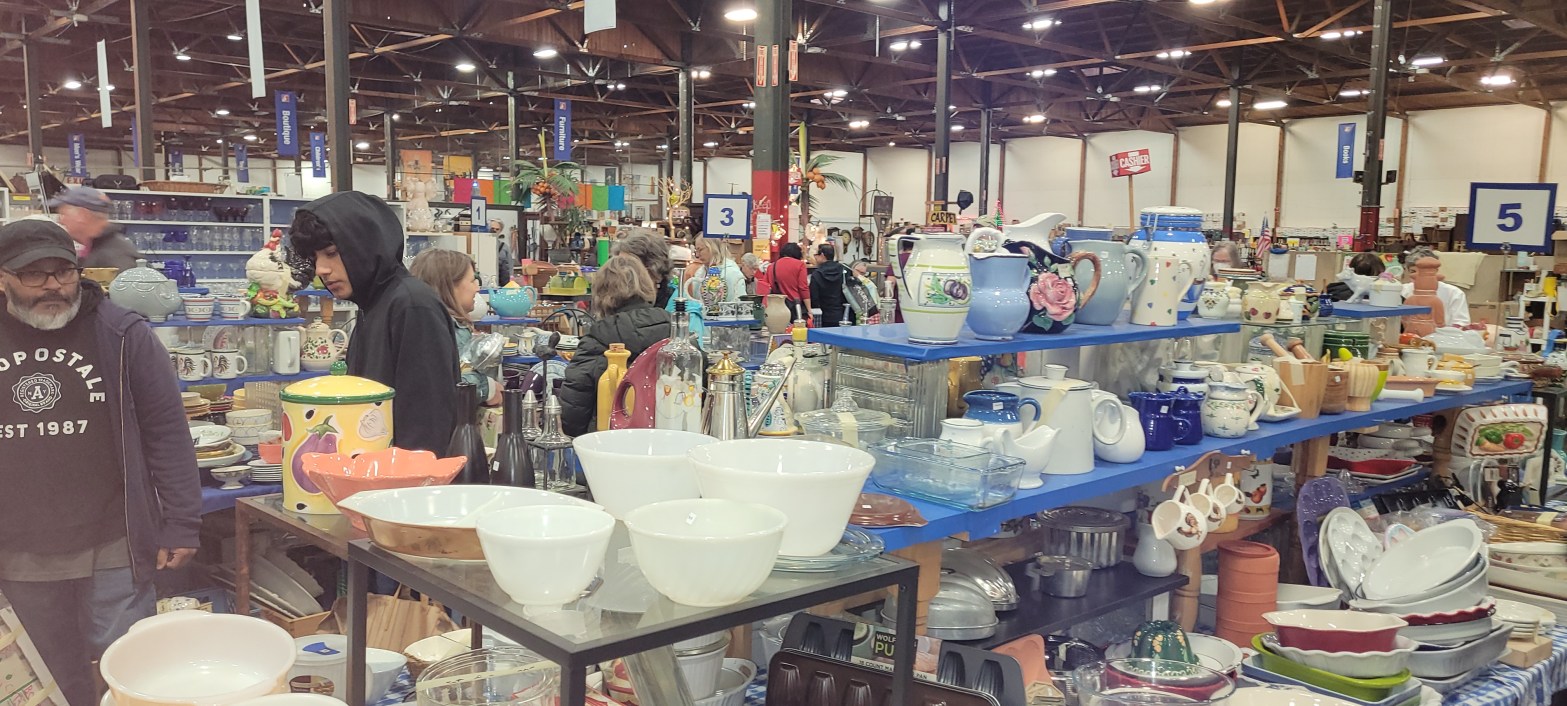
Think of a football field, 100 yards long by 160 feet wide. The interior of the Oakland Museum’s White Elephant Warehouse is almost twice that size. The building is over 90,000 square feet. The organization organizes donations for sale into 17 huge departments: men’s clothing, women’s clothing, children’s clothing, sewing, linen, kitchen appliances, China, dishes and baking ware, tools, garden, art, bric-a-brac, toys, musical instruments and music, lamps, furniture, and accessories.
My heart fluttered like a hummingbird in flight as I entered the building.
We rushed like we were being followed by bears, turning right for the garden department. Lily immediately found two metal buckets and a watering can. She grabbed them and got in line to check out. Buyers must check out their treasures before leaving a department. The volunteers write up a receipt, wrap up the items, and take payment. Or, like we did, you can pay for everything at a cashier near the exit.
Becky found a trellis, clutched her fingers around it and got behind Lily. As I passed them, Lily pointed to two more watering cans and asked me to get them for her.
After the garden department, we separated, each of us following our personal whims. As I wandered in the dishes and baking ware department, I joined hordes of treasure-hunters in picking up items, inspecting them, and then either tucking them under their arms or putting them back on the shelf for someone else.
Teapots, mugs, bowls, plates, platters of all sizes and design, wine glasses, glasses, cast iron skillets, ladles, cutlery, and a hundred other kitchen items covered table after table, shelf after shelf. There was pewter, pottery, stainless steel, stoneware, glass, and copper.
I found sixteen 4-ounce canning jars with lids for my sister who loves to can. I also found a white mixing bowl for my daughter. I would’ve bought something for myself, but I knew my cupboards at home were full of treasures from past sales. I have a white oval platter that I bought last year and three glass serving bowls from other years.
Becky went to the art department and bought a pastoral painting in an ornate wooden frame. She also bought dishes. Lily bought a 24-inch brown wooden bench to put near her front door.
After much wandering from China to art to bric-a-brac to furniture to everywhere, I found a 30-inch garden statue of a young girl holding an umbrella. I hemmed. I hawed. I walked away and wandered some more. I watched a few other women touch the statue and look at it from several angles. I turned it around, placed it on a table, stood it on the floor. I considered its color—a shade of verdigris. After walking away several more times, I came back.
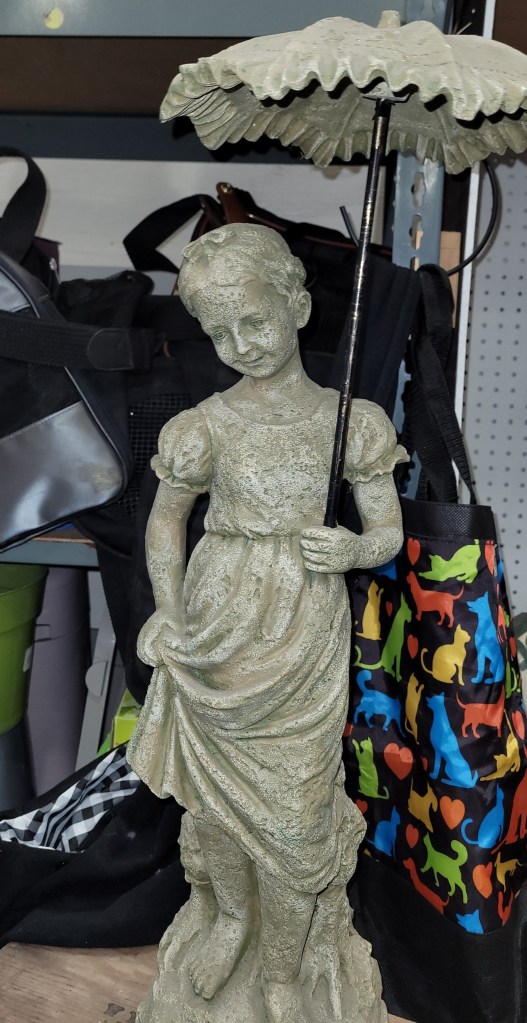
Finally, it was noon, and my friends would be about finished with their hunting, so I picked up the statue, tucked it under my arm, and got in line to check it out. It was heavy, so, while I waited, I put the statue on the floor and nudged it forward inch by inch.
Even if I didn’t like it, I was supporting the museum. And it was cheap.
We packed our treasures into the back of Lily’s car. In order to fit into the back seat, I had to push Becky’s trellis and painting over. I leaned them against the inside of Lily’s bench legs so they wouldn’t decapitate me if Lily stopped short in traffic.
Teasing drops of rain hit the windshield. Gusts of wind shook the car as Lily navigated out of Oakland and back into suburbia.
I got great deals. Becky came out with a few bags of bargains, and Lily, well she brought home several packages of treasures.
Thank goodness we bought treasures instead of white elephants. Our yards are too small for an elephant.
 Tess Perko's Blog