I sat down on the wooden bench in Sycamore Park and pulled Sadie’s leash toward me.
Sadie was an English Settler that I had rescued from the San Francisco Animal Rescue Foundation five years ago. The therapist said that she had been flown from Turkey where she lived on the street for several years. When I adopted her, she was only thirty pounds, so skinny that I could see her ribs.
Sadie turned away from the concrete path and sat down in the grass at my feet. She was always looking for a reason to sit down since she was getting old. After five years of good food and snacks, however, she had gained fifteen pounds and was in good shape for her age. Sadie arched her neck to look up at me, showing her crooked grin of contentment.
I sighed loudly, feeling my breath exiting through my teeth. It’s good I had a dog. Otherwise, I’d be completely alone.
Two years ago, I left my husband, Arsen, of five years. Really, I shouldn’t have married him. I was twenty-five and didn’t even know what my values were, much less his. I met him in Greece while I was living there for a year. He moved to San Francisco when we got married, but he brought his Greek values with him. We didn’t think about work the same way. He missed his family and forgot that I was his new family. What a mess we both made of it all. We were still waiting for the final divorce papers.
Since then, I’ve had two jobs. But now I’m unemployed. My boss said I did good work, but the company had to cut me anyway. I could hardly afford to pay my overpriced rent, much less have enough money for food. I thought my mom and dad would give me some money when they found out that I lost my job. But no. Seems like I was on my own.
I spent every day looking for a new job. Application after application. A few interviews and then . . . nothing. Even my friends were losing their jobs. Cali’s husband had just lost his job, and Cali was having a baby the next month. Whoa.
I looked down a Sadie who was now flat on her side with her legs sticking out. She looked comfortable.
My phone buzzed. It was Mom. I let it buzz on.
“Why does Mom keep calling me, Sadie? I don’t want to explain that I spend every single day trying to get a job.” Sadie tilted her head off the ground at the sound of my voice and looked into my eyes.
“She’ll tell me to budget better. I know that.” Sadie tipped her chin up and barked so slightly that it sounded like a cough. “Yeah, you agree with me. Good girl.”
I had met a lot of guys since I left Arsen. First, there was Colin, who was immature and acted like a clown. Then came Philip, a scientist, who soon moved to Boston for a new job. After Philip was Anders. He was smart, but oh-so-boring. And now I was dating Amir, who was born in San Diego, but whose parents immigrated to the United States from Iran.
My friends really liked Amir. They thought he was considerate and stable, something that Arsen never was. They invited him to all their parties and sought him out to talk to him. I was happy about that. They didn’t like Arsen that much.
But sometimes, Amir made me so angry. He was so jealous of Arsen, and never said anything good about him. Arsen always said nice things about Amir. I reached down and rubbed the side of Sadie’s belly. She groaned in appreciation.
“Does that mean that Amir isn’t a nice guy?” I asked Sadie, who closed her eyes as I continued to rub her belly.
I had once asked my mom if it was a mistake that I had left Arsen. She said, “No.” I told her that Arsen had always been excited about asking me about my life. Amir didn’t ask me those questions.
“That’s not what you said when you were married to him, Dani,” she said. “You complained that he wouldn’t eat dinner with you, and he didn’t want to hear about your job. Instead, he’d sit in front of the television until late at night, long after you went to bed.”
I just want life to be the way it was with Arsen when we had good times. I feel so alone.
When my mother was rested and happy, her eyes were the color of bluebells. During late March in England, bluebells carpeted the forest and unfarmed hillsides. Each blossom was a bell, a delicate invested cup the color of a late summer sky, rolling over acres of mature cornfields. A sky on a day after the rains have stopped, unadorned and simple in beauty. Their petals are the color of periwinkle, like cold water lapping over a pool of shallow rocks beside a shore of snow. The blue of smooth silk dresses and spring tablecloths. In full bloom, these blue cups tilt toward the sky hiding the earth with a shimmer of sapphire sheen.
When I was eleven, I stood at the edge of the bluebell meadows, feasting on their color. Running back to the house, I grabbed the bucket used for scrubbing to carry the bluebells that I wanted to take home.
My mother’s home was lacking in softness; beauty took a back seat to the basic necessities involved in caring for her ten children.
Then, in my mother’s life, the day included no time for picking and arranging flowers. She woke up children, fried bacon and eggs, supervised the wearing of school uniforms, matching socks, coats, and hats. In the mornings, she gathered piles of laundry, washed it, ironed shirts, smoothed tablecloths, swept floors, and made beds. Dinner was such a tremendous feat to accomplish that its beginnings were initiated right after breakfast. My mother’s daily crowning achievement was sending her children to school with clean hands and clothes and feeding them a hearty dinner each night.
The bluebells started at the edge of the trees. As I entered the woods, my legs became tangled in the cluster of their stalks. Crouching into the sea of blue, I found the base of each flower, gently bent its stalk, and twisted it loose. Milky nectar oozed over my fingers and down my forearms like pancake syrup, sticky and viscous. I held the flowers close to my face to inspect the little bells as they shook in the breeze like bells around the necks of cows walking through a pasture. Then, carefully to prevent crushing them, I placed each long stem into the bucket so the blossoms poked out of the top.
On the way to a full bucket, I examined the hairy moss on the barks of trees and the other gifts that the woods offered. In-between picking the bluebells, I cradled fallen chestnuts from under the greening trees, cracking their hulls and rubbing the shiny boot-brown nut underneath with my sticky hands. In the hollows between the trees, I found walls built with old dead tree branches, scattered rocks, and other debris from the forest floor.
Eventually, the bucket was full, and I skipped home with it swinging from my arm like the milk maids that I read about in fairy tales who carried pails full of milk from the barn to the house every morning.
I took out my mother’s two empty vases and filled them with flowers for the dining room table and the bookcase in the living room. After these were arranged, I stooped down to the cupboard where my mother kept empty jars, jars used for everything from leftover dinner vegetables to fish bowls for the brown fish we caught in the pond on the other side of the woods. I picked fat jars with large openings. When I tucked the bluebells inside them, they were transformed into wide-mouthed jars of crystal. The stalks showed straight and strong through the sides of the jars, and the bursts of bell blossoms sprayed over the ridges, bursting with profusions of blue so intense that, as I admired them, I felt like my feet rose off the floor and my heart fluttered like the wings of a hummingbird.
Once the bucket was emptied, every room in the house was accented by a bouquet of bluebells . . . on a dresser here, table there, or a windowsill.
My mother passed me as I stood back to appreciate their beauty. Her eyes creased into jewels, and, at that moment, her irises were the same hue as the petals of the bluebells, even though she wasn’t rested and had a whole list of things to do that day.
Some women have a favorite perfume brand, like Chanel. Other women have a favorite fashion designer, like Gucci. My mother Rose Marie, though, has a favorite brand of chocolate, See’s Candies.
I remember the days when my parents would buy a variety of chocolates—Cadbury, Lindt, Godiva, Ferrero Rocher, and See’s; they covered their wooden coffee table with boxes filled with little paper cups of assorted chocolates. One by one, they sampled chocolates from each box, evaluating each one for the best texture, sweetness, richness, creaminess, and chocolate quality. The winner, hands down and every time, was See’s Candies.
My mother was born on September 1, in 1928 on a farm in Pine Creek, a little hamlet in Southern Wisconsin. Her mother was Florence Jereczek, a tiny woman with big opinions. Her father was August Jereczek, a not-too-tall man, lean and truly in love with his wife. After Florence died, he used to reminisce about how her hair was fluffy, kinda like a Brillo Pad. Then he’d smile and look up at the clouds.
My mom had three sisters with whom she clucked like hens whenever they got together and over the phone on a regular basis. She had one brother who sported red hair and an Irish temper, but they were close anyway.
Mom graduated from high school with a practical attitude. She didn’t think she was smart enough to be a nurse, and she loved to count and think about money, so she became a bookkeeper. She met my father, Paul, at a dance in the nearest town across the state line, Winona, and they dated for seven years before getting married. You see, he was a farmhand for his grandfather, and my mother didn’t want to marry a farmer. Finally, my dad joined the Air Force in the spring, and they got married the coming September.
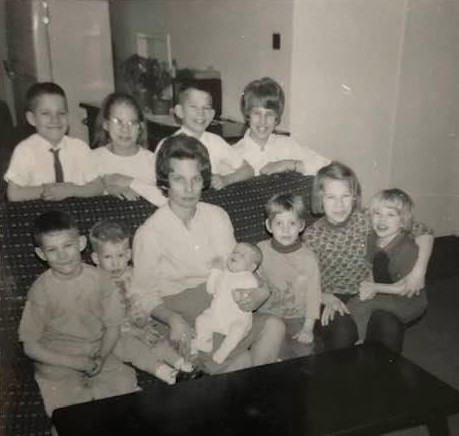
Paul’s dream was to have nine kids, like one of his uncles. From Alabama to Minnesota to California to England, they pumped out babies one by one until they reached ten.
* * *
Now that my mother is 92 and I am a senior citizen myself, I am reflecting more than ever on how much I appreciate her. I am grateful for so many things:
My mother visited me when I was two and in the hospital for an eye operation. When she left, she kissed me on the cheek and told me she loved me. I thought that was generous of her, considering that she still had more kids at home to love;
My mother felt sad when President Kennedy and Elvis Presley died;
My mom danced the polka like a top with my lanky father around a dance hall;
She introduced me to my dozens and dozens of aunts, uncles, and cousins who mostly look like a different version of me;
She bought a goat to milk when I was born because I was lactose intolerant;
She showed me how to make butter and ice cream by hand, and how to skim the cream off the top of pasteurized milk and eat it from the same spoon;
My mother taught me the names of numerous flowers and home-gown fruits and vegetables;
She allowed me to decorate every room in the house with Mason jars filled with wild flowers;
She worked on the school board of my high school;
My mom convinced me that I was a good clothes folder and ironer so I could stay in the laundry room folding mountains of clothes and getting some alone time. (I’m still good at folding and ironing. Hire me;
My mother at first resisted, but finally smiled when my dad sang “Smile a little smile for me, Rose Marie:”
She demonstrated to me what commitment and loyalty mean;
She gave me her fur coat so I can pretend that I’m as pretty as she is;
My mom loved my two children as much as she loved her children;
She treated motherhood like the greatest profession that ever was or will ever exist because raising children is building a community;
She illustrated how to develop both male and female friendships;
She showed me that forgiveness may be hard, but it can also lead to future love and happiness;
She loved money and slot machines even though my father hated gambling;
She loved each and every one of her children even though we are as different as color crayons stuck in the same box;
She can talk to my husband Bob about golf even though she’s never played it herself;
Her white hair is as pretty as cotton candy and her skin as lovely as fresh bread from the oven;
She didn’t try to understand the Bible too well because “that’s what priests are for.”
My mother didn’t think she was smart, but, in her view, average intelligence provided more options. She didn’t think she was beautiful, but in my eyes, she was a lovelier Polish version of Sophia Loren. She wasn’t a great cook, but she canned enough tomatoes and pickles to feed an army. She filled enough jelly jars to supply every church bazaar and Catholic summer camp. My mother wasn’t extravagant, but she played slot machines like they were on the endangered list.
What my mother was is sweet—the See’s Candy kind of sweet—rich in flavor, a little funny with not too much sugar. She didn’t require special treatment like refrigeration. You could put my mother on a dark shelf and, in no time at all, her shelf would become your favorite place to find comfort and unconditional love.
I asked my 91-year-old mother if the Corona Virus Pandemic was as bad as World War II.
“It’s worse” she said. “During World War II, we could go outside. We worked. We played. We walked in the sun.”
She was in eighth grade when Pearl Harbor was bombed, and a junior in high school on May 8, 1945, the day the Axis powers surrendered.
“When we heard the war ended, everybody ran outside and celebrated. We partied all night,” she remembers. “I don’t think that’s going to happen this time.”
What I heard in my mother’s voice was hopelessness. As we talked on the phone, she sighed over and over again, anxiety filling each breath with fear.
During the last six months, I’ve been on a clear journey of trying to develop my own cultural humility so that I can become a stronger college professor and help my marginalized students better succeed. When I heard my mother’s sighs, however, I recognized that I could work on developing some cultural humility within my own family relationships.
Two and a half years ago, when my mother became unable to care for herself at home, I and my siblings helped her move into an assisted living facility. Since we have a LARGE family, all of us have contributed to visiting her regularly, taking her shopping, driving her to her doctors and dentists, paying her bills, completing her tax returns, buying her supplies, taking her shopping, and planning family holidays and birthday parties for her to attend. From the perspective of being loved, she has been the luckiest mother and grandmother in the world.
My mother, however, has macular degeneration, can’t read small type, and finds it difficult to sign her name. Instead of engaging in activities such as reading, she has created a new life for herself at her assisted-living home by socializing with other 90+-year-old women, exercising, playing BINGO with giant BINGO cards, and participating in discussions about topics found on Google. I am impressed with her ability to form relationships with new neighbors and, also, with her caregivers. She keeps track of their lives and even gives them some of her firmly-expressed advice.
“Don’t go on walks by yourself, Miriam,” I saw her tell one of her new friends. “You could fall and break your hip.”
“Did you run that marathon last weekend, Sylvia?” she asked one of the waitresses at lunch when I was eating with her one day. I didn’t even know my mother knew what a marathon was and was even more surprised that she was interested in people who ran them.
My mother never was a strong reader. At one point during her retirement, she joined a Bible group at her church. She attended two of the meetings and then gave it up. “Why’d you stop going?” I asked.
“I didn’t understand anything,” she said. “That’s why we have priests.” Instead of thinking too much about spiritual values, my mother is comfortable just following rules and using already-prepared prayers to get her into heaven.
Clearly, she is not the philosophical type, but she’s excellent at belting out orders to her children or care-givers. If she had been born later in the twentieth century, she would have made a formidable general in the military; she knows how to command and expects complete compliance.
She’s strong at math as well and likes to think about how much money she has in the bank and plays Solitaire. She also loves to pull the handles on slot machines whenever she can manage to get a ride to a casino. A numbers gal, for sure.
Which means, when the Corona Virus Pandemic forced her assisted living facility to shelter-in-place, her strengths did not prepare her for staying in her apartment all day by herself. She’s a social animal, not a solitary thinker.
She’s endured the slowly-dwindling social activities at her facility. First, visitors had to use hand sanitizer, then they were locked out. The residents played BINGO while sitting six-feet apart, then they perched in chairs at the doorway of their apartments and followed their exercise leader while using their own personally-assigned exercise props. Now, all social activities are terminated, and, if residents want to talk to each other, they have to make a phone call.
The trouble is, unless my mother has your phone number programmed into her cell phone, she can’t phone you. She can’t see well enough to punch in a new number on her phone, and her children can’t visit her in order to program new numbers for her. This means she can only call people who are already in her phone, albeit, she has nine children, numerous relatives, and several friends already ready to dial.
But as we’re all finding out, a person can only spend so much time on the phone, watching movies, or doing whatever it is he or she has found to do during this shelter-in-place.
It’s hard being old, and harder being aged when you can’t even fill your days with pleasant activities. Being cooped up in an assisted-living facility might feel like being in prison. You’re probably not planning on going on a vacation the next summer or even buying a new home. The activities that you can look forward to—going out to lunch, visiting nearby lakes and theaters, or shopping at Raley’s once a week on the facility bus—all have been cancelled until further notice.
My siblings and I are sending letters to my mother in large type (48-point font) so she gets more mail that she can actually read. A few of us have sent her flowers, which she loves to watch bloom on the desk in her room.
Two of my sisters have created word puzzles for her; unfortunately, word puzzles are related to reading, and not one of her favorite things to do. She admitted to me that she tries to cheat on the puzzles by asking her care-givers to look over the puzzle and point out a word or two. I thought she taught me not to cheat, but I never experienced a pandemic during my childhood, so maybe there are exceptions.
This is why my mother is making heavy sighs over the phone. She has played too much Solitaire, watched too much news, listened to too many soap operas, and spent too much time waiting listlessly for the next meal.
My quest for more cultural humility seems to apply here. I might be able to help her weather this shelter-in-place.
Cultural humility encourages me to develop empathy for how my mother feels and what she is experiencing, not as I would, but as she does. I asked myself, what can a person do if she can’t see or talk to another person very often? In addition, what would help my mother attain a greater level of peace while she socially distances during this pandemic? Since my mother is a doer and socializer, not a solitary thinker, my ideas must keep that in mind.
Perhaps I can also consider what her life achievements have been; in my mother’s case, she grew up on a farm, worked as a bookkeeper, was married for 52 years, raised a brood of children, served on the school board and church council, worked in voter polling places, and practiced traditional Catholicism her whole life.
As I thought about ideas for her, I kept seeing that red recliner in her apartment, situated so perfectly in the corner of the room, so she can hear sounds from both outside her window and from all parts of the apartment. I also thought about how to help her decrease her anxiety.
Since she is a doer, I felt that short activities would be best, and, for the anxiety, I thought that I could suggest activities that encouraged a meditative state—because, on her own, she would never engage in meditation, thinking it was too foreign and too hard. This is a woman, remember, who wants fast results.
Also, my ideas would have to be typed in 48-point font, meaning that I can only list as many large-type activities as I can fit onto one or two pages.
So, at four o’clock in the morning, when my sleep was interrupted by my thoughts about her, I got up to type my suggestions. I set up my computer to 48-point font in a landscape layout and typed up “Corona Virus Shelter-in-Place Things to Do.” Here is a sample:
1. Pray the rosary for your own intentions.
2. Breathe slowly 5 times.
3. Stretch your fingers and toes, one at a time.
4. Picture flowers,one at a time, and name them out loud.
6. Think about people you love, one at a time.
7. Create math problems for your great-grandchildren, then call them and tell them to solve them.
8. Create a new prayer and say it out loud.
9. Compliment a care-giver.
10. Lift your arms 5 times.
11. Close your eyes and think about a candle burning.
12. Remember funny events, one at a time.
13. Tell a joke to a care-giver.
14. Watch a talk show on television.
I typed half of these suggestions on one page, put them in an envelope, and mailed them today. I put the other half in a second envelope to mail to her next week.
I’m not sure if my attempt at cultural humility toward my mother will help her navigate through this crisis. I’ll have to wait until she lets me know.
Oh, believe me, General Mom will be letting me know.





 Tess Perko's Blog