
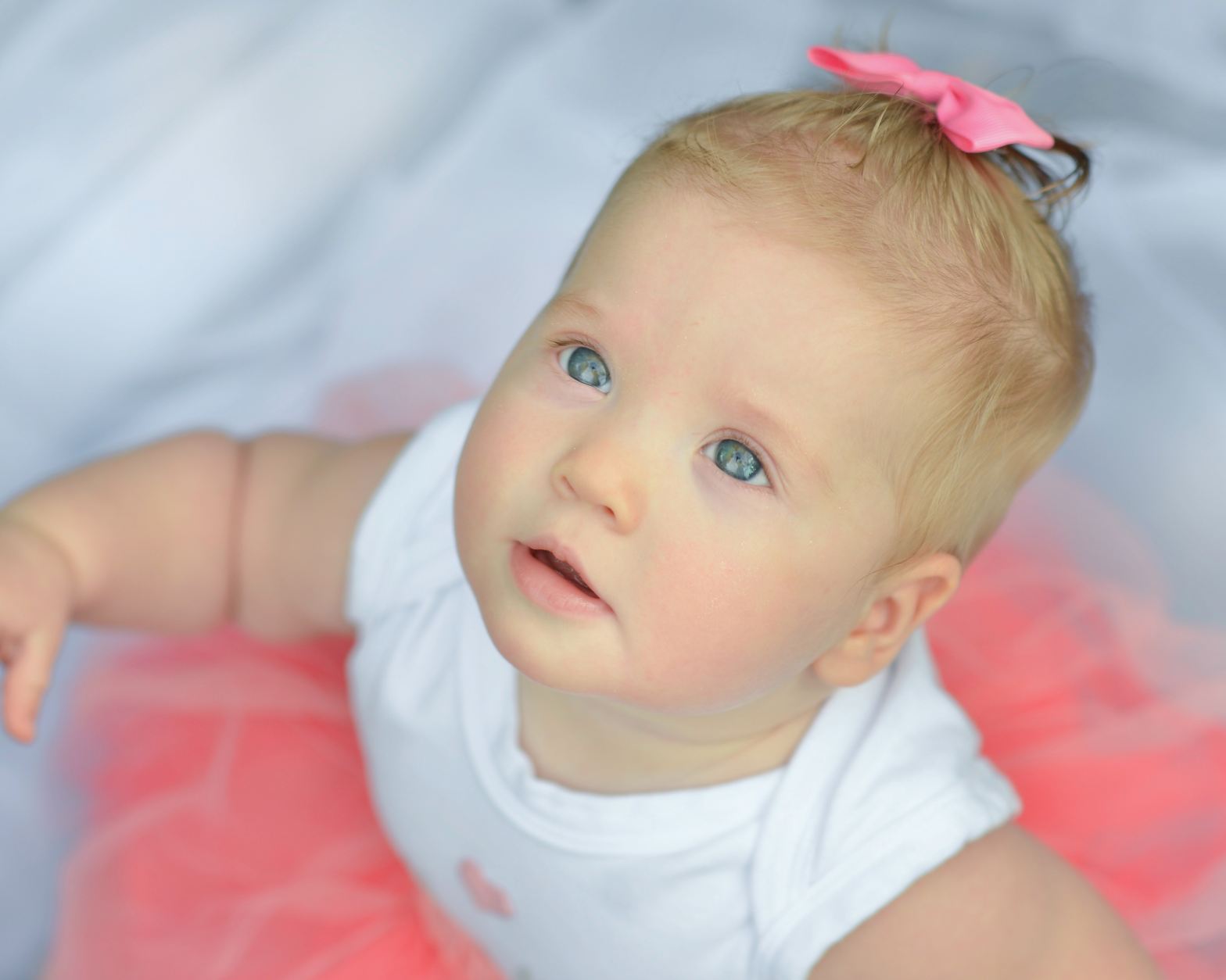
Photo by Cristina Anne Costello on Unsplash
Good morning. My name is Tess, the third child in a family of ten children and Carol’s older sister. Carol was the sixth child in our family, born on October 20, 1960 at Mather Air Force Base hospital in Sacramento.
As a baby, Carol was a pretty little blonde girl with fine hair and features that mirrored her mother’s: a long forehead, an awfully straight nose, and a smile that created dimples in her cheeks.
Carol loved, loved, loved music.
She enjoyed old-fashioned country music by the likes of Hank Williams who wrote “Hey Good Lookin,” which she heard when Mom and Dad played the radio.
When Carol still lived with us, Beverly, Carol’s oldest siter and another musician in the family, sang songs to her, such as “Do, Re, Mi” from the musical Mary Poppins and “My Favorite Things” and “Edelweiss” from The Sound of Music. Carol smiled, laughed enthusiastically, and sometimes rocked to the beat.
Just before Carol died, Ron and I visited her in the hospital. She was anxious, and the only noises in the room were the beeping of the medical monitors. We turned on some music by the Russian composer Sergei Rachmaninoff. Immediately, Carol turned her head toward the music speaker and calmed down. Her eyes gleamed with joy.
We believe Carol would have been a great musician if she hadn’t suffered from Cerebral Palsy.
Carol possessed determination.
Even though she didn’t speak, Carol had ways of letting people know what she didn’t like. Whenever someone tried to brush her teeth or feed her sour fruit, she clenched her mouth closed to prevent anyone from getting anything past her teeth.
While she was in the hospital, Carol demonstrated determination as well. She didn’t like having oxygen tubes in her nose, so she moved her head from side to side until they fell out. One time, after I had inserted the tubes back in, Carol used her left hand to accurately bump the tubes out of her nose and above her head. A look of satisfaction spread across her face as she became free of them. I laughed out loud realizing that her spirit was still strong and impressive.
Carol was sometimes mischievous and annoyed.
One time when Margaret visited Carol while she was living in transitional housing, she found a caretaker feeding her.
Margaret knew that Carol had been attending school to learn how to eat on her own, so Margaret said to Carol, “Carol, you know how to feed yourself.”
Carol swallowed, looked up at Margaret, and laughed heartily.
Apparently, she was hungry, and, if she had to feed herself, it would take much longer. She knew what she was doing.
When Carol was annoyed, she set her mouth in a tight straight line to let us know. Her expression was so like the countenance of Mom’s face when she was irritated that we recognized it easily.
Carol enjoyed the support of a loving family throughout her life.
Our parents’ greatest gift was a strong family bond, and Carol was an integral part of our family unit.
Carol lived with our family for nine years. When she was a little girl, I lifted her onto the swing and pushed her. She raised her face to the sky to feel the breeze. I also took her by the hand and walked her around the back yard so she could see the animals. Her eyes followed the ducks and chickens as they strutted around for food.
When we flew to England to live for almost four years, I sat next to Carol on the plane. I thought I was luckier than my two older sisters because they had to take care of more siblings than me. As long as I took good care of Carol, Mom was happy. I danced stuffed animals in front of her, fed her the airplane food, of which she didn’t complain, and sang her to sleep.
After we returned from England, my parents decided to arrange for Carol to live in an assisted living home. One of her homes was in Santa Clara. At the time, I worked in Santa Clara, so, once a week, I visited Carol and fed her dinner. Sometimes, I was able to take her outside to enjoy the warm sun and soft breezes by the Bay. We sat on the expansive lawn under the shade of an oak tree, and I told her stories about the people in our family while her hazel eyes stared at my face.
Margaret and Liz also visited Carol in Santa Clara. First, they went to Great America for a day of fun, then called Carol’s facility to see if they could visit. Since they were arriving after visiting hours, they knocked on the back door. Once admitted, they sat next to Carol in the sitting room and told her about their day at the amusement park. Since Margaret and Liz love roller-coaster rides, they described the thrill of bouncing up and down and all around, and Carol stared at them, probably day-dreaming about a calmer choice such as “It’s a Small World.”
Finally, my parents arranged for Carol to move to Sacramento so she could live closer to them.
Once, while visiting, Margaret took Carol to Starbucks and ordered her a Strawberry Créme Frappuccino. She wheeled Carol outside since it was summer and she wanted Carol to enjoy the good weather. Margaret held the Frappuccino up to Carol’s mouth and told her not to drink it too fast or she would get a brain freeze. Carol eagerly sucked quickly through the straw for a few seconds, then let the straw go, wrinkled up her nose, and squeezed her eyes shut. Oops, she got a brain freeze.
When Carol moved to a home in Penryn, she was extremely popular with her roommates. She had more visitors than anyone, and her roommates thought she was Miss Congeniality. When we visited her, not only did we talk to Carol, we spent time with her friends. The joy on all the faces was rewarding. We felt popular, too.
Mom and Dad supported Carol throughout their lives, making sure she was well-cared for wherever she lived. Often, they brought her home for holidays such as Christmas so everyone could see her. Carol even showed up at Mom and Dad’s 50th wedding anniversary at St. Mel’s Church, accompanied by her caregiver.
Later, after Dad passed away, Mom visited Carol as often as she could even after she moved into an assisted living facility herself when she was 89. Whenever Carol saw Mom, she didn’t have eyes for anyone else. She gazed into her face with a tender look of love, often accompanied by a smile.
Mom was a dedicated mother; she called Carol’s home every Sunday afternoon to check up on her. Our parents also purchased a burial plot for Carol next to their own so she could rest beside them.
Closing
We will miss Carol. Like any sibling, she was our friend, our companion, our entertainment, and most of all our teacher. She inspired us to slow down our racing lives to enjoy basic joys and connection with her. She showed us the value of unconditional love and how to practice it. She taught us that family bonds go beyond childhood and are maintained by commitment.
Our lives were and still are enriched by hers, and we are grateful to God that she was our sister.

 Tess Perko's Blog