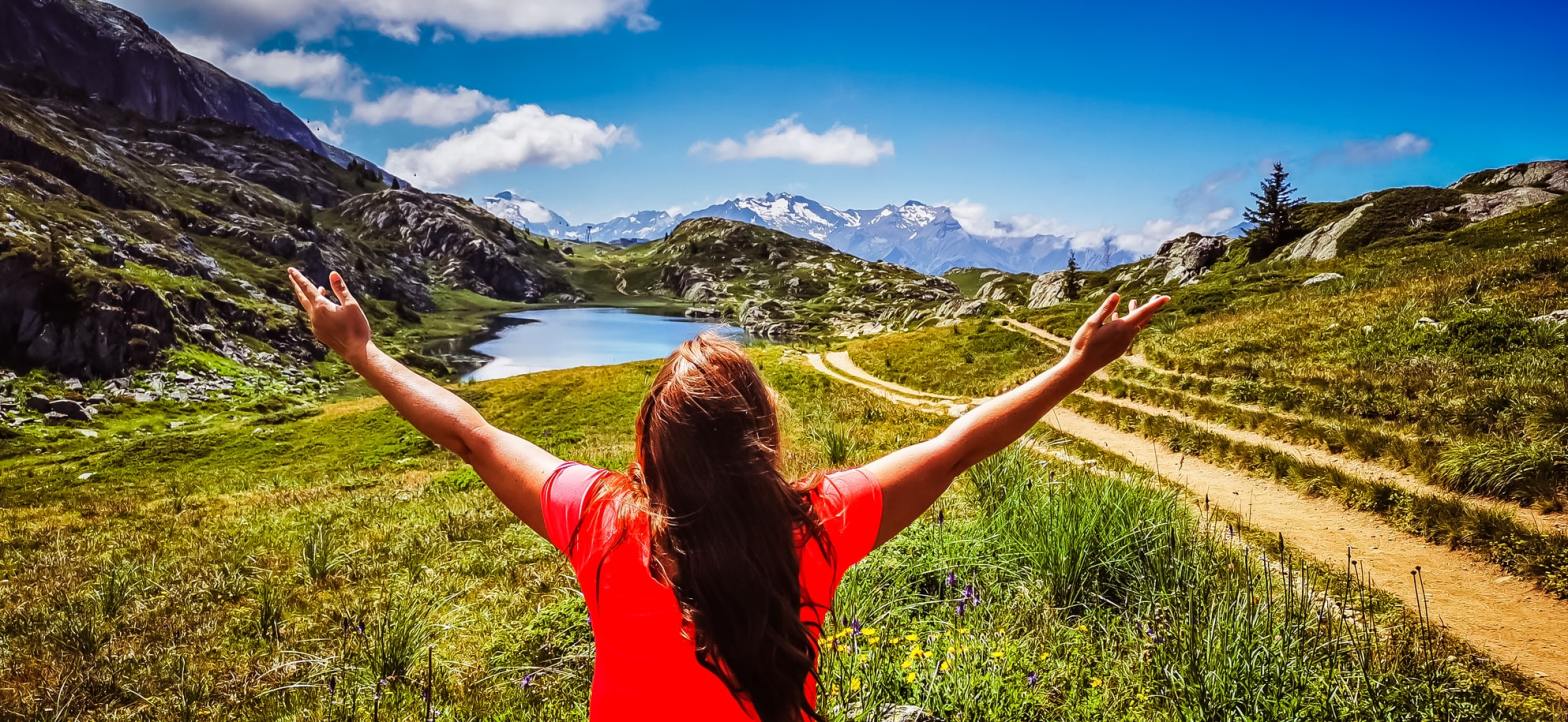
Making a Plan to Have Fun

This is not my idea. I got it from my daughter who is the most entertaining person in our family. She’s an adult—thirty-three-years-old—who loves to have fun. What she did is to make a list of things she wanted to do during Fall to make her life more enjoyable. She downloaded a free template from Canva and made one column for the activity and another for checking it off when she completed it.

What did she include in the columns? Well, for one, nothing cost a lot of money. One thing she wrote was to buy paper Halloween cups to enjoy when she had coffee. She has a dog, so she walks a lot, and a holiday coffee cup would be a super conversation starter for all the other dog walkers in her neighborhood.

Here are some things I would write:

  • To make lamb stew
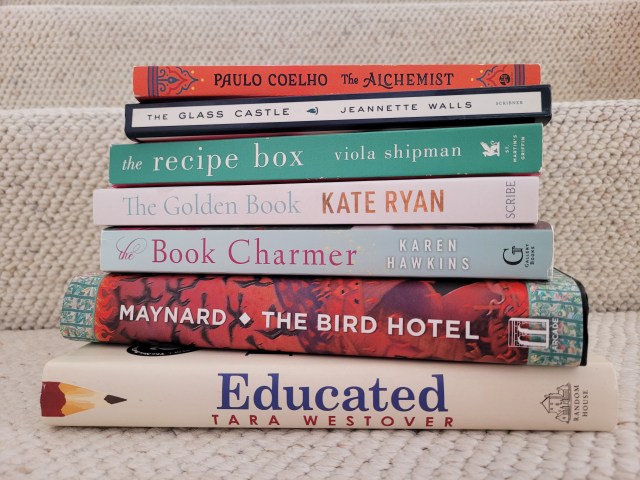
  • To read On Writing: A Memoir of the Craft by Stephen King
  • To watch a movie in a movie theater
  • To take flowers to a friend that needs cheering up
  • To go to a craft fair with a friend
  • To take a hike to a natural labyrinth near my house
  • To visit my local library
  • To wander around in a large nursery
  • To prune my roses
  • To send my daughter a card for no reason except to say “I love you.”

Darkness and Loss

Photo by Tuvalum on Unsplash

Meira didn’t realize the sun would set so quickly.

Right after she got off work, she had hung her new mountain bike on the rack of her car and driven to Sycamore Open Space, just five miles from home.

She’d rented three different mountain bikes on three different weekends before she decided to buy this one. One bike shop was all the way down in Santa Cruz. She had driven down there to rent a bike and took a ride in the butterfly sanctuary near the ocean.  She’d loved the sanctuary, but not the bike. The other two bikes were from shops in Walnut Creek. Her third rental was the one she fell in love with. Sophisticated gears and a front suspension. It also put a dent in her savings account, but she was excited to have it.

When Meira started to ride up the dirt trail, the sun was dipping toward the west. She thought she’d have at least an hour of daylight in which to ride.

The beginning of the trail was flat. It meandered along the back side of a neighborhood of expensive houses, their manicured yards butting up to the golden weeds of the park. Gigantic oak trees shaded the path with strong leafy arms, and acorns crunched under the wheels of Meira’s bike.

At the end of the neighborhood, the trail rose to follow the curve of a hillside. As Meira increased her peddling, she noticed dried pads of cow manure covering the trail like dollops of brown paste. To her left, a foot-long gopher snake wiggled out of her way and disappeared into the grasses.

It felt wonderful to be out in nature. Work had been stressful. She had four meetings in the morning, one after another with members of her team from all over the world. Exhausting.

She’d spent the afternoon working on the graphics for the training video. Her eyes were tired from focusing so intently as she altered photographs and added special effects in all the right places. The only thing that kept her going was thinking about how she’d go for a bike ride after work.

She didn’t bring any electronics with her, not even her phone. What she needed was to be alone in the quiet landscape. No voices, no conflicts to solve, nothing but stillness.

The trail curved to a higher altitude, and Meira stood on the pedals of her bike to make it to the top of the hill. She noticed the cloudless sky turn a darker shade of blue. Yellow wallflowers poked their heads out from among the dry weeds on both sides of the trail. A few oak trees cast huge shadows over the hill as the sun sank lower.

She took deep breaths as she pumped the bike up the grade. Turning her head side to side to stretch her neck, she pushed her shoulders down and sat up as straight as she could. Finally, she reached the top of the ridge, braked, and put her feet on the ground.

She could see a panorama of golden hills and valleys, the hills rising higher and higher until they created the twin peaks of Mount Diablo. The gray-blue sky perfectly complemented the grasses that had taken on a rusty hue as the daylight waned.

In one of the valleys, a coyote slinked across a trail, its body strong and well-fed. Two hawks sailed overhead. They had red tails and enormous wingspans. She watched them make circles.

The path led down the hill, so Meira followed it in low gear, pumping her brakes to prevent from losing control. That side of the hill was gloomier than the western side. She’d make sure she turned around before it got too dark.

When she reached the bottom of the valley, Meira peddled fast to create momentum for ascending the next hill. She breathed deeply as she started her next ascent and stopped the bike where the trail met a second track halfway up the hill.

She’d never been down the Northgate Trail before, so she turned right and followed it as it circled around the hillside. A clump of golden poppies waved their blossoms from out of the weeds as if they were happy to see her. She was surprised to still see them still blooming in late October. The trail spiraled around the hill, slowly ascending to the top.

All of a sudden, Meira spied a dark, moving object in front of her. It was live, that was for sure. She braked and stopped the bike about a yard in front of it, leaned over the handle bars to get a better look.

A tarantula.

She had forgotten that the tarantulas migrated across the park in October to find a mate. This one was bigger than her hand.

Meira climbed off her bike and carefully set it on the trail. She crept quietly closer to inspect the spider. Fascinating.

The tarantula had long legs with little hooks on the two front ones. It was a male. She knew that the females had fatter bodies and shorter legs. They also didn’t have those little hooks that the males used to hold onto the female during mating.

Meira scanned the trail for signs of holes covered with white threads, places where female tarantulas waited to mate and then lay their eggs. She parted some of the weeds to search harder. No luck.

Well, this poor guy was going to have a long walk to find a mate. She sat down on the dirt about a foot away to watch him slowly crawl across the trail. He didn’t seem to mind her attention. He continued his turtle crawling, one furry leg at a time.

Before Meira realized, the sun had fallen behind the Las Trampus Mountain Range in the distance, washing the sky in a smearing of orange and red streaks.

She stood up, dusted off the back of her jeans, and nodded to the tarantula.

“Gotta go, Buddy. I hope you find yourself a girlfriend soon.”

Meira climbed on her bike and turned it around to follow the trails back to the parking lot. Their outlines were hardly distinguishable from the landscape around them. She pedaled as quickly as she could around the side of the hill to find the four-way stop where she had turned. As she passed by an oak tree, the path became so dark that she couldn’t see to avoid cow paddies or rocks in her way.

Finally, the reflectors on the four-way stop lit up like a single match in the dusk. She turned left.

The problem was, she still had to take the trail up the next hill and down the other side in the dark. Then she had to follow it behind the neighborhood to get to the parking lot.

She drove fast, hoping that she wouldn’t hit a rock and throw herself into the weeds. She reached the valley floor and started up the next hill when she heard the yips and howls of a coyote. Or maybe more than one. She shivered.

The oranges and reds of the sky had turned to reds and purples. Behind her, the sky was indigo. How long before all evidence of light was gone?

When she reached the top of the hill, she stopped to catch her breath. She was wheezing with fear, wondering where those coyotes were.

Would she meet a rattlesnake and not see it? Would she run over a tarantula? They were fine in the daylight, but not at night.

The coyotes insistent yapping cry rose again. Meira held her breath, opened her eyes as wide as she could to see through the dusk, and looked frantically around for moving shadows.

Without seeing more than a few yards in front of her, she started down the trail again, going slow so she wouldn’t fall off the bike. The temperature had dropped at least five degrees; cold air bit her face.

She couldn’t see where the trail flattened out so when she hit the bottom of the hill, the back of her bike jerked up and threw her off. She landed with her right leg stuck under the bike. Her right hand had landed on a rock and she could feel thick warm liquid oozing out of her palm. Blood.

Slowly, hoping she wouldn’t feel a furry tarantula or the scaly body of a snake, she untangled herself from the bike, stood up, groped around to find the handlebars, and pulled the bike up.

The neighborhood of expensive houses was a few yards ahead.

Whew, she was almost there. All she had to do was follow the flat trail behind the neighborhood to the parking lot.

Some of the houses had back lights turned on which cast enough light so that she could at least tell where the fence line was. The other side of the trail was pitch black since the massive oak trees completely blocked the fading sunset.

Meira pushed the pedals as fast as she could, following the porch lights and fence line. Up ahead was a lone street light. The entrance to the parking lot. She hiccupped a breath as she leaned over her handlebars to increase her speed.

The single street lamp created a circle of light on the ground. Meira stopped her bike underneath it and searched the small parking lot to find her car.

There it was. The only car in the lot, covered in shadows from the nearby sycamore trees. The only sounds she heard were the crickets chirping like cell phones in the blackness.

She was safe.

She walked her bike to the back of her car. The straps of the bike rack hung like despondent arms lost in the night. Meira shook her head quickly to dispel her fear, hoisted the bike onto the rack, and strapped it securely.

She unhooked the pack on the back of the seat and removed her water bottle. She had left her cell phone at home, so she didn’t have to worry about that.

It would be good to get back and have dinner.

Meira scanned the perimeter of the lot for signs of movement. Breathing shadows? Hungry animals that hunted in the darkness? Slithering or crawling predators? Seeing nothing but pitch blackness, she took a long, deep breath.

All clear. Let’s go.

She bustled up to the driver’s side of the car and reached into her back jeans pocket for her car keys.

They weren’t there.

What Really Makes Me Tick (Happy)

Wouldn’t it be a better world if everyone knew what they needed to be happy? I’m retired, and I loved my teaching job; however, now that I don’t have to commute to work five days a week or grade college essays on the weekends, I just want to do things that make me happy. Here they are.

Admiring Flowers

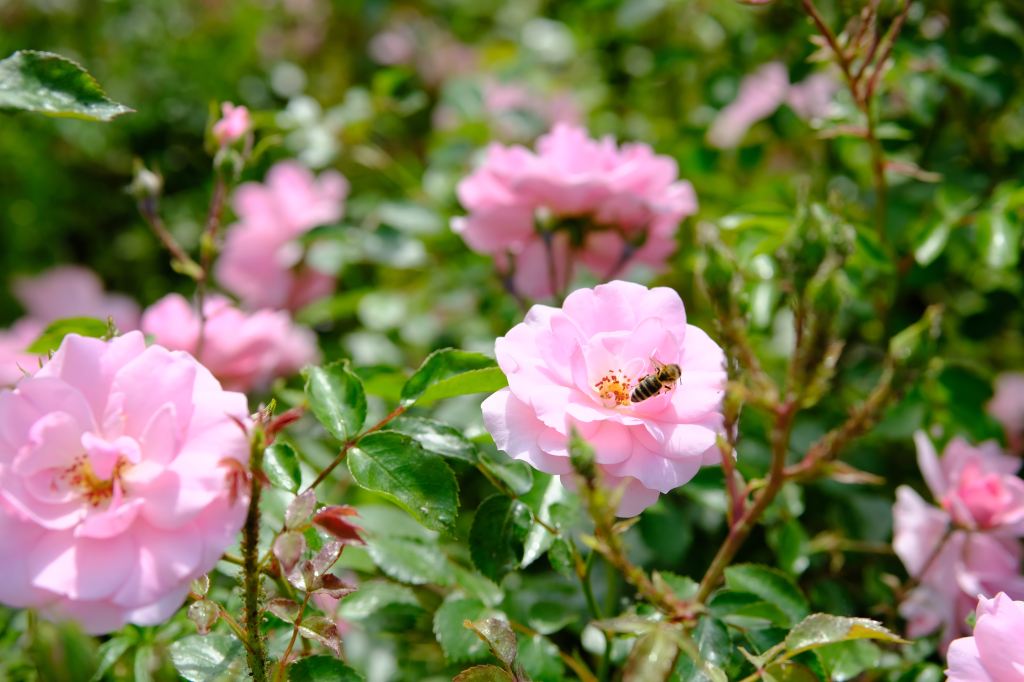
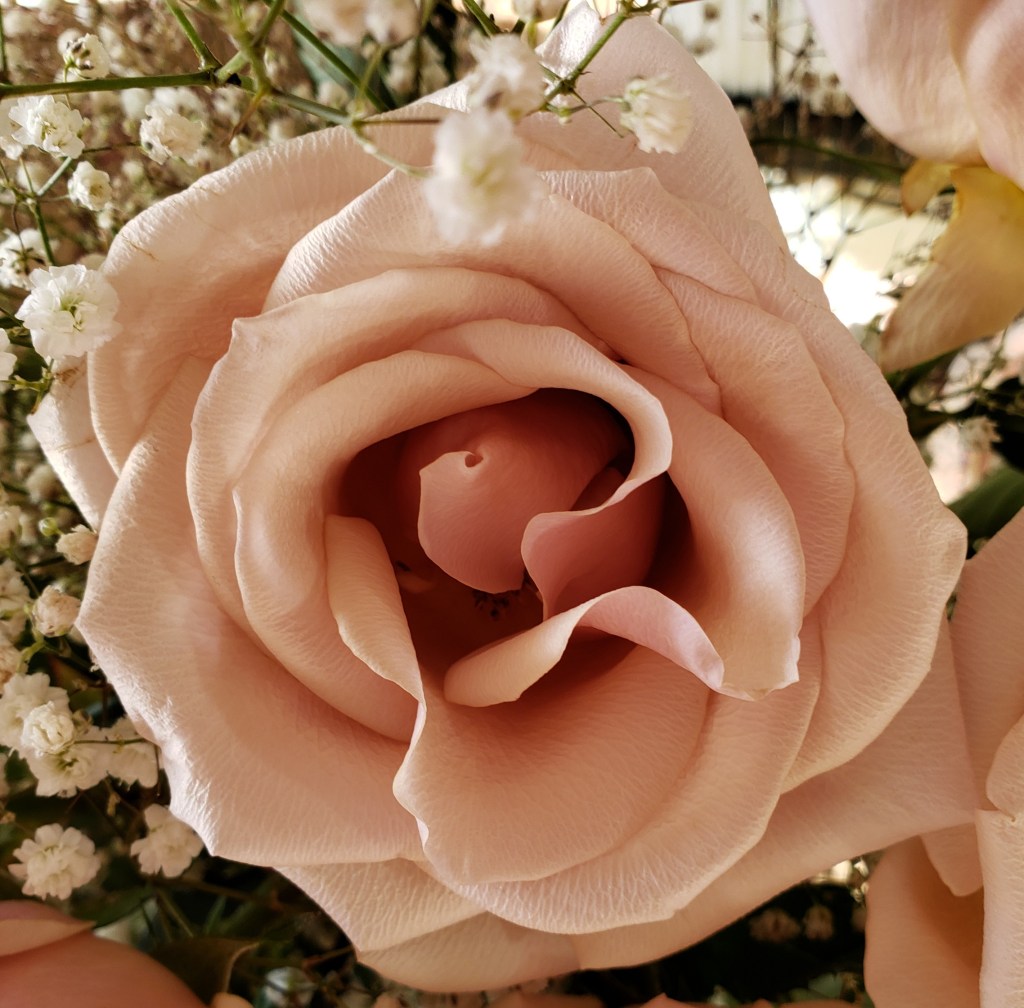
Stopping to smell a rose may seem like an unimportant action, but, when I do it, it brings me joy. I have rose bushes in my front yard and back yard, and every morning, I wander outside to inspect every bush to see the new blooms. I sniff and stare and smile to my heart’s content.

I remember the flowers of my childhood, too. In January, crocuses poked out of the soil in the flower beds in the front yard. In February, the daffodils came. Tulips arrived in March, and Irises after them.  By the time Lent was over, Easter Lilies grew like sophisticated ladies in white hats in our back yard. And in May, the meadows were carpeted with Bluebells.

For four years of my childhood, I lived in England with my family, and I was impressed by the colorful blooms of summer that thrived in the temperate climate. Rambling roses climbed up cottage walls. Cosmos waved their rainbow heads in the breezes like pretty bonnets. Hydrangeas brightened shady nooks of gardens with their puffy burst of blue and pink. I was entranced by their beauty.

At Christmas, my mother bought at least one Poinsettia to decorate the house. She bought red poinsettias, white poinsettias, and ones with white flowers with red stripes. Sometimes, she had an amaryllis bulb growing in a pot. Every day, I’d inspect it to see whether it was blooming or not. I was in more of a hurry than it was.

Making a Stew or Pot of Soup

Whenever my dad cooked, he made “water” soup. He added pieces of beef and vegetables to a pot of water to create soup. Ugh. We kids would cringe when we saw him taking out a pot. His were the worst soups I’ve ever tasted.

Maybe that’s why I love making delicious soups.

I own an old Dutch oven that is the perfect size for making one-pot meals. Some mornings even before I change out of my pajamas, I scour the refrigerator and pantry for the ingredients for a minestrone—onions, celery, carrots, zucchini, chick peas, barley, chicken broth, chopped tomatoes, oregano, salt, and pepper. Sometimes I add cooked shredded chicken. Often, I don’t.

Or I find the fixings for chicken noodle soup for a recipe from a William’s Sonoma Soups book that I bought a long time ago. While I’m chopping the carrots and celery for this soup and simmering the chicken breasts in the broth, I think back when I made this for my two children who loved it. I see their little faces above their steaming bowls, their hands holding spoons, their mouths filled with savory egg noodles.

On one European trip, I bought cookbooks in the Czech Republic and Austria, so when I want to make goulash, I search for recipes from those books. My favorite goulash is a beef, onion, and smoked paprika concoction that is topped with cornmeal dumplings. I first ate cornmeal dumplings at the restaurant at the Belvedere Palace Museum in Vienna. I’m still practicing to make mine taste as good as those were.

Reading Inside When It’s Cold Outside

To me, the essence of decadence is waking up in the morning, seeing that it’s cold and rainy outside, then reaching for a novel and reading it in bed. To take all the time in the world to read a story, then stopping and thinking about it is heaven on earth.

Reading when its cold outside reminds me of when I read as a child. I had time to sit on the floor in a corner of the house with a treasured book of fairy tales and get lost in another world. When my mother took me to the open-air market, I found the bookstore, walked to the back shelves, pulled out a tome, and read it while sitting on the floor. I was always afraid that the shop owner would find me and kick me out, but he never did.

Decorating My Home

When I was a child, we never had an expensive home, but that didn’t keep us from making it beautiful. In the spring and summer, I picked flowers in the meadows, poked them into vases and brightened every table and dresser in the house. In the fall, I cut branches of colored leaves for the mantel in the living room. For winter, my mother and I found pine cones and spray-painted them silver and gold for Christmas. We added holly and pine branch garlands in-between them.

Today, when a new season comes, I still have the irresistible urge to celebrate it with seasonal décor. Right now, I have a collection of pumpkins on my front porch accompanied by a little witch. I also have put pumpkins on the table on the back patio so we can feel the season when we go outside in the afternoons. Every time I pass these decorations, I feel like celebrating.

Writing

I wrote my first poem when I was nine years old, and I’ve been writing ever since. Sometimes, I use writing to help me sort out a problem. Currently, I’m the chair of a scholarship committee for a charitable organization. When I’m planning the meeting agendas, I write them to organize my thoughts. When I’m thinking about how to improve my author’s platform, I write my thoughts down. I write down daily affirmations and New Year’s Eve resolutions. I write every day.

Even when I’m traveling, I have a journal that I use to take notes or write a spontaneous poem. I remember one vacation that I took by myself to Boston. After I toured Paul Revere’s tomb and all of Boston’s historic sites, I drove north up the Atlantic coast. I stopped in Salem and visited another graveyard where a huge oak tree that had gotten so big over the centuries that tombstones were poking out of its bark halfway up. There was so much to write about. Finally, I stopped the car at the edge of the road near a beach. As I sat in the sand and gazed over the surging navy-blue sea, I wrote a poem about the peace that I felt.  

When I visited Sorrento, Italy, I stayed in the Grand Hotel Excelsior Vittoria. Our room had a large terrace that overlooked the Sorrento Harbor. Across the Bay of Naples with its slate-blue ripples, we could see Mount Vesuvius. Every day, I sat at the patio table on this terrace with my journal to write about the gorgeous scenery or about my excursions into the town of Sorrento or its nearby attractions. I wrote how my husband had to scrunch down going into the Blue Grotto Cave in Capri. I described the ceramic factories that we toured in Almalfi. With words, I wondered what it was like to be a citizen of Pompeii in 79 AD when Mount Vesuvius spewed its lava all over the populated city.

Now that I think about it, I’ve been doing these happy things my whole life. Naturally. Now, though, I have more time to do them. What joy.

How French Chickens Saved My Roses

A few months ago, I was touring through the gardens of Chateau Chenonceau in the Loire Valley in France with my husband. A guide had told us that the chateau used organic gardening methods for all the plants. As I walked past the gorgeous rose bushes, I wondered how the gardeners made them so healthy and beautiful. They had no black spot disease, no pests, and their blooms were vibrant and vigorous. What was their secret?

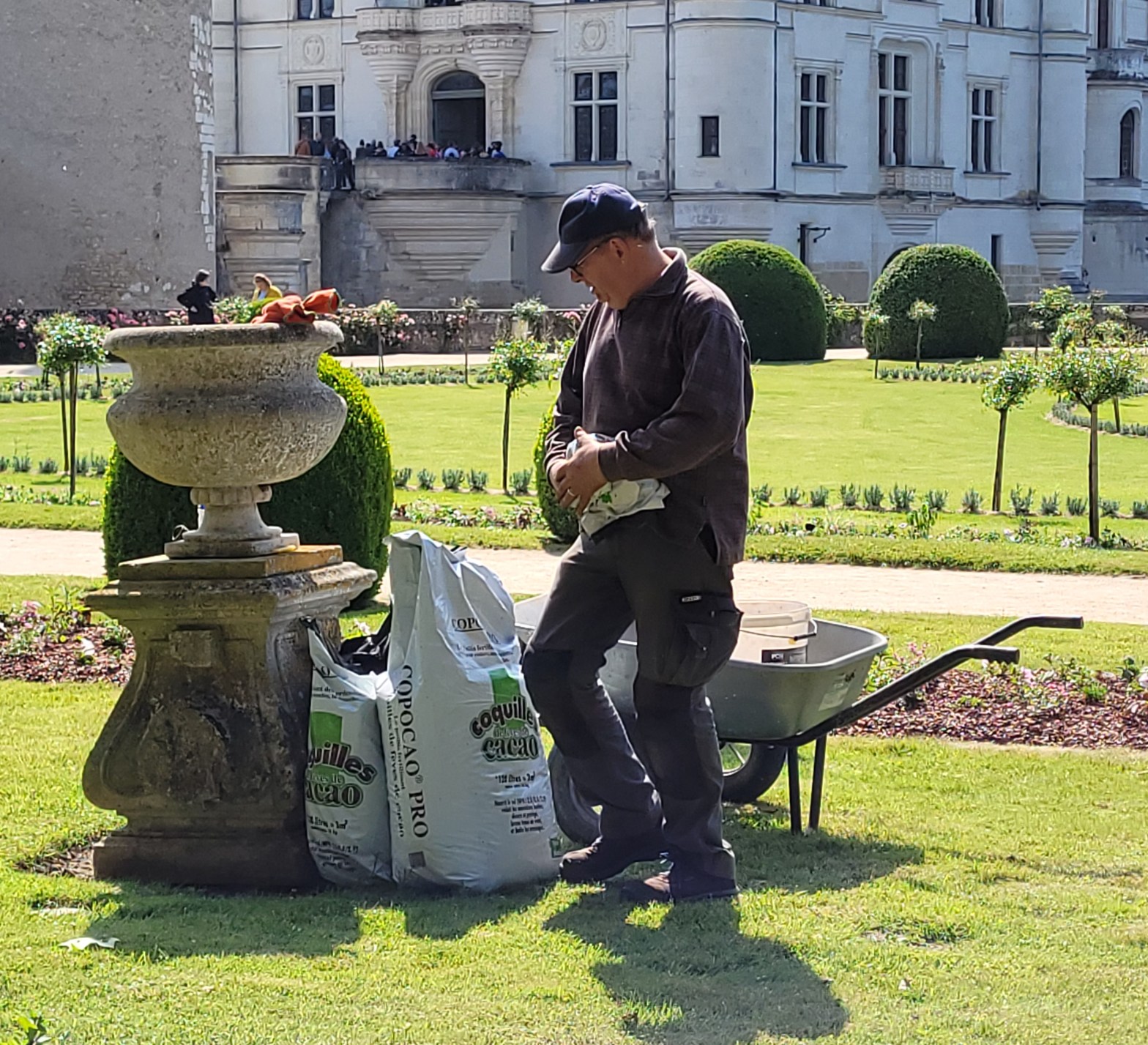
As I was about to leave the gardens, I saw a man leaning over a rose bush while sprinkling something brown around its base. Nearby, leaning up against an ancient stone urn next to his wheelbarrow, were two bags of coquilles caocao. I have had enough French training to know that the bags were full of chicken manure, and he was fertilizing the roses with them. This momentary experience transformed me from a chemical rose grower to an organic rose gardener with much better results. Here’s how I care for my roses now, and they have never been more beautiful.

Chicken Manure

I have roses under the window in my front yard, on my side yard, all along the lawn in the back, and a raised bed of my prized tea roses on the other side of the house. I’ve fertilized them, sprayed them, clipped them and I’ve always had problems. As soon as I got home from France, I bought six bags of chicken manure and spread it at the base of every rose bush. I was smelly. The mosquitoes seemed to like it, too, and they bit both me and my husband. I drank wine in my lawn chair with the smell in my nostrils. But it was worth it. Slowly, day by day, the rose bushes became stronger and their diseases cleared up. I didn’t use the fertilizer or disease control liquid at all. The chicken manure, which contains large amounts of nitrogen, phosphorus, and potassium, revitalized my roses all by themselves. And that smell, it’s gone now.

Vinegar Water

It took several days to almost two weeks for the chicken manure nutrients to be absorbed by the rose bushes, and while that was happening, some of the rose bushes had mildew. I did some research and found another organic solution to this problem. In an empty spray bottle, I combined a quarter of a cup of apple cider vinegar and one quart of water and sprayed it on the mildewed leaves of stems. I kept this container of solution near my tea roses so it was easy to use whenever I found problems. It worked. Now, two months after first applying the chicken manure and spraying the mildewed stalks and leaves, my roses are as healthy as the roses at Chateau Chenonceau.

Bone Meal Fertilizer

I was on a roll, and I kept reading about organic gardening for roses. What I found out next is that bone meal is good for promoting blooms. Its phosphorus and calcium strengthen the plant and promote bloom growth. I applied the bone meal, and low and behold, my roses staring producing more roses that ever before. I also gave some bone meal to my African irises, and they gave me the most beautiful white, yellow and purple irises I had ever seen. I only have to apply bone meal every four months since it releases its nutrients over time.

Clipping Old Blooms

I have known that a good rose gardener should clip off the old roses in order to preserve the rose plants energy for the new blooms, but when my plants were diseased and ugly, I had little incentive to do this. In the last two months, however, I’m excited to take a pair of sharp clippers and to snip off the spent flowers, making sure that I cut the stalk just above a five-pattern of leaves. While I’m clipping the old blooms, I also clip the vibrant flowers to take into the house to enjoy in a vase on the table.

I never expected that my life would be changed by walking through an ancient garden in France. Even though my roses didn’t go to France with me, I brought them back something better than a souvenir: healthier lives.

Photo by Yuliia Dementsova on Unsplash

A Town Girl on a Dairy Farm

I’m from a town—a suburbia in the San Francisco Bay Area–a place that is less densely populated than a city and bigger than a village.  My town has clean streets lined with sycamore and crepe myrtle trees, houses with front and back yards, barbecues, swimming pools, cabanas, patio sets, and walking mail carriers.  People walk their poodles and Labrador retrievers on neighborhood hiking paths and buy popsicles from the singing ice cream truck that meanders the streets on summer days. 

I own a tidy little home in my town.  Yards with manicured hedges, carefully pruned flower beds, edged lawns.  Clean and tidy. I sweep under my garbage cans each week when I take them out for collection.  My children are grown and have homes of their own, so my house is immaculate too.  I spray my shower down after each use.  I wipe the stove after each meal, and I own five vacuum cleaners, one for each type of vacuuming task.  You get the picture.  I’m a clean freak. 

I decided to visit my relatives in the country this last month.  They live on farms all around the city of Winona, Minnesota, in both Minnesota and Wisconsin. I also am lactose intolerant, and, when I was born, my parents bought a goat to feed me.  My mother grew up in Wisconsin, a state popular for milk and cheese.  Her whole life, she drank three tall glasses of cow’s milk a day, one at every meal.

I wasn’t one of those town kids that thought milk originated in the refrigerator case at the grocery store.  My mother told me where it came from.   After all, she grew up on a farm.  I’m smart enough to know that most milk at the grocery store comes from cows, not goats, almonds, coconut, or oats.  Sorry vegans.

When I visited my relatives in Minnesota and Wisconsin this month, my cousin Scott–a handsome man with a ready smile, who owns a 600-cow dairy farm near Altura, Minnesota, invited a bunch of us to visit his farm.  I didn’t mention to him that I was lactose intolerant since I didn’t want to feel ostracized.  I was confident, however, that his cows would like me just fine.  Really appreciate me, in fact. 

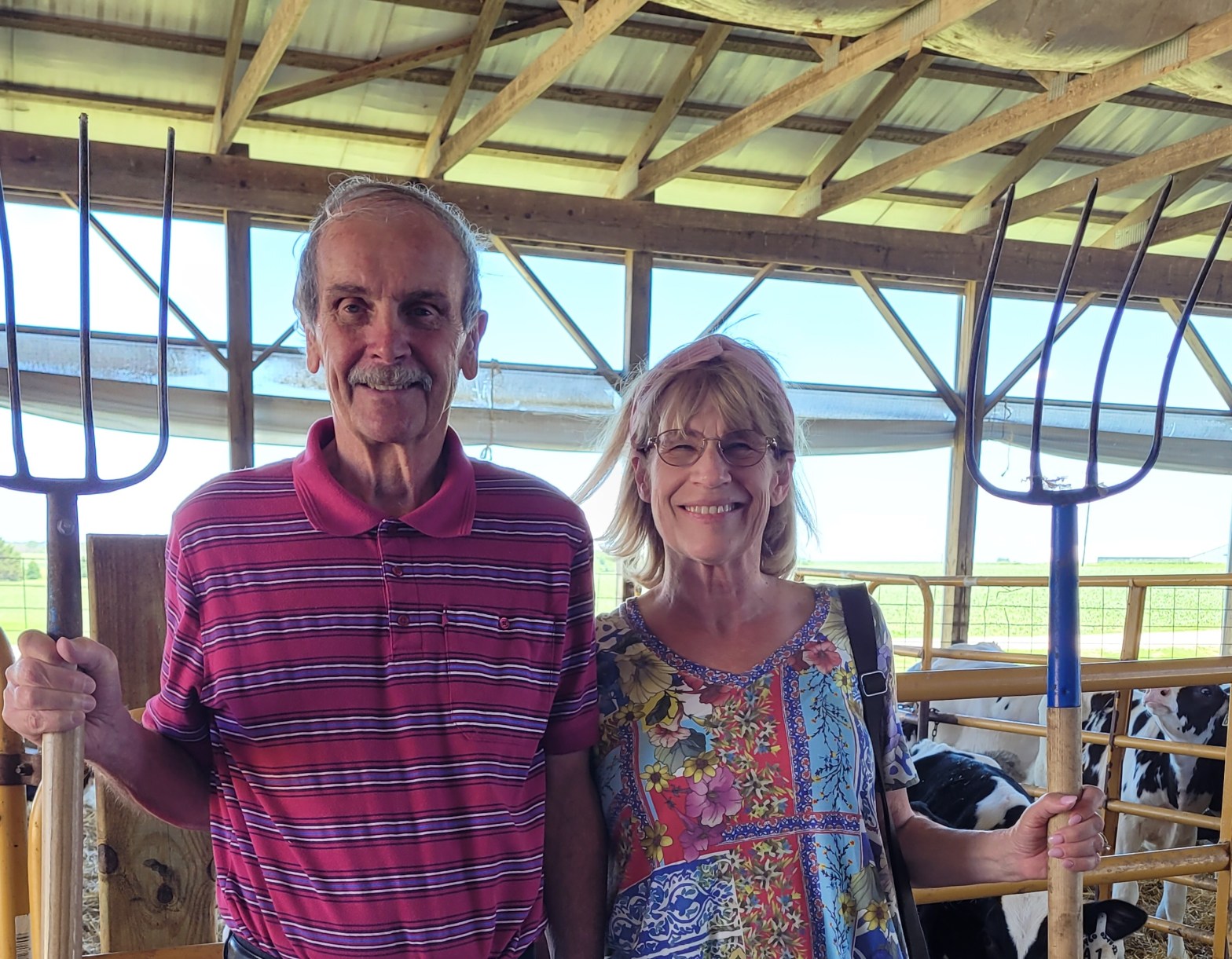
We got to the farm before Scott did, and his workers told us to wait outside.  As we walked through a barn full of teenage cows—some with the cutest faces, we found some pitchforks and posed for a picture like Grant Wood’s 1930 American Gothic painting, except both my husband Bob and I held a pitchfork since we believe in equality.  In Grant’s painting, the farmer’s daughter didn’t have a pitchfork in her hand.  I hate to think what Scott’s pitchforks were actually used for and what debris was on the handles that I touched, but I wasn’t going to pass up a great opportunity for a memorable photograph.

I was wearing a clean T-shirt and skort and a pair of running shoes, knowing that we’d be traipsing around in cow emissions of all kinds.  When Scott arrived, I gave him a cousin hug.  He recoiled away from me, and when I let go, I noticed that his Tshirt was full of dirt stains.  He didn’t want to get me all dirty, apparently.  He had already been at work on the farm the whole morning, and had had meetings with lots of females (cows) who never put on a suit or blouse.  That was a town-girl blunder.  I surreptitiously looked down at my T-shirt and skort to see if I was still presentable. 

I’m not at all a dumb person, but, living in a town, I spend more time thinking about the best hiking trails and restaurants than I do about the biology of animals.  This visit brought my knowledge of cows out of the back room of my brain into my frontal cortex.  I appreciated, too, that Scott was as informative as an agricultural professor at the University of California, Davis where they offer classes in dairy farming. 

The first thing people must understand about milking cows is that a cow has to have a baby before it produces milk; therefore, the process of milking cows takes patience and great skill.  Because the cows have to be impregnated, go through about a 280-day pregnancy, give birth, and then produce milk, a dairy farm is comprised of a fertilization lab, pregnancy dorm, maternity ward, nursery, elementary school, high school, milking station, and milk refrigeration tank. 

There’s a lot to learn about a cow’s life.  About half of the calves that are born are female and the rest are male.  I know this seems obvious, but Scott doesn’t need all those males so this statistic is unfortunate; he keeps a few males for breeding but sells off the rest to beef processing facilities.  What happens there is for another blog post, likely not written by me. 

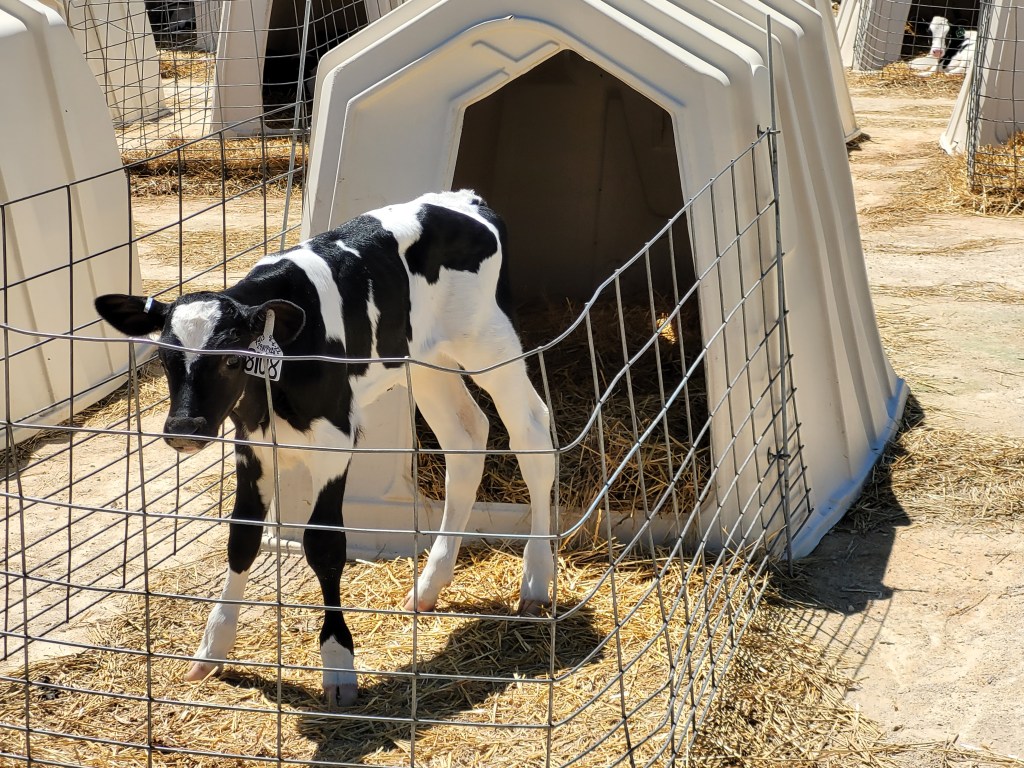
At the back of his property, Scott raises his calves in individual pens, each one living in a domed shelter with food and water.  When the calves get bigger, they live in a barn—organized like a college dormitory—which has an insulated roof and fans that blow constant breezes through the building to keep the cows cool.  The cows are encouraged to spend as much time in the field as they want. I was intrigued that they actually had a choice in this matter; Scott talked about them like they were his valued students.  Their rooms were also much cleaner than most college dorm rooms I’ve visited. 

Pregnant cows also live in a barn dormitory.  A long building that holds several dozens of cows, organized into three rows that run the length of the barn, each row is divided into individual pens filled with a soft bed of sand.  The two outside rows are where the cows stay when they’re inside.  They can either stand up or lay down in the soft sand.  They face out, having access to fresh water and hay.  Their backsides face into the center row through which a stream of water flows, sweeping up the cow manure and any sand that is soiled and discarded by the cow’s movement. 

The dirty water, filled with excrement and sand is processed through a filtering system near some manure holding reservoirs.  The clean water gets recycled back into the barn stream, and the excrements are deposited into the holding reservoir where it is treated and used for fertilizer to grow alfalfa or corn.  A well-thought-out system that truly impressed this town-girl.

So many problems can occur with milking cows.  They can get sick, dehydrated, infected, or overheated—all of these situations affecting their ability to produce high-quality milk.  We saw calves that had spikes put through their noses to prevent them from milking on other cows.  We learned that new babies were removed from their mothers so they wouldn’t milk, and they were given milk that was tested to ensure good health.   We witnessed testing tools, pages of testing data and production statistics.

In the milking shed, the cows are milked twice a day.  They are led into the stalls and encouraged to turn around so that the workers have access to their relevant body parts–teats.  Some milking sheds, Scott informed us, have turnstiles that turn the cows into the right position.  Scott doesn’t have those.  His milk hands push the cows into the correct position, clean each cow’s teats and attach the milking tubes which automatically milk the cows for an average of 20 minutes.  When the milk hand punches the cow’s serial number into the machine on her stall, the machine measures her milk output and adds it to the farm’s data system.  See why math classes are so important.  Everyone uses math. 

Cows are insanely fruitful.  One cow produces about 60 pounds of milk a day—that’s 90 glasses a day for people like my mother.  The milk travels through pipes into a stainless-steel cooling tank that looks a lot like the stainless-steel wine tanks in Napa, California that hold sauvignon blanc or chardonnay.  These dairy tanks are expensive—one can cost from $100,000-$140,000.  What struck me was that the purpose of the tank was not just to store the milk, but to also cool it.  The milk is warm when it comes out of the cow.  Again, I might have figured this out on my own, but, secretly, I was surprised to hear about it. 

I asked Scott whether his farm was considered a small, medium, or large dairy.  “It depends on who you ask,” he replied. “I’m only one of three dairy farms left in the immediate area.  Smaller farms are disappearing due to the rising costs of operation.”

Scott now has a female manager at his dairy.  I can’t remember her name, but let’s call her Laci.  “Laci likes to be in charge,” said Scott. “She also fell in love with my one-in-a-million cow hand, married him and now has a child.”  Scott’s calls this cow hand one-in-a-million because of his excellent work ethic.  Apparently, One-in-a-million is also supremely savvy; he married his boss.

By the time we had toured the whole process, my T-shirt and skort reeked of cow sweat, dust, and hay and the treads on my running shoes were caked with a smelly, nefarious, brown sludge.  I found myself holding my arms away from my body in a desperate attempt to feel cleaner.

Scott invited us into his office where his hound was waiting.  When we sat down, the dog plunked his muddy paws onto my lap and slobbered my skort with drool. First, I looked down in horror, but, then, I quickly composed myself and left the drool alone, trying very hard to adapt my cleanliness obsession into an acceptance of the natural dairy farm environment.

Scott opened his little refrigerator and offered us frozen chocolate treats and push-up ice cream popsicles.  They were certainly welcome after a hot tour of his cow quarters.  I hadn’t had a push-up popsicle for ages, and I tried hard not to drive the whole piece of ice cream out of the tube and onto the floor as I struggled with it. 

Turns out, Scott gave the last part of his popsicle to the hound who licked it up joyfully on the floor.  This helped me relax a little, and when I had just a little of my popsicle left, I shared the rest with Scott’s hound too.  This was a remarkable development, you see, because a town-girl would have never put her popsicle down on the floor for a dog to roll around and lick up. 

That day, on Scott’s dairy farm, I proved that even town-girls can leave the town behind and have a little fun in the country.

A Story about Straw Pile Hill

Between Stockton Valley and the west side of the Mississippi near Winona, Minnesota is a ridge covered with white pine trees.  Once upon a time, my great grandfather, Leon Ambrose Bronk Sr., bought land on this ridge to grow alfalfa and corn.  Throughout the years, he bought more adjoining farms until his land holdings reached 761 acres. 

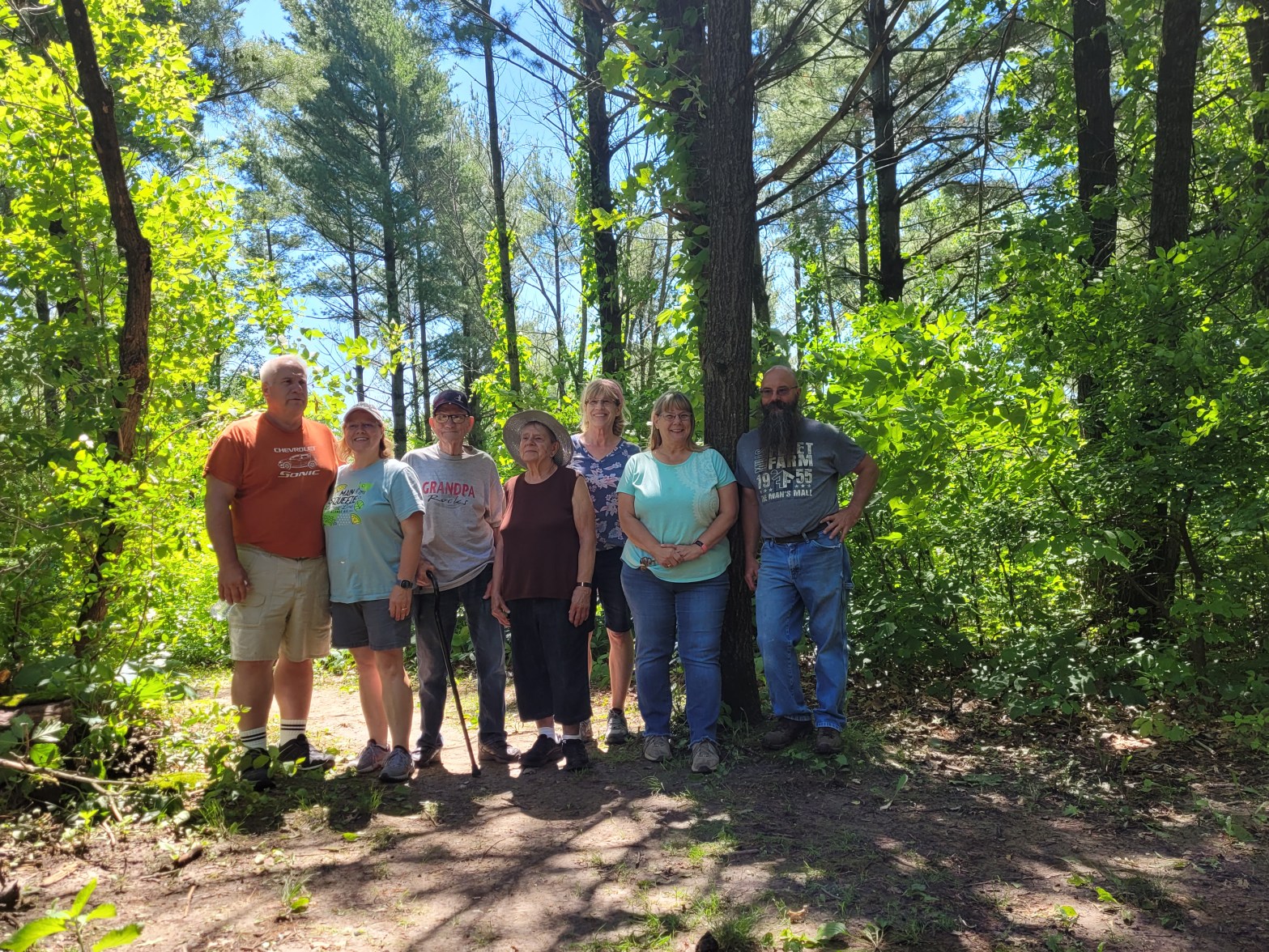
On June 16, 2022, when I was visiting, two of my cousins arranged for a group of family members to ride up into the park in 4-wheel drive trucks so that my 92-year-old uncle could see the land where he spent the first 14 years of his childhood. 

Great-grandfather Leon bought this property in the 1920’s and lived in a white wooden house at the bottom of the ridge where he planted a family garden and built a barn for cattle and horses.  Twenty years ago, I remember walking through the ruins of that house.  When he bought some farms at the top of the ridge, Leon Sr. let his oldest son Leon Jr. and his family live in one of the farm houses up there.  Leon Jr.’s first son, Paul—my father, was born in 1929 and his second son, David, was born in 1931.  David is the father of ten of my closest cousins.  Twenty years ago, we found a rusted sled that Paul and David used to travel down the snowy slopes of the ridge when they were little. 

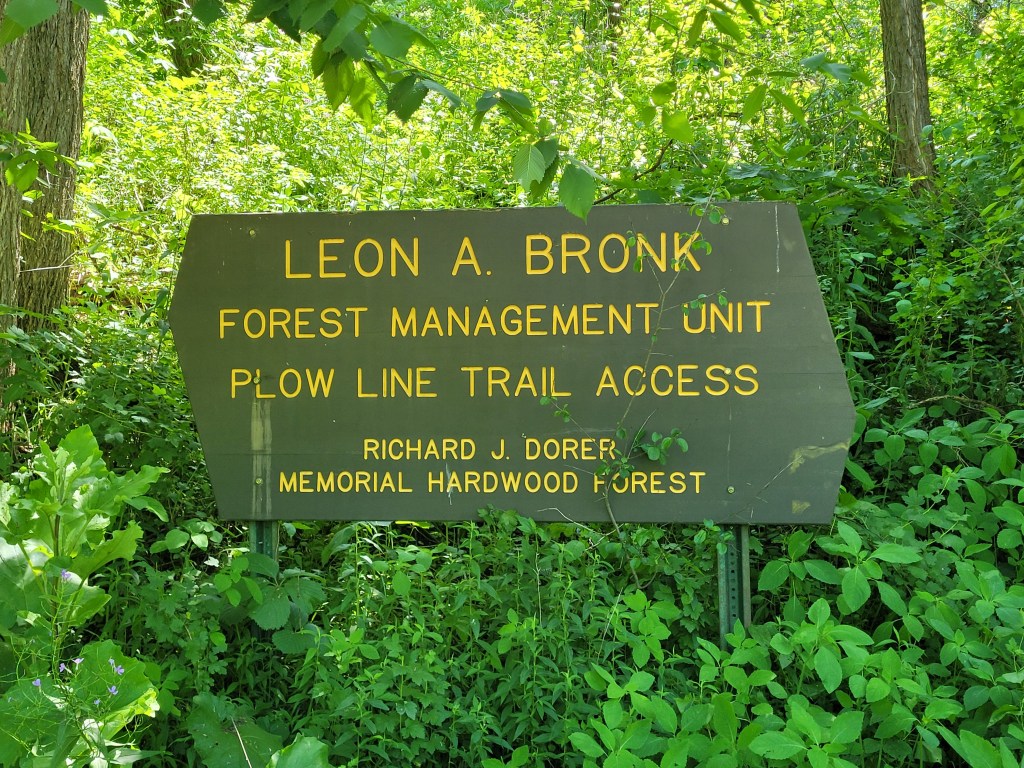
In 1969 when he was 81-years-old, Leon Sr. sold the land to the State of Minnesota, and it became part of the Richard J. Dorer Memorial Hardwood State Forest.  Since much of the property rises 500 feet above the surrounding valleys, it provides hikers and bikers tremendous scenic views of the land and water below.  The State of Minnesota planted thousands of white pine trees in rows, a forest that now covers up any evidence of houses, gardens, and alfalfa fields.

On this day, cousins Diane and Bill drove the trucks into the park and up the ridge under the supervision of a park volunteer named Mark.  Mark is an avid off-road bicyclist, and he started to maintain the 6.5 miles of hiking trails in this park by using his electric weed-whacker to cut the weeds. One day when he was working, he met a state park ranger, and he explained how he biked up the ridge with his whacking machine to keep the trails open.  He also wished that the gate was open so he could use his four-wheeler jeep to bring his mower up; because the weeks grew so fast, the mower would do a better job in a shorter amount of time.  The ranger gave Mark a key to the gate and unlimited access to the park.

When my cousin Diane wanted to arrange a family drive, she called Mark to get the State’s permission to drive trucks through the gate and up to the top of the ridge.  He helped her out because he wanted to meet the oldest living Bronk relative, my Uncle David, who had actually once lived on the property.

Mark was excited to hear stories about the property’s history.  The park is named the Bronk Unit Plowline Trail referring to the line where the Bronks stopped plowing their fields.  Uncle David revealed that one ridge is known as Cherry Hill, probably due to the cherry trees growing there.  Another ridge is known as Straw Pile Hill.  That’s where, when he was a mere boy, David dumped the hay that he harvested from the fields, and Paul would pick it up and haul it off to be sold.  David had to plow the fields and collect the hay with a horse-drawn contraption.  Paul got to drive the tractor since he was older. 

My dad used to say that “You can take a man away from the farm, but you can’t take the farm out of the man.”  All his life, my father was an excellent farmer.  When I was born, my family rented a two-acre farm in Fair Oaks, California.  I was allergic to cow’s milk, so my parents bought a goat and gave me its milk.  We had chickens, bunnies, and geese.  My mother made butter and ice cream by hand. 

Later, when we moved to a smaller property, my dad raised sheep.  One sheep was our favorite, and we named him Jerimiah.  One day when we got home from school, we couldn’t find him.  At dinner, we asked my parents where he was.  “He’s on your plate!” said my dad with a grin. 

David, too, farmed his whole life.  He bought a farm that had been owned by my Great-Great Grandpa Ignatius Bronk, who immigrated to the area from Gostomie, Poland and bought this farm in 1886.  When Ignatius died in 1896, his son Theodore took over the farm; Theodore was the older brother of my Great-Grandfather Leon Sr.  Today, David lives on the farm with his wife Linda and a herd of cows that his son, Bill, manages for him.  While I was visiting, about twenty-five of us cousins, first-cousins-once-removed, second cousins, and Uncle David and Aunt Linda had a picnic on a hot and humid 100-degree day. To stay cool, we sat under the spreading branches of a white oak tree and slapped the gnats that buzzed around our faces.

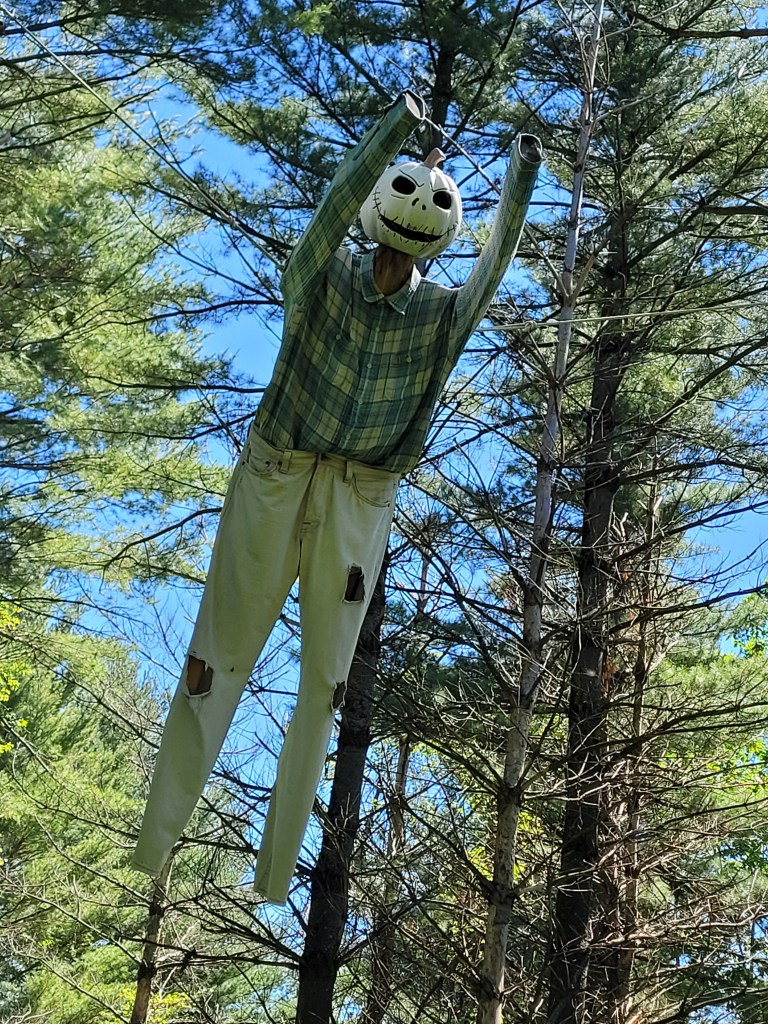
While we walked around the top of the ridge on Great-Grandpa’s property, we found wild carrots and asparagus—souvenirs from the gardens that once fed the Bronk families.  Hanging high above a hiking trail, we found a scarecrow with a Jack-o-lantern head, plaid shirt, and farmer pants.  Mark told us that a solar light made the head light up at night, creating an unexpected scary encounter.  We watched big, Eastern Tiger Swallowtail butterflies settle on wild flowers and examined tiny pine cones that fell from the white pine trees.  The floor of the forest was covered in a thick matting of dead pine needles, hiding the remnants of our relatives’ lives. 

What occurred to me that day was that all of the farmers who worked on my great-grandfather’s land had been removed from it: my great-grandfather, my grandfather, my father, and my uncle.  Yet, there was evidence all around the area and in places far away, like California, that these people and their descendants were still farming.  David’s son Bill will one day take over David’s historic farm.  My brother, Donald, can grow any vegetable or flower in his patch of garden in California.  I have a green thumb when it comes to growing flowers. Apparently, you can’t take the farm out of a farming family. 

Wisdom of the Trees: Chapter 4

Chapter 4 – Willow

Friday was the last day of class, and Profesora Casti lead her students to Almagro, the part of the city known for its flower vendors.  First, the group wandered among the flower stalls on Acuňa de Figueroa where baskets of roses filled the air with intense fragrances.  Leonie bent over the bunches to breathe in their perfume, and she took turns saying their names out loud with her classmates.  They chatted with the vendors who told them where they grew their flowers and how they worked from early in the morning until late at night planting seeds, hand-watering, and pruning in order to produce the most beautiful flowers. 

The vendors smiled when they talked about Mother’s Day, weddings, and baptisms for which they sold the most flowers.  Some vendors stayed open 24 hours a day.  The best time to buy flowers—late at night or early in the morning.

Then, the class meandered to Calle Sarmiento where even more vendors had their shops.  One shop was filled with tuberose and jasmine, which filled the shop and the air outside its door with heady perfume.  Inside, the vendor was busy wrapping flower bouquets in cellophane paper for a woman and her two daughters. 

Leonie wandered away from the group to admire the lilies of another vendor.  While she was reaching out to touch a petal, a woman dressed in a green apron came out to greet her. 

“Your lilies are gorgeous,” exclaimed Leonie.

“Thank you.  My grandfather used to sell flowers on the streets of Buenos Aires.  My father sold flowers in the old market in stall 8, and, now, I rent this shop here to continue our family tradition.”

Leonie moved under the shade of the willow tree that grew right in front of the storefront.  “I love flowers,” she said.

“I love flowers, too,” replied the vendor.  “I’m sure I’ll sell flowers until I’m old and frail.”

Leonie paused in thought, running the woman’s response through her mind.  Forever was a long time to do just one thing.  Leonie didn’t know that she would ever find something that she wanted to do for so long.

“So,” Leonie asked, “You don’t ever wish that you could do anything else?”

The woman smoothed down the front of her green apron with hands that were crusted with dirt and chapped from years of working with plants.  “No, I never wish to do anything else,” she finally said.  “I feel that each day in my flower shop is another day where I get to express my creativity, and doing that gives me intense joy.  Besides, I know that I like to be around beautiful things, and what could be more beautiful than a shop full of flowers.”

“You seem so contented,” said Leonie.

“You see this willow tree that’s giving you shade?  A willow tree symbolizes fulfilling wishes of the heart.  It also symbolizes inner vision.  I’m lucky to know what fulfills my life.  That knowledge is my inner wisdom.”

The vendor showed Leonie around her tiny shop, identifying the names of all the flowers and inviting her to smell their fragrances.  Leonie told the vendor that she was about to take a trip to search for her life’s purpose.  As the woman listened to her story, her eyes glistened and a whisper of a smile set upon her lips.

Before Leonie left, she held out a yellow rose.  “This rose symbolizes our new friendship,” she said.  “Friends are one of the most precious treasures of your life.  From now one, you and I are lifelong friends.  I wish you success on your trip and hope that you find your version of life fulfillment. 

That night, just before Leonie went to bed, she sat at her desk to write in her journal.  I know what fulfills me, she wrote.  After setting down her pen, she felt anxious.  But I don’t know what fulfills me, she worried.  I don’t know what I want to do with the rest of my life.  I don’t know what makes me happy day after day after day. 

As she sat, she thought about the vendor in the green apron and how she had found fulfillment.  She remembered how gently the woman had picked up each flower and described its characteristics.  She had moved among her flowers with grace, touching each blossom with respect and admiration; her movements were filled with love. 

Now Leonie knew.  The woman had been a messenger from her own soul to teach her how to find her own purpose.  Love was an integral part of finding fulfillment.  When she found out what she loved, she would find her contentment. 

An Old Rose

She was worried about her mother who seemed to struggle to stay present, something pulling her focus away or inward.  Some days she sat in the arm chair by the window, staring straight ahead, her gray-blue eyes lost in deep thoughts. 

When Sestina tried to talk to her, her mother struggled to respond.  “Wait a minute,” she would say, then, with a determined set to her mouth, she’d squeeze her eyes shut for a brief moment, open them wide, and glare at Sestina while she slowly made a lucid response. 

Her mother woke up early every morning, took a spit-bath at the sink in her bathroom, put on her clothes, and combed her golden white curls until she looked neat and ready for an outing.  After breakfast—not a big one mind you—just a piece of bacon and half a piece of toast with butter and strawberry jam—she sat down in the chair by the window and disappeared into her private thoughts.  Her breathing was labored, and she raised her shoulders every time she inhaled, her chest rising slowly, and she exhaled by opening her mouth and releasing a small burst of air.

On Wednesday, while her mother was sitting in her arm chair, Sestina went out to prune the old roses off the rose bushes.  She knew her mother not only loved flowers, but she loved roses most of all, and Sestina wanted the roses to look perfect when her mother looked out the window.   Eight tea rose bushes grew in the redwood planter, a raised bed so that the roses bloomed at the same height as the window.  The planter was about six feet from the window so when her mother looked out, she could see the stems wave gently in the breeze and glow in the sun. 

The yellow rose bush was the heartiest with big blossoms that bloomed like cabbages.  One bush grew lavender roses, medium in size with delicate petals and a hue that took Sestina’s breath away.  Four of the bushes bloomed with various versions of red flowers, each a unique shade of red and shaped petals.  The two white bushes bloomed with the most flowers, always producing plenty of blossoms so that Sestina could cut some and bring them in the house.

Sestina held the kitchen shears in her right hand and pulled back a single stem from a rose bush, looking for the perfect compound leaf of five leaflets so she could prune the dead rose at just the right angle and place to encourage more growth. 

As she made the cut, the daylight intensified into a blaze of light all around her.  Insects’ voices grew loud into a hum like a Gregorian chant, and she heard the wind rush under the wings of a swallowtail butterfly who hovered over a rosebush nearby.  The butterfly glided toward her, waved its wings close to her nose, and she thought that she heard it whisper, it’s time for her, time for her.   Its black face smiled, and its eyes looked deep into hers, speaking wordlessly of love.  She heard the breath of the breeze travel through the petals of each rose, and the scissors snapped the rose’s stem like a clap of thunder.  She heard the leaves of the lemon tree give birth to new cells and buds of fruit.  Then, suddenly, the breaths of the insects and flying creatures, echoes of the growing plants, and pneuma of the wind were silent, and the garden was still.

When Sestina got back to the cottage, she found that her mother had died.   Her face was turned toward the open window and her hands were folded over each other like a final prayer.

Rosie’s Blooms

My mother’s name was Rose Marie—most appropriate for when she attended church, sitting at the end of the third row, her mouth pursed into a straight line and her eyes staring obediently at the altar.  Yet, one of her male friends called her “Rosie,” which, most of the time, suited her better.  She was feisty, knew how to get you to do what she wanted, and a woman with the most interesting hobbies.  One of her favorite hobbies was her appreciation of flowers. 

It’s not surprising, then, that I’ve loved flowers since I was a little girl.  When I was four years old, playing house with my younger brother, my mother grew calla lilies in a corner of the back yard.  I admired heir smooth, white bell-shaped flowers and bright, yellow pistils, and my mother called them “resurrection” flowers because they bloomed around Easter time when Jesus rises from the dead. 

My mother cut the lilies and took them indoors to decorate our dining room table.  I loved their intoxicating scent–a comforting aroma of clover mixed with a lemony fragrance.  Their creamy-textured petals exuded luxury, and they lasted longer than most other cut flowers.

When we lived in Air Force base housing for four years in England, my mother planted bulbs in the rectangular planting beds under the windows in the front yard.  After the snow melted in late January, daffodils poked their green shoots out of the brown soil.  Day by day, I watched them grow bigger and taller.  The flower knobs soon formed, and, slowly, pastel yellow flowers peeked out from the green stalks until one day they brightened our simple front yard with happy yellow fringed trumpets. 

After the daffodils lost their blaze, the tulips came up behind them like copycats—rising like slender dolls out of the earth until, in a few weeks, their red cups of petals swayed in the light breezes of March.  My mother told me to never pick a tulip because they represented perfect love, and she wanted them to bloom for as long as possible to bring good luck to our home. The variety of tulips that she grew were just right—not too showy, not too dramatic, not overly romantic.  When they were blooming, our front yard felt comfortable and stable.

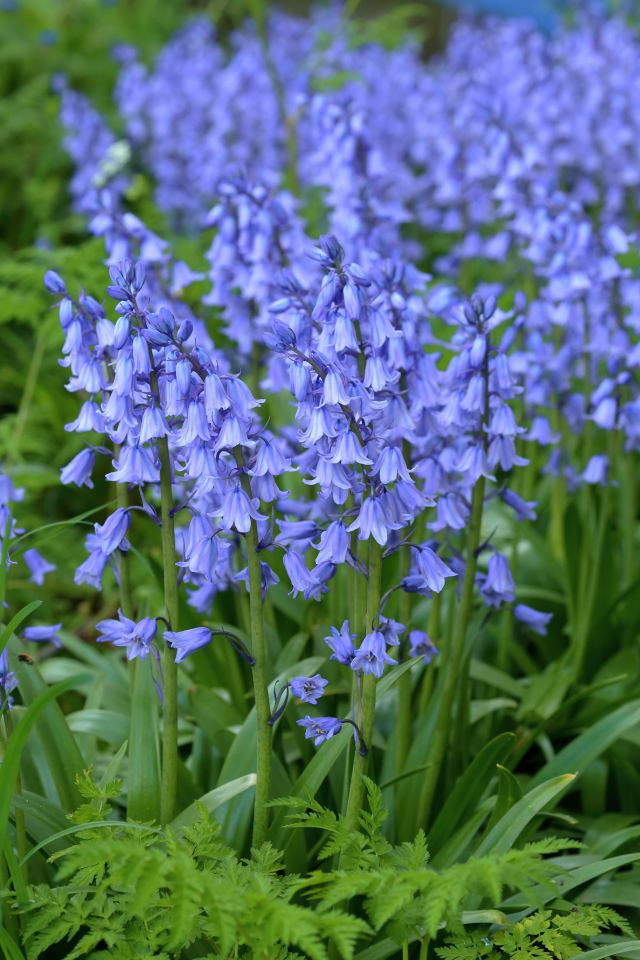
Across the street from this house on Shepherd’s Way was a forest where bluebells bloomed in mass profusion every April and May.  English bluebells are associated with fairies, those miniature creatures that cause mischief for humans.  I had a wistful imagination, and I spent hours walking amongst these bluebells with their sticky stems, watching for fairies and feeling grateful for the experience of being lost in a sea of blossoms. 

My mother let me take a bucket out to the forest and fill it full of bluebells.  I brought them home and arranged them in as many vases I could find, and when the vases were full, I used Mason jars for the rest of the flowers.  I placed vases and jars full of the humble bluebells on bookcases, tables, dressers, and night stands, and my mother’s blue eyes lit up when she saw them.

My high school years were dominated by carnations.  Homecomings, proms, dances, and balls called for corsages, and corsages always came as carnations.  After the dances, I saved each corsage by sticking its stem into a tiny vase of water.   Later, I dried it out on a saucer on my dresser, and, often, lifted it to my nose to inhale its floral and peppery scent. My mother didn’t like them because their scent reminded her of funerals and sadness.

When I was seventeen, my mother and I visited The Berkeley Rose Garden, a colorful display built into the hills of Berkeley comprised of hundreds of varieties of roses and thousands of individual rose bushes.  The rose beds were terraced on the hills into the shape of an amphitheater and separated by flagstone paths. 

My mother taught me the differences between polyantha roses, floribunda roses, and tea roses, and she explained how new roses were developed by cross-breeding every year.  I liked the polyantha buses for their smaller heights and tightly packed blooms.  I liked the floribunda bushes for their profusion of blossoms on branching stems, especially the varieties that produced variegated blooms like “purple tiger”—roses with streaks of purple, lavender, and white in each flower.  These showy bushes had other dramatic names, too, like Celestial Night, Scentimental, Sweet Madame Blue, and Forever Amber. 

Most of all, I adored the tea roses—their thick stems punctuated by large thorns and leaves that grew in patterns of five, with the stems ending in large graceful blooms of circling petals.   The names for these sophisticated blooms were grandiose—Double Delight, Mister Lincoln, Chantilly Cream, Love Song, and Oympiad.

Arbors held the climbing roses like the orange Top of the World, the pink Pearly Gates, and the lavender Long Song varieties.  Shrub roses and tree roses filled in every nook and cranny so that the whole garden produced a cacophony of colors for our eyes.

Together, we read the names of as many varieties as we could, pausing at the ones that were the most fragrant or dazzling.  I nestled my nose into the blooms as deep as I dared, trying to memorize the smells forever.  Never before had I been in the midst of such splendor, unrivaled beauty, and mesmerizing fragrances.

According to Mother, each color of rose had its own meaning and the number of roses given has a significance as well.  Yellow roses are for friendship and red roses show love.  Six roses means a growing affection and a dozen roses demonstrates complete love. 

The Berkeley Rose Garden also possessed an incomparable backdrop for our mother-daughter conversation.  As we walked together between the rows, we wondered at the vast view of the San Francisco Bay where the Golden Gate Bridge spread across the Bay’s exit like the arms of a graceful goddess.  The water changed from denim to indigo to periwinkle to cerulean to navy to slate depending on how the surrounding hills cast their shadows, the currents massaged its surface, and the sun penetrated into the prisms of the ocean’s molecules. 

Back at home, around the perimeter of my mother’s Sacramento patio grew dozens of camellia bushes under the shade of a giant mulberry tree.  From November to April, these glossy green overgrown bushes produced hundreds of curly, pink blossoms.  Mother told her children that camellias mean “young sons and daughters,” which seemed so fitting for my mother’s house since she had ten children who were easily outnumbered by the profusions of camellias in her garden.

When my mother moved into an assisted living apartment, she made sure that she had a vase in her cupboard for flowers.  This vase was about 8 inches high and made out of white milk glass; any type of flower would look beautiful in it.   

She had developed macular degeneration in both eyes, so she couldn’t read or, sometimes, even find the food on her dinner plate; she could, however, always sense when you held a bouquet of flowers in your hands to give her.  A smile that matched the petals of a pink rose would light up her face as she took them from you. 

She asked you to put them in her vase or find a place for them on her desk or window sill.  Every few days, she called and told you how they looked or smelled, or how many blooms were still perky or drooping, until one day, she called and told you that she was cleaning out the vase.  I gave her lilies at Easter, red roses during the summer, chrysanthemums during the fall, and a poinsettia at Christmastime.  Her favorite were always the roses because, after all, she was named after them.

I ordered the flowers for my mother’s casket when she died.  The funeral representative recommended a spray of red roses and red carnations, but I knew better.  Never would I allow carnations to come near my dear mom.  I ordered the largest spray of red roses I could because I knew that nothing less would make her happier.

The officiate at the gravesite told us that red roses were such an appropriate choice.  “Red roses symbolize eternal love,” he said.  We placed our spray of eternal love over her gravesite after the service, and their blooms thrived for weeks in the chilly California air of December and January. 

Two months later, my husband bought me a dozen deep red roses for Valentine’s Day.  I carefully extracted them, one by one, from the brown wrapping paper, snipped each stem with a pair of sharp pruning scissors by about one inch, and arranged them in a tall, clear crystal vase filled with fresh water and rose food.  Then, I ceremoniously placed the vase of love on the coffee table in the living room—a place visible from most places in our house during the day. 

One day, as he sat in an arm chair in front of these red roses, he told me how wonderful he felt looking at their beauty.  “I’ve never thought about how beautiful flowers looked before,” he said, with joy filling his eyes.  “I want to sit here forever.”

I realized then, that my mother’s appreciation of flowers was so strong that its influence had passed from her to me, and through me, to my husband.  My love for flowers also positively influences my son, my daughter, my friends, and even people I don’t know with the optimistic power of beauty. 

My mother—my Rosie knew that the delicate blooms of flowers—so ethereal in their form and beauty—are most extraordinary at communicating the powerful, yet intangible nature of love.

Wet Cathedral

That night, they were down at the beach. The two couples had taken a long, slow walk, curving their footprints along the shore in a crescent until they reached the pier and turned back. Minnie and Katy were collecting shells for their children back home. Owen scanned the sand for bodies of sand crabs after each wave receded, and Efren walked silently, once in a while joining Owen to ogle over a group of crabs gathered around a shell for feeding. Midway back to the base of the cliff where they began, Katy scratched an image of a bear into the gravelly sand, took out her cell phone, and snapped a photo.

When they reached the top of the cliff, wooden picnic tables were strewn with their camping supplies. Owen took out long metal rods, marshmallows, bars of chocolates, and graham crackers. Katy stoked the dying fire and added some kindling until it was burning with life again. They roasted marshmallows, Minnie allowing hers to burn into a black crisp on the outside. She pressed it, ash and all, between the crackers and melted the chocolate around it.

Efren had retreated to the stone wall overlooking the beach to watch the sunset. He and Minnie lived in Colorado, and he couldn’t remove his eyes from this Pacific Ocean, which, to him, looked like an expanse of blankets being waved by strong-armed giants. As he gazed at the sun positioning itself on the horizon like orange lace, he spotted the seal.

“Come and see the seal, Minnie. Watch the sunset. It’s beautiful out there.”

Minnie, Katy, and Owen joined him to watch the seal bobbing in and out of the waves as if it was about to ask a question. Below them on the beach, a group of people was huddled around a fire, which lit the center of their circle like a gas burner. Two surfers in black wet suits frolicked in the waves far from the seal, their sleek bodies reflecting in the glowering light. As the sun settled lower, its dusky brightness deepened the lows and lightened the highs of the ocean swells.

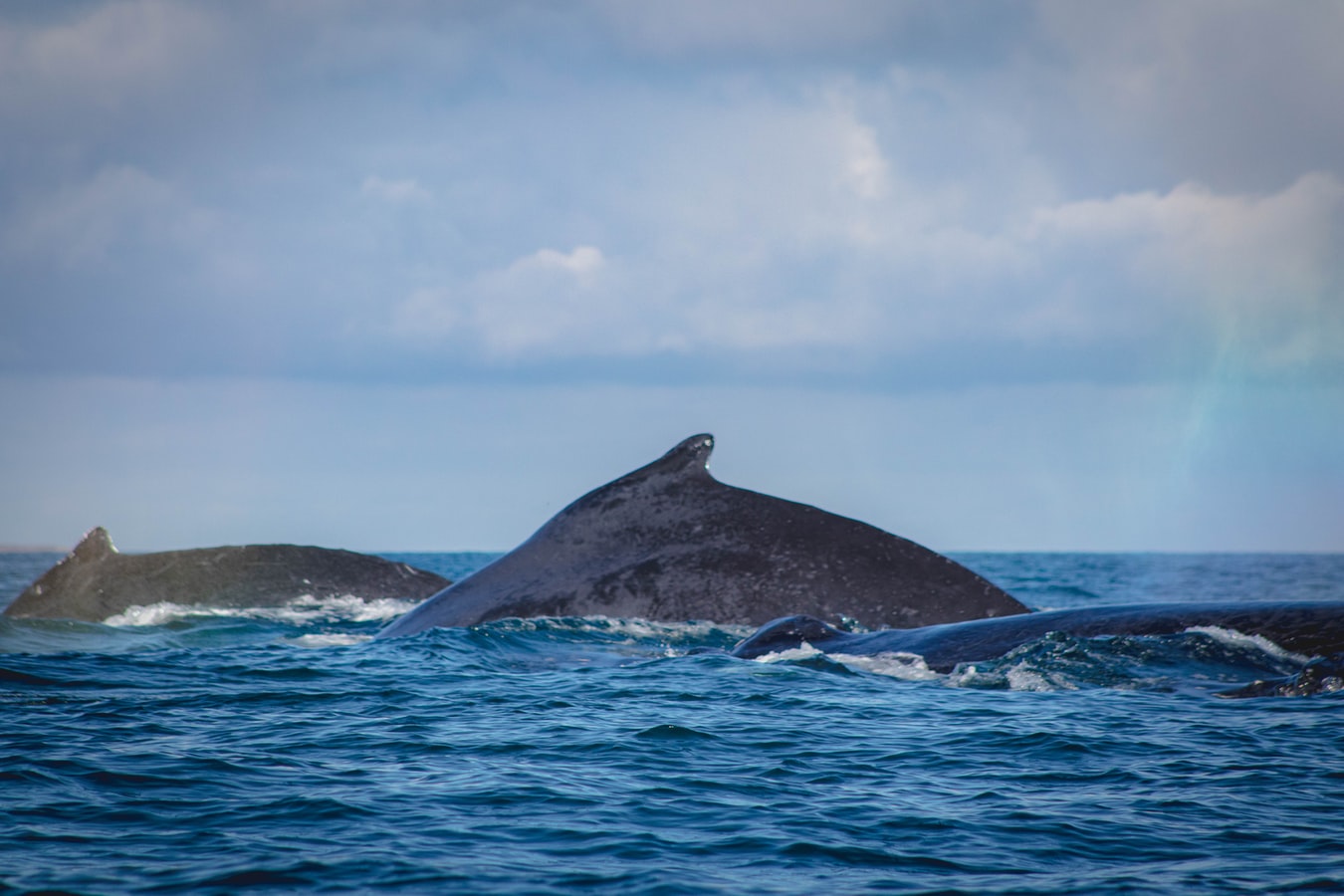
Efren spied the cocked head of another seal, and, as the couples turned to see it, two shiny, long, black backs broke the surface of the waves. Whales.

The whales frisked and frolicked about twenty yards away from the surfers who seemed unaware as they acrobatted their boards toward shore again and again. The black backs arched above the surface and sprays of water gushed through the froth.

Then, two more backs glistened closer to the surfers now, cavorting and ignoring the humans on the beach who had lined up, fixated on them. The surfers saw them stare, looked behind at the waves a few times, then swam to shore, pulling their boards by the cords behind them. They shook their sleek bodies, then stood with the others on the rim of the watery stage.

As the sunlight deepened, hundreds and hundreds of black backs broke the darkening and undulating sea. Glossy bodies arched, bent, sprayed, thrust, thrashed, and crested the swells. The ocean was a playground of swimming children, unaware of how their antics amused the audience or how their magnificence inspired the human souls watching them from the sand.

Katy, Minnie, Efren, and Owen exchanged looks, their mouths paused in chewing and their eyes wide. The surfers and campfire friends smiled at each other until every human being watching the whales became part of a congregation, knit together by their admiration of the wet nature. The ocean waves sang like a choir, the voices echoing from the choir loft and reverberating from nooks and crannies on stone walls before descending into the nave and ears of the people. The beach, the ocean, the bobbing seals, the cavorting whales, and the silent humans shared a single energetic symphony as the sun dimmed its spotlight on the Pacific ‘s stage.

The tide moved in to accompany the oncoming darkness. In two’s, three’s, and four’s, the spectators on the beach snuffed their campfire and climbed the gravel path to stand with the two couples at the wall framing the cliff. Finally, the sky deepened into a mass of navy sheets and the dark backs of the whales and bobbing heads of the seals were no longer distinguishable from the folds of the water.

The waves crept steadily up the shoreline and, wave by crashing wave, erased the footprints which had earlier curved all the way to the pier.

A Belly of Snow

Where I live it never snows.  Hardly ever rains.  Winter starts and finishes with fog huddling close to the ground like a damp layer of dust coating a glass tabletop.  The one day it did snow, I was stuck inside.

“You have to stay in the house, Carlota,” said Mama, tucking the blanket around me in my wheelchair.  She was always so careful with me.  “The ramp to the yard is icy and dangerous.” 

Usually I liked Mama’s special attention, but sometimes it got in the way.  Like now.  I wanted to feel that snow, ball it up in my hands to see if it stuck.  It would be fun to make a snowman.  I thought about how I’d carve the cheekbones and eyebrows on the head.  Javier, my little brother, would help find bark and sticks for the eyes, nose, and happy mouth.  I’d wrap my red scarf around its neck.

I pressed my face against the window, the glass feeling like a jar of chilis just taken from the refrigerator.   The yard was all white, the trees draped with snow lace doilies.  I watched Arnoldo, my older brother, Maria, my sister, and Javier playing in the yard.  They were lying back in the snow, swooshing their arms up and down to make angels.

Mama carried baby Jessie to his bedroom.  As soon as she was down the hall, I wheeled myself over to the door, opened it, and rolled out onto the patio.   The air gripped me like the draft from the freezer, chilling and exciting. 

“Carlota, what are you doing out here?” Maria asked.  “Mama told you to stay inside.”

“I’m just coming out for a little while, to see what it’s like. Mama won’t mind.”  I turned to the ramp and stopped at the top.   The cement looked slick and glossy like a mirror, reflecting the snaking branches of the mulberry tree.

With my hands gripping the rims of the wheels, I inched down the ramp, braking, almost going nowhere.

“Careful, Carlota. It’s really slippery there,” Arnoldo said.  He dropped a fistful of snow.  Javier gawked at me.  Maria’s mouth opened.  I couldn’t tell if their faces showed fear or admiration.

The chair twisted on the ice, and I lost hold of the other wheel.  The chair slid across the glassy surface, crashing into the rail, thrusting my chest and head over the side like I a floppy, rag doll.  My rib muscles throbbed. 

Maria, screeching, ran to me, grabbed my collar, and folded me back into the chair.  Arnoldo gripped the wheelchair’s handles, braced himself against the opposite rail, and pushed me back up to the patio.

“Are you all right?” Maria asked, hunching down and peering into my face.

“My chest hurts .  .  .  where I hit the rail,” I said, breathing hard.  I rubbed where the wood had stopped me, feeling to see if my ribs were broken.  “I’m O.K.”

“You almost killed yourself, you fool!” Maria said.  “Does Mama know you’re out here?”

I didn’t answer.  I looked down at my legs and noticed that my shoes were jammed behind the footpads.  Javier lifted my feet and placed them on the pads.

“Let’s cart you back in there before Mama finds out what you did,” Maria said.       Javier held open the screen door as Arnoldo drove me back into the house.  Long before Mama came out of baby Jessie’s bedroom, I was back, looking out the window.

I leaned my arms on the sill and breathed mouthfuls of fog onto the glass.  Arnoldo was shaking his head as Maria squawked at him and flapped her arms. 

After a while when she calmed down, Maria walked out into the yard under the naked walnut trees with Arnoldo and Javier following behind.  As I looked at the sky through the craggy branches of those trees, a tear drizzled down my cheek onto my lips.

Stupid wheelchair!   I wanted to be outside.   I wanted to play in the snow with everyone else.   It wasn’t fun being cooped up in here with nothing to do.

I was surprised Maria didn’t tell Mama what I’d done.  Instead, she told Arnoldo to get the red wagon from the patio and pull it out under the trees where the snow was smooth and thick.      

My brothers and sister filled the wagon with a mountain of snow.  I watched as they packed it in, patting it with the palms of their mittens, building it higher than even the wooden slats on the wagon’s sides.  Arnoldo dragged the wagon up the yard to the side of the house out of my view, everyone trailing behind him.

I sighed, turned my chair away from the window, and rolled over to the desk where I laid my head on my folded arms.  I had nothing to do, and, now,  couldn’t even watch Maria and the others playing.   Was Maria still mad at me for scaring her?   Is that why they went to play where I couldn’t see them?

“Carlota, go to the garage. Maria is asking for you,” Mama said from the kitchen.  I could hear the chopping of her knife on the cutting board. 

As I turned my chair around towards the garage door, I felt a flutter in my chest, a lump in my throat.  Would Maria tell Mama what I had done?

I opened the door and rolled down the ramp.  Maria, Arnoldo, and Javier stood in the middle of the garage floor, next to the snow-filled wagon.  They were all smiling with big, toothy grins.  Arnoldo patted the snow like it was a big belly.  Javier laughed so big that I could see the spaces where his two teeth were missing.

I squeezed my eyes shut.  Something good was about to happen.  Something warm and comfortable and happy just the way I liked it.  Like when I woke up in the morning and smelled fresh tortillas.  Like when Mama gave me her ribbons and sewing kit to decorate my doll clothes, or when Daddy wrote poems to me on the back of my birthday cards.  This something would be like that. 

“Now you can have snow, too,” Maria said. 

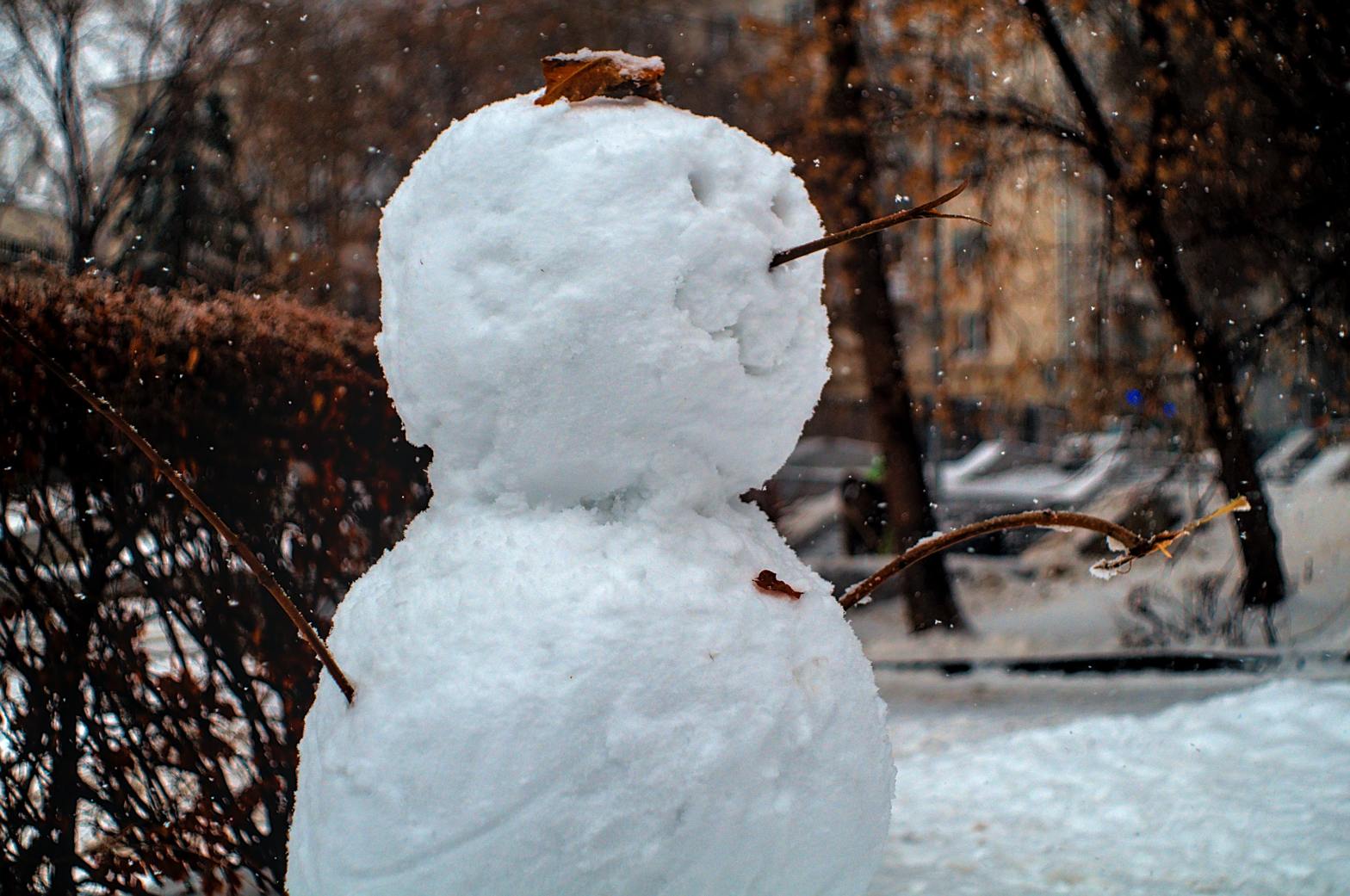
I wheeled over and braked abruptly in front of the wagon. “Help me build a snowman!” I shouted as I dug a hand into the cold, white mound.

Outside the garage window, sunshine peeked through a gray cloud.  The snow would be melting soon.  Daffodils would poke their heads through the dirt liked it hadn’t been cold at all.

It never snows where I live. It hardly ever even rains.  

Beyond the Tidepools

DSC01774

As soon as I arrive at the beach house in Pacific Grove, I tuck my suitcase inside the front door and find the path to the beach.

During rainy season, the path is muddy, but today dust kicks up around my shoes and melts into the ocean breeze wafting up from the beach.  Tufts of grass poke out of the dirt like uncombed hair, and around a tiny pink house, birds perch on the rails of a wooden fence.  The sun is not yet up, but it’s light enough for me to see a doe lying in the dry grass beside a single sun flower.

In only five minutes, I reach the beach, cross the two lane highway, and climb onto the sandy trail that follows the dark coastline.

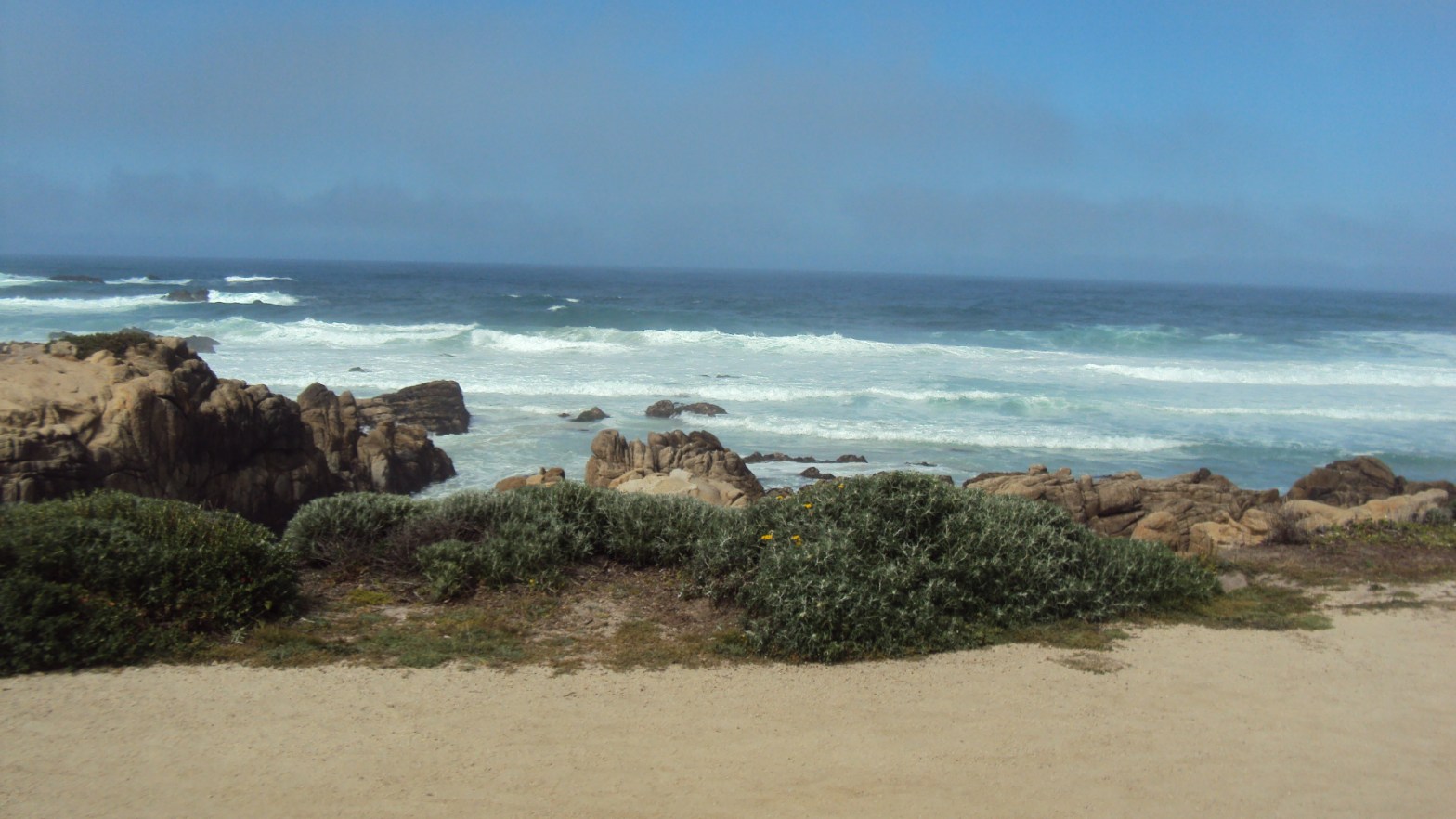
In the crags of the beach, I find a few tide pools bathing in foam, partially hidden by necklaces of seaweed, and I squat down to inspect them.  The seaweed smells like fish, a stench so powerful that my nostrils flare in defense.

I trace a figure eight on the surface of one tide pool and suddenly notice a starfish stranded on the pond’s bank, drying out like beef jerky in the sun.  Red scales scar its parched skin like bloody tattoos.  Blistering white pockmarks cover its body and legs. Its tentacles jerk slightly as it hopelessly reaches for the tide pool’s wetness.  It dies.

A sadness pummels me like grief and I shriek soundlessly, bending my head into my knees, blacking out the sand, the ocean, and the tide pool.  I mourn.

DSC01894

A crack startles me out of my imposed darkness.  I look up so fast that I see only dots in front of my eyes for a few seconds, searching.

On a rock, about four feet away, a stout seagull grips a crab in its beak, and knocks it on a rock.  Crack, crack.  The crab’s shell fractures, splits, and splinters.  A few legs fly off and land in the sand, still squirming.

Crack, crack.  The seagull slaps the crab onto a flat piece of rock and jabs its beak into the body.  It pulls bits of white flesh out from under the crushed shell, shifts it down its throat, and swallows.  Motionless, I watch the murder over and over again until the crustacean stops quivering and lies broken, mashed, and still.

My chest tightens.  I inhale and hold.

My beach is fear and death.  Hopelessness.  Nothing is forever; life is worthless since everyone dies anyway.  Bad people hurt good people, and I can’t do anything about it.  I lie my head back down on my knees and let my tears run down my bare legs like rivers of pain.  Great sobs echo in the darkness, and I fold my arms over my head to protect myself from the dangerous pictures in my mind.

A long time passes.  Finally, the sea’s music wipes my tears.

A whiff of breeze sails through a window between my knees and kisses my face.  I look up—across the dark sand, over the crawling shore, beyond the undulating navy cobalt marine to the horizon. 

Whales. The backs of dozens and dozens of gray whales.  They cavort and blur the horizon, ruffle the surface of the sea, blowing spouts of steam.

The sea billows like a blanket in the wind; in its creases, lines of white bubbles flirt with the shore, ever closer, ever bigger, until the bubbles splash onto the sand like happy cartoon characters, and pop!

Rocks, as massive as houses, glisten in the dawn, black and craggy.  There, sea lions lie and roll over like lazy teenagers out of school.  They yelp for food.  Herons float over the lions like white fans, circling, gliding, dipping.  Their pleated wings wave.

As the sleepy sun rises like a yellow pearl in the morning sky, I fill up with a new essence–beach, ocean, wideness, greatness.  I change my position and sit Buddha-legged on the dark sand and become what I see. The whales salute me with their blows.   I am one of them, swimming and diving in a wet heaven.  The waves roll toward me like wide smiles, and the sand sticks to my feet like stars.

The swell of the water fills me with hope.  I search the line of the crooked horizon and find peace.

DSC01778

The Miracle of Perspective

When the air turns slightly crispy and the California sun dresses the land in a lustrous golden skirt, autumn comes to the ridges and folds of Mount Diablo.  The mountain looms over the East San Francisco Bay like an ancient mother who has seen oceans lap at her sides, Indians forage in her curves, and suburbs grab at her ankles.  She stands against a pale blue sky, adorned in antique oak trees and Manzanita brush.  I ache to climb her.

To get to the South Gate of Mount Diablo State Park, I have to drive through the roads of the old town of Diablo where oak trees cast shadows like huge canopies and stately homes hide behind mechanical iron gates.  The road winds slowly past rows of oleander hedges and stone columns until the mountain comes into view around the last suburban curve.  I feel like Dorothy opening the door to Oz.

Houses sink lower on my right and the mountain swells on the left—a pregnant belly planted with gold and dusty green children that dance in the breeze.  But no breezes break the tranquility and the stillness today.  Instead, big leaf maples poise on the landscape like jewels in red and green.   Poison oak gleams like branches of garnets in the sun.

The whole world holds its breath as I climb into the solitude, as I scan the view for recognizable landmarks, as I marvel at the preciousness of being alone to see a perspective that is not broken by company.

Several miles up, Rock City is like a neighborhood of boulders.   Teenagers have written graffiti on several, large stones but the squirrels and insects don’t seem to mind.  The critters climb in and out of the dark, small caves like hurried waitresses in a cavernous San Francisco restaurant carrying acorn shells, pine nuts, bits of leaves, and grains.

DSC01980

Nearby, a furry tarantula slowly crawls through the dirt on the way to find a mate.  He plods carefully like a rover scaling a planet, placing his legs down cautiously with each step as if feeling the earth for signs of life.  A few yards away, I spot a hole curtained off by tightly-woven, white, silk threads.  This is the door of a female tarantula’s nest and the poor bachelor, who is now only a few feet away, is out of luck.  This female has already mated and is now settling down in her new home.  But this he doesn’t know yet.  He is close to the ground and can’t enjoy the perspective I have until he reaches the silk door and finds it closed. 

For those close to the ground, life is like that.

DSC02028

Livermore Valley Overlook is only several yards up the road from Rock City.  From this lookout point, I can see for miles.  Brushy Peak out in Livermore sits on the valley like an upside-down cupcake.  The 580 freeway draws a blurry line on the earth and the campus of Lawrence Livermore Lab on Greenville Road lays out like a rectangle filled in with wooden blocks of different sizes.

As I search the Livermore landscape for wineries and vineyards, I feel empowered, like the tallest person in a crowd who can see over the heads of hundreds of people.  I can see the stage, clear and unobstructed.  I’m getting a lot for my money, and, because I can see more, my lungs fill up with air and every cell in my body grows stronger, healthier, and happier.

DSC01985

With fortitude, I climb the winding road ever higher until I reach 2,900 feet at an outlook on the other side of the mountain called the Diablo Valley Overlook.  The San Francisco Bay paints the view with a silky, light blue ink, and I seek out the numerous landmarks that poke up into the San Francisco skyline—the Oakland Port, Oakland Bay Bridge, Angel Island, and the Golden Gate Bridge.

This is a fourth dimensional view.  Not only have I see the valleys of the East Bay from the other side of the mountain, but I can see clearly for miles and miles beyond the corporate stairs of the City; over the artists’ loft studios; and even farther than where crab sailors deftly navigate the fierce currents of the Bay.  I recognize earth and water, good and bad energy.  The cells in my body grow more vibrant and vigor courses through my muscles and veins.  I am renewed, and even though I am alone, I feel connected to all the people filling the spaces in front of me

So I climb now with gusto, feeling like a bird that soars over the majestic oak and buckeye trees of the mountain’s grassy elevations.  I feel strong and joyful, playful and beautiful.   Finally, at 3,849 feet, I reach the summit, where even mere mortals can sometimes discover immortal perceptions.

DSC02010

To the southeast, Mount Hamilton rises like a brother.  To the south, Mount Loma Prieta marks the crest of the Santa Cruz range.  To the East, I follow the meandering arms of the San Joaquin and Sacramento Rivers as they twist into the watery mazes of the Delta.  To the north, I see the massive shoulders of Mount St. Helen and Mount Lassen.  And finally to the West, beyond the orange cables of the Golden Gate Bridge, the Farallon Islands lie like giant seals floating on the gray Pacific Ocean.  The view is clear and unambiguous like the perspective of the fifth dimension where every thought is bathed in light and love.

Perspective is everything.  At the bottom of the mountain I could only see as far as the wandering tarantula.  My perception was limited.  The higher I climb, the more I see.  The more I see, the better I understand my environment and my potential.  The better I understand, the more peace I feel.

While I stand at the balcony of this fifth dimensional perspective, I don’t feel the need to be anywhere else.  To do anything else.  To finish any tasks, solve any problems, acquire any more things.  All I clearly need is the miracle I can see.

DSC02019