
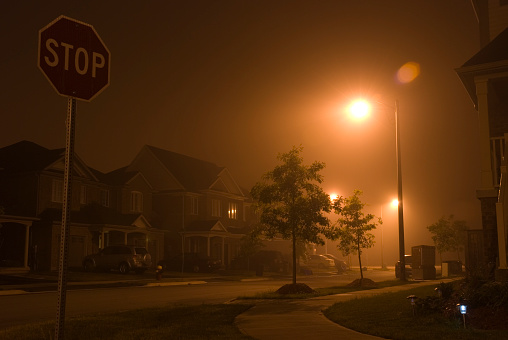
A Tule Fog Morning

When I walked outside to get the newspaper this morning, tule fog blanketed my world. The blades of grass chilled my slippered feet, and the air bathed my face in cold breath. The street lamps glowed like steaming, yellow jewels. Houses wore shrouds of gauze, and both ends of the street disappeared into a thick, milky blanket.

I grew up in Sacramento where tule fog covers the neighborhoods, hills, and American River from November to early March. When the humidity is high and the nights cool down fast, the condensation lifts from the ground like a thick mist, as white as a clean sheet.

I paused in the front of my house to enjoy the mystical sensation. I couldn’t see any details past about a hundred feet, and the whole morning was clothed in mystery. My heart skipped a couple beats at the excitement of remembering long bicycle rides in the tule fog, not knowing whether I’d be cycling head-on into a mailbox or a person walking on the street. I rode slowly, but deliberately, tempting the fog to clear just in time to save my life from a disaster.

While I was standing outside this morning, my almost bare feet chilling, my arms cupped around my torso, holding my robe together, I felt the thrill of the mystery of not knowing what the fog was hiding.

Mystery is an exciting part of life. We never know what will happen the next day, the next year, or the next decade, even if we plan conspicuously. Life has a way of retaining a sense of mystery.

I thought back to the day when I was nine-years-old, writing my first poem. When I was a teenager and I got up early in the morning to walk in the dew-filled yard just so I could write a poem about how it looked. About when I won the Cadbury’s Essay Contest before I ever knew that writing would become my major passion. Mystery.

I thought back to the times when my parents and nine brothers and sisters celebrated Thanksgiving, Christmas, and Easter, sitting around a plain, mahogany dining room table. Later, when some of us got married and had kids, the food would be set off to the buffet; we’d line up, say prayers, and then jostle for a seat. Lots of fried chicken, sliced ham, potato salad, broccoli salad, a tray of raw vegetables, ranch dip, fruit salad, pecan pie, trifle, and pop out of the can. Never would I have imagined that these family dinners would create an unbreakable bond between me and my siblings that is even more important now that both of our parents have passed. Mystery.

I thought back to my first college adventure when I majored in accounting. I planned to work in finance my whole career since it was a good field for women at the time. I admired my mother’s sharp ability to manage money, and thought that this major would give me the independence I sought. I did. What I didn’t know was that my love of writing would eventually win out, and I’d go to graduate school to become an English professor. The change was exciting, and I’m sure a lot of the excitement came from studying a completely different topic.

I saw myself in a silk wedding dress walking down the aisle of a church in Sonoma, California toward my first husband. The mystery of not knowing that the marriage would become a disaster allowed me to stay married for nineteen years, long enough to almost get my two beloved children raised and launched, and long enough for me to pick my crippled self off the floor and walk decidedly out the door to a healthier life.

So this morning when I stood in my robe in awe at the impenetrable tule fog, I became astutely aware that my life was still full of mystery, and I felt excited. Will I ever truly become fluent in Spanish? Will I ever get the chance to fly to Argentina to visit my son-in-law’s mother and be able to chat with her?

Will I finish writing my novel? If I finish it, will I publish it? If it’s published, will I visit bookstores to read and sign it?

Will I live to be sixty-five, seventy, eighty, or ninety? If I do, will I be able to write until the very end, or will my health limit my ability to follow my passion.

That’s the thing about mystery and the future. We just don’t know what’s going to happen until it happens. This forces us to focus on the present and helps us do the best we can now so that our future has a chance of imitating our dreams.

The tule fog covered the ground for hours this morning, reminding me to make the best of my day. That’s as far as I really can see.
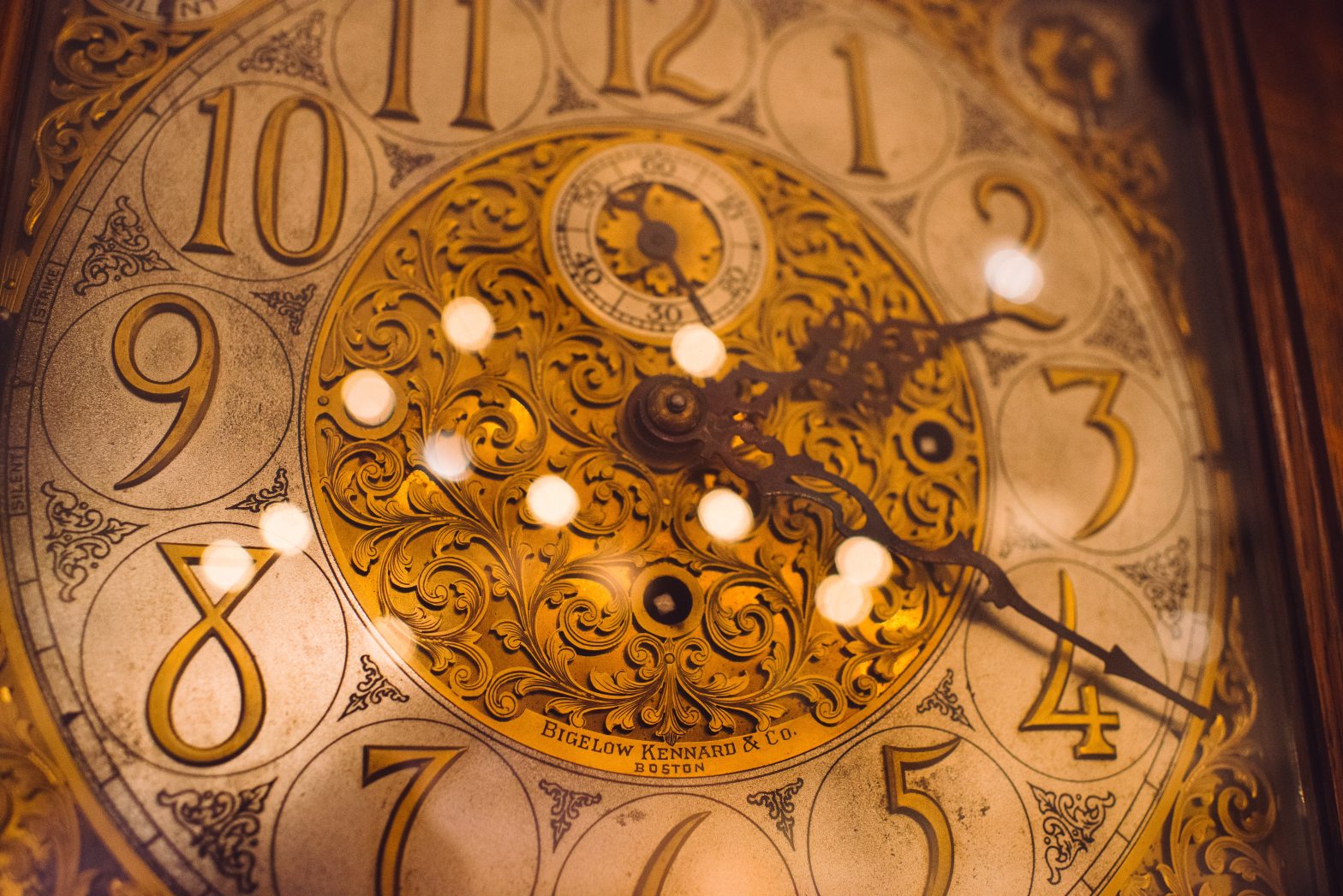
The Imagination Grandpa Story 1: The Clock Man’s Wise Clocks

Photo by Ella de Kross on Unsplash

Instead of going to Third Grade, Rosie was in a hospital bed with tubes connected all over her body.  Rosie’s heart had a problem and the doctors took her into an operating room one day to fix it.  Now, she had to lie down in bed all the time, and she couldn’t play.

The day after the operation, Grandpa Joy came in to visit Rosie.  He wore his blue jean jacket that had lots of pockets.  When he came in the door, he took off his beret and placed it on the table beside Rosie’s bed. 

“Should I tell you a story?” he asked.

“O.K.” said Rosie.  She was so bored just lying in bed. 

Grandpa started his story. 


Once upon a time, an old man owned a clock shop.  The shop was a huge room, and clocks covered every inch of the four walls.  He had clocks with black hands, silver hands, gold hands, and bronze hands.  Some clocks had round faces with 12 birds to mark the numbers.  Some clocks were carved out of wood with long pendulums hanging from the clock faces all the way to the bottom of the cases.  On one wall, a whole line of coocoo clocks hung silently, their birds frozen in various stages of entering or leaving through the coocoo doors. 

In the middle of the great room, large trunks were propped on their sides, and, against these great boxes, grandfather and grandmother clocks leaned silently.  No ticking escaped from their chambers because all the them were broken. 

In fact, all of the clocks in the whole store were broken and quiet.  The only noise in the vast room was the scratching from a mouse family that lived inside one of the walls and came out whenever the old man dropped crumbs and bits of cheese from his sandwiches.

One day, a young man came in to buy a clock.  He smiled at the old clock seller when he opened the creaking door and walked right up to the counter.  This young man wanted a clock to give to his wife for her birthday

“What kind of clock should I buy for my wife?” the young man asked. 

“Well, a grandmother clock might be nice,” said the old man.  I have several of them leaning against these big trunks.  Which one do you like?”

The young man hemmed and hawed.  He tucked his first under his chin and looked at the clocks with big eyes.  He peered into the clocks’ faces, and inspected inside the glass doors that held the pendulums. 

“I like this one,” the smiling man said.  “but it doesn’t seem to be working.”

“All of these clocks are broken,” said the old man.  “I get them from people who no longer want to fix them, and I save them until someone new comes along that will appreciate them.  Some of these clocks are over a hundred years old.  When someone wants to buy one, I fix it until it works perfectly again.”

“Is an old clock be better than a new one?” asked the young man.

“I’d say so,” said the clock man.  “Old clocks have seen so many years go by.  They’ve watched girls and boys fall in love, lovers get married, babies being born, Christmases and Easters and Passovers celebrated.  And as they’ve watched these stories, they’ve saved these memories as wisdom to pass onto their next owners.  A new clock is just a metal face or a wooden box, but an old clock is a treasure chest of life.”

The smiling man stood in thought for a long minute, and then looked straight into the clock man’s face.  “Well, someday my wife and I would like to have a family, and we’re going to need a lot of wisdom when we do.” 

He peered again into the Grandmother clock standing next to him.  Her face shone like mother-of-pearl and the numerals glistened in the tiny spotlights that hung from the ceiling.  The face was set into a rosewood box and the rose-bronze pendulum matched the numerals.

“I’ll take this one,” said the smiling man.  “My wife will not only love how beautiful it is, but she’ll also love the stories that come with it.”

So the clock man fixed the clock.  He bought new wheels and whirs and inserted them behind the face so that the hands of the clock started moving and the pendulum swung gently from side to side.  He rubbed the face until it shone like a pearl and the rosewood until it gleamed like a shiny chestnut, and he cleaned and dusted every part inside and out.  One week later, the clock was ready.

The next day, the smiling man came into the shop.  With him, he brought a pile of blankets.  He looked around for his clock and his eyes found it standing under a single spotlight, glistening like a mermaid in the sun.

“My wife is going to be so happy,” the smiling man said.  “I can’t wait to get this home.”

The two men helped each other wrap a small blanket around the pendulum inside the clock case.  They covered the outside of the clock with more blankets and tucked the blankets securely so the clock wouldn’t get broken.  Then the smiling man paid for the clock and carried it out the door, his eyes shining like buttons. 

For a whole year, the clock man ate his sandwiches inside his clock shop where only his silent clocks kept him company.  Every day, he dropped crumbs and cheese bits from his sandwiches, and the mouse family darted into the room to pick them up, then rushed back to the hole in the wall. 

People came in to give him their old clocks, and other people came in to buy one of the broken clocks.  The man worked hard to make the clock customers happy, but he was lonely.

Then one day, the smiling man opened the creaking door and stood back.  Inside walked a young smiling woman holding a baby in her arms.  The smiling man walked in behind her.

“I want you to meet my family,” said the smiling man.  “This is my wife Sharon and my new daughter Rosie.”

The old man was so surprised that, at first, he couldn’t speak.  He just stood by the counter and opened and closed his mouth like a goldfish for several long seconds.

“I’m so happy to meet you,” he finally uttered.  “Did you like your birthday present?”

“Oh, yes!” replied Sharon.  “My birthday clock is so beautiful that it inspired me to name our new daughter Rosie, like the beautiful rosewood and the mother-of-pearl face.”

The clock man beamed like a shiny copper penny.

“You were right about old clocks,” said the smiling man.  “Sharon’s clock not only inspired us to name our daughter, but it also reminds us to sing every hour, and that makes us happy.”

The old man’s face lit up like a flashlight.

“Would you mind if we visited you once a week so that Rosie gets to know you and learns about your shop of wise clocks.

The clock man looked around his clock shop as if he had never really looked at it before. These clocks were all potential friends, he thought. Then he looked back at the rosewood clock family and knew then that he’d never feel lonely again.


Grandpa was finished with his story, and Rosie looked up at him with shining eyes.

“That was a wonderful story, Grandpa,” she said.  “That baby had the same name as me?  Was it a true story?”

“No, Rosie.  I used my imagination to make it up.  Of course, the idea for the story is true.”

“What do you mean Grandpa?”

“Well, I wanted to tell you a story that started with you, and so I told my imagination to use your name to invent one.”

“Oh, I like that Grandpa.  That makes me happy.”

The Grandpa kissed Rosie’s cheek and tucked her blankets around her.  “When I come back tomorrow, I’ll tell you another story,” he said.  “Meanwhile, you can use your imagination to keep you company until your next visitor comes.”

“O.K. Grandpa.”  Rosie snuggled into her blankets and feel asleep a few minutes later, her face glowing . . .