
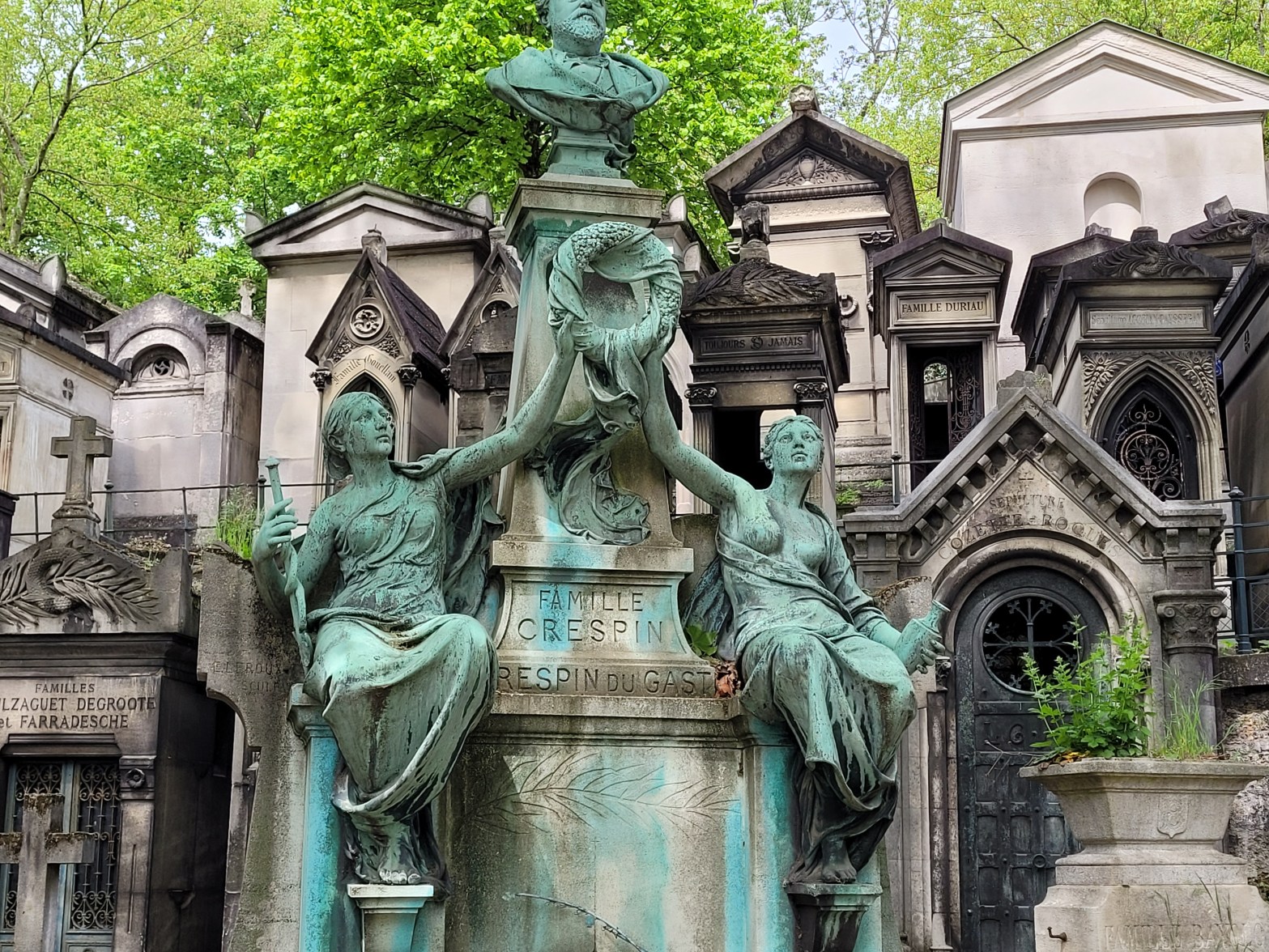
Getting Ghosted at the Paris Cemetery

My husband and I got to Paris three days before our tour of France was to begin. Our goal was for both of us to overcome jetlag before the tour started and to see parts of Paris not on the tour.

I had been to the Paris catacombs the last time I visited Paris with my daughter. These are underground alleys beneath the city to where thousands of bodies were transferred from cemeteries above ground as Paris expanded. For miles under the city, tourists can walk past bones piled up against the walls in neat displays. Hip bones are in one place, skulls in another.

One place I had never been before, though, was the Pere-Lachaise Cemetery, known for the graves of dozens of famous people from all over the globe. We took a taxi ride to the cemetery’s entrance at 16 Rue de Repos in the 20th Arrondissement, about a half hour ride from our hotel in Bercy.

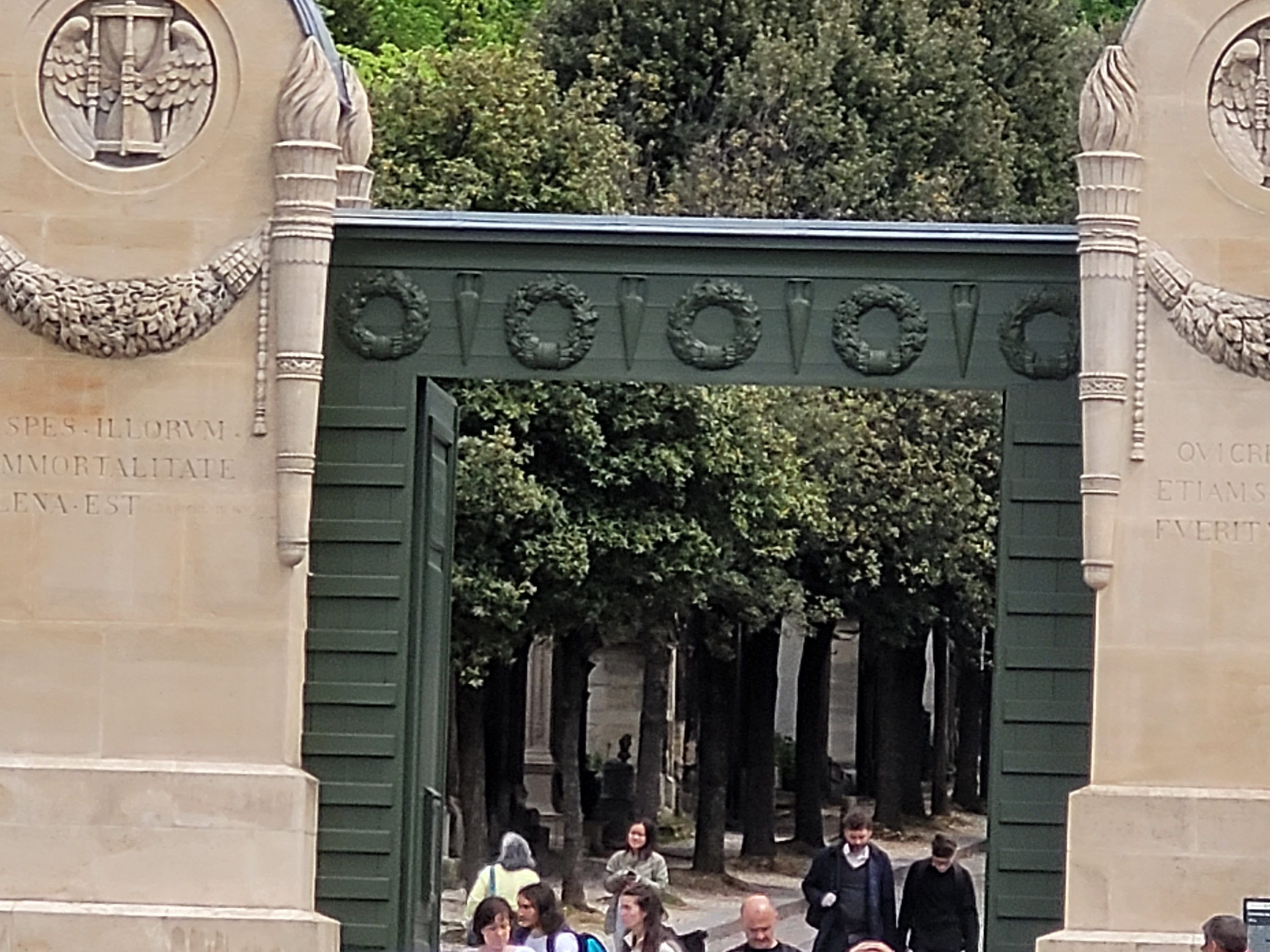
The entrance was a massive olive-green set of doors framed by wreaths. On both sides, the doors were flanked by two white granite columns topped with the carving of an hour glass circled by angel wings. The doors were open and, inside, we could see several erect tall tree trunks with leafy branches. In-between the trees, blackened marble mausoleums and statues beckoned to us.
I had a map of the cemetery from my Frommer’s Easy Guide to Paris, so I felt well-prepared to find many famous graves including Frédéric Chopin, the renowned Polish composer and virtuoso pianist of the Romantic period who lived half his life in Paris, and Oscar Wilde, the provocative Irish poet and playwright. But since we entered through the main gate, I decided we would start by finding the grave of Camille Pissarro, who was known for his Impressionist and Neo-impressionist paintings.

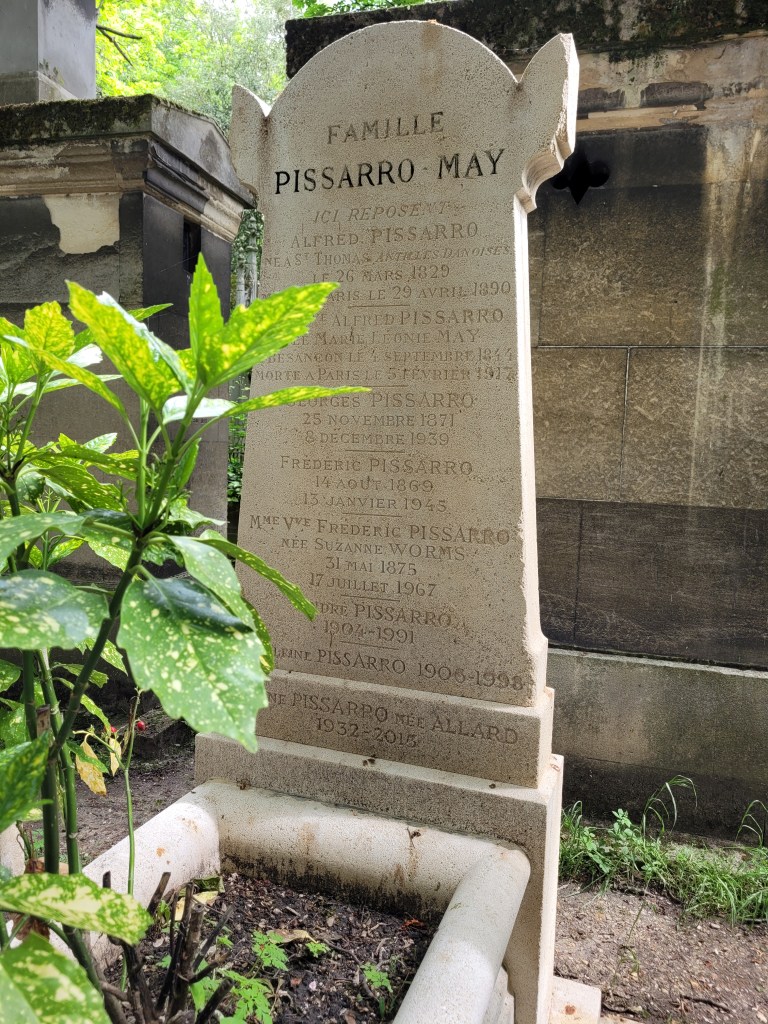
The cemetery has a few paved paths and dozens of tiny dirt paths that take visitors past the graves. To find Pissarro, we took a right just inside the gate to walk along the west perimeter of the cemetery’s wall. After several steps, sure enough, we found Pissarro’s crypt where at least eight family members were buried. The names were listed on a grand rounded slab of white marble with two angel wings sticking out at the top.
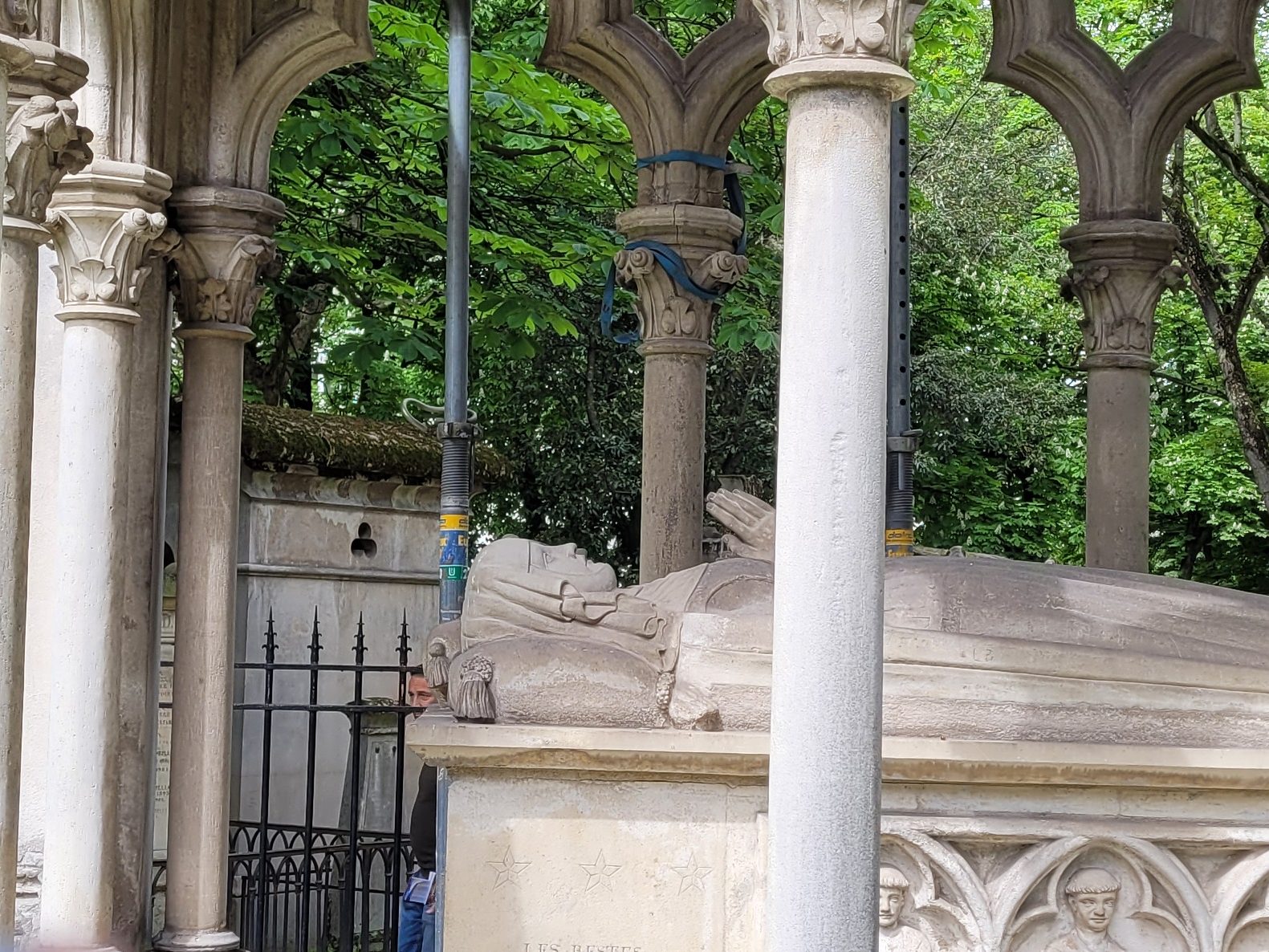
Nearby Pissarro, my map indicated that the 12th century lovers, Héloise and Abélard, were buried, their remains brought to the cemetery in 1817 from Brittany. We found their monument which is an openwork Gothic Chapel from an abbey in southwestern France. Underneath the roof are two reposing statues of the tragic lovers who were forced apart by their families and spent the rest of their lives writing letters of love.
After finding the tombs of these lovers, our luck evaporated. According to my map, the Rothschild family plot was nearby. Since the French Rothschilds were the founders of a banking dynasty in France, I expected their tomb to be colossal and easy to find. We scanned the names on several large monuments beside the dirt path, but we never found them. We found ourselves alone on the claustrophobic dirt path edging the gargantuan cemetery wall, shivered at the thought of being amongst more deceased souls than live ones, so gave up our search for the Rothschilds.

We took a teeny side path to reach Chemin Serre, a wider path than the lonely one we had just left, but still somber from the shade of countless trees which blocked out the view of the sky. Somewhere on this path was the grave of one of the most famous souls in the cemetery, the 1960s rock star Jim Morrison. According to my guide book, Morrison’s grave is the most visited in the grounds and, ever since he died, people have made pilgrimages to see his tomb, leaving behind graffiti, trash, and samples of drugs. We searched for the fenced-in tomb, which is supposedly an unexceptional relic. We asked passers-by if they knew where the grave was, and they pointed us in the right direction. We couldn’t find it. We looked for a grave that had a crowd of people gazing at it, but couldn’t find either a crowd or the famed resting place. We gave up.

I was probably most excited about seeing the tomb of Oscar Wilde since I am a fan of his novel The Picture of Dorian Gray, Wilde’s story about a man that has his portrait painted and then sells his soul so he never loses his youth; instead, his portrait ages and records the sins of his amoral life. To reach Wilde’s grave, a visitor has to walk up the hill to the top of the cemetery, and my husband was unwilling to do this. Leaving him sitting on a bench on a popular paved pathway, I started ascending the hill. Oscar’s grave was at the juncture of Avenue Carette and Avenue Circulaire. I walked, I inhaled through my nostrils and out through my mouth to regulate my breathing as I ascended the steep terrain. I passed tombs of men surrounded by statues of weeping women, which I thought was a bit arrogant on their part.
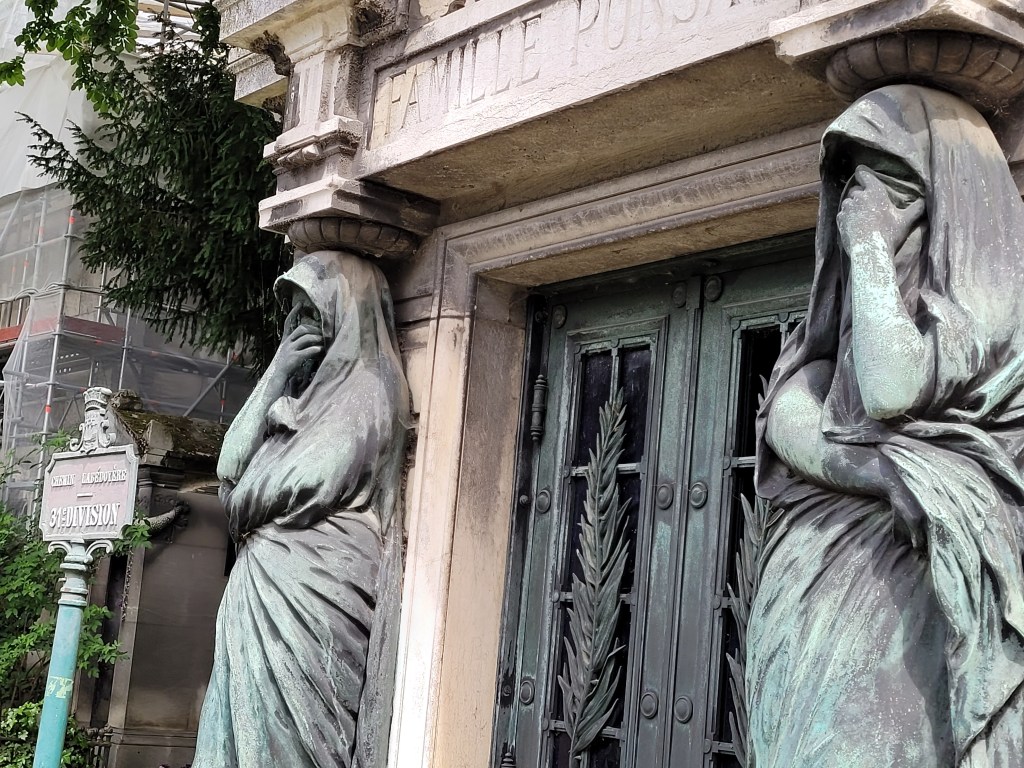
I discovered the mausoleum of the Monet family, which may or may not be related to the impressionist artist Claude Monet who is buried in Giverny. I also found a crypt for the Macon family which I hoped was related to Emmanuel Macon, the French president. Unfortunately, though, when I reached the spot where I thought Oscar Wilde was buried, I couldn’t find him. I looked up at the grand crypts. I read the names on several flat tombs, but Wilde’s final resting place eluded me.

I next took the opportunity to find the side-by-side tombs of Gertrude Stein and Alice B. Toklas, who were also supposed to be buried at the top of the cemetery on Avenue Circulaire. Gerturde Stein was an American novelist, poet, playwright, and art collector who hosted a salon for writers and artists in Paris. Toklas was her long-time lover. Where were they? Did I have to step over graves to find them hidden in the middle of a mass of deceased humanity? I’ll never know because I gave up and went to join my own lover who was still sitting on his bench watching other people struggle with their maps.

Together, we found a memorial for the 6,000 Jews who died in World War II in the German concentration camps. We also discovered a crypt for the Famille Charlemagne, and since the ancient King of the Franks had 18 children, I know he certainly has descendants who are now buried in this Paris cemetery.

The last person I wanted to find was Frédéric Chopin, the Polish composer that I mentioned earlier. According to my almost useless map, he was buried at the juncture of three dirt paths a short walk away from the Monument aux Morts, a grandiose marble monument to the dead with several grieving statues. I left my husband again, sitting on a bench along the circular road that surrounds the monument, and, again, I traipsed uphill to find Chopin. Standing on the path, I searched every name on the tombstones near the juncture. No Chopin. Feeling desperate, I courageously scooted between the tightly packed graves to read the graves behind them. No. I hurriedly got out of there. Chopin didn’t want to be found.

Back at the entrance to the cemetery, I read that the cemetery was named after a Jesuit priest, a confessor for King Louise XIV, who lived in a house on the property before the cemetery was built. In 1804, Napolean bought the land so that all Parisiens could be buried, no matter their race or religion. I also learned that, today, over 1 million bodies and cremains are buried in the cemetery. That made me feel better. In the midst of a million ghosts, most of the ones I wanted to see were the ghosts too shy to do any spooking.

Photo by David Baker

Chemotherapy Christmas

The room was large, windowless, and sterile. Blinding florescent lights. Beige linoleum floors. Twelve green reclining chairs placed with their backs against the walls around the room. Each chair accompanied by a metal stand hung with bags of fluid and tubes.

The woman sitting in one of the chairs wore a scarf around her head. I looked for wisps of hair, but couldn’t see any. Her body filled up the chair like of sack of potatoes, lumps everywhere. She wasn’t smiling like the nurse who stood next to her, hooking up a tube to a port embedded in her upper chest.

A man whose body disappeared within his baggy shirt and trousers sat in a recliner in a corner. His scrawny hands hung over the chair’s arms like shriveled leaves caught on the edge of a forgotten lawn chair in the fall. His bald head shone in the florescent lights like a bare bulb. His face was gaunt, lined, and dry, and his eyes were closed. A young woman sat in a chair in front of him reading the Bible.

I watched the room’s activity with a lump in my throat as I stood behind my mother and brother by the door. A woman with a cane was led to another recliner in the room. The male nurse helped her sit into the chair, gently pushed her back, and lifted the foot rest. The nurse lifted a matching green blanket from a small chair nearby and laid it over the woman’s body, tucking the edges around her snugly. Then he efficiently began hanging the bags of chemicals on a metal stand and hooking up the bags with the tubes.

This was my mother’s chemotherapy room. Mom’s last chemotherapy session was scheduled for December 24, Christmas Eve. She had asked my brother Zach and me to accompany her to the appointment. My brother had flown home from college in Southern California for Christmas, and I was home from college too. The only thing my mother wanted for Christmas was to finish chemotherapy with her children around her.

A female nurse wearing an ugly, plain, blue smock and pants led my mother to a chair on the emptier side of the room. Zach helped Mom take off her coat and climb into the chair. She looked small, dressed in her pink cotton beanie, pink V-neck sweater, and jeans. How pale her pretty face was. Mom nodded when the nurse asked if she wanted a blanket, and Zach took it from the nurse and covered her gently like he was placing a precious jewel into a new setting.

This was not how I wanted to spend my Christmas. Wasn’t college supposed to be one of the happiest times of my life? I was too young to worry about my mother dying or even being too sick to visit me at school.

The nurse pulled two straight-back chairs close to my mother’s recliner, and invited us to sit down. I took the chair farther away and leaned back as if my mother was contagious. My brother pulled his chair closer to Mom and took hold of her left hand. When she smiled at him, her eyes watered like green pearls.

Before long, Mom was hooked up to the tubes that would feed chemicals into her body. I could tell that she was putting on a brave face because, underneath her smile, she looked tired and weak.

I didn’t want to think about her being that way. Instead, I wanted her to jump out of her chair, hug me tight around the waist, and ask me about college. I wanted to tell her about Jasmine’s new boyfriend, Sara’s job offers, and David’s article in the college newspaper.

Her smile withered away as the chemicals dripped into her veins. She gave up trying to hold a conversation with my brother, who was bent towards her in his chair, his chocolate eyes full of concern. She looked at me several times, but I retreated away from her with a grimace on my face.  I didn’t want to be here.

Once in a while, Mom opened her eyes and looked up at the bag hanging beside her as if gaging how long she had to endure the procedure, but, for the most part, she kept her eyes closed, and we sat in front of her fidgeting in our chairs, biting our lips, and staring at each other with worried eyes.

Three hours later, the nurse in the blue smock and pants pulled the catheter out of my mother’s port, gathered up the tubes, and rolled away the metal stand with the empty bags.

A young woman with brunette hair and rosy cheeks pushed a wheel chair up to our station.  She asked my brother to move his chair, then maneuvered the wheel chair as close to my mother’s chair as she could.

“I’ll help you,” she said kindly. She took ahold of my mother’s upper arm and guided her from the recliner into the wheel chair.

My mother let out a whimper as she moved. Zach helped her put on her coat as she sat in the wheel chair, wrapped her pink scarf around her neck, and gave her a wool cap to pull over her pink beanie. Still, she shivered when the nurse wheeled her outside to the car.

Zach drove us home, and the next day was Christmas.

Rain

Photo by Ahmed Zayad on Unsplash

When Don woke up, it was raining.  The water that he ran in the tub sounded like rain chortling out of a storm pipe.  The water that streamed from the kitchen faucet for his tea beat into the kettle like rain on a wheelbarrow left out in the yard.  Rain. Rain. Rain.  It had rained for months.

Don’s mother had died at 10:05 a.m. on the same morning that Don worked his last day.  He was looking forward to retirement, and one thing he would do more was spend time with his mother—playing Scrabble, going out for hamburgers for lunch, driving her past her old house where prolific flowers signaled the change of seasons. 

At 10:06 on the day she died, the rain started.  He had kissed her on the forehead as she lay quiet in her hospital bed, checked to see if she was safe, and slipped out of the room to live the rest of his life without her. 

Claire had managed the funeral and service arrangements which were beautiful.  On the day Mom was buried, the sun came out for a couple hours—just enough time for Mom’s ten children to say their prayers and lay red roses on her casket.  When the casket was lowed into the ground and the earth filled in her vacancy, the grounds men laid the large spray of red roses over the dirt.

Then the rain began again.  It rained while they cleaned out Mom’s room at the assisted living home.  Maddy took all their mother’s clothes home in garbage bags.  A few weeks later, she knocked on Don’s door and handed him a teddy bear.  The bear was blue and green and peach and red, made from pieces of Mom’s shirts, pants, and dresses.  It looked both happy and sad as Don sat it on the couch in his living room.

Soon, the group texts began.  Don shared memories of his mother with his nine siblings every day.  Old memories.  Vague memories.  Disputed memories.  Sunny memories.  Rainy memories. 

Some people in the text posted pictures of what they made for breakfast.  Don posted pictures of his new seedlings and old pumpkins.  He talked about his clocks inherited from Mom and Dad.  Claire posted perfect plates of salmon dinners.  Rita identified the birds that Maddy found in her garden by looking them up in her bird bible.  Beatrice posted old photos of Mom from her twenties when she was thin, before she had ten children. 

The siblings discovered each other again.  Most of them had moved out of town since their childhood, and their communication had been through Mom for the most part.  Through their texts, they found out that Don had the best green thumb, Claire grew flowers but not vegetables, Rita was a bird and owl watcher, Maddie loved wine and dessert most of all, Beatrice was just starting a walking routine, Minnie continuously created new jam recipes, Jim was the handyman at his job, Carol had learned how to play guitar, Ron still told the best jokes, and Geo wrote poetry in his spare time. 

The texts started usually around 7 a.m. in the morning and lasted until the last sibling drifted off to bed.  Good mornings.  Breakfast recipes. Descriptions of walks.  Flower postings.  Loaves of bread.  Jars of jam.  Bowls of soup.  Directions to parks.  Comments on the news.  Revelations about hobbies.  Progress on quilts, puzzles, and charity projects.  Movie recommendations and dinner plans.  All these subjects and pictures streamed between the ten children that Mom left behind.

A few months later, the rain stopped.  The sun came out like a herald of good news, and Don woke up to the birds chirping outside his bedroom window. 

When he wandered out into his living room, he saw his colorful teddy bear leaning over on its side and bent down to sit it upright, and, as he did, the sun blazed through the window and lit up the bear in a shaft of light.

“Let’s go visit Mom, today,” Don said to his bear.  “The sun is out and I know she’ll be happy to see us.”

Half an hour later, after an oatmeal breakfast and coffee with chocolate, Don put the bear in the passenger seat of his blue truck, and drove to the cemetery.

When he got there, the sun streamed like yellow curtains through the oak trees whose branches spread over the graves like kind arms.  The green grass, which covered the shallow hills and valleys, glistened with diamonds of left-over rain. 

Don drove his truck onto the center road and stopped it in front of his parents’ graves.  There they were—lying side by side like happy campers in sleeping bags.  Their gravestone rose from the top of their plots like a crown, and Don noticed that one of his siblings had stuck some colorful plastic flowers into the metal vase in front of the headstone. 

Don knelt down in the middle of his two parent’s plots, reached out, and placed his teddy bear on his mother’s side of the stone near the flowers.

He paused for a few minutes, furrowed his brow, then recited the Hail Mary prayer, and his words wafted through the cemetery like a low whisper.  When he finished praying, he looked up at his teddy sitting quietly.

“You can’t stay here,” he said.  “We’re just visiting.  You and I have to go home and live some more.”

Don looked at the words of his mother’s name on the head stone and the dates of her birth and death.  92 years long.  Somehow, not long enough.

“Thank you for giving me life, Mom,” Don said, placing his hand on his heart gently. 

He reached over, lifted his teddy bear from the ledge beside the plastic flowers, and held the bear against his bent frame.

“I’m always here, Mom, for you, just as you were always here for me.”  Then Don slowly stood up from the ground, brushed the wet grass off his jeans, and walked back to his truck.

When he got into his seat, he checked his phone to see if any of his siblings had posted another message.  A few rain drops fell onto the windshield as he drove away. 

An Old Rose

She was worried about her mother who seemed to struggle to stay present, something pulling her focus away or inward.  Some days she sat in the arm chair by the window, staring straight ahead, her gray-blue eyes lost in deep thoughts. 

When Sestina tried to talk to her, her mother struggled to respond.  “Wait a minute,” she would say, then, with a determined set to her mouth, she’d squeeze her eyes shut for a brief moment, open them wide, and glare at Sestina while she slowly made a lucid response. 

Her mother woke up early every morning, took a spit-bath at the sink in her bathroom, put on her clothes, and combed her golden white curls until she looked neat and ready for an outing.  After breakfast—not a big one mind you—just a piece of bacon and half a piece of toast with butter and strawberry jam—she sat down in the chair by the window and disappeared into her private thoughts.  Her breathing was labored, and she raised her shoulders every time she inhaled, her chest rising slowly, and she exhaled by opening her mouth and releasing a small burst of air.

On Wednesday, while her mother was sitting in her arm chair, Sestina went out to prune the old roses off the rose bushes.  She knew her mother not only loved flowers, but she loved roses most of all, and Sestina wanted the roses to look perfect when her mother looked out the window.   Eight tea rose bushes grew in the redwood planter, a raised bed so that the roses bloomed at the same height as the window.  The planter was about six feet from the window so when her mother looked out, she could see the stems wave gently in the breeze and glow in the sun. 

The yellow rose bush was the heartiest with big blossoms that bloomed like cabbages.  One bush grew lavender roses, medium in size with delicate petals and a hue that took Sestina’s breath away.  Four of the bushes bloomed with various versions of red flowers, each a unique shade of red and shaped petals.  The two white bushes bloomed with the most flowers, always producing plenty of blossoms so that Sestina could cut some and bring them in the house.

Sestina held the kitchen shears in her right hand and pulled back a single stem from a rose bush, looking for the perfect compound leaf of five leaflets so she could prune the dead rose at just the right angle and place to encourage more growth. 

As she made the cut, the daylight intensified into a blaze of light all around her.  Insects’ voices grew loud into a hum like a Gregorian chant, and she heard the wind rush under the wings of a swallowtail butterfly who hovered over a rosebush nearby.  The butterfly glided toward her, waved its wings close to her nose, and she thought that she heard it whisper, it’s time for her, time for her.   Its black face smiled, and its eyes looked deep into hers, speaking wordlessly of love.  She heard the breath of the breeze travel through the petals of each rose, and the scissors snapped the rose’s stem like a clap of thunder.  She heard the leaves of the lemon tree give birth to new cells and buds of fruit.  Then, suddenly, the breaths of the insects and flying creatures, echoes of the growing plants, and pneuma of the wind were silent, and the garden was still.

When Sestina got back to the cottage, she found that her mother had died.   Her face was turned toward the open window and her hands were folded over each other like a final prayer.