Making a Plan to Have Fun

This is not my idea. I got it from my daughter who is the most entertaining person in our family. She’s an adult—thirty-three-years-old—who loves to have fun. What she did is to make a list of things she wanted to do during Fall to make her life more enjoyable. She downloaded a free template from Canva and made one column for the activity and another for checking it off when she completed it.

What did she include in the columns? Well, for one, nothing cost a lot of money. One thing she wrote was to buy paper Halloween cups to enjoy when she had coffee. She has a dog, so she walks a lot, and a holiday coffee cup would be a super conversation starter for all the other dog walkers in her neighborhood.

Here are some things I would write:

  • To make lamb stew
  • To read On Writing: A Memoir of the Craft by Stephen King
  • To watch a movie in a movie theater
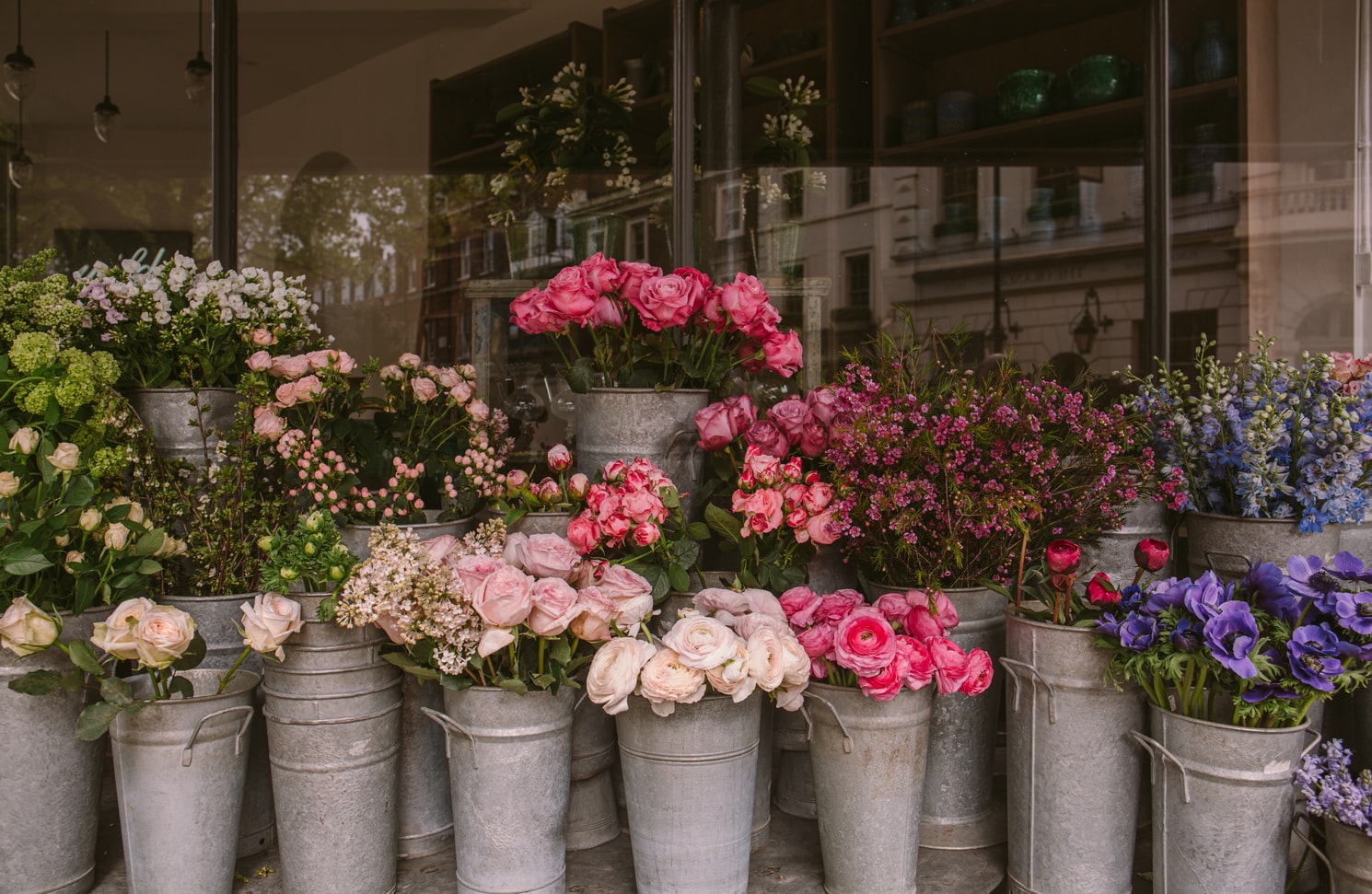
  • To take flowers to a friend that needs cheering up
  • To go to a craft fair with a friend
  • To take a hike to a natural labyrinth near my house
  • To visit my local library
  • To wander around in a large nursery
  • To prune my roses
  • To send my daughter a card for no reason except to say “I love you.”

White Elephant Appetites

The term “white elephant” originated in Southeast Asia. Monarchs possessed white elephants to convey that they ruled justly, and that their kingdoms enjoyed peace and prosperity.

The white elephant was considered sacred, so it couldn’t be used for labor; it was an animal that did not contribute to a household, but had to be fed and sheltered.

 Expensive for an elephant.

The gift of a white elephant from a monarch also was troublesome. On the one hand, a recipient had the monarch’s favor, but on the other hand, the elephant could not be given away and was costly to keep.

A white elephant is, accordingly, something whose value does not equal its cost to maintain. Today, a white elephant is a “used” item that’s no longer wanted by its owner.

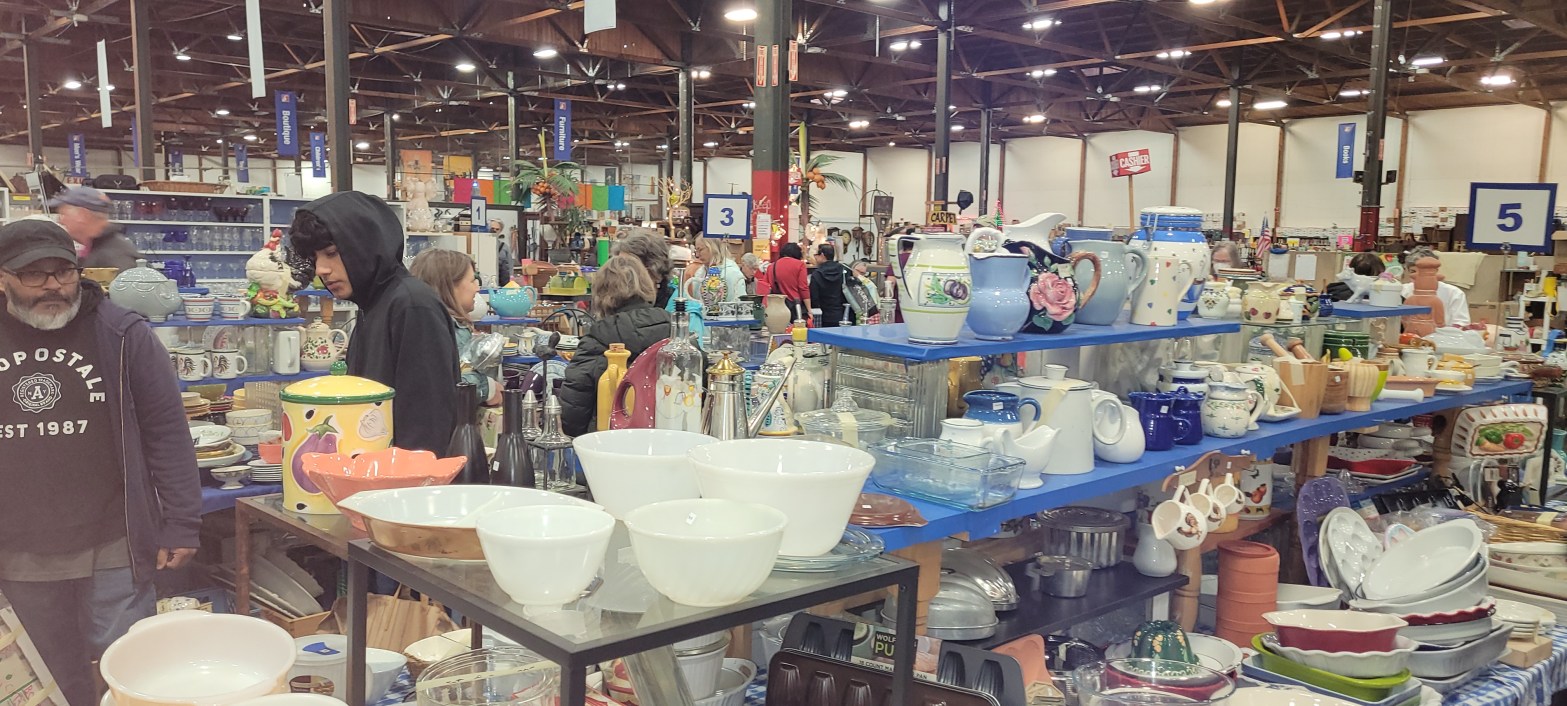
Two friends and I went to the Oakland Museum’s White Elephant Sale yesterday. Lily had purchased our $5 tickets at the beginning of January, and yesterday was the first $5 day for the sale. If we wanted to pay $40, we could’ve gone last Sunday. Our goal, however, was to get the best deal possible, so a $40 ticket didn’t qualify for that.

We wanted to find a white elephant that we could transform into a treasured object.

The Oakland Museum’s White Elephant Sale is sponsored by the Oakland Museum Women’s Board, an organization of just over 100 members. However, this group of women recruit thousands of volunteers who work all year long collecting used items for their annual White Elephant Sale which is held each January to March. This year, 2024, is the 65th anniversary of the event.

Why would these women work year-round to hold a rummage sale? Since they began holding this event, their organization has raised over $30 million for the Oakland Museum. That’s why.

We got to the White Elephant Sale Warehouse on Lancaster Street at approximately 9:30 a.m. The doors were going to open at 10:00, and the line of people waiting with tickets to get in was two blocks long. Everyone was dressed in coats, hats, and gloves for a chilly day in Oakland and a threat of rain. A woman who lived in a condo came outside to find out why hundreds of people were standing on the sidewalk outside her building. Her eyes were as big as saucers.

Volunteers scanned our tickets and wrapped bracelets around our wrists.

Friends asked each other which department they would visit first.

“Tools,” said one guy, standing next to his two fellow male rummage sale fans.

“Garden,” I said, imagining statues of angels, terra cotta pots of all sizes and shapes, and wrought iron tables and chairs.

“Art,” said a woman dressed in a pink jacket, her hood pulled over her wind-blown hair.

Finally, the doors opened, and the coat-shrouded shoppers in front of us filtered through the wide doors into the windowless interior. Portable toilets were set up outside at the bottom of the entrance stairs. We climbed the old steps to the metal porch, showed our bracelets, and walked inside.

Think of a football field, 100 yards long by 160 feet wide. The interior of the Oakland Museum’s White Elephant Warehouse is almost twice that size. The building is over 90,000 square feet. The organization organizes donations for sale into 17 huge departments: men’s clothing, women’s clothing, children’s clothing, sewing, linen, kitchen appliances, China, dishes and baking ware, tools, garden, art, bric-a-brac, toys, musical instruments and music, lamps, furniture, and accessories.

My heart fluttered like a hummingbird in flight as I entered the building.

We rushed like we were being followed by bears, turning right for the garden department. Lily immediately found two metal buckets and a watering can. She grabbed them and got in line to check out. Buyers must check out their treasures before leaving a department. The volunteers write up a receipt, wrap up the items, and take payment. Or, like we did, you can pay for everything at a cashier near the exit.

Becky found a trellis, clutched her fingers around it and got behind Lily. As I passed them, Lily pointed to two more watering cans and asked me to get them for her.

After the garden department, we separated, each of us following our personal whims. As I wandered in the dishes and baking ware department, I joined hordes of treasure-hunters in picking up items, inspecting them, and then either tucking them under their arms or putting them back on the shelf for someone else.

Teapots, mugs, bowls, plates, platters of all sizes and design, wine glasses, glasses, cast iron skillets, ladles, cutlery, and a hundred other kitchen items covered table after table, shelf after shelf. There was pewter, pottery, stainless steel, stoneware, glass, and copper.

I found sixteen 4-ounce canning jars with lids for my sister who loves to can. I also found a white mixing bowl for my daughter. I would’ve bought something for myself, but I knew my cupboards at home were full of treasures from past sales. I have a white oval platter that I bought last year and three glass serving bowls from other years.  

Becky went to the art department and bought a pastoral painting in an ornate wooden frame. She also bought dishes. Lily bought a 24-inch brown wooden bench to put near her front door.

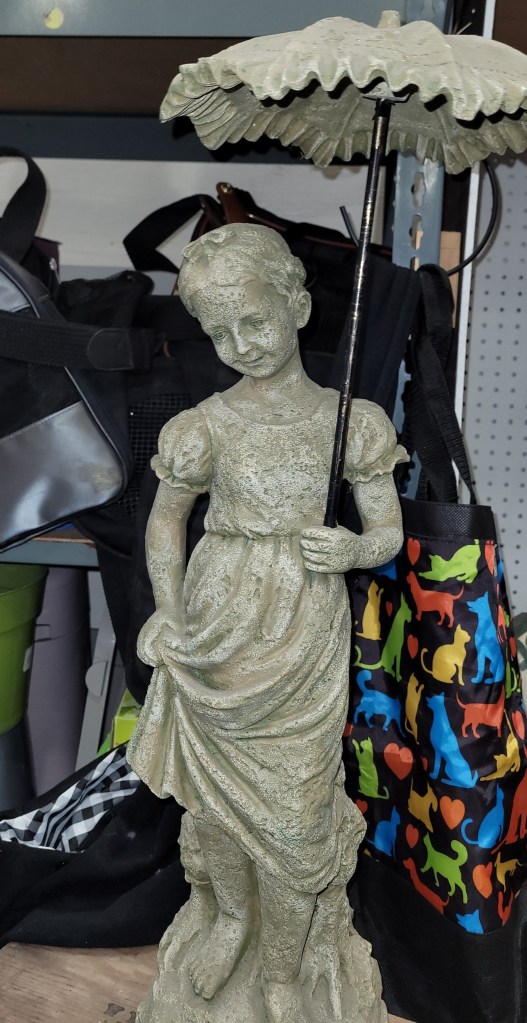
After much wandering from China to art to bric-a-brac to furniture to everywhere, I found a 30-inch garden statue of a young girl holding an umbrella. I hemmed. I hawed. I walked away and wandered some more. I watched a few other women touch the statue and look at it from several angles. I turned it around, placed it on a table, stood it on the floor. I considered its color—a shade of verdigris. After walking away several more times, I came back.

Finally, it was noon, and my friends would be about finished with their hunting, so I picked up the statue, tucked it under my arm, and got in line to check it out. It was heavy, so, while I waited, I put the statue on the floor and nudged it forward inch by inch.

Even if I didn’t like it, I was supporting the museum. And it was cheap.

We packed our treasures into the back of Lily’s car. In order to fit into the back seat, I had to push Becky’s trellis and painting over. I leaned them against the inside of Lily’s bench legs so they wouldn’t decapitate me if Lily stopped short in traffic.

Teasing drops of rain hit the windshield. Gusts of wind shook the car as Lily navigated out of Oakland and back into suburbia.

I got great deals. Becky came out with a few bags of bargains, and Lily, well she brought home several packages of treasures.

Thank goodness we bought treasures instead of white elephants. Our yards are too small for an elephant.

How to Meet Stimulating People in Retirement

Photo by Dario Valenzuela on Unsplash

Retirement can be lonely.

People who are used to working with a diverse group of people may miss that dynamic social network. For example, I worked as a professor at a community college. Every day was filled with fascinating interactions with numerous college students full of young energy and ambition. After I retired, I missed my students’ vigor and spontaneity. I also missed the intellectual conversations I had with other professors whose goals were aligned with mine.

Individuals used to engaging with technological advances may miss those challenges. A software programmer I know felt bored when he retired from his technical job. He also developed anxiety that he would become out of date.

Medical workers such as doctors and nurses who strive to care for others often miss the opportunities to help their patients. When they retire, they may find it difficult to focus solely on their own needs instead of the needs of others.

Retirees often face loneliness due to the changes in their families. When they retire, they no longer have their parents or children available in their lives on a frequent basis. Their parents may have passed away, and their children may have become adults with busy careers and families of their own.

This blog post addresses how retirees can avoid loneliness and achieve a socially-satisfying retired life with stimulating friendships and meaningful activities.

Take a Class

One way to meet people with the same goals is to take a class on a subject that interests you.

I’ve always wanted to become fluent in another language, so when I retired, I found some adult education classes that taught Spanish. I started this activity during the pandemic, so the classes were held online. When the pandemic ended, the students, who are mostly retired, voted to keep the classes online.

I began taking Spanish 2 and now I’m taking Spanish 4 with many of the same students I’ve known for two-and-a-half years. During class, we were in groups a lot, so I’ve even more familiar with four of five people with whom I’ve worked. Besides helping each other learn Spanish, we share our hobbies, family news, backgrounds, and travel adventures as we converse. Sometimes, we have even helped each other with technical problems relating to the class. Furthermore, a few of us meet outside of class to strengthen our Spanish conversation skills while we enjoy a cup of coffee or have lunch together.

My community offers a variety of classes for seniors including courses about Medicare, computer skills, line dancing, and yoga. My town also organizes social outings for seniors such as trips to theaters, local public gardens, or historical monuments.

One of the most interesting classes I’ve taken is a class on movie directing. In the class, attendees watch movies by specific directors and then discuss the techniques used in the movies. I found this class not only relaxing, but intellectually stimulating.

Join a Philanthropy Organization

Individuals who love to contribute to their community can find many opportunities to do so by joining a philanthropy.

One of my retirement goals was to help financially disadvantaged students. I joined an organization which raises money for college and vocational scholarships. In fact, I’m now the chairperson of the scholarship committee which gives me many opportunities to interact with high school seniors and college students. I also manage the production of a scholarship luncheon at which we award our scholarships.

A woman with a degree in gerontology and psychology volunteers on a county committee that develops transportation options for senior citizens. She interacts with a variety of county agencies and uses her expertise to develop worthwhile programs.

A woman who retired as a buyer for Safeway now works at the county food bank, sorting food and organizing bags for distribution. She enjoys talking with the management about sources of food and how best to store them.

Hang Out in a Bookstore

One of the most stimulating places to hang is a local bookstore. The bookstore in my town always has its door open even when it rains. Its display tables and shelves are chock full of the latest books or books recommended by its staff.

When I looked up this bookstore’s website, I found out that it has a mailing list so that customers can stay abreast of the store’s activities. They invite authors into their store for readings, arrange readings at various schools, and …

The store also sponsors eight book clubs. One is for mystery readers. Another is for wine drinkers. On Wednesdays, a book group meets at 10:00 a.m. and goes for a 45-minute walk while discussing their book. Another meets at a local assisted-living home. Obviously, this book store aims to please all of its potential readers.

Find a Social Group

The goal of some retirees may be to socialize as much as they can after working hard in a career.

In my area, there are men’s groups known as Sons in Retirements (SIRS). This group is organized into various chapters. Each chapter caters to the interests of the men in that chapter. For example, the chapter to which my husband belongs offers a wine club, golf, book clubs, hiking, and bocce ball on a weekly basis. The group also sponsors monthly lunches with speakers, a spring lunch for spouses, and a Christmas Dinner Dance for couples. My husband had never played Bocce Ball before joining this group, and now he never misses a game.

My local town offers Mah Jong and Bridge socials. If you belong to a country club, they may also offer games such as poker or other card games.

In the San Francisco Bay Area, retirees have lots of options for hiking and walking. My philanthropy organization sponsors a hike once a month. I found a MeetUp group for seniors that hikes on various open-space trails. I even found a MeetUp walking group that focuses on interesting walks in Berkeley, Oakland, and San Francisco.

The best thing to do is to pursue activities that you enjoy. While you’re doing those things, you’ll meet like-minded people. Don’t be shy. Reach out and develop stimulating friendships.

Character Study: Dani

Photo by Jamie Street on Unsplash

I sat down on the wooden bench in Sycamore Park and pulled Sadie’s leash toward me.

Sadie was an English Settler that I had rescued from the San Francisco Animal Rescue Foundation five years ago. The therapist said that she had been flown from Turkey where she lived on the street for several years. When I adopted her, she was only thirty pounds, so skinny that I could see her ribs.

Sadie turned away from the concrete path and sat down in the grass at my feet. She was always looking for a reason to sit down since she was getting old. After five years of good food and snacks, however, she had gained fifteen pounds and was in good shape for her age. Sadie arched her neck to look up at me, showing her crooked grin of contentment.

I sighed loudly, feeling my breath exiting through my teeth. It’s good I had a dog. Otherwise, I’d be completely alone.

Two years ago, I left my husband, Arsen, of five years. Really, I shouldn’t have married him. I was twenty-five and didn’t even know what my values were, much less his. I met him in Greece while I was living there for a year. He moved to San Francisco when we got married, but he brought his Greek values with him. We didn’t think about work the same way. He missed his family and forgot that I was his new family. What a mess we both made of it all. We were still waiting for the final divorce papers.

Since then, I’ve had two jobs. But now I’m unemployed. My boss said I did good work, but the company had to cut me anyway. I could hardly afford to pay my overpriced rent, much less have enough money for food. I thought my mom and dad would give me some money when they found out that I lost my job. But no. Seems like I was on my own.

I spent every day looking for a new job. Application after application. A few interviews and then . . . nothing. Even my friends were losing their jobs. Cali’s husband had just lost his job, and Cali was having a baby the next month. Whoa.

I looked down a Sadie who was now flat on her side with her legs sticking out. She looked comfortable.

My phone buzzed. It was Mom. I let it buzz on.

“Why does Mom keep calling me, Sadie? I don’t want to explain that I spend every single day trying to get a job.” Sadie tilted her head off the ground at the sound of my voice and looked into my eyes.

“She’ll tell me to budget better. I know that.” Sadie tipped her chin up and barked so slightly that it sounded like a cough. “Yeah, you agree with me. Good girl.”

I had met a lot of guys since I left Arsen. First, there was Colin, who was immature and acted like a clown. Then came Philip, a scientist, who soon moved to Boston for a new job. After Philip was Anders. He was smart, but oh-so-boring. And now I was dating Amir, who was born in San Diego, but whose parents immigrated to the United States from Iran.

My friends really liked Amir. They thought he was considerate and stable, something that Arsen never was. They invited him to all their parties and sought him out to talk to him. I was happy about that. They didn’t like Arsen that much.

But sometimes, Amir made me so angry. He was so jealous of Arsen, and never said anything good about him. Arsen always said nice things about Amir. I reached down and rubbed the side of Sadie’s belly. She groaned in appreciation.

“Does that mean that Amir isn’t a nice guy?” I asked Sadie, who closed her eyes as I continued to rub her belly.

I had once asked my mom if it was a mistake that I had left Arsen. She said, “No.” I told her that Arsen had always been excited about asking me about my life. Amir didn’t ask me those questions.

“That’s not what you said when you were married to him, Dani,” she said. “You complained that he wouldn’t eat dinner with you, and he didn’t want to hear about your job. Instead, he’d sit in front of the television until late at night, long after you went to bed.”

I just want life to be the way it was with Arsen when we had good times. I feel so alone.

Character Study: Claire & Alice

Photo by Baptist Standaert on Unsplash

I drove up to Alice’s house in my GMC Terrain and parked the car near the curb. Alice’s home was next to a neighborhood open space. A gigantic hedge, over twelve feet high separated her front yard from the park.

I pushed my purse under the front seat, taking my car key with me. When I opened the door and got out, I tucked the key into my fanny pack where I had already put my cell phone. I put on my walking hat, which was pink and matched my hoodie. It also had a flap to protect my neck from the sun.

It was Tuesday, the day we always walked together. Alice walked her Border Collie while I stayed on her right. For some reason, the dog liked to pull the leash to the left onto the grass.

I’d known Alice since my son was in kindergarten; her son was my son’s best friend. We had met in the kindergarten playground after school while picking up our children. Later, we saw each other at another friend’s house for swimming, and even later when the boys were in middle and high school, they took turns hanging out at Alice’s and my house. In fact, when my son, Zach, graduated from high school at went to college, Alice had said that her grocery bill went down. Apparently, he liked her snacks and chocolate.

But now our sons were grown and working in Silicon Valley for high-tech companies, and we were both divorced from their dads. We were members of a single’s group named Rusty Bindings, which was a ski club for single people over 50. Alice and I were both in our sixties.

We looked pretty good for our age. Both of us had dyed our hair blonde since our thirties when the gray started to show. In addition, we both were avid exercisers, even though we didn’t ski. Alice did Zumba in her kitchen via Zoom and I attended Pilates classes four times a week. And we walked.

I ambled up Alice’s driveway over the flagstones. Her yard was a profusion of flowers and succulents of all kinds. Alice believed that lawns were ridiculous for yards in a state like California which was experiencing a drought, so she had ripped out all her grass and planted flowering bushes. Roses climbed up a metal arbor standing in the middle. African irises punctuated the landscape around the edges, and tea roses of pink, white, and yellow filled in the remainder of the middle.

Under the four-foot-wide eaves of the house, Alice had planted azaleas and gardenias in the shade that were now in full bloom. The gardenias gave off a strong vanilla scent as I walked up to the door.

On the porch, pots of all shapes and sizes held a variety of succulents: red, green, purple, curly, and pointed. The yard was a green thumb’s paradise.

As soon as I knocked on the door, a cacophony of barking began inside the house. Running paws pounded the floor and bodies thumped against the inside of the door. I jumped when the door shook since I had once been bitten by a German Shephard that was off its leash. I still had the scar just above my right ankle, an angry red curve.

After waiting two full minutes, I heard Alice come into the front hallway yelling at her dogs to let her through. The deadbolt clicked and then the door knob clunked as she unlocked the door. When she opened it, the Border Collie and Jack Russel dogs scooted through the narrow opening, jumped clear across the porch and pounced onto my chest with their front paws.

“Here Jack,” Alice called. “Come get your treat.” Jack jumped down, turned like a top, and ran back inside. As he did, Alice handed me the leash for the Border Collie, then she disappeared and closed the door.

I had gotten a little smarter over the years that we had been walking together, so I took a treat out of my pocket and threw it on the ground for Cali, the Collie. When she bent down to eat it, I clipped on her leash in a flash.

Alice came out of the door holding her hat and a flask of water. Her blonde hair was pulled back into a pony tail. She was dressed in blue jeans, a printed blouse, and a buttoned-up red cardigan sweater. She set the flask on the top of her car in the driveway while she put on her hat and I held onto Cali’s leash for life.

“I’m ready,” said Alice.

“Cali’s been ready,” I said.

Cali heard me and took off running with me holding onto the leash like a kite in the wind.

Leona’s Tacos

Photo by Jeswin Thomas on Unsplash

My friend Leona taught me how to make tacos when I was in my early twenties. She was the grandmother of one of my college friends, and I stayed with her for two weeks when I first moved to Los Angeles. Leona was fifty years older than me, but we developed a deep friendship.

Leona lived on Verde Street, on a hill in East Los Angeles in a house built by hand by her late husband. All the houses on the street looked homemade, each one like a small collection of shoe boxes glued together on tiny lots overlooking the San Bernadino freeway.

When Leona made tacos, she browned ground beef in one pan. She didn’t add any spices, not even salt and pepper. In another pan, she fried tortillas in vegetable oil until they were golden on each side, then flipped one half over the other to make a half-moon. With a spatula, she tossed the slightly crispy tortillas on a plate, using paper towels between each one to soak up the oil. She put grated cheddar cheese and a jar of mild salsa on the tiny chrome and Formica kitchen table.

When everything was ready, we sat down and combined the simple ingredients to make our own tacos while we looked out the window. From our eagle’s perch, we could watch the freeway as automobiles, trucks, and police cars lit up the night like Christmas. We also talked about the people in our lives, her children, her grandchildren, my friends, and each other. This is when I learned that the best lives are simple ones, no drama, no difficult entanglements, easy to manage. Those were the first tacos I had ever eaten, and I loved them.

While raising my two kids, I made tacos all the time. My dad was an avid fisherman, yet he didn’t like to eat fish; therefore, he brought freezer chests full of frozen fish to my house for us to eat. From his bounty, I made fish tacos—long before they became popular in restaurants. I invented sturgeon tacos with lettuce, sour cream, cilantro, and salsa. I created salmon tacos with fresh guacamole, basil leaves, shredded lettuce, and salsa. When we ran out of grandpa’s fish, I made tacos with shrimp, ground turkey, left-over steak, and pork chops. My kids loved them and, at the end of every taco meal, the serving plates were empty. In between bites, my kids told me about what had happened at school that day, what their friends were doing, and how they had to write papers for English and history class. As their mother, I learned to listen to them carefully before jumping in with advice and was thrilled they were confiding in me.

Now my kids are grown, and they have to feed themselves. My son is a taco specialist. For two years, he lived off of rice and bean tacos with shredded carrots, lettuce and salsa. It was his way of eating healthy and saving money at the same time.

The other day, I stopped at a farmer’s market on my way home from Sacramento. I bought red onions, peaches, cilantro and peach salsa. At home, I had some leftover roasted leg of lamb and spinach tortillas, and had decided I was going to make tacos for dinner.

Like Leona taught me, I fried the tortillas on each side until they were golden and then flipped one half over the other to make a half-moon. I transferred each one to a plate with paper towels to soak up the oil, even though I was using olive oil instead of vegetable oil.

I chopped up some red onion, cilantro and peaches, then sliced the lamb in finger-sized pieces and warmed it up in the same skillet that I had used for the tortillas. When everything was ready, I assembled the tacos: roast lamb, chopped red onion, chopped peaches, cilantro leaves, and peach salsa. I arranged two tacos on each of two dinner plates and called my husband to supper. Before we started eating, we expressed our gratitude for each other and the life we had built together. From listening to my husband’s prayer, I have learned that he is most grateful for having me in his life.

Leona and I were friends until she died at the age of ninety-five. We drove together from Los Angeles to Sacramento to visit our respective families. We stopped to taste olives and almonds. We visited missions. We ate lunch at Bob’s Big Boy and Denny’s. She made quilts while watching movies, and I made needlepoint pillows.

Leona taught me that life was a journey, and that every stop along the way was just one sojourn in a series of manageable experiences. Simply, Leona was a precious friend. I still love her, and am most grateful that she taught me how to make tacos. From that first day when she made them for me until today when I make them for my husband, I’ve learned that the relationships in my life are my most important possessions.

Learning a Language for a Better Life in Retirement

Photo by Jon Tyson on Unsplash

I’ve been retired for two and a half years, and a month after I retired, I started taking Spanish lessons. I previously took French in high school and college and two years of Spanish in graduate school, but I hadn’t used either language much at all. Now, my goal is to be fluent in Spanish one day.

It turns out that taking Spanish during retirement is a great idea. It’s great for health and also enhances my social life. Here’s how.

Learning a Language Sharpens Memory

Because studying a new language involves absorbing new information and practice, it is good for retaining the brain’s memory capability. According to Carly Spence at Cambridge.org, “[language] students learn new words and grammatical constructs and spend time reviewing and building on their previous knowledge as part of the learning process. This . . . is . . . an effective brain workout and protects older learners against dementia and other degenerative neurological conditions.” My memory is just as sharp as it was thirty years ago, and I want to keep it that way, so I guess I’ll be studying Spanish for years to come.

Learning a Language Boosts Cognition

Learning a language can also make a person smarter or help her stay sharp as she ages. In The Sydney Morning Herald, Evelyn Lewin explained the positive effects of studying a new language as determined by a 2019 Italian study. The study “looked at the effects in adults aged between 59 and 79 and found that, after just four months, people learning a second language scored significantly better on two research-backed measures of brain health and acuity: global cognition (such as thinking, understanding and problem-solving) and functional connectivity.” Many elderly people take it for granted that they will lose their ability to think clearly or maintain their intelligence, but this isn’t true for people who continue to use the high-level functions of their brains such as in studying another language.

Learning a Language Makes Travel More Fun

I just traveled to France for almost a month, and everywhere I went, I had opportunities to speak French. A French friend suggested that I always greet a French person by saying Bonjour first as a polite gesture. This small habit helped me engage in many lovely conversations in which I learned about the area I was visiting and the wonderful people I was meeting. As I continued my trip, French phrases popped up in my brain from my old French classes so that I could extend my conversations in French more and more. I felt proud of my capability and had much more fun.

Learning a Language Improves Creativity

Studying a language promotes a student’s creative abilities. According to Carly Spence at Cambridge.org, “This could be the result of the thought processes involved in language learning. These include translation, language switching and disciplined study, along with a willingness to learn and adapt.” Learning a language takes courage and humility, which are two characteristics of a creative person as well. A language learner believes that it is possible to learn to speak and understand a new language, and a creative person believes in new thought processes or ideas, so learning Spanish and being creative are truly close companions.

One of my goals is to do something creative every day since creating makes me happy. I’m a writer, but I also cook, garden, and decorate my home and yard. When I retired, I started to write a novel, and now that novel is almost ready for publication. I’ve been amazed at my creative power during the last two-and-a-half years. I believe my study of Spanish has enhanced my ability to create in other areas.

Learning a Language Leads to New Friendships

I’ve been taking Spanish classes for two-and-a-half years now, and this fall, I’ll be in Spanish 4. Each of my classes has consisted of over twenty students, most of them being retired. Often, the teacher arranges students into small groups to practice verb tenses or other tasks. When students work in groups, conversations become more trusting and students learn about what they have in common with their classmates.

I’ve made two new good friends in my classes. One is a former chemist who is married to an Indian man and has adopted two Indian children. The other woman is a former physician assistant whose husband is also studying Spanish. In-between classes, I meet with these friends at a coffee shop or for lunch to practice conversational Spanish. We share favorite restaurants, talk about our vacations, and reminisce about our childhoods.

Studying a language is not only educational and fun; it makes retirement a happier and healthier time of life.

Female Philanthropy

Photo taken by Peggy Fleming

This is the story of 69 women who dedicate themselves to improving their community.

Every year, for the last 87 years, the Alamo Women’s Club (AWC) has given scholarships to college-bound students. For the last several years, they have offered $5,000 scholarships to single parents who are attending local community colleges and to students who have been emancipated from the California foster system. They also offer financial-needs scholarships to local high schools, but that topic is for another blog post.

How do they raise money for these scholarships? Well, in creative ways. First of all, every October, AWC hosts an Authors’ Faire to which they invite five to six authors to speak at a catered luncheon. The authors sell more books and AWC makes a profit on the event.

Most importantly, for raising money for scholarships, AWC collaborates with a local senior group to collect unwanted used jewelry, both precious and costume. Four times a year, AWC sponsors jewelry sales to which they invite the public. They’ve raised over $200,000 from these sales so far.

Most of these AWC women are retired, but in no way inactive. The organization has a five-year-plan for growth and an updated website for both members and the public. They attend business meetings one Wednesday a month and social luncheons with speakers for another Wednesday a month.

Most of all, however, these women work hard on philanthropy. The Author’s Faire takes a boatload of women to recruit new authors; choose a venue with great food, sufficient parking, and reliable service; and orchestrate the luncheon. A crew of women set up the jewelry sales. Others help sell it, and another team packs it up for the next event. While they’re working, they discover common interests and develop new friendships.

The AWC Scholarship Committee started its work last September. First, they contacted the Contra Costa community colleges and Youth Homes (for emancipated foster children) to notify them about their scholarships.

The important thing about offering scholarships is getting the information to the students. AWC’s Scholarship Committee worked hard to stay in contact with the counselors of each school and to ensure that students could access the scholarship information on AWC’s and the schools’ websites. For example, as soon as AWC received the first application from Diablo Valley College, they wrote an email to the counselor thanking her for her work. This continued all the way up to the due date.

Meanwhile, the Author’s Faire was a resounding success with over 200 people in attendance, and the jewelry sales earned money bracelet by bracelet.

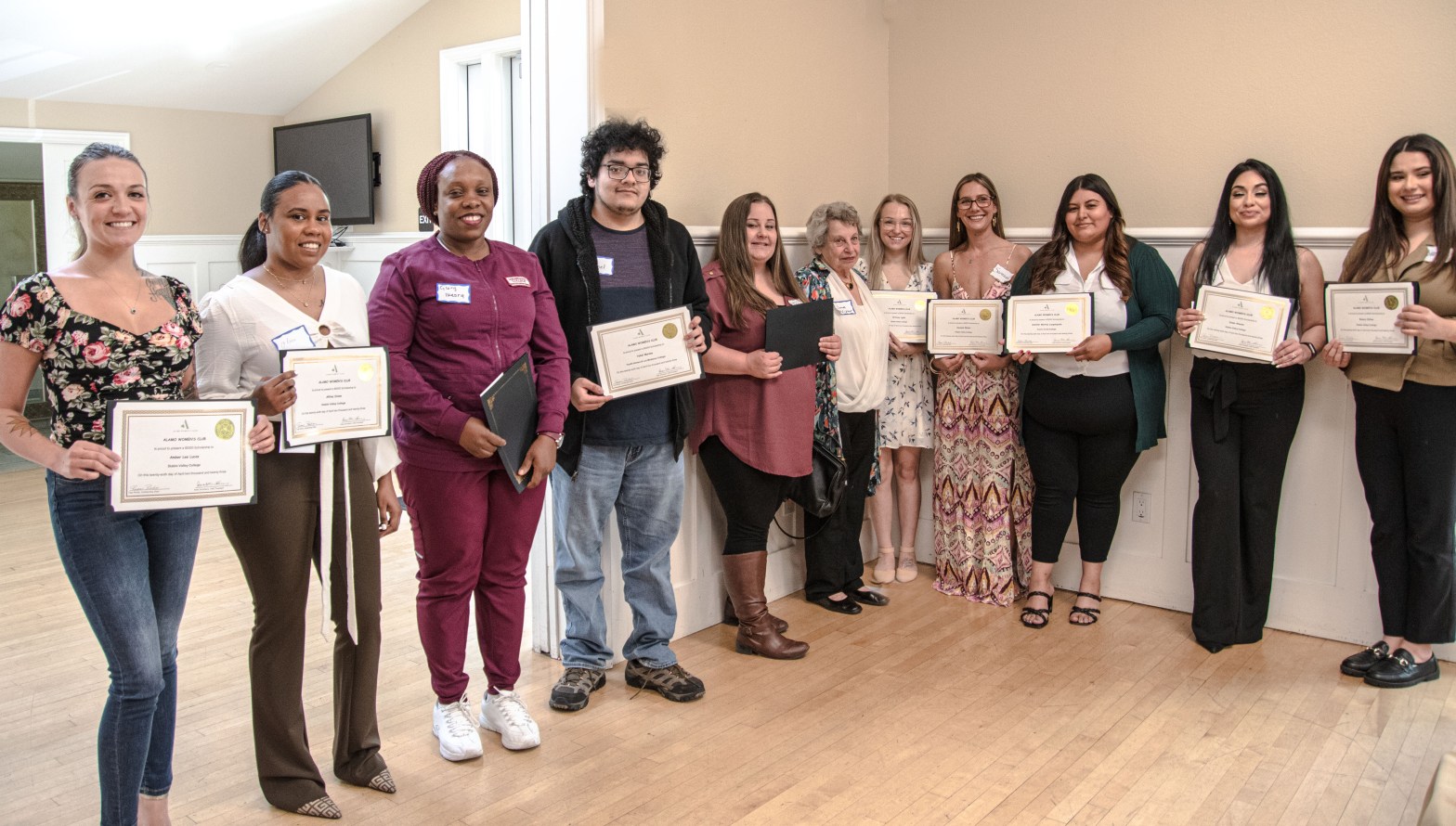
In March, the Scholarship Committee chose ten single parents and one former foster child to receive $5,000 scholarships. The recipients were chosen for their financial need and their dedication to continuing their college education. Several were nursing majors and the former foster student wants to become a programmer. If they can stay in school despite their financial hardships, they can all become successful.

Immediately, the AWC members started planning the Scholarship Luncheon. One group chose the caterer. Another arranged for the table decorations. A kitchen crew covered the tables with tablecloths and set the China and silverware. A video was developed to honor the Scholarship Committee and the recipients. Finally, a cake was ordered and decorated with the words We Are the Champions!

The Scholarship Committee created and ordered a new banner to hang outside the clubhouse that said Congratulations to our 2023 Scholarship Recipients! They also designed and ordered the programs, arranged for members to greet and escort the scholarship recipients throughout the luncheon, and hosted the presentation of the certificates.

On that special day, over 70 people came together to celebrate boosting the success of students who may not otherwise achieve it. The recipients came with their guests and sat with the AWC members for lunch. They received their certificates and shared their stories. The women were all smiles and the recipients blushed with gratitude.

One of the students stood up to tell her story of single parenting. She ended her speech by saying that, for her, the scholarship was more than just money. It represented support and new friendships, gifts that would last a lot longer than money.

The AWC members nodded their heads. Philanthropy and friendship were natural companions.

Dying Words

Rose Marie could feel it. Life slipping away.

For years, the Macular Degeneration in her eyes had slowly darkened her vision. The blindness had started in the middle of her eyes and took over more and more of her sight as it covered her vision like a dark blanket. At the lunch table, her friend Ruth read the menu to her.

Last year, her doctor had diagnosed her with Alzheimer’s. She had called each of her ten children with the news. They didn’t know how to react, and she didn’t either. She didn’t think her memory was bad. She still knew her children’s and friends’ names and the address where she had lived for sixty years.  

Her apartment was on the second floor overlooking the front garden of the assisted-living facility. When she had moved in, she could see the roses blooming and the branches of the sycamore trees swaying in the breeze. Now, she knew the roses and trees were outside the window, but she had to turn her head to see them from the perimeter of her eyes. Sometimes, she didn’t bother. She just let the circle of light enter her mind without trying to focus on any details.

She had gone down to the dining room for breakfast. Ruth didn’t have to read the breakfast menu to her since the server knew that she ate the same thing every morning: a piece of bacon, toast with jam, and a full glass of milk. Sometimes, her daughter Margaret brought her some homemade jam that she stored in the refrigerator in her studio apartment. Strawberry-rhubarb was her favorite. She would carry the small jar of jam down to the dining room and ask the server to spread it on her toast.

She found her way around her studio by reaching out to touch the furniture as she walked to the bathroom, the bed, or her recliner. To get down to the dining room, she found the knob on her front door, twisted the door open, scooted her body around it, closed it behind her, took the apartment key that she hung on a lanyard around her neck, and locked the door by finding the keyhole with her left fingers.

Once she got outside of her studio into the second-floor hallway, she reached out to touch the armchairs, side tables, lamps that led her to the elevator. Since her studio was at the end of the hallway and the farthest from the elevator, she passed many other apartments along the way. She could discern from her perimeter vision that some had wreaths on the doors. She knew when she was passing Nellie’s door since she could hear her chihuahua barking.

Lately, she’d noticed that she had trouble talking to her friends at the dining room table. She knew what she wanted to say, but it seemed hard to get the actual words out. The same thing happened to her when she phoned her children. In fact, it was exhausting to talk for any amount of time.

“Wait a minute,” she would say as she struggled to express herself. They waited so patiently, much more patient than she had been as their mother. Then, slowly and deliberately, she would answer their question with a complete sentence.

Since she had moved into the assisted-living facility, two of her long-time friends had died. Jim had severe back pain for a week before her passed away. She and her husband had known him and his wife for sixty years. They attended the same church. Their kids went to the same schools.

Patty passed away in her sleep one night. When her daughter came to clean out her studio, Rose Marie asked if she could have Patty’s tiny cabinet desk. The handyman had moved it into her apartment, and she kept her calendar and pens in it now. When she opened it, the wood felt warm, like Patty’s arms.

Rose Marie had always told her children that death was part of life. This time, however, the death that was coming was her own. Throughout the day, more and more of her life was transitioning to a new place with which she was unfamiliar. She couldn’t play Solitaire anymore at her desk because she couldn’t see, so she sat in her recliner and let the window’s light stimulate her thinking.

She was afraid. What would happen to her children when she died? Would they still be a family? Who would her sons talk to when they had problems to discuss? Who would need her when they got a divorce or lost a baby?

When she had first moved into the facility, her friend Morgan had picked her up every Sunday and drove her to Mass. She didn’t come anymore since Rose Marie no longer felt safe enough to walk around a place where she hadn’t memorized the placement of the furniture. Now on Sundays, she went down to the chapel when the priest came to bring Communion for the Catholics.

“I don’t know how to die,” she said one day. She could see him put his hands in his lap before he answered her. “I’m fully aware that I will die soon, but what should I be doing right now, before it happens.”

Father Moyer took a deep breath through his nose, and let the air out like a sigh before responding. “Well,” he said. “You don’t need to worry about dying. Just spend your days loving your family and friends. That’s all that matters.”

“So simple,” she said. She heard Father take another calm breath. When he exhaled, she was reminded of the ocean. She thought his answer would have involved praying, repenting, forgiving, or philosophical discussions. “I’m afraid of what will happen to my children when I’m gone. I’m the matriarch of the family. I keep them together. Shouldn’t I talk to them about these things?”

“No. They won’t remember anything like that, but they’ll remember how you love them.” He breathed in and out like the ocean again. It sounded so beautiful and relaxing to her.

Later, when Rose Marie went back to her apartment, she sat down in her recliner and picked up her cell phone. She pushed “1” which would dial her oldest daughter’s phone number automatically.

They only talked for two minutes. It was so hard to get out the words she wished to say. At the end of the phone call, Rose Marie said, “I love you.”

“I love you, too, Mom,” Celia said. “So much.” Rose Marie hung up.

Then she pushed “2” so she could talk to her second child. Then “3,” then “4,” then “5.” Her fifth child Ron didn’t answer. She’d have to call him later. By the time she had talked to the rest of her children, she could tell that the sun was setting between the branches of the sycamore trees outside her window. Soon, she’d have to walk down for dinner. She dialed “5” again, and Ronald picked up.

“I just wanted to say I love you,” she told him. She took a long slow breath and exhaled. The ocean flowed through her lungs.

The Yellow Rose

Friday was the last day of class, and Profesora Casti lead her students to Almagro, the part of Buenos Aires known for its flower vendors.  First, the group wandered among the flower stalls on Acuňa de Figueroa where baskets of roses filled the air with intense fragrances.  Leonie bent over the bunches to breathe in their perfume, and she took turns saying their names out loud with her classmates.  They chatted with the vendors who told them where they grew their flowers and how they worked from early in the morning until late at night planting seeds, hand-watering, and pruning in order to produce the most beautiful blooms. 

The vendors chatted about Mother’s Day, weddings, and baptisms for which they sold the most flowers.  Some stayed open 24 hours a day.  The best time to buy flowers, they said, was late at night or early in the morning.  These really were the most romantic times of the day anyway. 

The class meandered to Calle Sarmiento where even more vendors had their shops.  One shop, filled with tuberose and jasmine, perfumed the air outside its door with heady floral fragrances.  Inside, the vendor was wrapping flower bouquets in cellophane paper for a woman and her two daughters. 

Leonie wandered away from the group to admire the lilies of another vendor.  While she was reaching out to touch a petal, a woman dressed in a green apron came out to greet her. 

“Your lilies are gorgeous,” exclaimed Leonie.

“Thank you.  My grandfather used to sell flowers on the streets of Buenos Aires.  My father sold flowers in the old market in stall 8, and, now, I rent this shop here to continue our family tradition.”

Leonie moved under the shade of the willow tree that grew right in front of the storefront.  “I love flowers,” she said.

“I love flowers, too,” replied the vendor.  “I’ll sell them until I’m old and frail.”

Leonie paused in thought, running the woman’s response through her mind.  Forever was a long time to do just one thing.  Leonie didn’t know that she would ever find something that she wanted to do for so long.  The woman in the green apron smiled at her, her face flushed with the essence of intense happiness, her eyes like shining opals. 

“So,” Leonie asked, “You don’t ever wish that you could do anything else?”

The woman smoothed down the front of her green apron with hands crusted with dirt, chapped from years of digging and planting.  “No, never. I never wish to do anything else. Each day in my flower shop I get to express my creativity, and that gives me intense joy.  Besides, I know that I like to be around beautiful things, and what could be more beautiful than a shop full of flowers.”

“You seem so content.”

“You see this willow tree that’s giving you shade?  A willow tree symbolizes fulfilling wishes of the heart.  It also symbolizes inner vision.  I’m lucky to know what fulfills my life.  That knowledge is my inner wisdom.”

The vendor showed Leonie around her tiny shop, identifying the names of all the flowers and inviting her to smell their fragrances.  Leonie told the vendor that she was about to take a trip to search for her life’s purpose.  As the woman listened to her story, her eyes glistened and a whisper of a smile set upon her lips.

Before Leonie left, the woman held out a yellow rose.  “This rose symbolizes our new friendship,” she said.  “Friends are one of the most precious treasures of your life.  From now one, you and I are lifelong friends.  I wish you success on your trip and hope that you find your version of life fulfillment. 

That night, just before Leonie went to bed, she sat at her desk to write in her journal.  I know what fulfills me, she wrote.  After setting down her pen, she felt anxious.  But I don’t know what fulfills me, she worried.  I don’t know what I want to do with the rest of my life.  I don’t know what makes me happy day after day after day. 

Leonie looked at the yellow rose that the flower vendor had given her.  Its yellow petals brightened up the shadows of her room.  She remembered how gently the woman had picked up each flower and described its characteristics, moving among her flowers with grace, touching each blossom with respect and admiration; her movements were filled with love. 

Now Leonie knew.  The woman had been a messenger from her own soul to teach her how to find her own purpose.  Love was an integral part of finding fulfillment.  When she found out what she loved, she would find her contentment. 

Leonie touched the yellow rose, and her heart filled with joy when she remembered that the woman promised that they would be friends for life.  Friendship, she thought.  I have love already. 

Wisdom of the Trees: Chapter 4

Chapter 4 – Willow

Friday was the last day of class, and Profesora Casti lead her students to Almagro, the part of the city known for its flower vendors.  First, the group wandered among the flower stalls on Acuňa de Figueroa where baskets of roses filled the air with intense fragrances.  Leonie bent over the bunches to breathe in their perfume, and she took turns saying their names out loud with her classmates.  They chatted with the vendors who told them where they grew their flowers and how they worked from early in the morning until late at night planting seeds, hand-watering, and pruning in order to produce the most beautiful flowers. 

The vendors smiled when they talked about Mother’s Day, weddings, and baptisms for which they sold the most flowers.  Some vendors stayed open 24 hours a day.  The best time to buy flowers—late at night or early in the morning.

Then, the class meandered to Calle Sarmiento where even more vendors had their shops.  One shop was filled with tuberose and jasmine, which filled the shop and the air outside its door with heady perfume.  Inside, the vendor was busy wrapping flower bouquets in cellophane paper for a woman and her two daughters. 

Leonie wandered away from the group to admire the lilies of another vendor.  While she was reaching out to touch a petal, a woman dressed in a green apron came out to greet her. 

“Your lilies are gorgeous,” exclaimed Leonie.

“Thank you.  My grandfather used to sell flowers on the streets of Buenos Aires.  My father sold flowers in the old market in stall 8, and, now, I rent this shop here to continue our family tradition.”

Leonie moved under the shade of the willow tree that grew right in front of the storefront.  “I love flowers,” she said.

“I love flowers, too,” replied the vendor.  “I’m sure I’ll sell flowers until I’m old and frail.”

Leonie paused in thought, running the woman’s response through her mind.  Forever was a long time to do just one thing.  Leonie didn’t know that she would ever find something that she wanted to do for so long.

“So,” Leonie asked, “You don’t ever wish that you could do anything else?”

The woman smoothed down the front of her green apron with hands that were crusted with dirt and chapped from years of working with plants.  “No, I never wish to do anything else,” she finally said.  “I feel that each day in my flower shop is another day where I get to express my creativity, and doing that gives me intense joy.  Besides, I know that I like to be around beautiful things, and what could be more beautiful than a shop full of flowers.”

“You seem so contented,” said Leonie.

“You see this willow tree that’s giving you shade?  A willow tree symbolizes fulfilling wishes of the heart.  It also symbolizes inner vision.  I’m lucky to know what fulfills my life.  That knowledge is my inner wisdom.”

The vendor showed Leonie around her tiny shop, identifying the names of all the flowers and inviting her to smell their fragrances.  Leonie told the vendor that she was about to take a trip to search for her life’s purpose.  As the woman listened to her story, her eyes glistened and a whisper of a smile set upon her lips.

Before Leonie left, she held out a yellow rose.  “This rose symbolizes our new friendship,” she said.  “Friends are one of the most precious treasures of your life.  From now one, you and I are lifelong friends.  I wish you success on your trip and hope that you find your version of life fulfillment. 

That night, just before Leonie went to bed, she sat at her desk to write in her journal.  I know what fulfills me, she wrote.  After setting down her pen, she felt anxious.  But I don’t know what fulfills me, she worried.  I don’t know what I want to do with the rest of my life.  I don’t know what makes me happy day after day after day. 

As she sat, she thought about the vendor in the green apron and how she had found fulfillment.  She remembered how gently the woman had picked up each flower and described its characteristics.  She had moved among her flowers with grace, touching each blossom with respect and admiration; her movements were filled with love. 

Now Leonie knew.  The woman had been a messenger from her own soul to teach her how to find her own purpose.  Love was an integral part of finding fulfillment.  When she found out what she loved, she would find her contentment. 

Wisdom of the Trees: Chapter 2/3

Chapter 2 – Birch

During the last week of class, Profesora Casti took the class on field trips so the international students could experience the culture of Buenos Aires.

On Monday, the class walked to the Manzana de Las Luces.  Profesora Casti explained that this was the Block of Enlightenment and contained some of the oldest buildings in Buenos Aires, including the Baroque church of San Ignacio, a church built by the Jesuits between 1686 and 1722. 

The students listened as their instructor explained how the Jesuits also built a school, museum, and pharmacy on the site, and operated all of them until the Spanish came and suppressed the Jesuits.  Since then, the site has been transformed into a university, cathedral, and Argentina’s first medical college.  Later, the Spanish opened Buenos Aires’ first printing press and orphanage on the site, extending its colorful and diverse history. 

What most fascinated Leonie was the warren of tunnels underneath the street, once used to store ammunition during Argentina’s fight for independence.  The students followed each other single file through the narrow, brick tunnels, stooping their heads low under the arched ceilings.  Here and there, the tunnels stopped, the entryways blocked by dirt and rocks from centuries of neglect. Utility lights lit up the corridors, and the lights created shadows on the walls that walked with them. 

When they came outside again, the sunlight blinded Leonie, and she shielded her eyes with her arm, squinting and squeezing her eyes shut until they became adjusted to the brightness.  The students sat down on stone walls in the courtyard to rest.

Leonie sat next to an older woman who was wearing a straw hat and drinking out of a metal flask.   Beside the woman leaned a walking stick, hewn out of white wood marled with yellow scars.  Leonie had never seen a walking stick so beautiful and unusual.

“Are you wondering about my stick?” the woman asked suddenly.

Leonie looked down at the ground quickly, fluttering her eyelids.  “Yes, I am,” responded Leonie.  “It’s so unusual.  What kind of wood is that?”  She slowly raised her eyes to look at the stick and then noticed the woman’s smile.

“I carved this out of birch wood when I was about your age, a wood that signifies new beginnings.  I can see that you are about to start a long journey, one that will give you a new beginning and help you find out your life’s purpose.”

Leonie opened her eyes wide and stared into the woman’s face.  “How did you know that I was going on a journey?  How did you know I was searching for my purpose in life?”

“I am an old soul, and old souls can read energy.  From your energy, I can see that you have suffered a great loss, but this loss will help you gain wisdom and strength, and, in the end, the loss will become your constant companion.”

“My mother died, and I miss her terribly.”  Leonie sank onto the rock perch, remembering the last time she saw her mother’s face.  Her mother had been beautiful, even when she suffered from the cancer.  Her face always glowed with an even sunny complexion, and her smile lit up her eyes like emeralds under a jeweler’s lamp light. 

“The first thing you need to do is to write down your affirmations,” said the old woman, rustling her wide skirts as she turned more to face Leonie.  “Whatever you wish to have, write it down like your already have it.”

“I don’t know what you mean.”  Leonie scratched the back of her head.

“An affirmation is a positive assertion that claims something is true.  When you put forth a personal affirmation, all of creation conspires to help you attain it.” 

“That sounds very interesting,” said Leonie, “but my father wants me to go home right after I finish this Spanish class.  I keep thinking I should stay here longer so I can find out what to do with the rest of my life.”

“You must learn how to believe in yourself and not to rely on the opinions of anyone else.  Your father cares for you, but your life is not his.  You must follow your own heart, or you will feel like you are not living.”  The woman stuck one of her tanned hands into the folds of her skirt and took out a small book, about the size of Leonie’s cell phone. 

“This is a gift from me.  Inside this journal are blank pages.  Today, start writing down your affirmations, and then your life and fulfillment will begin.”  The woman smiled at Leonie just as the sun poked through the branches of an oak tree.  Leonie had to close her eyes it was so bright, and when she opened them, the woman with the birch walking stick was gone.

That night, Leonie sat up in bed, the journal opened before her, a pen in her hand.  She wrote—I want to make a difference.  No, that wasn’t right.  The old woman had told her to write as if what she wanted was already true.  She put a line through the sentence and tried again—I am making a difference, she wrote.

Pressing the journal to her chest, she leaned back to see if she felt better.  No.  She still felt like she hadn’t a clue of what to do or how she could contribute to the world. 

Contribute—a good word, she thought.  She wrote another sentence underneath the first one—I am contributing something positive to the world.  Now she felt a little better.  The way she would make a difference would be by contributing something positive.  She didn’t know what that was yet, but she was determined to find out. 

Leonie placed the journal and pen on her nightstand, turned out the lamp, laid her head on her pillow, and fell asleep with a feint smile on her face.

Chapter 3 – Myrtle

On Wednesday, Profesora Casti took the class to Iglesia de Santa Felicitas on Calle Isabel la Catolica in the Barracas District.  The students learned that this church was built in the early nineteenth century in honor of Felicia Antonia Guadalupe Guerrero, considered to be the most beautiful woman in Buenos Aires.  Her husband died from yellow fever, leaving her a widow.  Later, she was killed by her rejected suitor, Enrique Ocampo. 

Leonie walked through the eclectic gothic interior of the church, gazing into the faces of the marble statues of Felicitas and her son and husband.   Around the perimeter of the church, she paused in front of the stained-glass windows, looking into the faces of the saints and admiring the colors of the roses.  She was so intrigued by how the natural light lit up the panes of glass that she didn’t see the young girl until she bumped into her.

“I’m sorry, said Leonie.  I didn’t see you there.  I was so interested in these beautiful windows.”

The girl didn’t respond.  She seemed lost in thought and sad.

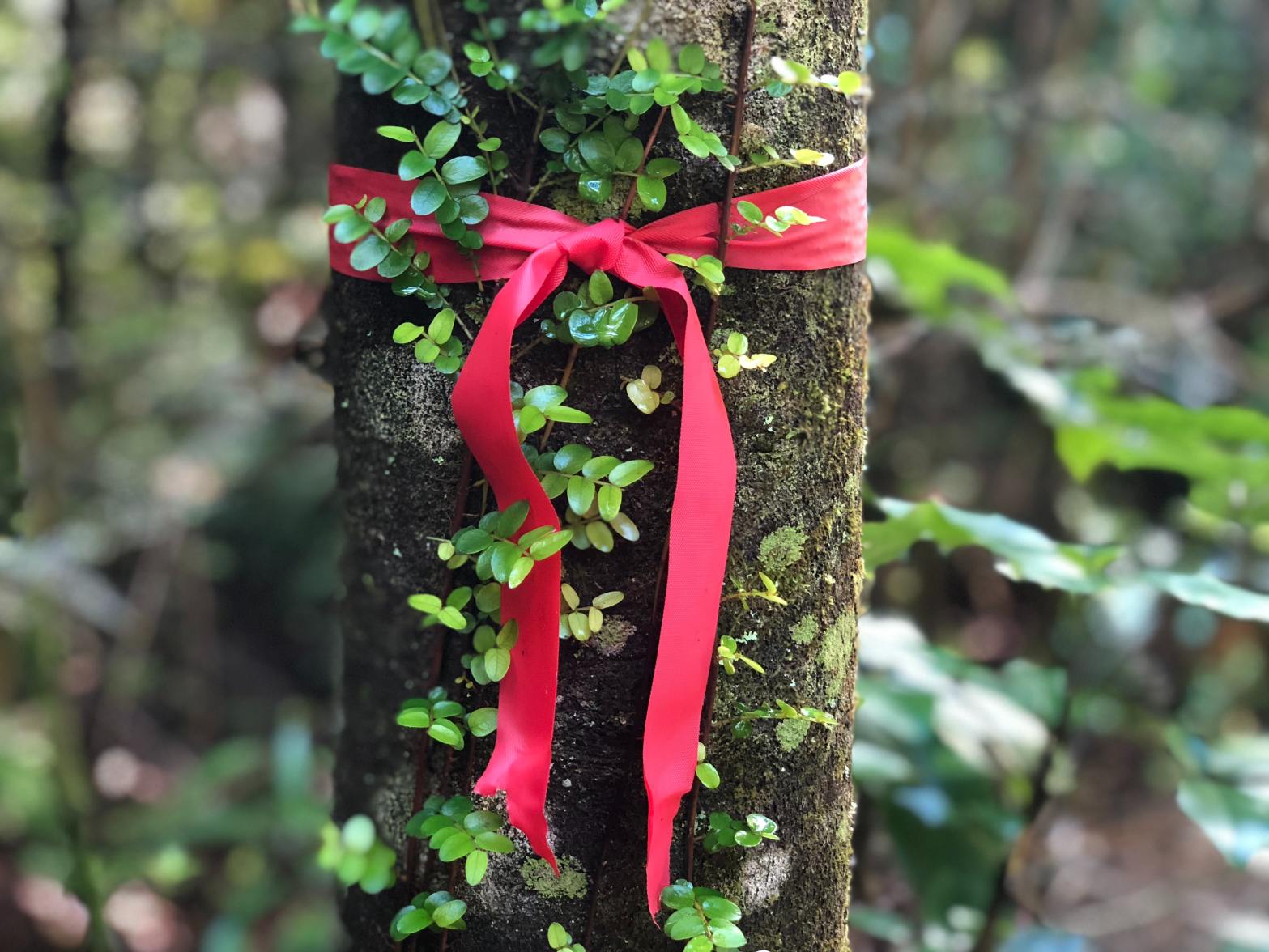
“Are you o.k.?” asked Leonie.  She gently touched the girl on her wrist, which she noticed was tied with a long, red ribbon.

The girl was about the same age as Leonie.  She had long brown hair, big brown eyes, full lashes, and a mouth that was wide and voluptuous.  Leonie thought she was beautiful. 

The girl looked at her.  “Oh, I was lost in thought.”  Her eyelashes scanned Leonie from head to toe, and then she smiled.  “Are you a student at the university?”

“Yes, I am.  I’m on a field trip with my Spanish professor.  This is the last week of classes, and we’re touring around Buenos Aires to learn more about the Argentine culture.  May I ask you why you are here?”

“I’m looking for love,” said the girl, waving her wrist in front of her. 

“I don’t understand,” responded Leonie.

“We have a tradition.  If a girl wants love, she comes to the cathedral and ties a ribbon on a branch of the myrtle tree in the garden, which symbolizes romantic and devoted love.  Soon, she will find a love that will be true and lasting.”

“What a nice tradition.”  Leonie smiled at the girl.

“Did your professor tell you that this church is haunted by its namesake?”

“No. What do you mean?”

“The woman for whom this church was built, Felicia, was murdered.  She was shot in the back by her suitor and died on January 30.  People say that on that day, a woman with a pale face and dark hair, dressed all in white, walks from the garden, opens the door to the church, proceeds down the aisle to the main altar and leaves a trail of tears behind her. 

“That’s such a sad story.”

“Now, Felicia brings love to all the women who request it by tying their ribbons on the myrtle tree.  She has turned her tragedy into positive deeds—bringing love to all women of her beloved city.”

“So, you are going to tie your ribbon on the gate?”

“Yes, to find my love.”

“May I help you?”

“I’d like that. Let’s go.”

The two girls walked out of the church together, smiling and chatting as they went.  Once they reached outside, they walked through the roses in the garden until they reached the myrtle tree.  The brown-eyed girl untied the ribbon from her wrist and, with Leonie’s help, tied it around one of the tree’s branches. 

“Thank you for helping me,” said the girl.  “I believe I will find my love even faster because of your kindness.”

“I was honored to share your dream,” said Leonie. 

“Let’s tie a ribbon on the tree so you can find your love.”

“Oh, I’m not ready for love,” said Leonie.

“That doesn’t matter.  Your love will arrive when you are ready.  Here, I have another ribbon.”  The girl pulled another red ribbon out of her pocket and handed it to Leonie.

Leonie raised her chin back and laughed which sounded like the rise and fall of a musical scale.  “I guess it won’t hurt.”  She chose another branch close to the girl’s ribbon and tied hers around it in a bow.

“I’m happy that you will find love too,” said the girl.  The girl smiled at Leonie, placed her hands on her shoulders, and kissed her lightly on each cheek.  Her eyes shone like topaz.

“I will never forget you,” said the girl, and she walked away, her skirts swishing gently from side to side. 

That night, before Leonie fell asleep, she wrote in her book of affirmations.  She wrote—I provide love to the world.  She looked at the words that she had written and thought about the girl with the full lashes who wanted to find love. 

I must first find out what I want, Leonie thought.  Until I know who I am and what my purpose is, I won’t attract the right kind of love. 

One thing I know.  I know I can provide love to others.  I’ll do this first and then, when the time is right, I’ll let someone love me. 

She turned out the light and dreamt about the myrtle tree and its red ribbons.

Wisdom of the Trees: Chapter 1

Photo by DARIAN PRO on Unsplash

From ancient times, trees have symbolized physical and spiritual nourishment, transformation and liberation.

Chapter 1 – Oak

One more week and she was done.  Graduated with a double major.  College over.  More educated than most of the people on earth. 

And you know what?  She wasn’t going back home, even when this class was over.  Her father had paid for a round trip ticket to Buenos Aires, but she was going to cash it in and stay.

This was her chance to really be independent, to find out what her values were without her father’s advice about this job or that apartment, this guy or that outfit. 

She missed her mother though, but her mother wasn’t at home anyway.  When Leonie was supposed to be having the time of her life in college, her mother had contracted breast cancer.  After three surgeries, six months of chemotherapy that sapped her effervescent energy, and twelve weeks of radiation that burned her skin red, the cancer came back. 

Just before she passed away, Leonie and her mother had sat under the oak tree in the back yard, the shadows of its branches spreading like arms across the grass. 

“I can’t lose you, Mom.”  She had wept beside her mom, the shade of the giant tree darkening her tears like black pearls.

“You won’t feel the same, but you’ll never lose me.  You’ll just have to learn how to live with me differently.” 

Leonie had felt so confused.  She stared at her mother’s face so that she could remember it—her gray-blue eyes, silky skin, a mouth that always held the hint of a smile.  She stared deep into her eyes, holding on, wishing for more time.

“I’ll be with you,” said her mother.  “I’ll guide you from a new place, a place you cannot see, but that is nevertheless powerful.  You’ll feel me.”

Leonie clutched her mother’s hand.

“I want you to find your inner strength.  Emulate this oak tree.  Every time you feel weak or lost, visualize yourself as an oak tree, rising strong, spreading wide, enduring challenge and finding the sun.  You won’t be alone because I’ll be beside you, breathing my love into your heart.”

“But I won’t see you.  You’re my inspiration.  I’ll be lost without you.”

“My love will remain here.  When you can no longer physically see me, you can find other women to inspire you.  Choose many, in fact.  One to follow for leadership skills, another to learn the art of love, and another to learn how to live with joy.  She may be one of your professors, a co-worker, a girl friend, a friend’s mother, or a woman you meet only one time in your life. Whatever you wish to be, you can find a woman to inspire you.”

“How can you be so strong?  You’re dying!”

“I’m content because I know that I will continue my life in another form.  My spirit is not dying.  My soul will continue, and I’ll grow from its future experiences.  I have many things to look forward to.”

Leonie remembered this conversation as she held her mother’s ashes six months later, secured in a pearlescent urn shaped like a heart.  Leonie kissed the top of the urn before placing it in the niche at the cemetery.   “Enjoy your journey, Mom,” she whispered.

Later, as she sat in the back yard next to her mother’s chair, Leonie thought she heard her mother’s voice.  No, maybe it was the breeze rustling the limbs of the oak tree instead. 

“My journey will be right alongside you,” said the breeze.

Staying focused on her studies was impossible after her mother’s death, but her girl friends had helped, and then Leonie decided to go overseas for a change of scenery—a much needed distraction that she needed to survive.

So now, she was in Buenos Aires and hungry.  She lived in a shabby dorm room in the basement of the university and tutored students in English to make money, but it wasn’t enough. 

Leonie searched through her backpack for something to eat: an empty plastic juice bottle, a paper envelope from the bocadillo she had for lunch.  She poked her fingers deeper.  Something waxy.  She grabbed at it and pulled out an apple, a little bruised, but it was food.

The next morning, Leonie woke up with a growling stomach and the sound of traffic.  Engines racing, horns blaring, and brakes squealing invaded her tiny room through the high window that wasn’t even big enough for her to crawl through.  Leonie grabbed her shampoo and towel, opened the door, and paced to the single shower room. 

Whew!  It was empty.  The water felt refreshing on her wet head, rinsing off the humidity and sweat of her body from the sweltering night.

Today, she was going to meet a friend that she had met in her Spanish class.  Clarissa was a native Argentinian and Leonie wanted to ask her about traveling throughout the country. 

Upstairs in the dormitory lobby, a canister of coffee stood on a table next to a large blue box of sweet pastries.  Leonie poured the thick, viscous liquid into her own mug, stuck a pastry between her teeth, and whisked out the door.

Clarissa was sitting at a table in the corner of the café with her laptop open when she arrived.  A cup of mate steamed to the right of her computer, Clarissa wildly typing on the keyboard.

“Hey, how’s it going?” asked Leonie, grabbing the back of the chair opposite her, scraping it across the floor, flinging her backpack over a post, and sitting down.

“Hey,” murmured Clarissa, finishing a sentence.

“You know, this Spanish class is my last college class, and I’ve got to figure out what to do with the rest of my life.  I feel lost without my mother, and I don’t want to go home without a plan.  I don’t even know if I want to live there anymore.”

Clarissa picked up her mate, sipped it, and looked up at Leonie. “I suggest that you travel and meet as many people as possible.  They’ll give you new ideas, and you’ll learn that you have endless options,” said Clarissa.

“That does sound good,” said Leonie.  “How should I start?”

“Just go,” said Clarissa. “Don’t think too much.  Don’t plan too much, but be ready to make your trip work each step of the way.  I’m emailing my sister.  She works at the Belmond Hotel, a few miles from Iguazu Falls.  Maybe she can get you a free room.  Iguazu Falls is one place you should go!”

“Oh, I’m so nervous about traveling by myself.  Maybe I’ll just stay here,” responded Leonie.

“Oh, no you won’t,” said Clarissa. “You’re going, and that’s that.”

“We’ll see,” said Leonie.  I have a whole week of classes left.”

“Yes, a whole week to build up your courage and begin your new life.”

Hidden

Photo by Anton Darius on Unsplash

Sylvia had a secret.  One that rolled around in her stomach like a marble in a maze, bashing against the walls until they bruised, swirling her energy into anxiety.

Sylvia’s friend Ruth told detailed stories about how her mother psychologically abused her during her teenage years.  When they were cleaning out her grandmother’s house after her death, Susan had wanted her grandmother’s wooden chest full of yarn.  Her mother refused to let her have it, and, instead, gave it to Susan’s older sister who didn’t even knit.  Susan wondered for decades why she wasn’t good enough to have such a treasured keepsake and why her mother had favored her sister over her.  Ruth told everyone about the hurts in her background, but she still walked around like a broken doll, permanently damaged, as if nothing could ever erase the scars she had suffered.

When Ruth talked about her feelings, Sylvia flashed her own memories across her mind about how her father had favored her sister over her.  “Isn’t she beautiful,” she remembered he had said.  Sylvia had looked in the mirror countless times wondering why no one ever called her beautiful.  She had clear skin, thick hair, blazing green eyes.  Weren’t green eyes as pretty as blue ones? 

Her friend Paul had told her about how his father was never around.  He never played sports with him, never sat with him on the couch for a game of chess, never even got to his high-school graduation until Paul had already walked across the stage and waved to his mother who was frantically waving back with both hands, as if she was waving for two.  Even today, Paul’s father didn’t act like a father, but like a distant friend who sent him an article once in awhile about a topic that never related to Paul’s life.  Paul had worked hard to build self-confidence, but struggling with a narcissistic father made that an up-and-down journey.

Sylvia’s friend Jen talked about her childhood, too.  She told Sylvia how a sixteen-year-old neighbor boy had raped her when she was eleven, luring her into his backyard shed one afternoon and slowly removing her clothes while he talked to her about the different birds in the garden.  Jen said that it was therapeutic to talk about it after so many years of keeping it hidden.  At first, she was embarrassed that it had happened to her.  What did she do to encourage that boy anyway?  Why did she let him get her into the shed by herself?  Didn’t she know better?  Sylvia didn’t see how Jen had let go of the trauma if she still had all these questions in her mind.

When Jen talked, Sylvia nodded empathetically: “It wasn’t your fault.  He took advantage of you.  He was stronger, and you couldn’t have stopped him.”  Inside her chest, however, Sylvia carefully drew a curtain in front of her own heart, shielding it from the memory of her own secret, stopping her from the minute-by-minute re-enactment of the scene, her shame, her acquiescence, her fear of exposure. 

Sylvia didn’t want her friends to know she had suffered so much, had been irreparably violated.  Maybe someone would use the information about her secret as revenge if they ever got angry at her.  They would expose her in front of people she didn’t trust, and she would endure more embarrassment than she could handle. 

Sylvia had spent years searching for her own self-esteem, her worthiness to be loved, her value as a treasured friend, her worth as an employee, her right to be happy at all.  She thought that she should go talk to someone about her secret so that she could get it off her chest.  Would that even work? 

Finally, she made an appointment with a female minister at a church she did not attend.  She told the woman about her secret, and asked her what she should do to heal from it.  

“First, ask God for forgiveness.  God will forgive anyone, even if you can’t forgive.  Once, you’re comfortable that God has forgiven you, then forgive yourself and anyone else involved.”

Sylvia had worked on forgiving herself and the other person involved for years.  Nevertheless, the memories, surfaced again and again like a nightmare when she least expected them.  Sometimes, she even invited them into her thoughts as if she could purge them out of existence by focusing on them one last final time. 

Nothing stopped the nightmares.  They came while she was sleeping in a vivid stream, and her fear rose incrementally during the dream until she would awaken all of a sudden, gasping for breath like she had been under water the whole time.  Her forehead was drenched with sweat, her heart tight with shame.

Sylvia did feel the pain of her friends, and because she did, she could listen to their stories and offer some solace just by suffering with them.  She also understood the pain that her students told her about. 

Samantha was a student in Sylvia’s college composition class.  Samantha’s mother had kicked her and her three-year-old daughter out of the house, and, now Samantha experienced anxiety that interfered with her performance at school.  Sylvia had counseled Samantha through several episodes of anxiety, and she had passed her English class in spite of her mother.

Van suffered from post-traumatic-stress-syndrome ever since he returned from Iraq, and his significant other left him right in the middle of the semester.  Since Sylvia knew what anxiety and poor self esteem felt like, she coached Van step by step until he, too, passed his writing class.

So many of her community college students needed emotional support in order to pass their classes.  Owen’s father beat him.  Misty lived with five family members in a noisy, two-bedroom apartment.  Monica’s parents wanted her to get married like a dutiful Islam daughter and give up going to school.  Randall had spent two weeks living out of his car during the semester until his uncle let him live in his garage. 

Sylvia knew that if she put in more effort to help these students, they could succeed and improve their lives through education and awareness of other opportunities.  Yet, sometimes, as Sylvia sat beside one student or another, she felt like a broken human being trying to help another broken soul.    

Was it true that people who never felt loved died of heart attacks?  Most mornings, she woke up with a tight chest.  She lay in bed breathing in and out of her nose until her chest relaxed a little, but the tightness never fully went away. 

Most people had a secret, didn’t they?  Weren’t most people walking around, hiding their secrets underneath their shirts, their polite manners, their rudeness, their abusive characters, their anxiety, their bullying, their surrender, and their repeated attempts at survival?

Yes, they were, Sylvia knew.  She was, too.  She had endured so many scars and affronts to her character, yet here she was, carrying her secret around like a satchel of wisdom.

Really, she thought she deserved a medal.

Seed Man

The Seed Man’s birthday came on February 11, and he walked out of his apartment, down the shaded path, past Martha’s porch, through the community garden area, in between the garden filled with camellias and hydrangeas, out to the row of mailboxes near the street. 

The Seed Man’s birthday came on February 11, and he walked out of his apartment, down the shaded path, past Martha’s porch, through the community garden area, in between the garden filled with camellias and hydrangeas, out to the row of mailboxes near the street. 

His mailbox was the one at the far end.  He flipped down the metal door and inside was a little stack of letters.  “Mmm,” the Seed Man said.  “More mail than usual.”

When he got back to his apartment, he sat down in his brown arm chair to open his letters.  “Lots of cards today,” he mumbled.  “Oh, yeah.  It’s my birthday.  I’m turning 64 today.  I’ve never been 64 before, so let’s see how it goes.”

One of the birthday cards was fat.  It was from his sister Claire, and the Seed Man opened it with a knife, slitting it across the top. 

The card was sweet, but inside the card were four packages of seeds—2 carrots and 2 radishes. “Oh,” he said. “I love seeds.  What a perfect birthday present!”

The man set up all his birthday cards on the window sill by his dining room table.  He poked the seed packages into a shelf which was also near the table.  This was his special shelf—for his seeds.  He had vegetable seeds on the left—carrots, radishes, green onions, tomatoes, zucchini, and pumpkins.  The flower seeds filled the tiny slots on the right—poppies of all colors and varieties, sun flowers, alyssum, marigolds, Sweet Williams, geraniums, and several packets more. 

The Seed Man loved planting seeds.  He loved this so much that sometimes he planted seeds when it was too cold, and the seeds died. 

He learned how to plant from his father who had grown up on a farm when he was a kid.  Every spring, the Seed Man and his father planted rows and rows of seeds, they sprouted, drank water, grew some more, until when summer came, the rows were filled with bushes of green beans, zucchini, pumpkins, tomatoes, peas, peppers, carrots, and onions. 

The man wanted to plant his birthday seeds as soon as possible, so he walked out of his apartment, down the shaded path, past Martha’s porch, to the community garden. 

The garden consisted of six planter boxes of about six by eight feet filled with soil.  One of the boxes had shoots of lettuce poking through the soil.  Those were from seeds that he had planted a month ago, and he bent down to inspect them.  “I can’t wait to eat you,” he said, smiling down at the lettuce babies. 

None of the other boxes had any plants.  The seed man had cleaned up the boxes in the fall from last year’s planting season.  He had picked all the pumpkins and placed one on each doorstep of the apartments so that the little old ladies who lived there could each have a pumpkin for Halloween. He had ripped out old tomato bushes and pumpkin vines and turned and loosened the soil.

The Seed Man chose another planter box for his birthday seeds.  Using his big, brown hands, he mixed new soil with the dirt in an empty planting box.  He squatted over the box and made little furrows in the fresh dirt, and then carefully shook the seeds out of his seed packets into the furrows.  Finally, he covered his carrot and radish seeds with a light coating of earth and watered the rows with a sprinkling can. 

From his tool bag, he took out a sign which he placed in the garden box which said, “These rows belong to the Seed Man. Please be careful!”

The Seed Man knew that the seeds would take about thirteen to twenty-one days to germinate, but he visited them every day anyway.  When the Seed Man went to the mail box, he visited his seeds.  Before he drove out to get groceries, he visited his seeds.  As he came back from visiting his mother, he visited his seeds like a loyal friend checking to see if they were alright.

On day thirteen, tiny green shoots peeked out of the soil.  As the Seed Man watered the shoots, he talked to them about how the sun was warm and how they would be just fine.  He told them about his seed collection and how, one day, he would plant them, too, and they would grow in the rain and sun.  The baby plants grew taller and taller every day, turning  from a delicate light jade to a robust emerald green, and then, a few weeks later, he knew the carrots and radishes were ready to eat. 

He brought a metal pail out to the garden.  With two thick brown fingers, he tugged a single carrot out of the soil, washed it off, and took a bite.  “Mmm.  So good,” he said.  He tugged at a few more and noticed how all of the greens were strong and the carrots and radish tops were bursting out of the soil.  

“Oh, dear.  They’re all ready to be harvested,” said the Seed Man to himself, so he pulled and pulled and pulled and pulled them out of the dirt until he had a gorgeous mound of carrots and radishes in his pail.  

When he stood up, Martha was standing on the other side of the planter box watching him, her bent frame leaning over her polished wooden cane.  “Whatcha got there?” she asked the Seed Man.

“I just harvested some carrots and radishes.  They’re all ready at the same time.  I can’t eat them all.  You want some for a salad?”

“I’d love some fresh carrots and radishes!” said Martha.  “Do you have enough for me to give Ellen some, too, for her lunch today?”

“Sure, I do,” said the Seed Man.  “Take what you like.”

The Seed Man had to hold the pail up so that Martha could reach in and take what she wanted.  She chose six carrots and six radishes.

“Thanks so much,” said Martha.  “You’ll have to plant something else now since you’ve pulled out all the carrots and radishes.

“I’m going inside to look at my seed packets said the Seed Man.  It’s April now and warmer.  I can start planting the spring and summer vegetables now.

When the Seed Man went inside, he took a picture with his phone of all his carrots and radishes and sent it to his sister Claire to thank her for the birthday seeds.  Then, he made himself a salad for lunch, and he forgot to look at his seed packages. 

He had a lot to do that day.  Since he was the maintenance man at the apartment complex, he had to rake the leaves on the front lawn, empty all the trash bins, and clean out an empty apartment.  By the time the day was over, he was so tired that he spent the evening stretched out on his brown arm chair browsing through a seed catalogue. 

The next morning, the Seed Man was excited to check his garden, so he walked out of his apartment, down the shaded path, past Martha’s porch, to the community planter boxes.  He sauntered over to the box where he had planted the carrots and radishes and looked down to inspect them. 

They were gone!  Missing!  Someone had come and picked all of them overnight.  The Seed Man felt like his heart was breaking.  A sadness started growing in the middle of his chest and spread outward until even his eyes were filled with gloom.

Martha hobbled down the path with her wooden cane to the garden while the Seed Man squatted dejectedly beside the empty planter box. 

“Those carrots and radishes sure were delicious!” she yelled in a shrill but excited voice even before she reached him.

“What?” said the Seed Man, scratching his head.

“I cut up the carrots and radishes you gave me and put them in a salad for my lunch,” said Martha.  “They tasted like rain and sunshine.  Thank you very much for sharing them.”

All of a sudden, the Seed Man remembered that he had picked all the carrots and radishes the day before and given some to Martha.  The sadness filling his chest popped like a balloon and he felt happy again—the air, the sun, and Martha’s company making his spirit soar again like a bird.

“I forgot that I picked them all,” he said, laughing.  “You know Martha, I just turned 64 a few months ago.”

“Did you now?” she said back.

His mailbox was the one at the far end.  He flipped down the metal door and inside was a little stack of letters.  “Mmm,” the Seed Man said.  “More mail than usual.”

When he got back to his apartment, he sat down in his brown arm chair to open his letters.  “Lots of cards today,” he mumbled.  “Oh, yeah.  It’s my birthday.  I’m turning 64 today.  I’ve never been 64 before, so let’s see how it goes.”

One of the birthday cards was fat.  It was from his sister Claire, and the Seed Man opened it with a knife, slitting it across the top. 

The card was sweet, but inside the card were four packages of seeds—2 carrots and 2 radishes. “Oh,” he said. “I love seeds.  What a perfect birthday present!”

The man set up all his birthday cards on the window sill by his dining room table.  He poked the seed packages into a shelf which was also near the table.  This was his special shelf—for his seeds.  He had vegetable seeds on the left—carrots, radishes, green onions, tomatoes, zucchini, and pumpkins.  The flower seeds filled the tiny slots on the right—poppies of all colors and varieties, sun flowers, alyssum, marigolds, Sweet Williams, geraniums, and several packets more. 

The Seed Man loved planting seeds.  He loved this so much that sometimes he planted seeds when it was too cold, and the seeds died. 

He learned how to plant from his father who had grown up on a farm when he was a kid.  Every spring, the Seed Man and his father planted rows and rows of seeds, they sprouted, drank water, grew some more, until when summer came, the rows were filled with bushes of green beans, zucchini, pumpkins, tomatoes, peas, peppers, carrots, and onions. 

The man wanted to plant his birthday seeds as soon as possible, so he walked out of his apartment, down the shaded path, past Martha’s porch, to the community garden. 

The garden consisted of six planter boxes of about six by eight feet filled with soil.  One of the boxes had shoots of lettuce poking through the soil.  Those were from seeds that he had planted a month ago, and he bent down to inspect them.  “I can’t wait to eat you,” he said, smiling down at the lettuce babies. 

None of the other boxes had any plants.  The seed man had cleaned up the boxes in the fall from last year’s planting season.  He had picked all the pumpkins and placed one on each doorstep of the apartments so that the little old ladies who lived there could each have a pumpkin for Halloween. He had ripped out old tomato bushes and pumpkin vines and turned and loosened the soil.

The Seed Man chose another planter box for his birthday seeds.  Using his big, brown hands, he mixed new soil with the dirt in an empty planting box.  He squatted over the box and made little furrows in the fresh dirt, and then carefully shook the seeds out of his seed packets into the furrows.  Finally, he covered his carrot and radish seeds with a light coating of earth and watered the rows with a sprinkling can. 

From his tool bag, he took out a sign which he placed in the garden box which said, “These rows belong to the Seed Man. Please be careful!”

The Seed Man knew that the seeds would take about thirteen to twenty-one days to germinate, but he visited them every day anyway.  When the Seed Man went to the mail box, he visited his seeds.  Before he drove out to get groceries, he visited his seeds.  As he came back from visiting his mother, he visited his seeds like a loyal friend checking to see if they were alright.

On day thirteen, tiny green shoots peeked out of the soil.  As the Seed Man watered the shoots, he talked to them about how the sun was warm and how they would be just fine.  He told them about his seed collection and how, one day, he would plant them, too, and they would grow in the rain and sun.  The baby plants grew taller and taller every day, turning  from a delicate light jade to a robust emerald green, and then, a few weeks later, he knew the carrots and radishes were ready to eat. 

He brought a metal pail out to the garden.  With two thick brown fingers, he tugged a single carrot out of the soil, washed it off, and took a bite.  “Mmm.  So good,” he said.  He tugged at a few more and noticed how all of the greens were strong and the carrots and radish tops were bursting out of the soil.  

“Oh, dear.  They’re all ready to be harvested,” said the Seed Man to himself, so he pulled and pulled and pulled and pulled them out of the dirt until he had a gorgeous mound of carrots and radishes in his pail.  

When he stood up, Martha was standing on the other side of the planter box watching him, her bent frame leaning over her polished wooden cane.  “Whatcha got there?” she asked the Seed Man.

“I just harvested some carrots and radishes.  They’re all ready at the same time.  I can’t eat them all.  You want some for a salad?”

“I’d love some fresh carrots and radishes!” said Martha.  “Do you have enough for me to give Ellen some, too, for her lunch today?”

“Sure, I do,” said the Seed Man.  “Take what you like.”

The Seed Man had to hold the pail up so that Martha could reach in and take what she wanted.  She chose six carrots and six radishes.

“Thanks so much,” said Martha.  “You’ll have to plant something else now since you’ve pulled out all the carrots and radishes.

“I’m going inside to look at my seed packets said the Seed Man.  It’s April now and warmer.  I can start planting the spring and summer vegetables now.

When the Seed Man went inside, he took a picture with his phone of all his carrots and radishes and sent it to his sister Claire to thank her for the birthday seeds.  Then, he made himself a salad for lunch, and he forgot to look at his seed packages. 

He had a lot to do that day.  Since he was the maintenance man at the apartment complex, he had to rake the leaves on the front lawn, empty all the trash bins, and clean out an empty apartment.  By the time the day was over, he was so tired that he spent the evening stretched out on his brown arm chair browsing through a seed catalogue. 

The next morning, the Seed Man was excited to check his garden, so he walked out of his apartment, down the shaded path, past Martha’s porch, to the community planter boxes.  He sauntered over to the box where he had planted the carrots and radishes and looked down to inspect them. 

They were gone!  Missing!  Someone had come and picked all of them overnight.  The Seed Man felt like his heart was breaking.  A sadness started growing in the middle of his chest and spread outward until even his eyes were filled with gloom.

Martha hobbled down the path with her wooden cane to the garden while the Seed Man squatted dejectedly beside the empty planter box. 

“Those carrots and radishes sure were delicious!” she yelled in a shrill but excited voice even before she reached him.

“What?” said the Seed Man, scratching his head.

“I cut up the carrots and radishes you gave me and put them in a salad for my lunch,” said Martha.  “They tasted like rain and sunshine.  Thank you very much for sharing them.”

All of a sudden, the Seed Man remembered that he had picked all the carrots and radishes the day before and given some to Martha.  The sadness filling his chest popped like a balloon and he felt happy again—the air, the sun, and Martha’s company making his spirit soar again like a bird.

“I forgot that I picked them all,” he said, laughing.  “You know Martha, I just turned 64 a few months ago.”

“Did you now?” she said back.

“Yep, and I’m finding out how difficult being old can be.”

The Imagination Grandpa Story 1: The Clock Man’s Wise Clocks

Photo by Ella de Kross on Unsplash

Instead of going to Third Grade, Rosie was in a hospital bed with tubes connected all over her body.  Rosie’s heart had a problem and the doctors took her into an operating room one day to fix it.  Now, she had to lie down in bed all the time, and she couldn’t play.

The day after the operation, Grandpa Joy came in to visit Rosie.  He wore his blue jean jacket that had lots of pockets.  When he came in the door, he took off his beret and placed it on the table beside Rosie’s bed. 

“Should I tell you a story?” he asked.

“O.K.” said Rosie.  She was so bored just lying in bed. 

Grandpa started his story. 


Once upon a time, an old man owned a clock shop.  The shop was a huge room, and clocks covered every inch of the four walls.  He had clocks with black hands, silver hands, gold hands, and bronze hands.  Some clocks had round faces with 12 birds to mark the numbers.  Some clocks were carved out of wood with long pendulums hanging from the clock faces all the way to the bottom of the cases.  On one wall, a whole line of coocoo clocks hung silently, their birds frozen in various stages of entering or leaving through the coocoo doors. 

In the middle of the great room, large trunks were propped on their sides, and, against these great boxes, grandfather and grandmother clocks leaned silently.  No ticking escaped from their chambers because all the them were broken. 

In fact, all of the clocks in the whole store were broken and quiet.  The only noise in the vast room was the scratching from a mouse family that lived inside one of the walls and came out whenever the old man dropped crumbs and bits of cheese from his sandwiches.

One day, a young man came in to buy a clock.  He smiled at the old clock seller when he opened the creaking door and walked right up to the counter.  This young man wanted a clock to give to his wife for her birthday

“What kind of clock should I buy for my wife?” the young man asked. 

“Well, a grandmother clock might be nice,” said the old man.  I have several of them leaning against these big trunks.  Which one do you like?”

The young man hemmed and hawed.  He tucked his first under his chin and looked at the clocks with big eyes.  He peered into the clocks’ faces, and inspected inside the glass doors that held the pendulums. 

“I like this one,” the smiling man said.  “but it doesn’t seem to be working.”

“All of these clocks are broken,” said the old man.  “I get them from people who no longer want to fix them, and I save them until someone new comes along that will appreciate them.  Some of these clocks are over a hundred years old.  When someone wants to buy one, I fix it until it works perfectly again.”

“Is an old clock be better than a new one?” asked the young man.

“I’d say so,” said the clock man.  “Old clocks have seen so many years go by.  They’ve watched girls and boys fall in love, lovers get married, babies being born, Christmases and Easters and Passovers celebrated.  And as they’ve watched these stories, they’ve saved these memories as wisdom to pass onto their next owners.  A new clock is just a metal face or a wooden box, but an old clock is a treasure chest of life.”

The smiling man stood in thought for a long minute, and then looked straight into the clock man’s face.  “Well, someday my wife and I would like to have a family, and we’re going to need a lot of wisdom when we do.” 

He peered again into the Grandmother clock standing next to him.  Her face shone like mother-of-pearl and the numerals glistened in the tiny spotlights that hung from the ceiling.  The face was set into a rosewood box and the rose-bronze pendulum matched the numerals.

“I’ll take this one,” said the smiling man.  “My wife will not only love how beautiful it is, but she’ll also love the stories that come with it.”

So the clock man fixed the clock.  He bought new wheels and whirs and inserted them behind the face so that the hands of the clock started moving and the pendulum swung gently from side to side.  He rubbed the face until it shone like a pearl and the rosewood until it gleamed like a shiny chestnut, and he cleaned and dusted every part inside and out.  One week later, the clock was ready.

The next day, the smiling man came into the shop.  With him, he brought a pile of blankets.  He looked around for his clock and his eyes found it standing under a single spotlight, glistening like a mermaid in the sun.

“My wife is going to be so happy,” the smiling man said.  “I can’t wait to get this home.”

The two men helped each other wrap a small blanket around the pendulum inside the clock case.  They covered the outside of the clock with more blankets and tucked the blankets securely so the clock wouldn’t get broken.  Then the smiling man paid for the clock and carried it out the door, his eyes shining like buttons. 

For a whole year, the clock man ate his sandwiches inside his clock shop where only his silent clocks kept him company.  Every day, he dropped crumbs and cheese bits from his sandwiches, and the mouse family darted into the room to pick them up, then rushed back to the hole in the wall. 

People came in to give him their old clocks, and other people came in to buy one of the broken clocks.  The man worked hard to make the clock customers happy, but he was lonely.

Then one day, the smiling man opened the creaking door and stood back.  Inside walked a young smiling woman holding a baby in her arms.  The smiling man walked in behind her.

“I want you to meet my family,” said the smiling man.  “This is my wife Sharon and my new daughter Rosie.”

The old man was so surprised that, at first, he couldn’t speak.  He just stood by the counter and opened and closed his mouth like a goldfish for several long seconds.

“I’m so happy to meet you,” he finally uttered.  “Did you like your birthday present?”

“Oh, yes!” replied Sharon.  “My birthday clock is so beautiful that it inspired me to name our new daughter Rosie, like the beautiful rosewood and the mother-of-pearl face.”

The clock man beamed like a shiny copper penny.

“You were right about old clocks,” said the smiling man.  “Sharon’s clock not only inspired us to name our daughter, but it also reminds us to sing every hour, and that makes us happy.”

The old man’s face lit up like a flashlight.

“Would you mind if we visited you once a week so that Rosie gets to know you and learns about your shop of wise clocks.

The clock man looked around his clock shop as if he had never really looked at it before. These clocks were all potential friends, he thought. Then he looked back at the rosewood clock family and knew then that he’d never feel lonely again.


Grandpa was finished with his story, and Rosie looked up at him with shining eyes.

“That was a wonderful story, Grandpa,” she said.  “That baby had the same name as me?  Was it a true story?”

“No, Rosie.  I used my imagination to make it up.  Of course, the idea for the story is true.”

“What do you mean Grandpa?”

“Well, I wanted to tell you a story that started with you, and so I told my imagination to use your name to invent one.”

“Oh, I like that Grandpa.  That makes me happy.”

The Grandpa kissed Rosie’s cheek and tucked her blankets around her.  “When I come back tomorrow, I’ll tell you another story,” he said.  “Meanwhile, you can use your imagination to keep you company until your next visitor comes.”

“O.K. Grandpa.”  Rosie snuggled into her blankets and feel asleep a few minutes later, her face glowing . . .

Taunting Mr. Kingsley

On Saturday, I went with my mother to Cornhill Market. We waited at the wooden bus stop for the red double-decker bus which arrived tardily after 8 a.m. Side by side, we sat for the forty minute ride to town, propping empty market baskets on our laps.

Up ahead in the old seats, I noticed a hat that looked familiar–a collard-green hat with a tuck on the top and a medium brim all the way around. The man wearing it wore a heavy wool coat. HIs big neck was lined with sagging skin and his hair was pewter gray. Mr. Kingsley, it was. I swallowed hard.

Mr. Kingsley was the man who monitored the children on the school bus. He was old, and when it was cold outside, he stomped his heavy, brown shoes on the metal floor in rhythm with the turning of the wheels on the bus. Every day, he wore a full length wool coat and beat his covered hands crossways against his chest to keep warm. Like a teapot, each blow on his chest released a burst of steam from his mouth.

As our market bus followed the rolling hills of farms and meadows, I watched the collard-green hat nod over the old man’s chest. Once in a while, I gazed out the window at the squares of empty fields covered in frost.

The children on the bus feared Mr. Kingsley. “Keep away from that door, you ragamuffins!” he yelled at the boys who wandered out of their seats.

We created stories about him. We told each other how he lived in a dark castle, dined alone at a long, wooden table, and ate the legs and arms of poor children for dinner. After dinner, he sat in a huge arm chair in front of a blazing fire, reading the gospel of Satan and blowing smoke rings with his pipe.

Soon, the frosty fields outside my window dissolved into the red brick factories and churches of the town Bury St. Edmunds. The bus would soon leave us off at the bus station near Cornhill Market.

I had never provoked Mr. Kingsley, but had laughed heartily at the boys who did. Some boys, those with a higher dose of daring, knocked off his hat when his back was turned, baring his baldness as if it were a hole in his armor. Kingsley would swirl around and swat at them while they tossed the dull hat from one seat to another.

Once, when his hat fell into my lap, Kingsley snapped it up and scowled into my face, “You’re naughty children, you are. Some day you’ll pay for this. Just you wait.”

The bus rolled into the station at the corner of Cornhill Market. In my haste to get off before Kinsley saw me, I dropped my basket in the aisle. I bent down, grabbed the basket’s handle, reached for my mittens which had fallen out, and hurried behind my mother to the exit.

“Meet me here at 11:30,” my mother said as she set out with both baskets towards the food stalls which filled the market. The stalls were covered in a kaleidoscope of colorful awnings which shaded slanted displays of farm vegetables, baskets of berries of all kinds, fish on ice, and jars of mincemeat, currant jellies, lemon curd, and pickles. I waved to my mother and rushed away before Mr. Kingsley appeared behind her.

First, I walked briskly to the shops surrounding the open market. In the chemist shop, I climbed the stairs to the second floor to smell the scents of the bath cubes lined up like tiny gifts. I closed my eyes and imagined gardens full of blooming flowers: violets, roses, sweet peas, and jasmine.

When I opened my eyes, I saw Mr. Kingsley coming up the stairs and heading my way. I dropped the bath cube I was holding and heard it crumble inside its wrapper. Some customers blocked his way, and I circled around several perfume aisles until I reached the stairs, skipped down the steps and out of the store.

My breath made puffs of smoke in the cold air. I must have left my scarf in my basket, so I swaddled my collar around my neck and looked for an escape. Curry’s Book Store was just around the corner of the market, so I decided to go there to hide and keep warm.

“Could you direct me to the young adult section, Sir?” I asked the man behind the counter.

“Yes, darlin’. It’s in the very back behind the dictionaries.”

I passed through the rows of best sellers with the big signs until I reached the very back of the store. Scanning the shelves, my eyes lit upon a section full of fairy tale volumes. Stooping down, I read the titles and slipped one out titled Old English Folk Tales. At the end of the bookcases was an empty space in the corner. I squatted up to it with my back and scrunched my body into its opening until I was hidden and began to read, raising the book to cover my face.

Every few minutes, I leaned out to see if Mr. Kingsley had followed me, but I seemed to have lost him. I read “Herne the Hunter,” a scary story about a ghost who haunts Windsor Park with a pack of hounds.

Suddenly, I heard Mr. Kingsley talking to the man at the front of the store. Soon, I heard his heavy shoes pacing toward the back, so I jumped up. Holding my breath and clenching my hands inside my pockets, I poked my head out, scooted, slipped behind the shelves of dictionaries, and crept along the rows at the edge of the store until I reached the door and escaped.

What would he do if he caught me? I imagined being stuffed into a black laundry bag, hurled over his shoulder, and carried on his back across open fields all the way to his black castle.

The market clock pointed to 10:30. Running into the stalls, I searched for my mother’s coat and ocean blue scarf. At every vendor, ladies in navy coats were selecting potatoes and turnips, tasting berries, and talking over codfish.

I dashed in a zigzag across the square to Moyses Hall, the town museum. Kingsley wouldn’t guess I was in there. Children never went to museums by themselves.

Moyses Hall, a massive flint and stone house, was the largest building surrounding the square. It was shaped like two huge but simple houses, connected by a thick stone pillar. At the base of the pillar was a smooth stone with the year 1180 carved into it. I had been inside during a school field trip and learned that it was once housed a Jewish family, and built as strong as a fortress. An air of mystery hid in its shadows as if the ghosts of the family were still there, witnessing the visitors who wandered in and around their former hearth.

I ran inside and caught my breath against the cold stone wall beside a life-sized suit of armor. After a few minutes, I wandered around the glass cases filled with cracked cups and bowls, fat statues of gnomes and dwarfs, hand shovels, coins, torture chains and screws. I read all the display descriptions waiting for the next hour to pass until I would meet my mother at Purdy’s, next to the bus station.

At 11:30, my mother was waiting. Two fat baskets leaned together on the ground next to her feet. I ran, anxious to hear the security of her voice. “Hi, Mom! Can we get some sausage rolls?”

“Claire, I already bought them from Purdy’s. Let’s hurry or we’ll miss the bus.” I didn’t tell her about Mr. Kingsley following me. She didn’t know how the children taunted him, and she wouldn’t like it. We boarded the bus and perched the heavy baskets on our laps.

Heavy shoes stomped up the back stairs. They sounded like Mr. Kingsley stamping his feet on the metal floor of the old school bus. I hunched my shoulders and bent my head down behind the basket on my lap.

A gruff voice bellowed right behind us: “At last, I’ve caught up with you.” Mr. Kingsley towered over me in the aisle. His eyebrow hairs stuck out like bent stickpins. Looking up, I saw the yellowness of his teeth and the gray hairs inside his nostrils, and I shivered as a chill swirled at the base of my neck and crept down the back of my coat.

“Mr. Kingsley?” my mother said with her eyes opening wide.

Mr. Kingsley thrust his gnarled hand into his oversized pocket. I squeezed my eyes shut. Seconds filled with silence. Cautiously opening my eyes, I saw that Mr. Kingsley was holding my red plaid scarf out to me. “Claire, I saw you leave the bus this morning. You dropped your scarf on your way out,” he said, a smile spreading beneath his salt and pepper mustache.

My mouth dropped open. I reached out a hand, took the scarf, and twisted it self-consciously around my hands. “Thank you.”

“Well, I have more shopping to do before I go home. I’d better get off this bus before it takes off. See you Monday, Claire.”

“Goodbye Mr. Kingsley. Stay warm,” said my mother.

The picture of Mr. Kingsley’s twinkling eyes lingered in my thoughts as I rolled the scarf around my neck.

“What a nice man Mr. Kingsley is,” my mother said. “and I’m glad he found your scarf. Get warm now.” My mother smiled and looked out the window.

The bus jerked into motion. Maybe Mr. Kingsley didn’t live in a black castle and eat children for dinner. Maybe he liked children instead and that was why he took care of us on the school bus.

The next time I saw him, I would smile and wish him a “Good morning.” Maybe those boys would get to like him, too.

Wet Cathedral

That night, they were down at the beach. The two couples had taken a long, slow walk, curving their footprints along the shore in a crescent until they reached the pier and turned back. Minnie and Katy were collecting shells for their children back home. Owen scanned the sand for bodies of sand crabs after each wave receded, and Efren walked silently, once in a while joining Owen to ogle over a group of crabs gathered around a shell for feeding. Midway back to the base of the cliff where they began, Katy scratched an image of a bear into the gravelly sand, took out her cell phone, and snapped a photo.

When they reached the top of the cliff, wooden picnic tables were strewn with their camping supplies. Owen took out long metal rods, marshmallows, bars of chocolates, and graham crackers. Katy stoked the dying fire and added some kindling until it was burning with life again. They roasted marshmallows, Minnie allowing hers to burn into a black crisp on the outside. She pressed it, ash and all, between the crackers and melted the chocolate around it.

Efren had retreated to the stone wall overlooking the beach to watch the sunset. He and Minnie lived in Colorado, and he couldn’t remove his eyes from this Pacific Ocean, which, to him, looked like an expanse of blankets being waved by strong-armed giants. As he gazed at the sun positioning itself on the horizon like orange lace, he spotted the seal.

“Come and see the seal, Minnie. Watch the sunset. It’s beautiful out there.”

Minnie, Katy, and Owen joined him to watch the seal bobbing in and out of the waves as if it was about to ask a question. Below them on the beach, a group of people was huddled around a fire, which lit the center of their circle like a gas burner. Two surfers in black wet suits frolicked in the waves far from the seal, their sleek bodies reflecting in the glowering light. As the sun settled lower, its dusky brightness deepened the lows and lightened the highs of the ocean swells.

Efren spied the cocked head of another seal, and, as the couples turned to see it, two shiny, long, black backs broke the surface of the waves. Whales.

The whales frisked and frolicked about twenty yards away from the surfers who seemed unaware as they acrobatted their boards toward shore again and again. The black backs arched above the surface and sprays of water gushed through the froth.

Then, two more backs glistened closer to the surfers now, cavorting and ignoring the humans on the beach who had lined up, fixated on them. The surfers saw them stare, looked behind at the waves a few times, then swam to shore, pulling their boards by the cords behind them. They shook their sleek bodies, then stood with the others on the rim of the watery stage.

As the sunlight deepened, hundreds and hundreds of black backs broke the darkening and undulating sea. Glossy bodies arched, bent, sprayed, thrust, thrashed, and crested the swells. The ocean was a playground of swimming children, unaware of how their antics amused the audience or how their magnificence inspired the human souls watching them from the sand.

Katy, Minnie, Efren, and Owen exchanged looks, their mouths paused in chewing and their eyes wide. The surfers and campfire friends smiled at each other until every human being watching the whales became part of a congregation, knit together by their admiration of the wet nature. The ocean waves sang like a choir, the voices echoing from the choir loft and reverberating from nooks and crannies on stone walls before descending into the nave and ears of the people. The beach, the ocean, the bobbing seals, the cavorting whales, and the silent humans shared a single energetic symphony as the sun dimmed its spotlight on the Pacific ‘s stage.

The tide moved in to accompany the oncoming darkness. In two’s, three’s, and four’s, the spectators on the beach snuffed their campfire and climbed the gravel path to stand with the two couples at the wall framing the cliff. Finally, the sky deepened into a mass of navy sheets and the dark backs of the whales and bobbing heads of the seals were no longer distinguishable from the folds of the water.

The waves crept steadily up the shoreline and, wave by crashing wave, erased the footprints which had earlier curved all the way to the pier.

Retirement Richness: Nourishing Relationships

Photo by Ekaterina Shakharova on Unsplash

When people think about retirement, they often struggle to think about what activities they will do to fill their days.  Some take up golf.  Others start biking.  Others work for the local food bank.  Retired teachers go back and teach a single class, and retired nurses volunteer for essential posts at the local hospital.   

I have a suggestion about another way to think about retirement and a rewarding focus for this special opportunistic time in life. 

Relationships are key to our happiness, and during our working years, we often fail to nourish them due to time constraints or career responsibilities.  In retirement, however, people have more time and can be more flexible with it.  I suggest spending some of that time to renew old relationships and build fulfilling new ones. 

One of the most gratifying sources of happiness is a positive relationship with a significant other.  When I retired, my husband had already been retired for a few years and he was just waiting in the wings to spend more time with me.  After a few weeks, we settled into a flexible routine for our retirement days.  We both have individual activities, but we consciously set aside several times during our day to spend with each other.  For example, on most days, we eat lunch together.  We sit down at our dining room table with a bowl of homemade soup or some takeout from a local restaurant and we share 45 minutes feeling grateful for each other and for the wonderful food and food providers in our lives.  Before we start eating, we even express our gratification to make it formal.

Another way we spend time together each day is by sitting down to talk at 4 p.m. until we eat dinner at 6.  Part of that time, we may sit outside if the weather is fine or make dinner in the kitchen.  We talk about foods we love, friends we talked with during the day, and what is happening in our extended family.  What makes this time so special is that we are both committed to being present with each other.

If you have been blessed with grandchildren by the time you retire, you can spend more time with them to enrich not only their lives, but also your own.  One retired couple that I know visit their grandchildren three afternoons a week after school to help them with their homework or to play games.  They interact with their grandchildren before the parents come home from work and they don’t stay for dinner.  They are not babysitting since the children’s nanny is there too.  The focus is on developing meaningful and loving relationships.

Retirement is also a wonderful time to spend more time with your own children.  By this time, they will be busy in their own careers, but retirement gives you the flexibility to meet them during times when they’re available and to participate in the development of their lives.  For example, one morning at 9:00 a.m., I helped my daughter practice for a future interview for a new job using Google Meetups.  Throughout the day, I play chess with my son using an app on my computer.  When they are free, we go for walks together.  I babysit my daughter’s dog while she gets her hair cut which keeps me in tune with her interests.  The key is to participate in their lives so they have time for you and feel comfortable sharing their life with you.

Perhaps you have retired and your parents are still living out the twilights of their lives.  Retirement gives you extra time to spend with them, too.  One person I know cuts his mother’s lawn every two weeks.  A woman whose mother lives in an assisted living facility visits her once a week to play games, help her with her tax return, make crafts, or eat a meal together.  I know from personal experience that this late-in-life time with a parent can prove to be the most cherished of all.

One extremely rewarding opportunity in retirement is renewing the relationships with siblings.  I come from a large family and have nine siblings.  Recently, my siblings and I have started keeping group chats going throughout each day.  We discuss family history, our goals, our exercise activity, problems. And more. I recently helped one of my brothers write his will and apply for retirement.  I helped another brother buy cremation services, and I got help from one of my sisters to plan a memorial service for someone.  This renewal of our relationships takes me back to the carefree days of my childhood when we played in the backyard until dark.  Only now, we are seasoned and more diverse in our experiences which makes our conversations so much more interesting.

Even relationships with extended family can blossom into beautiful connections.  As soon as I retired, one of my nephews asked me to read the novel he was writing and provide him with feedback.  I jumped at the chance and carved out a space in my schedule to achieve this.  From our connection, we have become much closer, I have helped him form a writer’s network, and we converse all the time. 

One of my mother’s sisters is a prolific letter writer, so I’ve decided to write her letters back and enjoy hers, too. Sometimes, instead of writing letters, I send her a short story that I’ve written about my mother or some other family member. She loves the connection, and writing letters helps me slow down and enjoy my connection with her, and through her, with my late mother.

When I was teaching English at a community college, I rarely had time to meet with my girlfriends, and, now that the pandemic has curbed my activity as well, I’m still not seeing them enough, yet I still am refreshing my friendships with my treasured women friends in a variety of ways.  One friend and I share our blog postings with each other, providing support and inspiration.  With another friend, I share new recipes, wine ideas, and plans for future travel.  Another friend and I go for socially-distanced walks and enjoy our spiritual connection with nature all around us. 

I’ve noticed that my husband works hard at nourishing his guy friendships as well.  He plays golf about once a week, not for the purpose of playing a great game, but for the opportunity to spend time with three of his favorite buddies.  They talk about travel, the news, sports, and their family lives.  One of his childhood friends keeps him in contact with friends from grade school, high school, and college.  They share pictures of their former sports’ teams and provide financial support for old friends who fall upon hard times.  On golf days, he comes home rested and happy, and, with his old friends, he and I share lots of laughter.

In retirement, our lives take on a new perspective.  We aren’t teachers, managers, salespersons, congressmen and women, cashiers, hairdressers, or waiters anymore, but the summation of those deep and diverse experiences that our careers have created; we, then, also may wish to develop new friends to accompany us in our new pursuits.

A few years ago, I joined a chorus comprised of mostly retired singers.  I only sang with them for three and a half years, but when I quit the chorus, I didn’t quit those cherished friendships.  Now, I attend their concerts as a listener instead of a performer.  I support their individual singing events, and I’ve made even more friends through my association with them.  I share their joys, witness their talents, and happily rejoice in their accomplishments.  And through all of these musical experiences, I nourish my own love of music.

Retirement is a new beginning—a time to rediscover the people who make us bigger than ourselves, better with company, and happier with connection.