Character Study: Karen

Instead of studying for her state CPA exam, her mother wanted Karen to do housework. After all, she was living at home and should contribute to the household.

Karen had used up all her savings during the first three years of college, paying for rent, tuition, and books. And the summer after her junior year, she took a group trip to Europe.

That trip had opened her eyes. She hung out with six other college students as they traveled from Italy, Austria, Germany, Belgium, to France for a whole six weeks. These students knew all about art and architecture, so they visited historical buildings and art museums in every city.

After the trip was over, however, Karen had to move back home to finish her last year. Since seven of her siblings still lived there, the house was noisy, even though she had her own bedroom.

She left home early for classes and used the university library for studying, coming home at 9:00 at night. When her head hit the pillow, she slept soundly until the alarm rang the next morning. Repeat.

On Saturdays, her mother asked her to fold a mountain of clothes. She needed to study, so she took her accounting books into the large laundry room and propped them open on the counter as she folded. She closed the door to silence the voices of her family in the rest of the house and memorized the laws pertaining to finance as she worked.

She was worried about passing this three-day, six-part exam. She had never taken any test like this before, and she had to pass it all to get her CPA license.

Even her father didn’t believe in her. He lectured her about how women were supposed to get married and have children. They didn’t need a career, and their minds weren’t geared for such intellectual pursuits. That was what men did.

But her parents’ lack of support was why she was so determined to become a CPA and financially support herself.

She was scheduled to graduate in 1978. Karen had wanted to major in journalism, but she didn’t think she’d get a job after she graduated. One day, she went to a lecture about careers and discovered that many women already worked in the accounting field. In fact, CPA firms came to campus every semester to interview graduating seniors for jobs, so she decided to major in accounting.

Karen got perfect grades in every accounting class, except one. In her junior year, she had taken Advanced Accounting and earned only a C. She had been horrified, thinking that she’d never get a job with such as low grade in her major. If she couldn’t get an accounting job, how would she support herself and move out?

She took the class over the next fall and earned an A. Whew! That felt better.

Whenever she could, she had lunch with the friends she had met on the Europe trip. They had all taken art and architecture classes for their elective courses, whereas Karen had taken Anthropology and Psychology. While in Europe with them, Karen had admired the sculptures by Michelangelo in Rome and the paintings by Leonardo and Raphael in the Louvre in Paris. But her favorites were the paintings by the Expressionist Claude Monet. His ephemeral depictions of flowers made her heart quicken.

Talking with these friends felt like a vacation all over again.

She couldn’t wait to graduate, get a good-paying job, and move out. She just knew a job was her ticket to freedom.

Freedom from the oppressive voice of her father. His limited hopes for her. His expectation that she would get married as soon as possible and have babies.

Freedom from drudgery.

She had babysat for years, saving money for college. She had cleaned people’s houses to save money. At home, she had washed dishes, swept floors, folded clothes, ironed tablecloths and men’s shirts, picked vegetables in the garden, made dinner, made cookies, scrubbed walls, and covered beds with clean sheets.

What she hadn’t done was experience freedom to do as she wanted.

When the schedule came out for the accounting interviews, she signed up for as many as she could.  

Putin’s History Lesson

Putin does not know history.

Great leaders

Do not build empires of bombed out cities,

Where water doesn’t flow and electricity doesn’t heat,

Where theaters are hollow since the drama lives outside,

Where churches are empty because praying goes underground,

Where store shelves are filled with dust instead of bread,

Where people shiver in subways and flee from shrapnel,

Where men must wear helmets and babies wear unwashed diapers,

Where lines form for water, blankets, evacuations,

Where graveyards echo with tragedy.

No, Putin.  Great leaders

Help people build their own cities,

Municipal happy places,

Where growing leaders

Have opportunities to taste love,

And learn how to spread it.

My Love for Ukraine

Ukraine,

I cry for you.

In war, no one wins:

The victims lose their homes, lives, daily joys, and peace,

The oppressor loses his sister’s respect and brother’s friendship.

Ukraine is every country that has ever tasted

The sweetness of freedom, the dignity of independence.

Putin is every leader who has eaten too much fast food

And developed cancer.

I’m planting sunflowers,

I’m wearing blue and yellow,

My love for Ukraine will go down in history.

Wisdom of the Trees: Chapter 2/3

Chapter 2 – Birch

During the last week of class, Profesora Casti took the class on field trips so the international students could experience the culture of Buenos Aires.

On Monday, the class walked to the Manzana de Las Luces.  Profesora Casti explained that this was the Block of Enlightenment and contained some of the oldest buildings in Buenos Aires, including the Baroque church of San Ignacio, a church built by the Jesuits between 1686 and 1722. 

The students listened as their instructor explained how the Jesuits also built a school, museum, and pharmacy on the site, and operated all of them until the Spanish came and suppressed the Jesuits.  Since then, the site has been transformed into a university, cathedral, and Argentina’s first medical college.  Later, the Spanish opened Buenos Aires’ first printing press and orphanage on the site, extending its colorful and diverse history. 

What most fascinated Leonie was the warren of tunnels underneath the street, once used to store ammunition during Argentina’s fight for independence.  The students followed each other single file through the narrow, brick tunnels, stooping their heads low under the arched ceilings.  Here and there, the tunnels stopped, the entryways blocked by dirt and rocks from centuries of neglect. Utility lights lit up the corridors, and the lights created shadows on the walls that walked with them. 

When they came outside again, the sunlight blinded Leonie, and she shielded her eyes with her arm, squinting and squeezing her eyes shut until they became adjusted to the brightness.  The students sat down on stone walls in the courtyard to rest.

Leonie sat next to an older woman who was wearing a straw hat and drinking out of a metal flask.   Beside the woman leaned a walking stick, hewn out of white wood marled with yellow scars.  Leonie had never seen a walking stick so beautiful and unusual.

“Are you wondering about my stick?” the woman asked suddenly.

Leonie looked down at the ground quickly, fluttering her eyelids.  “Yes, I am,” responded Leonie.  “It’s so unusual.  What kind of wood is that?”  She slowly raised her eyes to look at the stick and then noticed the woman’s smile.

“I carved this out of birch wood when I was about your age, a wood that signifies new beginnings.  I can see that you are about to start a long journey, one that will give you a new beginning and help you find out your life’s purpose.”

Leonie opened her eyes wide and stared into the woman’s face.  “How did you know that I was going on a journey?  How did you know I was searching for my purpose in life?”

“I am an old soul, and old souls can read energy.  From your energy, I can see that you have suffered a great loss, but this loss will help you gain wisdom and strength, and, in the end, the loss will become your constant companion.”

“My mother died, and I miss her terribly.”  Leonie sank onto the rock perch, remembering the last time she saw her mother’s face.  Her mother had been beautiful, even when she suffered from the cancer.  Her face always glowed with an even sunny complexion, and her smile lit up her eyes like emeralds under a jeweler’s lamp light. 

“The first thing you need to do is to write down your affirmations,” said the old woman, rustling her wide skirts as she turned more to face Leonie.  “Whatever you wish to have, write it down like your already have it.”

“I don’t know what you mean.”  Leonie scratched the back of her head.

“An affirmation is a positive assertion that claims something is true.  When you put forth a personal affirmation, all of creation conspires to help you attain it.” 

“That sounds very interesting,” said Leonie, “but my father wants me to go home right after I finish this Spanish class.  I keep thinking I should stay here longer so I can find out what to do with the rest of my life.”

“You must learn how to believe in yourself and not to rely on the opinions of anyone else.  Your father cares for you, but your life is not his.  You must follow your own heart, or you will feel like you are not living.”  The woman stuck one of her tanned hands into the folds of her skirt and took out a small book, about the size of Leonie’s cell phone. 

“This is a gift from me.  Inside this journal are blank pages.  Today, start writing down your affirmations, and then your life and fulfillment will begin.”  The woman smiled at Leonie just as the sun poked through the branches of an oak tree.  Leonie had to close her eyes it was so bright, and when she opened them, the woman with the birch walking stick was gone.

That night, Leonie sat up in bed, the journal opened before her, a pen in her hand.  She wrote—I want to make a difference.  No, that wasn’t right.  The old woman had told her to write as if what she wanted was already true.  She put a line through the sentence and tried again—I am making a difference, she wrote.

Pressing the journal to her chest, she leaned back to see if she felt better.  No.  She still felt like she hadn’t a clue of what to do or how she could contribute to the world. 

Contribute—a good word, she thought.  She wrote another sentence underneath the first one—I am contributing something positive to the world.  Now she felt a little better.  The way she would make a difference would be by contributing something positive.  She didn’t know what that was yet, but she was determined to find out. 

Leonie placed the journal and pen on her nightstand, turned out the lamp, laid her head on her pillow, and fell asleep with a feint smile on her face.

Chapter 3 – Myrtle

On Wednesday, Profesora Casti took the class to Iglesia de Santa Felicitas on Calle Isabel la Catolica in the Barracas District.  The students learned that this church was built in the early nineteenth century in honor of Felicia Antonia Guadalupe Guerrero, considered to be the most beautiful woman in Buenos Aires.  Her husband died from yellow fever, leaving her a widow.  Later, she was killed by her rejected suitor, Enrique Ocampo. 

Leonie walked through the eclectic gothic interior of the church, gazing into the faces of the marble statues of Felicitas and her son and husband.   Around the perimeter of the church, she paused in front of the stained-glass windows, looking into the faces of the saints and admiring the colors of the roses.  She was so intrigued by how the natural light lit up the panes of glass that she didn’t see the young girl until she bumped into her.

“I’m sorry, said Leonie.  I didn’t see you there.  I was so interested in these beautiful windows.”

The girl didn’t respond.  She seemed lost in thought and sad.

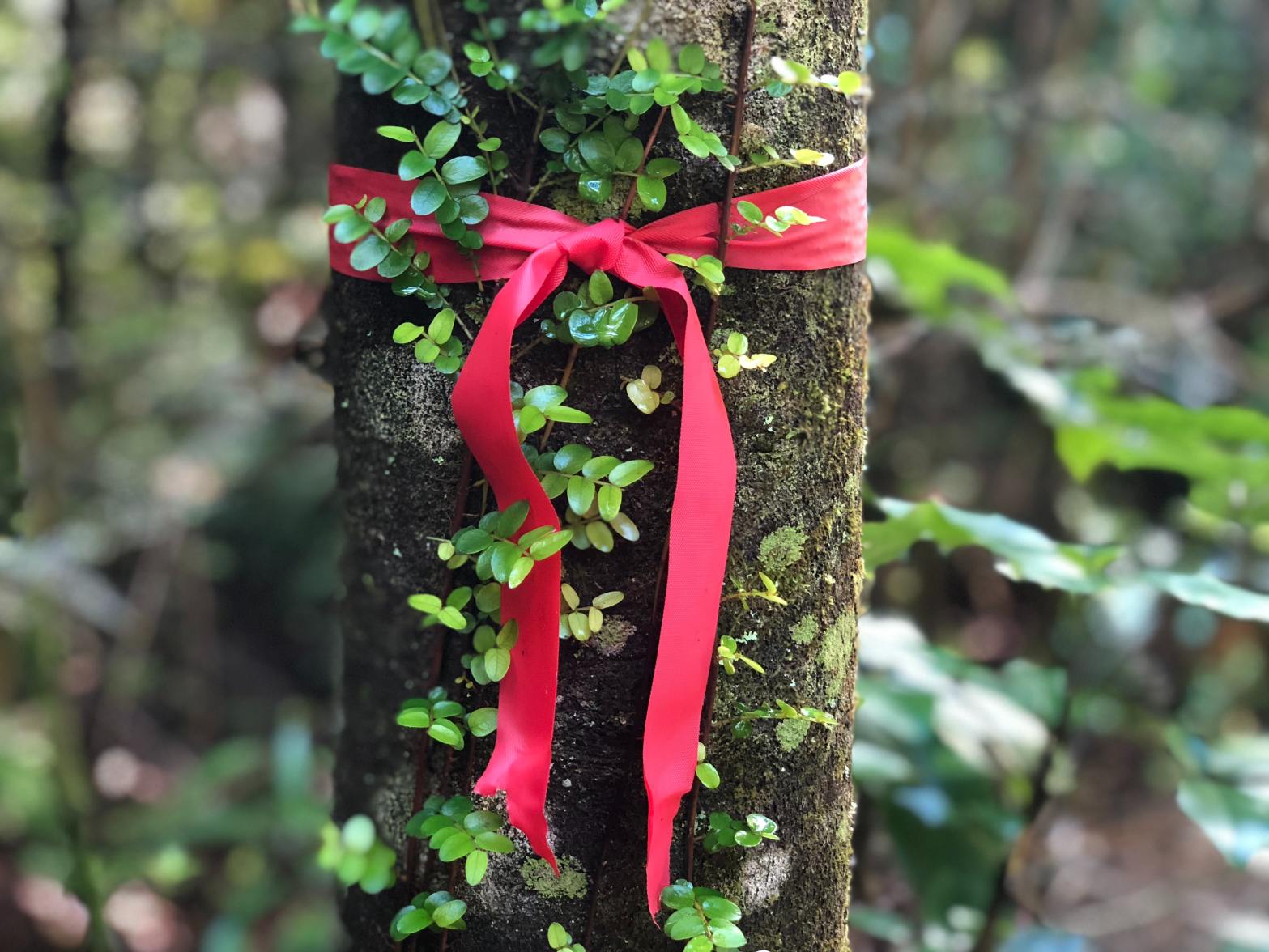
“Are you o.k.?” asked Leonie.  She gently touched the girl on her wrist, which she noticed was tied with a long, red ribbon.

The girl was about the same age as Leonie.  She had long brown hair, big brown eyes, full lashes, and a mouth that was wide and voluptuous.  Leonie thought she was beautiful. 

The girl looked at her.  “Oh, I was lost in thought.”  Her eyelashes scanned Leonie from head to toe, and then she smiled.  “Are you a student at the university?”

“Yes, I am.  I’m on a field trip with my Spanish professor.  This is the last week of classes, and we’re touring around Buenos Aires to learn more about the Argentine culture.  May I ask you why you are here?”

“I’m looking for love,” said the girl, waving her wrist in front of her. 

“I don’t understand,” responded Leonie.

“We have a tradition.  If a girl wants love, she comes to the cathedral and ties a ribbon on a branch of the myrtle tree in the garden, which symbolizes romantic and devoted love.  Soon, she will find a love that will be true and lasting.”

“What a nice tradition.”  Leonie smiled at the girl.

“Did your professor tell you that this church is haunted by its namesake?”

“No. What do you mean?”

“The woman for whom this church was built, Felicia, was murdered.  She was shot in the back by her suitor and died on January 30.  People say that on that day, a woman with a pale face and dark hair, dressed all in white, walks from the garden, opens the door to the church, proceeds down the aisle to the main altar and leaves a trail of tears behind her. 

“That’s such a sad story.”

“Now, Felicia brings love to all the women who request it by tying their ribbons on the myrtle tree.  She has turned her tragedy into positive deeds—bringing love to all women of her beloved city.”

“So, you are going to tie your ribbon on the gate?”

“Yes, to find my love.”

“May I help you?”

“I’d like that. Let’s go.”

The two girls walked out of the church together, smiling and chatting as they went.  Once they reached outside, they walked through the roses in the garden until they reached the myrtle tree.  The brown-eyed girl untied the ribbon from her wrist and, with Leonie’s help, tied it around one of the tree’s branches. 

“Thank you for helping me,” said the girl.  “I believe I will find my love even faster because of your kindness.”

“I was honored to share your dream,” said Leonie. 

“Let’s tie a ribbon on the tree so you can find your love.”

“Oh, I’m not ready for love,” said Leonie.

“That doesn’t matter.  Your love will arrive when you are ready.  Here, I have another ribbon.”  The girl pulled another red ribbon out of her pocket and handed it to Leonie.

Leonie raised her chin back and laughed which sounded like the rise and fall of a musical scale.  “I guess it won’t hurt.”  She chose another branch close to the girl’s ribbon and tied hers around it in a bow.

“I’m happy that you will find love too,” said the girl.  The girl smiled at Leonie, placed her hands on her shoulders, and kissed her lightly on each cheek.  Her eyes shone like topaz.

“I will never forget you,” said the girl, and she walked away, her skirts swishing gently from side to side. 

That night, before Leonie fell asleep, she wrote in her book of affirmations.  She wrote—I provide love to the world.  She looked at the words that she had written and thought about the girl with the full lashes who wanted to find love. 

I must first find out what I want, Leonie thought.  Until I know who I am and what my purpose is, I won’t attract the right kind of love. 

One thing I know.  I know I can provide love to others.  I’ll do this first and then, when the time is right, I’ll let someone love me. 

She turned out the light and dreamt about the myrtle tree and its red ribbons.

Wisdom of the Trees: Chapter 1

Photo by DARIAN PRO on Unsplash

From ancient times, trees have symbolized physical and spiritual nourishment, transformation and liberation.

Chapter 1 – Oak

One more week and she was done.  Graduated with a double major.  College over.  More educated than most of the people on earth. 

And you know what?  She wasn’t going back home, even when this class was over.  Her father had paid for a round trip ticket to Buenos Aires, but she was going to cash it in and stay.

This was her chance to really be independent, to find out what her values were without her father’s advice about this job or that apartment, this guy or that outfit. 

She missed her mother though, but her mother wasn’t at home anyway.  When Leonie was supposed to be having the time of her life in college, her mother had contracted breast cancer.  After three surgeries, six months of chemotherapy that sapped her effervescent energy, and twelve weeks of radiation that burned her skin red, the cancer came back. 

Just before she passed away, Leonie and her mother had sat under the oak tree in the back yard, the shadows of its branches spreading like arms across the grass. 

“I can’t lose you, Mom.”  She had wept beside her mom, the shade of the giant tree darkening her tears like black pearls.

“You won’t feel the same, but you’ll never lose me.  You’ll just have to learn how to live with me differently.” 

Leonie had felt so confused.  She stared at her mother’s face so that she could remember it—her gray-blue eyes, silky skin, a mouth that always held the hint of a smile.  She stared deep into her eyes, holding on, wishing for more time.

“I’ll be with you,” said her mother.  “I’ll guide you from a new place, a place you cannot see, but that is nevertheless powerful.  You’ll feel me.”

Leonie clutched her mother’s hand.

“I want you to find your inner strength.  Emulate this oak tree.  Every time you feel weak or lost, visualize yourself as an oak tree, rising strong, spreading wide, enduring challenge and finding the sun.  You won’t be alone because I’ll be beside you, breathing my love into your heart.”

“But I won’t see you.  You’re my inspiration.  I’ll be lost without you.”

“My love will remain here.  When you can no longer physically see me, you can find other women to inspire you.  Choose many, in fact.  One to follow for leadership skills, another to learn the art of love, and another to learn how to live with joy.  She may be one of your professors, a co-worker, a girl friend, a friend’s mother, or a woman you meet only one time in your life. Whatever you wish to be, you can find a woman to inspire you.”

“How can you be so strong?  You’re dying!”

“I’m content because I know that I will continue my life in another form.  My spirit is not dying.  My soul will continue, and I’ll grow from its future experiences.  I have many things to look forward to.”

Leonie remembered this conversation as she held her mother’s ashes six months later, secured in a pearlescent urn shaped like a heart.  Leonie kissed the top of the urn before placing it in the niche at the cemetery.   “Enjoy your journey, Mom,” she whispered.

Later, as she sat in the back yard next to her mother’s chair, Leonie thought she heard her mother’s voice.  No, maybe it was the breeze rustling the limbs of the oak tree instead. 

“My journey will be right alongside you,” said the breeze.

Staying focused on her studies was impossible after her mother’s death, but her girl friends had helped, and then Leonie decided to go overseas for a change of scenery—a much needed distraction that she needed to survive.

So now, she was in Buenos Aires and hungry.  She lived in a shabby dorm room in the basement of the university and tutored students in English to make money, but it wasn’t enough. 

Leonie searched through her backpack for something to eat: an empty plastic juice bottle, a paper envelope from the bocadillo she had for lunch.  She poked her fingers deeper.  Something waxy.  She grabbed at it and pulled out an apple, a little bruised, but it was food.

The next morning, Leonie woke up with a growling stomach and the sound of traffic.  Engines racing, horns blaring, and brakes squealing invaded her tiny room through the high window that wasn’t even big enough for her to crawl through.  Leonie grabbed her shampoo and towel, opened the door, and paced to the single shower room. 

Whew!  It was empty.  The water felt refreshing on her wet head, rinsing off the humidity and sweat of her body from the sweltering night.

Today, she was going to meet a friend that she had met in her Spanish class.  Clarissa was a native Argentinian and Leonie wanted to ask her about traveling throughout the country. 

Upstairs in the dormitory lobby, a canister of coffee stood on a table next to a large blue box of sweet pastries.  Leonie poured the thick, viscous liquid into her own mug, stuck a pastry between her teeth, and whisked out the door.

Clarissa was sitting at a table in the corner of the café with her laptop open when she arrived.  A cup of mate steamed to the right of her computer, Clarissa wildly typing on the keyboard.

“Hey, how’s it going?” asked Leonie, grabbing the back of the chair opposite her, scraping it across the floor, flinging her backpack over a post, and sitting down.

“Hey,” murmured Clarissa, finishing a sentence.

“You know, this Spanish class is my last college class, and I’ve got to figure out what to do with the rest of my life.  I feel lost without my mother, and I don’t want to go home without a plan.  I don’t even know if I want to live there anymore.”

Clarissa picked up her mate, sipped it, and looked up at Leonie. “I suggest that you travel and meet as many people as possible.  They’ll give you new ideas, and you’ll learn that you have endless options,” said Clarissa.

“That does sound good,” said Leonie.  “How should I start?”

“Just go,” said Clarissa. “Don’t think too much.  Don’t plan too much, but be ready to make your trip work each step of the way.  I’m emailing my sister.  She works at the Belmond Hotel, a few miles from Iguazu Falls.  Maybe she can get you a free room.  Iguazu Falls is one place you should go!”

“Oh, I’m so nervous about traveling by myself.  Maybe I’ll just stay here,” responded Leonie.

“Oh, no you won’t,” said Clarissa. “You’re going, and that’s that.”

“We’ll see,” said Leonie.  I have a whole week of classes left.”

“Yes, a whole week to build up your courage and begin your new life.”

Retirement Richness: Project Self

Photo by Sherise VD on Unsplash

For about a year before I retired, I kept asking everyone for ideas about what I should do to keep busy, to stay active, to find purpose during retirement.  I thought about working for the local food bank, reading with children in Oakland schools, or volunteering to work at one of the county libraries. 

Many people think they need to fill their retirement with activities.  One retired nurse I know still rushes through her day trying to fill up every minute.  She volunteers at the local hospital for three hours a week, sews quilts and activity blankets for seniors, takes walks, and feeds the birds.  Yet, whenever she gets tired of these activities, she searches hectically to figure out what to do next. 

For those who truly loved their careers, like many teachers and nurses I know, retirement is an especially challenging transition.  I taught English to college students for 16 years.  I’m proud of my growth as a reading, writing, and critical thinking professor and of my unique ability to inspire and educate students of all backgrounds and skills.  My job gave me tremendous purpose and fulfillment. 

To retire is to rest from the frenetic pace which a career often requires.  Engaging in activities just to stay busy defeats its purpose.  Instead, retirement’s purpose can blossom from the time available to reflect and explore new life paths. 

After thinking long and hard about what my retirement purpose could be and by consulting advice from a variety of sources, I am now content in what my purpose for retirement will be; my primary purpose is now ME.

This goal may sound a little selfish to those who have strong feelings about doing charity work or participating in volunteer activities.  Many people judge their own worth mostly by how much they give to others; however, if people ignore their own psychological well-being, they can’t offer their best self to others.  Their volunteer work will be marred by feelings of stress and anxiety.  Instead of leaving those they serve with better peace, they could even raise the anxiety levels of the people whose lives they hope to improve. 

Focusing on the Process

Since my retirement is a brand-new phase of my life, I knew that I had to treat it as a process of discovery instead of expecting to know right away how to spend my retirement years.  If I had assumed that my retirement would just “happen,” I would have been sorely disappointed.   

The first thing I had to do was to avoid filling my days with busyness.  Each day, I chose to do projects that make me happy.  My own happiness is my primary goal since I know that, if I am happy, I will naturally share this joy with my family and community. 

Thinking of retirement as a process gives me permission to be patient and to let my life unfold in a natural progression.  It also gives me freedom to try new activities that I hadn’t previously thought of because I was so tenaciously focused on trying to be “retired with purpose.”

Viewing retirement as a process empowers me.  Because I don’t assume I have to know how I will spend the rest of my life, I don’t stress about not having all the answers.  I don’t expect to know what comes after today.  I only know that what I do today will lead me to more knowledge about what I value and more opportunities; every day, I achieve personal growth and this growth teaches me what is possible next.  I take confidence in my baby steps and know that my staircase has no last stair. 

Re-evaluating Values

I’ve discovered that the voices in my head that drove my career and previous life are no longer all relevant.  My new role in life, focusing on myself, encourages me to discard old “rules” that were given to me by my parents or previous bosses.  Why?  Some of those old rules don’t allow me to explore my true potential.  I know retired people who have adopted a new spiritual focus by discarding the religion taught to them by their parents.  Others have become creative for the first time by learning how to arrange flowers or paint in watercolors, activities far different than their careers.  I am re-evaluating everything, and I feel great. 

For example, I have decided to write short stories because I love fiction and think that it is one of the highest forms of creativity.  I also walk and perform yoga which both help me feel healthy.  When I finish one activity, I sit down and carefully choose my next one so that I don’t get caught up in mindless activity.  I focus on the present with each activity, knowing it is enough and is leading me to a greater, happier self.

Releasing Negativity

I don’t want to be a crabby old lady who chases people away with her bitterness and narrow mindedness.  I don’t want to act like a nasty old man that can find nothing positive in what others do because he can’t find his own joy.  I want to cultivate joy within myself that will naturally touch others.

Sometimes, in order to build self-joy, a person must eliminate the negative energy of others or of negative activities that threatens to usurp their joy.  I’ve chosen to to gradually eliminate anything or anyone that negatively affects my life.  Since I don’t want to injure my knees or ankles, I only walk for as long as I am comfortable, and I never compete with others.  I also set firm boundaries to prevent negative people from affecting my growth and joy.  I take no responsibility for their development, only mine.

Measuring Growth

Since my retirement project is a process, I’ve found ways to measure my growth to witness progress.  Here are some examples.  Whenever I walk, I use an app on my phone to measure my steps and distance.  I set rewarding goals for each day and observe how much I achieve per week.  In my writing, I post my short stories and articles on this blog to feel “published” and to keep track of my accumulated posts.  I also keep another blog for posting recipes that I create.  When I garden, I take time to admire new plantings or newly pruned hedges.  I observe and enjoy my growth on a daily basis or even several times a day.

Retirement truly is the gift of time to discover how life can be joyful, but a person must intentionally focus on achieving peace within themselves if they want to attain the greatest version of themselves.  What better way to do this than to make my biggest retirement project all about me.

Five Features of a Perfect Democracy

Ever since the pilgrims landed on the North American Continent, Americans have struggled with freedom. 

On January 7, 2021, Darren Walker, President of the Ford Foundation made this statement in the Foundation’s Equals Change Blog: “Our founding aspirations were just that: aspirations.”  What he means is that the freedom which we aspire to in the Declaration of Independence, the Constitution, and the Bill of Rights has not yet been achieved.  In fact, Walker admits that these aspirations were a “founding contradiction.”  When white settlers took control and settled across what is now the United States, they took away the rights of the natives who had previously lived on the land.  As white plantation owners built tobacco, rice, and cotton empires, they enslaved human beings from Africa to serve like cattle in the muddy fields under sweltering sun.

On January 6, 2021, a mob of white supremists stormed the capital, our citadel of democracy.  This event horrified most American citizens and made them realize how fragile our democracy really is. 

Yet, some good came from this insurrection toward our government.  It signifies that we have not achieved the freedom that we strive for; we have not reached the level of a true democratic government.  This violent, but sad act against our government makes the brokenness of our democracy blatantly clear, and that is what is good.  We have clarity that we must act to improve our democratic dream.

In his blog post, Walker makes it clear that “inequality is the greatest threat to justice—and, the corollary, that white supremacy is the greatest threat to democracy.”  As long as people exist who do not seek equality for all peoples, our democracy is flawed. 

What is a true democratic freedom?  I mused over this question for days, and my mind constantly wandered back to Aristotle’s rhetorical philosophy practiced in the original democracy of Greece which solved community issues, not with force, but with respectful dialogue. 

I wondered about how a citizen should act or what a person should be in order to promote democratic freedom.  I’m not a specialist, but I do have aspirations to promote democratic freedom for every person in the United States.  As I mused about what qualities would promote freedom for all peoples, I came up with five overlapping features that must exist in the populace for a truly democratic community: openness, self-discipline, moral courage, empathy, and respect.

Openness

The United States is a diverse country, and, therefore, in order for us to achieve to true democracy, different types of people with dissimilar customs and cultures must live together without criticism or conflict.  This requires citizens to adopt an openness to customs and cultures that are diverse, even when those practices are against what citizens may choose for their own lives. 

To be open means to be imaginative, curious, and ready to learn about the lives of other people, no matter how unlike they are to oneself.  Being open means to be receptive to new ideas without feeling threatened.  It means to be attentive to all people no matter what their background is.  It means to be transparent in action, acknowledging what is new, but accepting it anyway. 

Here are some examples of openness.  A heterosexual couple willingly accepts the lifestyle of a homosexual couple who moves into the apartment next door to them.  They treat this couple as a respected neighbor and do not make judgments about them just because they are homosexual.  A pedestrian encounters a peaceful demonstration while he is walking down the street.  Instead of prejudging the participants, he reads their signs and engages in a conversation with one of them to hear their point of view.  A manager who is hiring a new employee does not discriminate when an applicant comes into an interview wearing a turban on his head. 

Self-discipline

Most humans work on improving their self-discipline throughout their whole lives.  In a truly-perfected democracy, self-discipline is important since one person must never infringe upon the freedom of another for any reason.  Whites cannot take away the freedom of Blacks or Hispanics.  The rich cannot take away the freedom of the poor.  City dwellers cannot erode the freedom of rural dwellers.

Self-discipline is the ability to control personal feelings and overcome personal weaknesses. It is the aptitude to pursue what is right despite temptations or any private fears.  Self-discipline involves acceptance, willpower, commitment, hard work, and persistence. 

Acceptance requires that people look at reality accurately and acknowledge it.  For example, the reality is that Whites have greater privileges in American society than other races; however, even today, many Whites don’t understand this.  They don’t understand what White privilege really is. 

The “willpower” part of self-discipline helps individuals set a course of action and start on it.  They set an objective, create a plan, and then execute their plan.  For example, I wanted to become a professor whose African American students succeeded in my classes.  That was my objective.  My plan was to use more African American authors in my course readings and more visuals of African Americans in my online course.  My plan also included in improving my own knowledge about African American history that was never taught in school; through study, I would better understand African American history and, through their history, my students’ current needs and feelings.  Then, I executed my plan, and my courses became more inclusive, I became more knowledgeable, and my students became more successful and happier.  Even I became happier in my growth and their success.

Commitment cannot be underestimated.  To be committed means putting in the time to whatever goal you have in order to achieve it.  For my goal of improving the success of my African students, I committed to reading numerous books on the African American experience even when reading those books took time away from more pleasurable activities.  I read every day.  When I finished one book, I started another right away.  If I wasn’t committed, I often would have chosen to read a light-hearted mystery or go outside to do some gardening in the sunny weather. 

Self-discipline also requires hard work.  I had to read challenging books even when I was tired after a long day teaching.  I had to look up new vocabulary words, reread certain paragraphs until I understood them, and take continuing education courses that complemented my newfound knowledge. 

Finally, nothing of value is accomplished without perseverance.  I started my quest to learn more about my African American students over five years ago, and now, I have accumulated a lot of understanding of the African American history.  This knowledge has allowed me a greater understanding of the current political issues today such as the George Floyd murder and the Black Lives Matter protests.  If I hadn’t persevered in my growth, I would never be able to comprehend the complicated issues America faces today.  And now, I’m at a new level of citizenship, ready to make new goals.

Moral Courage

Moral Courage is integrity.  People with moral courage are honest, true to their word, do the best they can, and own up to their shortcomings.  They do not make excuses or blame others for their actions or faults.  They do not try to cover up their mistakes.   They try to make others feel better, and they do the right thing even when it is difficult. 

Here are some examples.  Travis intervenes when Roger bullies Mario on the playground.  When Sarah goes for a walk, she takes a plastic bag so she can pick up litter on the street.  Ivan completes his chores without being reminded by his father.  Killian pays for the college tuition for his nephew without telling anyone.  Recently, Vice-President Pence refused to block the electoral vote in Congress even though it would have been easier to submit to President Trump’s aggressive demands. 

Practicing moral courage is hard, but our country needs citizens who possess it.  People can draw inspiration from people who have demonstrated great courage such as John Lewis, the former Georgia Congressman who helped Martin Luther King, Jr. demonstrate against prejudice and then worked in Congress for decades to continue King’s work. 

Another way to strengthen moral courage is to practice acts that require courage and to avoid actions that lack courage.  People can compliment those who treat them badly, and consciously can avoid gossiping.  They can think of new acts of courage on a daily basis so that acting with courage becomes a habit. 

Empathy

To help America attain a perfect democracy, people must possess an empathy for their fellow citizens.  The type of empathy required is a compassionate empathy where a person’s logic and emotion are balanced.  Compassionate empathy is a combination of logic and emotion—a concern that leads someone to act for the betterment of another. 

When someone intervenes for a bully victim, they feel compassion for the victim and they are able to stop the bullying from taking place because of their intervention.  When a professor feels compassion for a Hispanic student who lacks the technology necessary to pass her course, she uses her resources to provide technological resources to that student.  The effect of the action is to improve the lives of those for whom you feel compassion, thus enhancing their freedom—to live without fear, to attain an education, to secure decent housing, to acquire a job that pays adequate wages, or to be able to vote in an election.

Respect

 Of course, in a perfect democracy, citizens must respect each other.  We must treat each other with dignity, with regard for each other’s feelings, wishes, rights, traditions, and needs.  Citizens must treat each other with kindness and politeness, hold each other in high esteem, and exude a positive attitude toward one another.

Citizens show respect when they discuss mistakes with kindness instead of hatred or criticism, when they make decisions based on what is right rather than whom they like.  Respectful citizens listen and hear one another and honor physical boundaries.  They treat each other’s property with care and they never violate or intrude to cause physical or psychological harm. 

Respect means never making assumptions about people just because they are poor or transgenders, or because they live in Oakland, wear a turban, or attend a synagogue or a Catholic church every weekend. 

We have many blemished citizens in our country, and this is why our democracy is flawed.  Maybe we will never achieve the perfect democracy where every human being is treated with equality, but we can do better than we are doing today.

Walker has not lost hope.  He says, “while much remains to be done, and undone, I believe we can emerge—and are emerging—a more unified, more equal, more just, more American America.”

It’s time to start talking about the qualities that will help us fulfill our democratic dream again.  Now that we have been awakened by the riots in our capital, we can use our new awareness to upgrade ourselves, fight against privilege that demeans others, and make plans to spread freedom to more people and to grow closer to a perfect democracy.