Turning Ordinary Events into Writing

I used to think that my life was too ordinary for fostering ideas for writing. But finally, I realized that the best story-telling is about human nature itself. That’s when I started looking for writing ideas everywhere and every day.

In this blog post, I share five ordinary life events that I turned into stories or posts.

The Pancake Contest

When I was five years old, I competed against my brother Don in a pancake contest. The contest happened at home at breakfast time. My mother made as many pancakes as we could eat. My brother lost the contest and I won by one pancake.

Fifty years later, I turned this ordinary childhood event into a funny story with descriptions of my brother groaning in pain and of me raising my arms in victory.

A Picture of a Road Bike

One day at 5 p.m., my son sent me a picture of the handlebars of his new trail bike. By 6 p.m., it was dark outside, and I started to wonder if he was biking out in the hills in darkness. Luckily, he wasn’t.

I wondered what it would be like if a bicyclist did get caught in the middle of the hills in the dark. I wrote a story about a girl who starts her bike ride at dusk and gets distracted when she finds a tarantula. She ends up in a valley at nightfall and has to find her way back to the deserted parking lot while the night wildlife threatens her safety.

Taking a Stuffed Bear to a Cemetery

A week after my mother died, my brother texted me and my siblings to tell me that he took a stuffed bear with him to visit her grave. The bear was created from clothes that my mother once wore.

I invented a story about this visit, which I titled Rain. The story describes a man driving a truck to the cemetery to see his mother as it rains. When he arrives, the rain stops. He thinks about how his siblings have connected via text messages since his mother died. He puts the bear next to her tombstone and says a prayer. As he drives away, the rain starts again.

A Hike in San Francisco

A few years ago, I joined a Meetup group that hosted walks all over San Francisco. One walk started at the Embarcadero and crossed the city from east to west for seven miles until we reached Land’s End. Another hike circled the exclusive neighborhoods of Twin Peaks and climbed up to the Sutro Tower, one of the highest points in the city.

When I was writing my novel Whistle, I used these hiking experiences in one chapter to help my protagonist escape the sorrow of her home after her mother dies. She walks along the ocean to Golden Gate Park.

Filbert Street Steps and Graffiti

When my friend came to town, I met her in San Francisco to climb the Filbert Street Steps. This staircase covers three ascending blocks from Sansome Street to Coit Tower and includes well over two hundred steps. On my way to the city in Oakland, I saw some graffiti on an overpass that said “Resist Authority.”

I turned the staircase and graffiti experiences into a short commentary about how I like to read graffiti so I can hear what the needs of people are. This post received a lot of attention on my blog. It seems like many people identified with it.

Now, I have a fertile writing attitude. My whole life is a garden of ideas, waiting for my creativity to take them from a personal experience into the world.

A Eulogy for my Sister Carol

Photo by Cristina Anne Costello on Unsplash

Good morning. My name is Tess, the third child in a family of ten children and Carol’s older sister. Carol was the sixth child in our family, born on October 20, 1960 at Mather Air Force Base hospital in Sacramento.

As a baby, Carol was a pretty little blonde girl with fine hair and features that mirrored her mother’s: a long forehead, an awfully straight nose, and a smile that created dimples in her cheeks.

Carol loved, loved, loved music.

She enjoyed old-fashioned country music by the likes of Hank Williams who wrote “Hey Good Lookin,” which she heard when Mom and Dad played the radio.

When Carol still lived with us, Beverly, Carol’s oldest siter and another musician in the family, sang songs to her, such as “Do, Re, Mi” from the musical Mary Poppins and “My Favorite Things” and “Edelweiss” from The Sound of Music. Carol smiled, laughed enthusiastically, and sometimes rocked to the beat.

Just before Carol died, Ron and I visited her in the hospital. She was anxious, and the only noises in the room were the beeping of the medical monitors. We turned on some music by the Russian composer Sergei Rachmaninoff. Immediately, Carol turned her head toward the music speaker and calmed down. Her eyes gleamed with joy.

We believe Carol would have been a great musician if she hadn’t suffered from Cerebral Palsy.

Carol possessed determination.

Even though she didn’t speak, Carol had ways of letting people know what she didn’t like. Whenever someone tried to brush her teeth or feed her sour fruit, she clenched her mouth closed to prevent anyone from getting anything past her teeth.

While she was in the hospital, Carol demonstrated determination as well. She didn’t like having oxygen tubes in her nose, so she moved her head from side to side until they fell out. One time, after I had inserted the tubes back in, Carol used her left hand to accurately bump the tubes out of her nose and above her head. A look of satisfaction spread across her face as she became free of them. I laughed out loud realizing that her spirit was still strong and impressive.

Carol was sometimes mischievous and annoyed.

One time when Margaret visited Carol while she was living in transitional housing, she found a caretaker feeding her.

Margaret knew that Carol had been attending school to learn how to eat on her own, so Margaret said to Carol, “Carol, you know how to feed yourself.”

Carol swallowed, looked up at Margaret, and laughed heartily.

Apparently, she was hungry, and, if she had to feed herself, it would take much longer. She knew what she was doing.

When Carol was annoyed, she set her mouth in a tight straight line to let us know. Her expression was so like the countenance of Mom’s face when she was irritated that we recognized it easily.

Carol enjoyed the support of a loving family throughout her life.

Our parents’ greatest gift was a strong family bond, and Carol was an integral part of our family unit.

Carol lived with our family for nine years. When she was a little girl, I lifted her onto the swing and pushed her. She raised her face to the sky to feel the breeze. I also took her by the hand and walked her around the back yard so she could see the animals. Her eyes followed the ducks and chickens as they strutted around for food.

When we flew to England to live for almost four years, I sat next to Carol on the plane. I thought I was luckier than my two older sisters because they had to take care of more siblings than me. As long as I took good care of Carol, Mom was happy. I danced stuffed animals in front of her, fed her the airplane food, of which she didn’t complain, and sang her to sleep.

After we returned from England, my parents decided to arrange for Carol to live in an assisted living home. One of her homes was in Santa Clara. At the time, I worked in Santa Clara, so, once a week, I visited Carol and fed her dinner. Sometimes, I was able to take her outside to enjoy the warm sun and soft breezes by the Bay. We sat on the expansive lawn under the shade of an oak tree, and I told her stories about the people in our family while her hazel eyes stared at my face.

Margaret and Liz also visited Carol in Santa Clara. First, they went to Great America for a day of fun, then called Carol’s facility to see if they could visit. Since they were arriving after visiting hours, they knocked on the back door. Once admitted, they sat next to Carol in the sitting room and told her about their day at the amusement park. Since Margaret and Liz love roller-coaster rides, they described the thrill of bouncing up and down and all around, and Carol stared at them, probably day-dreaming about a calmer choice such as “It’s a Small World.”

Finally, my parents arranged for Carol to move to Sacramento so she could live closer to them.

Once, while visiting, Margaret took Carol to Starbucks and ordered her a Strawberry Créme Frappuccino. She wheeled Carol outside since it was summer and she wanted Carol to enjoy the good weather. Margaret held the Frappuccino up to Carol’s mouth and told her not to drink it too fast or she would get a brain freeze. Carol eagerly sucked quickly through the straw for a few seconds, then let the straw go, wrinkled up her nose, and squeezed her eyes shut. Oops, she got a brain freeze.

When Carol moved to a home in Penryn, she was extremely popular with her roommates. She had more visitors than anyone, and her roommates thought she was Miss Congeniality. When we visited her, not only did we talk to Carol, we spent time with her friends. The joy on all the faces was rewarding. We felt popular, too. 

Mom and Dad supported Carol throughout their lives, making sure she was well-cared for wherever she lived. Often, they brought her home for holidays such as Christmas so everyone could see her. Carol even showed up at Mom and Dad’s 50th wedding anniversary at St. Mel’s Church, accompanied by her caregiver.

Later, after Dad passed away, Mom visited Carol as often as she could even after she moved into an assisted living facility herself when she was 89. Whenever Carol saw Mom, she didn’t have eyes for anyone else. She gazed into her face with a tender look of love, often accompanied by a smile.  

Mom was a dedicated mother; she called Carol’s home every Sunday afternoon to check up on her. Our parents also purchased a burial plot for Carol next to their own so she could rest beside them.

Closing

We will miss Carol. Like any sibling, she was our friend, our companion, our entertainment, and most of all our teacher. She inspired us to slow down our racing lives to enjoy basic joys and connection with her. She showed us the value of unconditional love and how to practice it. She taught us that family bonds go beyond childhood and are maintained by commitment.

Our lives were and still are enriched by hers, and we are grateful to God that she was our sister.


Getting Ghosted at the Paris Cemetery

My husband and I got to Paris three days before our tour of France was to begin. Our goal was for both of us to overcome jetlag before the tour started and to see parts of Paris not on the tour.

I had been to the Paris catacombs the last time I visited Paris with my daughter. These are underground alleys beneath the city to where thousands of bodies were transferred from cemeteries above ground as Paris expanded. For miles under the city, tourists can walk past bones piled up against the walls in neat displays. Hip bones are in one place, skulls in another.

One place I had never been before, though, was the Pere-Lachaise Cemetery, known for the graves of dozens of famous people from all over the globe. We took a taxi ride to the cemetery’s entrance at 16 Rue de Repos in the 20th Arrondissement, about a half hour ride from our hotel in Bercy.

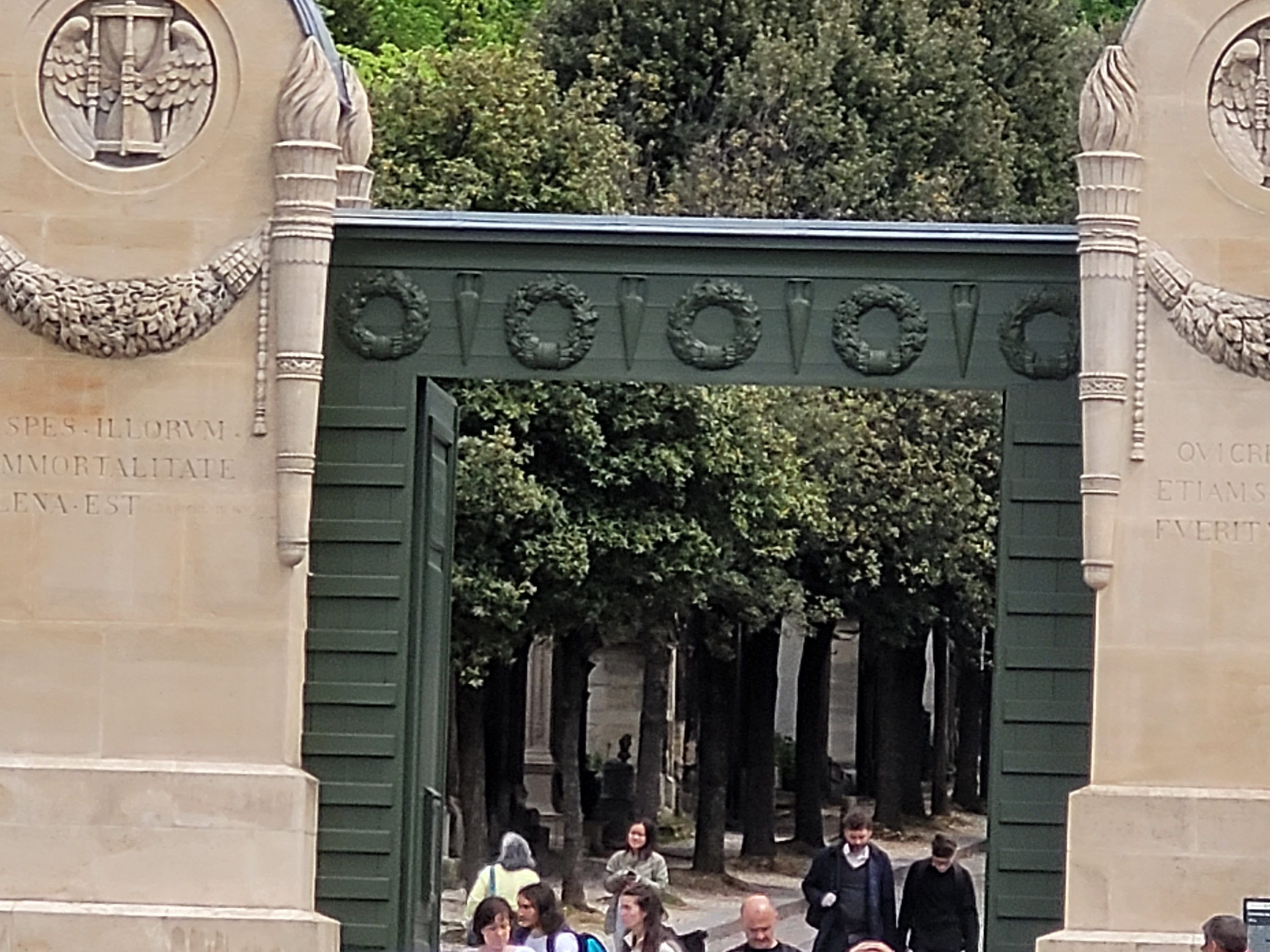
The entrance was a massive olive-green set of doors framed by wreaths. On both sides, the doors were flanked by two white granite columns topped with the carving of an hour glass circled by angel wings. The doors were open and, inside, we could see several erect tall tree trunks with leafy branches. In-between the trees, blackened marble mausoleums and statues beckoned to us.

I had a map of the cemetery from my Frommer’s Easy Guide to Paris, so I felt well-prepared to find many famous graves including Frédéric Chopin, the renowned Polish composer and virtuoso pianist of the Romantic period who lived half his life in Paris, and Oscar Wilde, the provocative Irish poet and playwright. But since we entered through the main gate, I decided we would start by finding the grave of Camille Pissarro, who was known for his Impressionist and Neo-impressionist paintings.

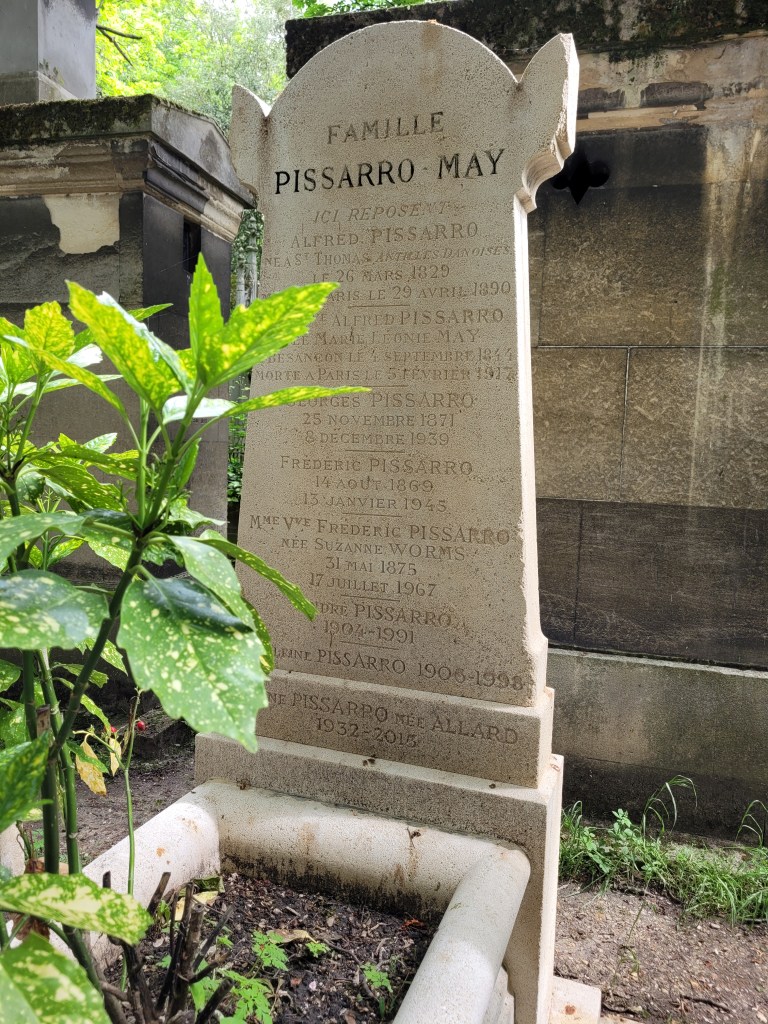
The cemetery has a few paved paths and dozens of tiny dirt paths that take visitors past the graves. To find Pissarro, we took a right just inside the gate to walk along the west perimeter of the cemetery’s wall. After several steps, sure enough, we found Pissarro’s crypt where at least eight family members were buried. The names were listed on a grand rounded slab of white marble with two angel wings sticking out at the top.

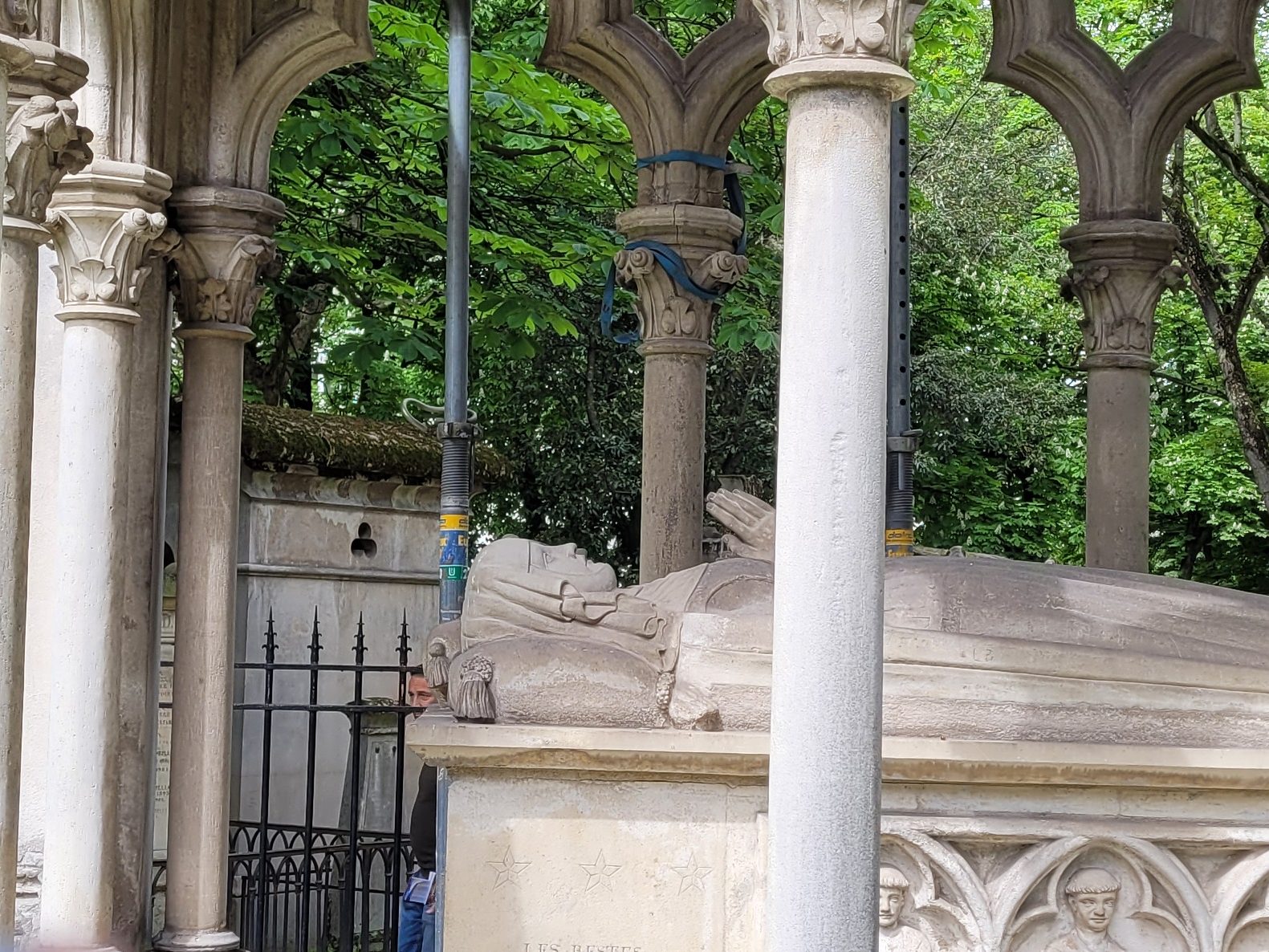
Nearby Pissarro, my map indicated that the 12th century lovers, Héloise and Abélard, were buried, their remains brought to the cemetery in 1817 from Brittany. We found their monument which is an openwork Gothic Chapel from an abbey in southwestern France. Underneath the roof are two reposing statues of the tragic lovers who were forced apart by their families and spent the rest of their lives writing letters of love.

After finding the tombs of these lovers, our luck evaporated. According to my map, the Rothschild family plot was nearby. Since the French Rothschilds were the founders of a banking dynasty in France, I expected their tomb to be colossal and easy to find. We scanned the names on several large monuments beside the dirt path, but we never found them. We found ourselves alone on the claustrophobic dirt path edging the gargantuan cemetery wall, shivered at the thought of being amongst more deceased souls than live ones, so gave up our search for the Rothschilds.

We took a teeny side path to reach Chemin Serre, a wider path than the lonely one we had just left, but still somber from the shade of countless trees which blocked out the view of the sky. Somewhere on this path was the grave of one of the most famous souls in the cemetery, the 1960s rock star Jim Morrison. According to my guide book, Morrison’s grave is the most visited in the grounds and, ever since he died, people have made pilgrimages to see his tomb, leaving behind graffiti, trash, and samples of drugs. We searched for the fenced-in tomb, which is supposedly an unexceptional relic. We asked passers-by if they knew where the grave was, and they pointed us in the right direction. We couldn’t find it. We looked for a grave that had a crowd of people gazing at it, but couldn’t find either a crowd or the famed resting place. We gave up.

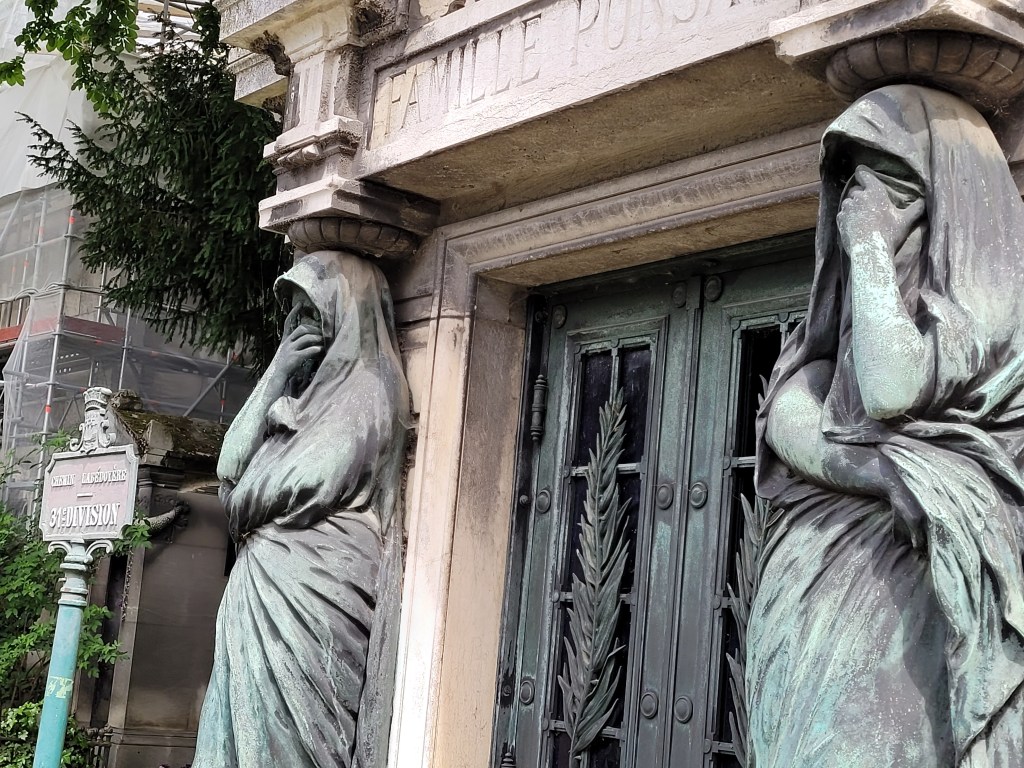
I was probably most excited about seeing the tomb of Oscar Wilde since I am a fan of his novel The Picture of Dorian Gray, Wilde’s story about a man that has his portrait painted and then sells his soul so he never loses his youth; instead, his portrait ages and records the sins of his amoral life. To reach Wilde’s grave, a visitor has to walk up the hill to the top of the cemetery, and my husband was unwilling to do this. Leaving him sitting on a bench on a popular paved pathway, I started ascending the hill. Oscar’s grave was at the juncture of Avenue Carette and Avenue Circulaire. I walked, I inhaled through my nostrils and out through my mouth to regulate my breathing as I ascended the steep terrain. I passed tombs of men surrounded by statues of weeping women, which I thought was a bit arrogant on their part.

I discovered the mausoleum of the Monet family, which may or may not be related to the impressionist artist Claude Monet who is buried in Giverny. I also found a crypt for the Macon family which I hoped was related to Emmanuel Macon, the French president. Unfortunately, though, when I reached the spot where I thought Oscar Wilde was buried, I couldn’t find him. I looked up at the grand crypts. I read the names on several flat tombs, but Wilde’s final resting place eluded me.

I next took the opportunity to find the side-by-side tombs of Gertrude Stein and Alice B. Toklas, who were also supposed to be buried at the top of the cemetery on Avenue Circulaire. Gerturde Stein was an American novelist, poet, playwright, and art collector who hosted a salon for writers and artists in Paris. Toklas was her long-time lover. Where were they? Did I have to step over graves to find them hidden in the middle of a mass of deceased humanity? I’ll never know because I gave up and went to join my own lover who was still sitting on his bench watching other people struggle with their maps.

Together, we found a memorial for the 6,000 Jews who died in World War II in the German concentration camps. We also discovered a crypt for the Famille Charlemagne, and since the ancient King of the Franks had 18 children, I know he certainly has descendants who are now buried in this Paris cemetery.

The last person I wanted to find was Frédéric Chopin, the Polish composer that I mentioned earlier. According to my almost useless map, he was buried at the juncture of three dirt paths a short walk away from the Monument aux Morts, a grandiose marble monument to the dead with several grieving statues. I left my husband again, sitting on a bench along the circular road that surrounds the monument, and, again, I traipsed uphill to find Chopin. Standing on the path, I searched every name on the tombstones near the juncture. No Chopin. Feeling desperate, I courageously scooted between the tightly packed graves to read the graves behind them. No. I hurriedly got out of there. Chopin didn’t want to be found.

Back at the entrance to the cemetery, I read that the cemetery was named after a Jesuit priest, a confessor for King Louise XIV, who lived in a house on the property before the cemetery was built. In 1804, Napolean bought the land so that all Parisiens could be buried, no matter their race or religion. I also learned that, today, over 1 million bodies and cremains are buried in the cemetery. That made me feel better. In the midst of a million ghosts, most of the ones I wanted to see were the ghosts too shy to do any spooking.

Photo by David Baker

Dying Words

Rose Marie could feel it. Life slipping away.

For years, the Macular Degeneration in her eyes had slowly darkened her vision. The blindness had started in the middle of her eyes and took over more and more of her sight as it covered her vision like a dark blanket. At the lunch table, her friend Ruth read the menu to her.

Last year, her doctor had diagnosed her with Alzheimer’s. She had called each of her ten children with the news. They didn’t know how to react, and she didn’t either. She didn’t think her memory was bad. She still knew her children’s and friends’ names and the address where she had lived for sixty years.  

Her apartment was on the second floor overlooking the front garden of the assisted-living facility. When she had moved in, she could see the roses blooming and the branches of the sycamore trees swaying in the breeze. Now, she knew the roses and trees were outside the window, but she had to turn her head to see them from the perimeter of her eyes. Sometimes, she didn’t bother. She just let the circle of light enter her mind without trying to focus on any details.

She had gone down to the dining room for breakfast. Ruth didn’t have to read the breakfast menu to her since the server knew that she ate the same thing every morning: a piece of bacon, toast with jam, and a full glass of milk. Sometimes, her daughter Margaret brought her some homemade jam that she stored in the refrigerator in her studio apartment. Strawberry-rhubarb was her favorite. She would carry the small jar of jam down to the dining room and ask the server to spread it on her toast.

She found her way around her studio by reaching out to touch the furniture as she walked to the bathroom, the bed, or her recliner. To get down to the dining room, she found the knob on her front door, twisted the door open, scooted her body around it, closed it behind her, took the apartment key that she hung on a lanyard around her neck, and locked the door by finding the keyhole with her left fingers.

Once she got outside of her studio into the second-floor hallway, she reached out to touch the armchairs, side tables, lamps that led her to the elevator. Since her studio was at the end of the hallway and the farthest from the elevator, she passed many other apartments along the way. She could discern from her perimeter vision that some had wreaths on the doors. She knew when she was passing Nellie’s door since she could hear her chihuahua barking.

Lately, she’d noticed that she had trouble talking to her friends at the dining room table. She knew what she wanted to say, but it seemed hard to get the actual words out. The same thing happened to her when she phoned her children. In fact, it was exhausting to talk for any amount of time.

“Wait a minute,” she would say as she struggled to express herself. They waited so patiently, much more patient than she had been as their mother. Then, slowly and deliberately, she would answer their question with a complete sentence.

Since she had moved into the assisted-living facility, two of her long-time friends had died. Jim had severe back pain for a week before her passed away. She and her husband had known him and his wife for sixty years. They attended the same church. Their kids went to the same schools.

Patty passed away in her sleep one night. When her daughter came to clean out her studio, Rose Marie asked if she could have Patty’s tiny cabinet desk. The handyman had moved it into her apartment, and she kept her calendar and pens in it now. When she opened it, the wood felt warm, like Patty’s arms.

Rose Marie had always told her children that death was part of life. This time, however, the death that was coming was her own. Throughout the day, more and more of her life was transitioning to a new place with which she was unfamiliar. She couldn’t play Solitaire anymore at her desk because she couldn’t see, so she sat in her recliner and let the window’s light stimulate her thinking.

She was afraid. What would happen to her children when she died? Would they still be a family? Who would her sons talk to when they had problems to discuss? Who would need her when they got a divorce or lost a baby?

When she had first moved into the facility, her friend Morgan had picked her up every Sunday and drove her to Mass. She didn’t come anymore since Rose Marie no longer felt safe enough to walk around a place where she hadn’t memorized the placement of the furniture. Now on Sundays, she went down to the chapel when the priest came to bring Communion for the Catholics.

“I don’t know how to die,” she said one day. She could see him put his hands in his lap before he answered her. “I’m fully aware that I will die soon, but what should I be doing right now, before it happens.”

Father Moyer took a deep breath through his nose, and let the air out like a sigh before responding. “Well,” he said. “You don’t need to worry about dying. Just spend your days loving your family and friends. That’s all that matters.”

“So simple,” she said. She heard Father take another calm breath. When he exhaled, she was reminded of the ocean. She thought his answer would have involved praying, repenting, forgiving, or philosophical discussions. “I’m afraid of what will happen to my children when I’m gone. I’m the matriarch of the family. I keep them together. Shouldn’t I talk to them about these things?”

“No. They won’t remember anything like that, but they’ll remember how you love them.” He breathed in and out like the ocean again. It sounded so beautiful and relaxing to her.

Later, when Rose Marie went back to her apartment, she sat down in her recliner and picked up her cell phone. She pushed “1” which would dial her oldest daughter’s phone number automatically.

They only talked for two minutes. It was so hard to get out the words she wished to say. At the end of the phone call, Rose Marie said, “I love you.”

“I love you, too, Mom,” Celia said. “So much.” Rose Marie hung up.

Then she pushed “2” so she could talk to her second child. Then “3,” then “4,” then “5.” Her fifth child Ron didn’t answer. She’d have to call him later. By the time she had talked to the rest of her children, she could tell that the sun was setting between the branches of the sycamore trees outside her window. Soon, she’d have to walk down for dinner. She dialed “5” again, and Ronald picked up.

“I just wanted to say I love you,” she told him. She took a long slow breath and exhaled. The ocean flowed through her lungs.

Chemotherapy Christmas

The room was large, windowless, and sterile. Blinding florescent lights. Beige linoleum floors. Twelve green reclining chairs placed with their backs against the walls around the room. Each chair accompanied by a metal stand hung with bags of fluid and tubes.

The woman sitting in one of the chairs wore a scarf around her head. I looked for wisps of hair, but couldn’t see any. Her body filled up the chair like of sack of potatoes, lumps everywhere. She wasn’t smiling like the nurse who stood next to her, hooking up a tube to a port embedded in her upper chest.

A man whose body disappeared within his baggy shirt and trousers sat in a recliner in a corner. His scrawny hands hung over the chair’s arms like shriveled leaves caught on the edge of a forgotten lawn chair in the fall. His bald head shone in the florescent lights like a bare bulb. His face was gaunt, lined, and dry, and his eyes were closed. A young woman sat in a chair in front of him reading the Bible.

I watched the room’s activity with a lump in my throat as I stood behind my mother and brother by the door. A woman with a cane was led to another recliner in the room. The male nurse helped her sit into the chair, gently pushed her back, and lifted the foot rest. The nurse lifted a matching green blanket from a small chair nearby and laid it over the woman’s body, tucking the edges around her snugly. Then he efficiently began hanging the bags of chemicals on a metal stand and hooking up the bags with the tubes.

This was my mother’s chemotherapy room. Mom’s last chemotherapy session was scheduled for December 24, Christmas Eve. She had asked my brother Zach and me to accompany her to the appointment. My brother had flown home from college in Southern California for Christmas, and I was home from college too. The only thing my mother wanted for Christmas was to finish chemotherapy with her children around her.

A female nurse wearing an ugly, plain, blue smock and pants led my mother to a chair on the emptier side of the room. Zach helped Mom take off her coat and climb into the chair. She looked small, dressed in her pink cotton beanie, pink V-neck sweater, and jeans. How pale her pretty face was. Mom nodded when the nurse asked if she wanted a blanket, and Zach took it from the nurse and covered her gently like he was placing a precious jewel into a new setting.

This was not how I wanted to spend my Christmas. Wasn’t college supposed to be one of the happiest times of my life? I was too young to worry about my mother dying or even being too sick to visit me at school.

The nurse pulled two straight-back chairs close to my mother’s recliner, and invited us to sit down. I took the chair farther away and leaned back as if my mother was contagious. My brother pulled his chair closer to Mom and took hold of her left hand. When she smiled at him, her eyes watered like green pearls.

Before long, Mom was hooked up to the tubes that would feed chemicals into her body. I could tell that she was putting on a brave face because, underneath her smile, she looked tired and weak.

I didn’t want to think about her being that way. Instead, I wanted her to jump out of her chair, hug me tight around the waist, and ask me about college. I wanted to tell her about Jasmine’s new boyfriend, Sara’s job offers, and David’s article in the college newspaper.

Her smile withered away as the chemicals dripped into her veins. She gave up trying to hold a conversation with my brother, who was bent towards her in his chair, his chocolate eyes full of concern. She looked at me several times, but I retreated away from her with a grimace on my face.  I didn’t want to be here.

Once in a while, Mom opened her eyes and looked up at the bag hanging beside her as if gaging how long she had to endure the procedure, but, for the most part, she kept her eyes closed, and we sat in front of her fidgeting in our chairs, biting our lips, and staring at each other with worried eyes.

Three hours later, the nurse in the blue smock and pants pulled the catheter out of my mother’s port, gathered up the tubes, and rolled away the metal stand with the empty bags.

A young woman with brunette hair and rosy cheeks pushed a wheel chair up to our station.  She asked my brother to move his chair, then maneuvered the wheel chair as close to my mother’s chair as she could.

“I’ll help you,” she said kindly. She took ahold of my mother’s upper arm and guided her from the recliner into the wheel chair.

My mother let out a whimper as she moved. Zach helped her put on her coat as she sat in the wheel chair, wrapped her pink scarf around her neck, and gave her a wool cap to pull over her pink beanie. Still, she shivered when the nurse wheeled her outside to the car.

Zach drove us home, and the next day was Christmas.

Limericks for Grandma

“Play a game with me, Grandma,” said Rachel.

“No, Rachel, I don’t feel like playing now,” said Grandma. “I miss Grandpa too much to play anything.”

Rachel missed Grandpa too. She missed sitting in front of the fireplace and listening to those
funny poems of his. What had he called them? Limericks, that’s right.

Rachel had started writing her own limericks too, just like Grandpa. It was fun to think of rhyming words and funny phrases.

Before he died, Grandpa had given Rachel his typewriter. If you want to write really funny
limericks, he said, use my typewriter. Some of my funniest limericks were punched out with these
keys. Rachel knew she would keep that old typewriter forever. It made her smile to see it on her desk. Why wasn’t Grandma happy to be surrounded by Grandpa’s things?

She had an idea. That night, she sat in front of Grandpa’s typewriter. T-h-e-r-e she typed.
Rachel noticed the “r” was lighter than the rest of the letters. She typed a limerick like one of
Grandpa’s, then folded her poem into an envelope. The next morning, she slipped it into Grandma’s
mailbox.

“Hi, Grandma,” said Rachel that afternoon after school.

“Look what I got today,” said Grandma. “A limerick. Like those funny poems Grandpa used to write. “This one is good too.” Grandma read the poem out loud:
There once was a girl named Dolly
Who felt so melancholy
She went for a walk
To the end of the block
And when she returned, she felt jolly.

“Why would anyone send you a limerick, Grandma?” asked Rachel, smiling.
“I don’t know. There’s no name on the page. Whoever it is must know Grandpa used to write limericks. Maybe this poet wants to help me remember him.”

“Let’s go for a walk too, Grandma. We can talk about Grandpa.”

“O.K.,” said Grandma. She rose slowly from her rocking chair. Rachel held her arm as they
descended the stairs and walked down the street. When they reached Rachel’s house, they turned and walked back.

“I feel better,” said Grandma as she sat down, but she didn’t look happy.

That night, Rachel typed out another limerick on Grandpa’s typewriter. Grandma found it in her mailbox and read it out loud to Rachel the next afternoon:
There once was a woman named Billy,
Who when she felt sad, she got silly,
She’d hop to her feet,
Dance a jig in the street,
“Til she felt just as fine as a filly.

“This poet sure knows how to rhyme,” said Grandma. “I wish Grandpa had met him.”
“Grandpa would act out his limericks,” said Rachel. “If he wrote this one, he’d have danced a jig for us.” Rachael jumped up in front of Grandma. She put her hands on her hips, twisted her
waist, kicked out her feet and turned around. She counted a beat. She stomped her feet. She turned and turned until she got dizzy and fell on the floor at Grandma’s feet. When she looked up,
Grandma’s foot was tapping on the floor. A slight smile brightened her face.

“There’s a little bit of Grandpa in you,” she said.

That night, Rachel typed out a third limerick. She tried even harder this time to make it funny. She wanted to hear Grandma laugh. She wanted so much for her to be happy again.

“I received another limerick from my secret poet, Rachel. I didn’t open it up yet. I wanted
you to hear it with me:”
There once was a woman named Jackie,
Who lived in a house that was tacky,
So she painted her plants,
And the bees and the ants,
“Til her garden became just as wacky.

Grandma leaned back in her rocker, raised her eyes to the roof and began to giggle. At first the giggle came from deep in her throat but as it rose higher, it grew into a laugh. She looked
straight at Rachel, put her wrinkled hands on both sides of her cheeks and heckled for a good long five minutes.

“Isn’t that funny,” she said, reaching for Rachel to come to her. She gave Rachel a big hug,
and laughed into her shoulder. “I have some bulbs in the garden shed. Help me plant them this
afternoon, will you?”

“Oh, yes, Grandma,” said Rachel. They planted tulips on each side on the stairs so Grandma
would see them from the porch when they bloomed.

Rachel was so tired that night that she forgot to write a limerick for Grandma. She woke up
late the next morning and rushed to get to school on time. When she got to Grandma’s house after school, there was a note on her rocking chair on the front porch:
I’m visiting your mom at your house today. Meet me there.
Love, Grandma

Rachel raced home. When she reached the mailbox, she noticed a letter stuck to its side with her name typed on the envelope. The “R” was lighter than the rest of the letters. “Mmmm,” she said. She opened the paper and began to read:
Most Grandkids think Grandpas are funny,
And Grandmas are just sweet as honey,
But I’m funny too,
Quite as funny as you.
Thanks for making my afternoons sunny.

Rachel ran through the front gate, up the path to the porch, skipped up the stairs, dashed to the screen door, opened it and yelled, “Oh, Grandma! How’d you know?”

A Tule Fog Morning

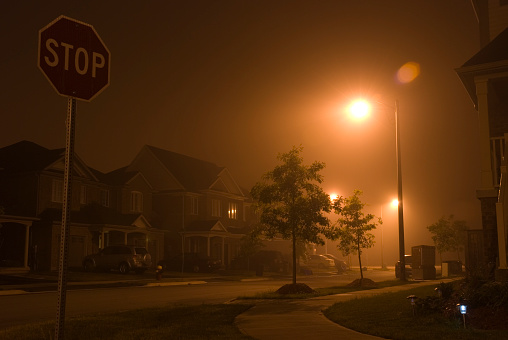
When I walked outside to get the newspaper this morning, tule fog blanketed my world. The blades of grass chilled my slippered feet, and the air bathed my face in cold breath. The street lamps glowed like steaming, yellow jewels. Houses wore shrouds of gauze, and both ends of the street disappeared into a thick, milky blanket.

I grew up in Sacramento where tule fog covers the neighborhoods, hills, and American River from November to early March. When the humidity is high and the nights cool down fast, the condensation lifts from the ground like a thick mist, as white as a clean sheet.

I paused in the front of my house to enjoy the mystical sensation. I couldn’t see any details past about a hundred feet, and the whole morning was clothed in mystery. My heart skipped a couple beats at the excitement of remembering long bicycle rides in the tule fog, not knowing whether I’d be cycling head-on into a mailbox or a person walking on the street. I rode slowly, but deliberately, tempting the fog to clear just in time to save my life from a disaster.

While I was standing outside this morning, my almost bare feet chilling, my arms cupped around my torso, holding my robe together, I felt the thrill of the mystery of not knowing what the fog was hiding.

Mystery is an exciting part of life. We never know what will happen the next day, the next year, or the next decade, even if we plan conspicuously. Life has a way of retaining a sense of mystery.

I thought back to the day when I was nine-years-old, writing my first poem. When I was a teenager and I got up early in the morning to walk in the dew-filled yard just so I could write a poem about how it looked. About when I won the Cadbury’s Essay Contest before I ever knew that writing would become my major passion. Mystery.

I thought back to the times when my parents and nine brothers and sisters celebrated Thanksgiving, Christmas, and Easter, sitting around a plain, mahogany dining room table. Later, when some of us got married and had kids, the food would be set off to the buffet; we’d line up, say prayers, and then jostle for a seat. Lots of fried chicken, sliced ham, potato salad, broccoli salad, a tray of raw vegetables, ranch dip, fruit salad, pecan pie, trifle, and pop out of the can. Never would I have imagined that these family dinners would create an unbreakable bond between me and my siblings that is even more important now that both of our parents have passed. Mystery.

I thought back to my first college adventure when I majored in accounting. I planned to work in finance my whole career since it was a good field for women at the time. I admired my mother’s sharp ability to manage money, and thought that this major would give me the independence I sought. I did. What I didn’t know was that my love of writing would eventually win out, and I’d go to graduate school to become an English professor. The change was exciting, and I’m sure a lot of the excitement came from studying a completely different topic.

I saw myself in a silk wedding dress walking down the aisle of a church in Sonoma, California toward my first husband. The mystery of not knowing that the marriage would become a disaster allowed me to stay married for nineteen years, long enough to almost get my two beloved children raised and launched, and long enough for me to pick my crippled self off the floor and walk decidedly out the door to a healthier life.

So this morning when I stood in my robe in awe at the impenetrable tule fog, I became astutely aware that my life was still full of mystery, and I felt excited. Will I ever truly become fluent in Spanish? Will I ever get the chance to fly to Argentina to visit my son-in-law’s mother and be able to chat with her?

Will I finish writing my novel? If I finish it, will I publish it? If it’s published, will I visit bookstores to read and sign it?

Will I live to be sixty-five, seventy, eighty, or ninety? If I do, will I be able to write until the very end, or will my health limit my ability to follow my passion.

That’s the thing about mystery and the future. We just don’t know what’s going to happen until it happens. This forces us to focus on the present and helps us do the best we can now so that our future has a chance of imitating our dreams.

The tule fog covered the ground for hours this morning, reminding me to make the best of my day. That’s as far as I really can see.

Child of Light

That child of mine. 

She was like the black sheep of the family, but that didn’t mean there was anything wrong with her.  On the contrary.  Ever since she was a little girl, she walked like she was floating on air—her feet swishing out from beneath her, her body gliding like a spirit, her head held up and her eyes cast high like she was watching a movie in the sky. 

Little Beth had a heart-shaped face, her blue eyes spaced perfectly apart and framed with blonde eyebrows, her pale rosy cheeks glowing like pink pearls, her plump cherub mouth, and soft chin.  But she was a shy creature and shunned the limelight, so most people didn’t notice her as she peeked into the room around a wall, hid in a corner on a stool, or swung on the swing outside, alone, when the rest of the kids were in the house. 

After Beth turned seven and received her Holy Communion, I walked up behind her to Communion at one Sunday Mass.  When Beth reached the priest, his eyes opened wide as he looked into her face, his hand paused with the wafer above the chalice.  After a frozen moment in time, he said, “The face of God.”

What did he mean?

My daughter stood there with her hands joined together, her fingers pointing to the ceiling like dove wings.  Finally, the priest fluttered his eyes, seeming to compose himself and said, “The body of Christ.”

“Amen,” said Beth, her voice rising like a musical whisper.  She stuck out her tongue and the priest placed the wafer there, then she circled around so I could see her. 

And then I knew.  A spotlight from the ceiling lit up her face, and I saw a glow in her eyes like the sun breaking through the clouds after a rain, radiant globes of love.  A warmth filled my body as she passed me, and I knew from then on that I was extraordinarily blessed to have her in my life. 

The priest’s eyes followed her as she left, and, because he was preoccupied, I also turned around and watched her glide down the aisle like a sail on the breeze.   Quickly, I faced the altar again, but still had to wait for him to recover and remember that more people waited in line for Holy Communion. 

***

My husband and I asked Beth to be the executor of our will.  We asked her because she studied finances in college and we thought she’d be qualified to deal with the mechanics of disbursing our assets. 

Peter died young so he wasn’t around when I started to go blind and I couldn’t write checks, cook on the stove, or drive my car anymore.

Beth told me that it was time that she took care of me.  She helped me move into an assisted living place where three of my friends already lived.  She helped me sort through the sixty years of belongings in my house, found charities to pick up unwanted furniture, hired a gardener to keep the lawn cut until the house could be sold, worked with my realtor, accepted a great offer on the house, and filled my bank account with the money. 

“You have enough money to live for 35 more years,” she told me.  “You saved and scrimped, and now, I’m going to make sure you are treated like a queen.”

I couldn’t see very well, but Beth knew that I could still smell the roses, so every time she came to visit, she brought a dozen roses, a chrysanthemum plant, Easter lilies, Gerber daisies, or an African violet to put on my windowsill. 

I died on a December morning instead of a January afternoon because Beth was beside me in the hospital, making sure that the medical professionals didn’t exceed their zeal in pointlessly extending my life with hoses down my throat, catheters in my neck, and countless blood transfusions. 

She ordered a giant spray of red roses to cover my coffin at the viewing and to decorate my grave after I was buried.  Red roses signify eternal love. 

That child of light of mine. 

Where the Spirit Is

Photo by nine koepfer on Unsplash

Ten years ago, the twenty-two-year-old son of a dear friend of mine died.  He was a junior at U.C. Davis and had just attended dance lessons the night before he died.  Alex also was intelligent, kind, and thoughtful, and full of an essence that made his face glow.

Six years ago, I went to a memorial for the twenty-five-year-old son some other dear friends of mine.  Max died while he was teaching English in Cambodia.  He was a spiritual, thoughtful, charitable, and intelligent young man.  On his last day, he had helped some friends rebuild their house after a storm.

What sense can be found in these losses?  How can such young people die before they have lived long enough to have children of their own?  How can parents endure the loss of a child?  It seems impossible to figure out the meaning of life when some lives end so early and abruptly.

At church one day, the priest told the congregation that the Hebrew word for spirit “ruach” also means “breath.”  When I heard this, I first thought that it meant that the spirit was alive as long as a person was breathing.  When the breath stopped, the spirit ceased.

But I kept thinking about this.  I know people that have died.  My dad died nine years ago and he is still alive in my life.  I breath thoughts about him or like him or with him at least once a week.  My friend Leona died even longer ago, and I still laugh every time I get lost because she and I got lost all the time.  We never worried because it was so much fun and we were too busy laughing.

My friend Henry died ten years ago.  Henry had lung cancer but he had also a heart attack while walking down the street.  When they put him on life support in the hospital, he registered as brain dead, and eventually died from organ failure.  As I sat next to him in the hospital for three weeks, I slowly realized that it was his time to go and nothing was going to stop him.

DSC06056

Now Henry lives for me in the pearly gold sunshine that bathes the granite face of Half Dome in Yosemite.  On spring afternoons, he walks with me up the mountain path behind my house where the wild flowers meet the even blue sky.  He fills my eyes with memories as I plant new flowers in my back yard.

My mother died last month. I remember her reading to me when I was a tiny, little girl. We sat on the edge of my bed, and her voice brought words to my life for the first time. She bought me pastries when I took the bus with her to the market on Saturdays. I still feel the greasy warmth of these pastries in my hands, and I think of those moments whenever I eat pastries today. During the last year before she died, she called me at least once a week to tell me she loved both me and my husband, Bob. I wondered, at the time, if she had experienced a spiritual enlightenment that instructed her to end her legacy of motherhood with the three most important words a mother could ever say to a child. In fact, the last three words she said to me were “I love you.”

These days, my mother doesn’t appear to me like a bird or a butterfly. I just feel the brush of her arm alongside mine as I go about my daily tasks and find out how to live a life without her pillar in the background. I turn to my phone to call her, and, then, I remember that her new phone number is “unlisted.”

So, what about these young people?  Will they live on like my dad, mom, Leona, and Henry, but come back in a different form?  Has their spirit been transformed from “breath” into something else?

I think these souls have something new to do.  I suspect that they were more evolved than I am and they had already achieved all they needed on this level of existence.  And if this is true, then I am happy that they got promoted.  Nothing is worse than being stuck in a dead-end job where you can already perform every task both forwards and backwards, and you’re yearning for a new experience.

Maybe the meaning of life is that life does have meaning.  Maybe it’s not important that we know where the spirit goes after life, but that we think about where the spirit is while we’re here, while we can sense the “ruach” through every breath.

Surely, the breath is tangible evidence and a good enough reminder that our spirit is alive and well.  I’m grateful for this because I often get caught up in less important details that don’t matter to anyone or anything, except to me for a brief, particular moment.  I need a reminder, like the habitual ticking of a clock or the consistent in and out of my breath to keep me balanced and focused.

But the souls that have stopped breathing don’t need the practice of yoga or any other rituals.  They don’t need the same constant reminders to stay focused on the essential essence of their purpose.  Now, I bet they’re working with a higher form of contemplation.

They make me a little jealous, and a lot inspired.

What should I do? Just what I now am doing. Focus on my “ruach” and make sure that my life has meaning. I’m not alone, after all. I have all of my beloved spirits brushing my arm.