
Character Study: Karen

Instead of studying for her state CPA exam, her mother wanted Karen to do housework. After all, she was living at home and should contribute to the household.

Karen had used up all her savings during the first three years of college, paying for rent, tuition, and books. And the summer after her junior year, she took a group trip to Europe.

That trip had opened her eyes. She hung out with six other college students as they traveled from Italy, Austria, Germany, Belgium, to France for a whole six weeks. These students knew all about art and architecture, so they visited historical buildings and art museums in every city.

After the trip was over, however, Karen had to move back home to finish her last year. Since seven of her siblings still lived there, the house was noisy, even though she had her own bedroom.

She left home early for classes and used the university library for studying, coming home at 9:00 at night. When her head hit the pillow, she slept soundly until the alarm rang the next morning. Repeat.

On Saturdays, her mother asked her to fold a mountain of clothes. She needed to study, so she took her accounting books into the large laundry room and propped them open on the counter as she folded. She closed the door to silence the voices of her family in the rest of the house and memorized the laws pertaining to finance as she worked.

She was worried about passing this three-day, six-part exam. She had never taken any test like this before, and she had to pass it all to get her CPA license.

Even her father didn’t believe in her. He lectured her about how women were supposed to get married and have children. They didn’t need a career, and their minds weren’t geared for such intellectual pursuits. That was what men did.

But her parents’ lack of support was why she was so determined to become a CPA and financially support herself.

She was scheduled to graduate in 1978. Karen had wanted to major in journalism, but she didn’t think she’d get a job after she graduated. One day, she went to a lecture about careers and discovered that many women already worked in the accounting field. In fact, CPA firms came to campus every semester to interview graduating seniors for jobs, so she decided to major in accounting.

Karen got perfect grades in every accounting class, except one. In her junior year, she had taken Advanced Accounting and earned only a C. She had been horrified, thinking that she’d never get a job with such as low grade in her major. If she couldn’t get an accounting job, how would she support herself and move out?

She took the class over the next fall and earned an A. Whew! That felt better.

Whenever she could, she had lunch with the friends she had met on the Europe trip. They had all taken art and architecture classes for their elective courses, whereas Karen had taken Anthropology and Psychology. While in Europe with them, Karen had admired the sculptures by Michelangelo in Rome and the paintings by Leonardo and Raphael in the Louvre in Paris. But her favorites were the paintings by the Expressionist Claude Monet. His ephemeral depictions of flowers made her heart quicken.

Talking with these friends felt like a vacation all over again.

She couldn’t wait to graduate, get a good-paying job, and move out. She just knew a job was her ticket to freedom.

Freedom from the oppressive voice of her father. His limited hopes for her. His expectation that she would get married as soon as possible and have babies.

Freedom from drudgery.

She had babysat for years, saving money for college. She had cleaned people’s houses to save money. At home, she had washed dishes, swept floors, folded clothes, ironed tablecloths and men’s shirts, picked vegetables in the garden, made dinner, made cookies, scrubbed walls, and covered beds with clean sheets.

What she hadn’t done was experience freedom to do as she wanted.

When the schedule came out for the accounting interviews, she signed up for as many as she could.  

How I Evaluate Publishers

I finished my novel last month, and now I am submitting it to publishers. During the process of finding the right publishers, I’ve learned a lot, and I’m sharing it with you.

Use a Good Source of Publishers

I didn’t know where to find the names of publishers, so I asked a writer friend what to do and she gave me two links of independent publishers. She suggested that I choose six of them and present my manuscript to them. Here are the links:

Publishers Group West: https://www.pgw.com/distribution-services/publisher-list, and Consortium Book Sales and Distribution: https://www.cbsd.com/publishers/our-publishers/.

I started to go down the list of publishers from Publishers Group West. What I found was a lot of publishers that didn’t accept the type of novel that I wrote, which is a coming-of-age novel. Some wanted non-fiction. Others were looking for fantasy, crime thrillers, adventure, historical, or memoir tomes. I spent hours and hours looking at their websites without a viable candidate. What I needed was a list of publishers who focused on coming-of-age novels or literary genres.

Another write friend told me to buy the current Writer’s Market. What a brilliant suggestion. This book contains 183 names of publishers and pertinent details in alphabetical order. Better yet, on page 855, is a “Book Publishers Subject Index” where I found three columns of publishers interested in literary novels. I’ve been investigating the websites for the companies on this list and, already, I have identified six publishers that are appropriate for my novel.

Find a Publisher that Publishes Your Type of Novel

I already mentioned how I was looking for a publisher interested in coming-of-age or literary novels, but I want to explain this further.

I found out that publishers have mission statements that explain the purpose of their company. For example, one publisher I reviewed has a mission to publish the works of authors from the Midwest. I live in California, so the chances of them picking up my novel is unlikely. Another publisher aims to publish books written about queer subjects. My book doesn’t qualify for this either. I don’t want to waste my time sending my manuscript to someone who doesn’t want it.

Buy a Book from a Target Publisher and Read It

I found a publisher that wanted coming-of-age novels, so I ordered one of its previous publications. When the book arrived, I didn’t like its cover, binding, or even the style of writing by the author. I felt like I would be disappointed if my book looked similar, so I didn’t send my manuscript to this publisher.

I bought a book published by another publisher. Immediately, I liked the cover and the binding. I even noticed how the cover design demonstrated complementary colors since I once taught art in an elementary school.

I read the book from cover to cover, including the book flaps and the quotes from other authors on the back cover. I liked the story and noticed how it was the kind of story that I could write.

I also read the author’s “Acknowledgments” and found out that her story was similar to mine in another way. The author is Caucasian, writing about a story set in a Central American country. I am Caucasian and my story takes place in South America. The author thanked her publisher for agreeing to print her book even though she wasn’t native to Central America, and she argued that an author should not have to be a native to the setting of her story.

I had heard about the argument of cultural correctness, but, as this author pointed out, many novels would not exist today if men could only write about men, women about women, Hispanics about Hispanics, and so forth.

I sent my novel to this publisher with a comment in my query letter that asserted that writing about a setting into which I was not born was part of my inspiration for writing the novel in the first place. I also mentioned that I had read the other author’s “Acknowledgements” and agreed with her. I’m sure this editorial team will be impressed that I went to the trouble to carefully familiarize myself with one of their previous publications.

Read the Submission Guidelines

Unfortunately for busy writers, every publisher has different submission requirements. I searched each publisher’s website to find them. Sometimes, I had to find the submission link at the bottom of the publisher’s page.

Some of them use a program called Submittable that is built into their website. One publisher allowed me to attach my manuscript to this portal and fill in my name and previously published works in the blank fields. Another publisher who uses Submittable didn’t allow any attachments. Instead, I had to summarize my 300-page novel in 150 words, write out my “hook,” and list my previously published works.

Other publishers wanted me to submit via email. One wanted a query letter, a one-to-two-page synopsis, an annotated chapter outline, a market analysis including competitive research, at least two sample chapters, and my curriculum vitae.

I had to do some research for this. For the query letter, I modeled my letter after a sample query letter that I found on page 23 in Writer’s Market. I scoured the publisher’s website to find the name of the main editor and addressed my letter to her. After I wrote it, I had one of my writer friends review it. She thought my version was solid.

For the synopsis, I wrote a 700-word version and had it reviewed as well. My writer friend helped me improve it to add pertinent and alluring details.

My novel has 40 chapters in it, so writing the annotated chapter outline took several days. I listed each chapter and its title and then added a paragraph or two about its content. I must say that this exercise helped me take another look at my novel. Along the way, I made changes to my manuscript to make the plot stronger.

I searched the Internet to find out how to write a market and competitive analysis. I found some excellent articles by the Blue Ridge Mountain Christian Writers’ Conference that explained what this was.

My final market analysis identified my target market as college-educated women between the ages of 20 and 30 who were interested in travel, cooking, gardening, or hiking. I also identified my secondary market as women who were members of book clubs and who enjoyed discussing life events such as the death of a parent or breast cancer. I even described my tertiary market as high school teachers and college professors who require reading for writing assignments.

For the competitive analysis, I identified six books that were comparable to mine. I explained how each of these books were similar, how they were different, and how related the purpose of each story was to mine.

When it came to developing my curriculum vitae, I divided my publications into poetry, short stories, and academic publications. Since I haven’t previously published a novel, I didn’t include this category. I also listed that I have a Masters in English concentrating in Literature and Composition.

The work for this one publisher was so comprehensive that I have used portions of it for other submissions.

Keep Track of Your Submissions

I’m not sure how many publishers I will need to contact in order to get my book published, so I devised a way to keep track of them. On Microsoft Word, I made a four-column table with the headings—Publisher Name, Requirements, Date Sent, and Response Expected. Under the name of each publisher, I typed in either the email of the company or Submittable so I can remember how I sent my work.

I feel that my date columns are extremely important. The Date Sent column shows me when I submitted my work. The Response Expected column tells me when the publisher promises to get back to me. Some publishers do not contact writers if they are not interested, so this column will also tell me when to stop waiting for a response and reach out to another company.

My life’s dream is to get my fictional novel published by a traditional publisher, and so I’m going to do everything I can to make that happen.

Getting Ghosted at the Paris Cemetery

My husband and I got to Paris three days before our tour of France was to begin. Our goal was for both of us to overcome jetlag before the tour started and to see parts of Paris not on the tour.

I had been to the Paris catacombs the last time I visited Paris with my daughter. These are underground alleys beneath the city to where thousands of bodies were transferred from cemeteries above ground as Paris expanded. For miles under the city, tourists can walk past bones piled up against the walls in neat displays. Hip bones are in one place, skulls in another.

One place I had never been before, though, was the Pere-Lachaise Cemetery, known for the graves of dozens of famous people from all over the globe. We took a taxi ride to the cemetery’s entrance at 16 Rue de Repos in the 20th Arrondissement, about a half hour ride from our hotel in Bercy.

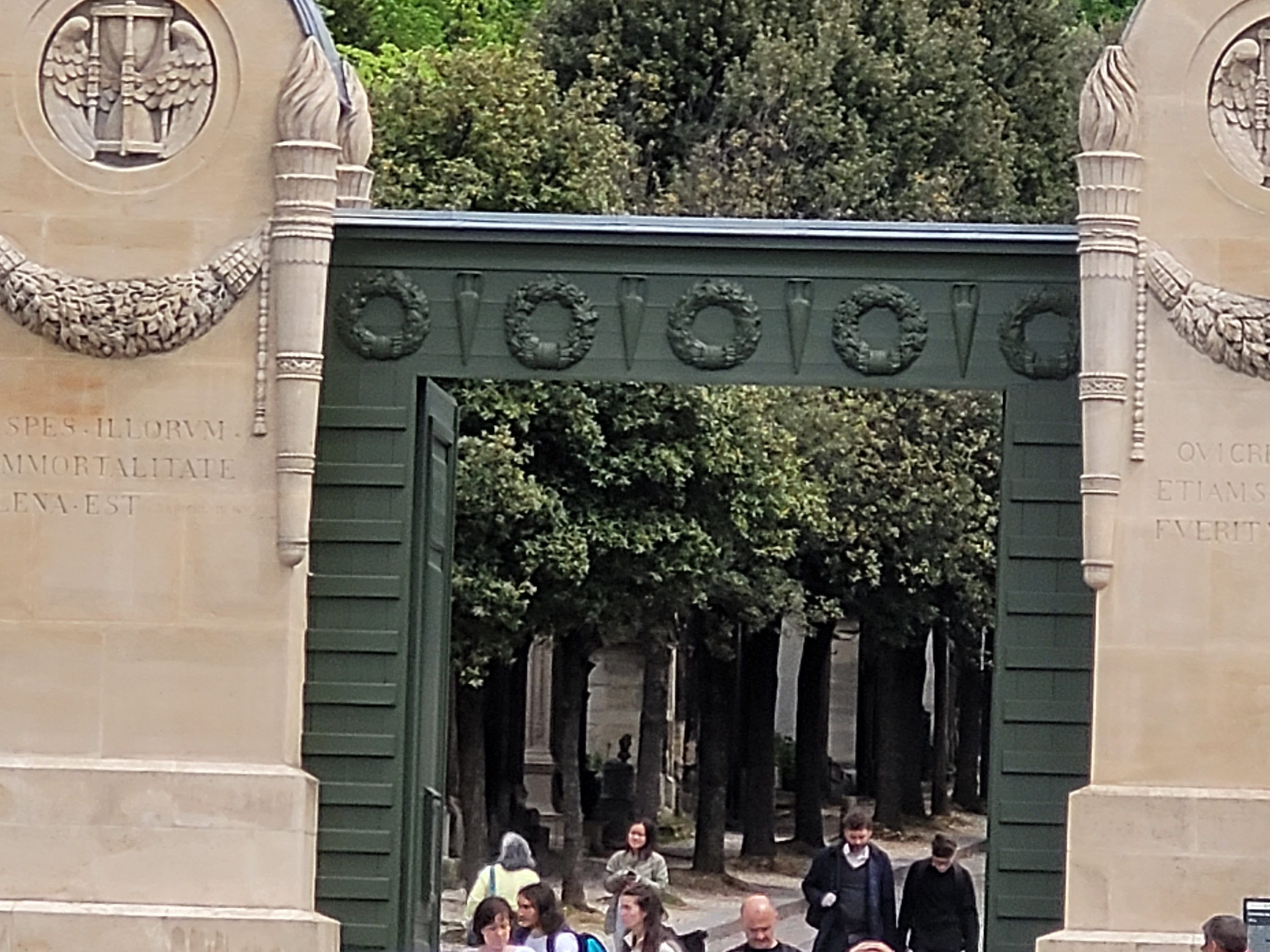
The entrance was a massive olive-green set of doors framed by wreaths. On both sides, the doors were flanked by two white granite columns topped with the carving of an hour glass circled by angel wings. The doors were open and, inside, we could see several erect tall tree trunks with leafy branches. In-between the trees, blackened marble mausoleums and statues beckoned to us.

I had a map of the cemetery from my Frommer’s Easy Guide to Paris, so I felt well-prepared to find many famous graves including Frédéric Chopin, the renowned Polish composer and virtuoso pianist of the Romantic period who lived half his life in Paris, and Oscar Wilde, the provocative Irish poet and playwright. But since we entered through the main gate, I decided we would start by finding the grave of Camille Pissarro, who was known for his Impressionist and Neo-impressionist paintings.

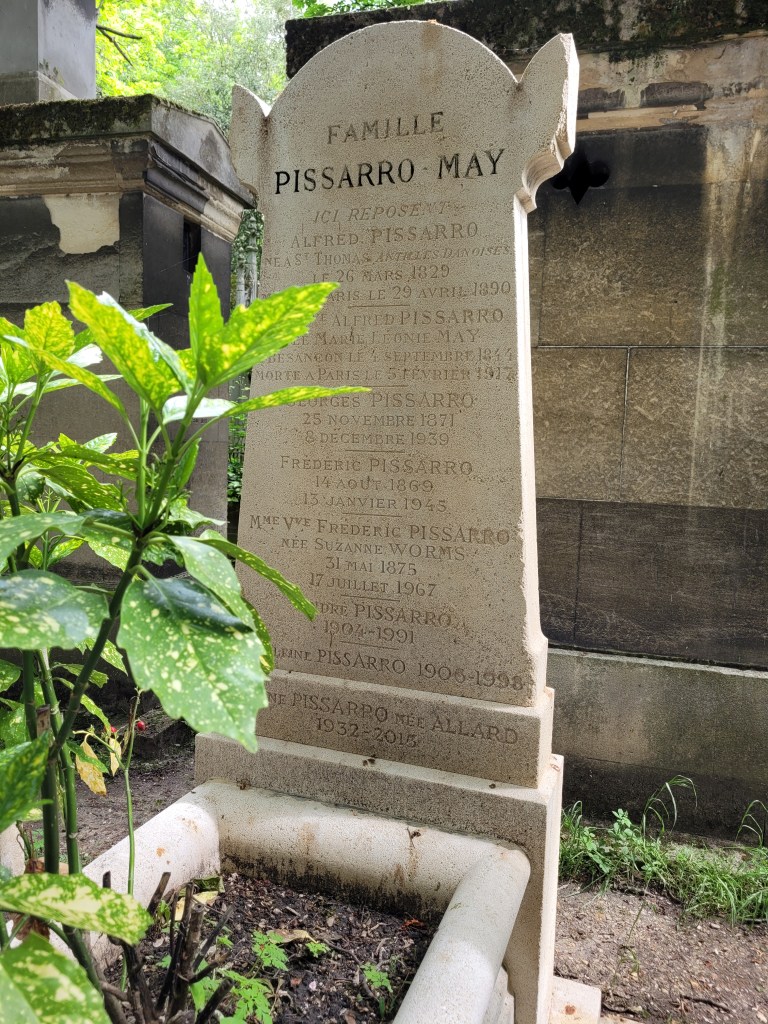
The cemetery has a few paved paths and dozens of tiny dirt paths that take visitors past the graves. To find Pissarro, we took a right just inside the gate to walk along the west perimeter of the cemetery’s wall. After several steps, sure enough, we found Pissarro’s crypt where at least eight family members were buried. The names were listed on a grand rounded slab of white marble with two angel wings sticking out at the top.

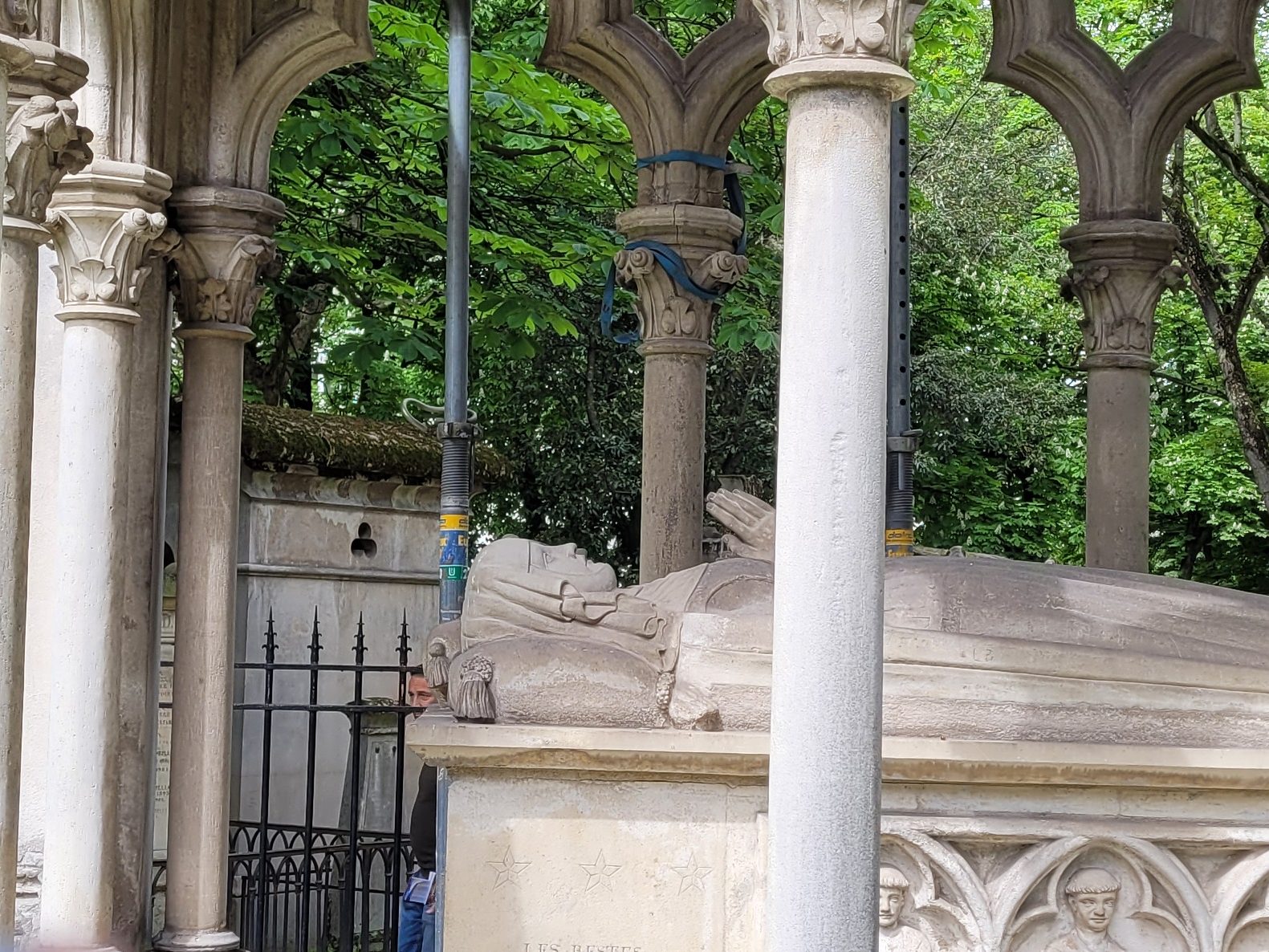
Nearby Pissarro, my map indicated that the 12th century lovers, Héloise and Abélard, were buried, their remains brought to the cemetery in 1817 from Brittany. We found their monument which is an openwork Gothic Chapel from an abbey in southwestern France. Underneath the roof are two reposing statues of the tragic lovers who were forced apart by their families and spent the rest of their lives writing letters of love.

After finding the tombs of these lovers, our luck evaporated. According to my map, the Rothschild family plot was nearby. Since the French Rothschilds were the founders of a banking dynasty in France, I expected their tomb to be colossal and easy to find. We scanned the names on several large monuments beside the dirt path, but we never found them. We found ourselves alone on the claustrophobic dirt path edging the gargantuan cemetery wall, shivered at the thought of being amongst more deceased souls than live ones, so gave up our search for the Rothschilds.

We took a teeny side path to reach Chemin Serre, a wider path than the lonely one we had just left, but still somber from the shade of countless trees which blocked out the view of the sky. Somewhere on this path was the grave of one of the most famous souls in the cemetery, the 1960s rock star Jim Morrison. According to my guide book, Morrison’s grave is the most visited in the grounds and, ever since he died, people have made pilgrimages to see his tomb, leaving behind graffiti, trash, and samples of drugs. We searched for the fenced-in tomb, which is supposedly an unexceptional relic. We asked passers-by if they knew where the grave was, and they pointed us in the right direction. We couldn’t find it. We looked for a grave that had a crowd of people gazing at it, but couldn’t find either a crowd or the famed resting place. We gave up.

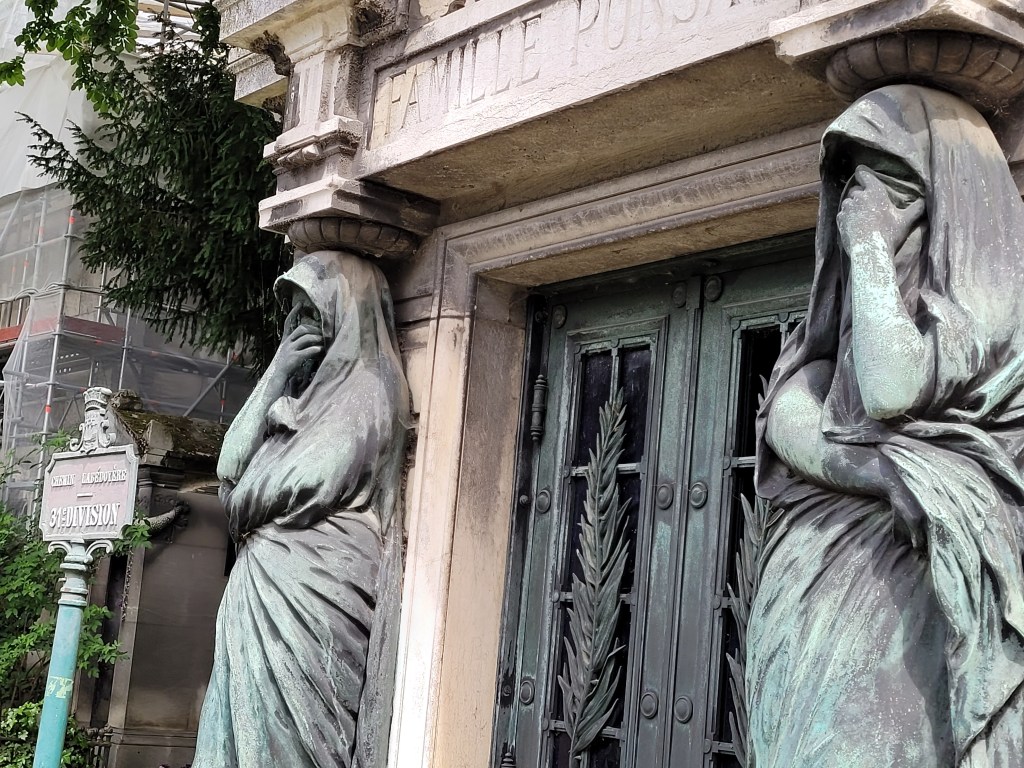
I was probably most excited about seeing the tomb of Oscar Wilde since I am a fan of his novel The Picture of Dorian Gray, Wilde’s story about a man that has his portrait painted and then sells his soul so he never loses his youth; instead, his portrait ages and records the sins of his amoral life. To reach Wilde’s grave, a visitor has to walk up the hill to the top of the cemetery, and my husband was unwilling to do this. Leaving him sitting on a bench on a popular paved pathway, I started ascending the hill. Oscar’s grave was at the juncture of Avenue Carette and Avenue Circulaire. I walked, I inhaled through my nostrils and out through my mouth to regulate my breathing as I ascended the steep terrain. I passed tombs of men surrounded by statues of weeping women, which I thought was a bit arrogant on their part.

I discovered the mausoleum of the Monet family, which may or may not be related to the impressionist artist Claude Monet who is buried in Giverny. I also found a crypt for the Macon family which I hoped was related to Emmanuel Macon, the French president. Unfortunately, though, when I reached the spot where I thought Oscar Wilde was buried, I couldn’t find him. I looked up at the grand crypts. I read the names on several flat tombs, but Wilde’s final resting place eluded me.

I next took the opportunity to find the side-by-side tombs of Gertrude Stein and Alice B. Toklas, who were also supposed to be buried at the top of the cemetery on Avenue Circulaire. Gerturde Stein was an American novelist, poet, playwright, and art collector who hosted a salon for writers and artists in Paris. Toklas was her long-time lover. Where were they? Did I have to step over graves to find them hidden in the middle of a mass of deceased humanity? I’ll never know because I gave up and went to join my own lover who was still sitting on his bench watching other people struggle with their maps.

Together, we found a memorial for the 6,000 Jews who died in World War II in the German concentration camps. We also discovered a crypt for the Famille Charlemagne, and since the ancient King of the Franks had 18 children, I know he certainly has descendants who are now buried in this Paris cemetery.

The last person I wanted to find was Frédéric Chopin, the Polish composer that I mentioned earlier. According to my almost useless map, he was buried at the juncture of three dirt paths a short walk away from the Monument aux Morts, a grandiose marble monument to the dead with several grieving statues. I left my husband again, sitting on a bench along the circular road that surrounds the monument, and, again, I traipsed uphill to find Chopin. Standing on the path, I searched every name on the tombstones near the juncture. No Chopin. Feeling desperate, I courageously scooted between the tightly packed graves to read the graves behind them. No. I hurriedly got out of there. Chopin didn’t want to be found.

Back at the entrance to the cemetery, I read that the cemetery was named after a Jesuit priest, a confessor for King Louise XIV, who lived in a house on the property before the cemetery was built. In 1804, Napolean bought the land so that all Parisiens could be buried, no matter their race or religion. I also learned that, today, over 1 million bodies and cremains are buried in the cemetery. That made me feel better. In the midst of a million ghosts, most of the ones I wanted to see were the ghosts too shy to do any spooking.

Photo by David Baker

4th Time to Paris

(Photo by Anthony Delanoix on Unsplash)

Next month, I’m going to Paris for the fourth time.

The first time I visited Paris was with six other college students. We were there on Bastille Day, July 14th, which commemorated the beginning of the French Revolution when the Parisians stormed the Bastille Prison. My friends and I were in the midst of a throng of human beings on the Champs Elysees since everybody celebrates the day by gathering in the streets. Two young men set off fireworks, and the police swept in and arrested them. To disperse the crowd, they launched tear gas grenades into the mass of bodies blocking their way. Suddenly, my throat was filled with knife-sharp chemicals and I croaked like an old frog. The crowd, a mass of forms heaving as a single unit, dragged me and my friend Nancy away from our friends. We never found them until hours later.

The second time I flew to Paris was for work. I stayed at a hotel where, every night, I watched the Eiffel Tower light up at dusk and twinkle over the city until 1:00 a.m. in the morning. I met Olivier at the office who became my French friend until he married and his wife ended our friendship. Olivier took me to a small Franc concert in a beautiful Gothic church and out for a crepe lunch where I enjoyed both savory and sweet crepes—the most delicious pancakes in my life.

The third time, my 17-year-old daughter came with me to Paris. One night, while we were sitting outside the pyramid beside the Louvre, we watched the sun set over the most beautiful skyline in the world. At 8:30, we decided to rush into the Louvre before it closed at 9 p.m. It was a free admission day, so we walked right in. We passed the headless Winged Victory of Samothrace as we climbed the grand staircase up to the gallery where the Mona Lisa was displayed behind bullet-proof glass. No one was there. No one. This gave us the unusual opportunity to gaze at Leonardo’s mystery woman from several vantage points and to watch her eyes follow us from side to side.

My daughter and I also toured the French Catacombs which contain the bones of over 6 million people who were once buried in the cemeteries of Paris above ground. We walked for miles within the old limestone tunnels underneath Paris, discovering piles of skulls, femurs, hips, and other bones stacked in piles along the shaft walls. I don’t want to ever visit those unfortunate disassembled people again.

Now, I’m going to Paris for my fourth time with my husband who has never been. We’re boating down the Seine, visiting the Louvre, inspecting the Impressionists at the Musee D’Orsay, witnessing Napoleon’s Tomb, and touring the Pantheon; however, I want to make sure we make it to Pere Lachaise Cemetery this time. This cemetery is above ground and within walking distance of the Louvre. Although people of all faiths are now buried there, the cemetery takes its name from a Jesuit priest, Francois Le Chaise, the confessor of King Louis XIV, who lived in a Jesuit house on the original site.  Hundreds of famous writers, artists, and musicians are buried there including Oscar Wilde, Honor de Balzac, Chopin, Gertrude Stein, and Jim Morrison. I’m trying not to think about why I’m so fascinated with cemetery tourist sites.

Well, I need to get started with my packing. I also have some projects to finish before I go, including completing the homework for my Spanish class. I know it’s ironic that I’m going to France while studying Spanish, but c’est mon vie.

Postcards from Italy

You know that feeling you get when you’re incredibly happy? Like you have butterfly wings and have flown so high that the clouds kiss your face. Your chest is so open that you can blow a star across the sky. Your arms are so wide that you can wrap them around the moon.

That’s how I felt this last August when I was visiting Italy. When I opened the sliding door to the balcony in my Sorrento hotel room and looked down at the rows of boats in the harbor, the blue-green water of the Bay of Naples, and the rising cone of Mount Vesuvius across the Bay.

Italy makes everyone happy. It’s incredibly beautiful. I wish you could have been with me and my husband as we boarded a little row boat at the bottom of a cliff off Capri Island so we could duck into the opening of the Blue Grotto and experience the most heavenly crystal-blue water. My heart was filled with elation as I watched my husband gaze at the water, the boats, and the walls of the cave. My heart quickened as I listened to the deep masculine voice of a sailor who sang an opera in baritone that echoed off the cave walls.

The people of Italy believe in making beautiful objects. In Amalfi, the streets were lined with shops that sold brightly painted ceramic pots, plates, plaques, and wall sconces. The blue, red, green, and yellow fruits and leaves on the pottery enthralled me so much that I couldn’t pass a shop without walking inside.

The architects and artists of Italy have been so prolific over the centuries that not one town in Italy lacks a beautiful church or fountain. When we toured St. Peter’s in Rome, I fell in love with the numerous doves holding olive branches in their beaks that decorate the walls of this catholic cathedral. The face of Mary on Michelangelo’s Pieta is such a beautiful example of a mother’s love for her child that my heart expanded as I stared at it for twenty minutes.

My husband had never been to Rome before, so when we visited the Trevi Fountain, I showed him how to toss his penny over his left shoulder so he would be sure to return. I took a photo of him in front of the colossal Baroque fountain, mostly made of travertine marble on the back of Palazzo Poli, with two-story Corinthian pilasters and a scene that conveys the taming of the waters. Through my camera lens, I could see Oceanus framed by a massive arch, with the goddess Abundance on one side and Salubrity, representing health, on the other. Below these immense statues, gigantic statues of titans guided a shell chariot, taming the sea-horse hippocamp. Above all of this marbleized action, I spied the story of the Roman aqueducts carved in bas relief. Tears filled my eyes before I had clicked the camera.

At one dinner during our tour, Theresa, our tour guide, gave me two post cards that she promised to mail for me after I filled them out. I wrote love letters to each of my children, addressed them, and gave the cards back to Theresa. After that, I promptly forgot about them since Italy had effectively mesmerized me.

When we weren’t gawking at architecture and charming alleys, we were eating. One day in Rome, I ordered a Napoli pizza with mozzarella and anchovies. The cheese was so light and creamy and the anchovies so fresh and sweet that I closed my eyes as I chewed—heaven on the lightest dough I’ve ever eaten. I sipped a bright Pino Grigio as I ate and my mouth had never been more fulfilled.

I’d never been to Umbria before, and so when we visited Orvietto, I was charmed by the quaint alleyways and stone staircases that led up to homes and shops. I was attracted by the beautiful mosaic cathedral dedicated to the Virgin Mary. When the sun hit the façade, the mosaics, gold, stain-glass windows, and bronze doors glowed like the entrance of paradise.

In Italy, charm is everywhere. We climbed countless steps in the town of Assisi, sailed along the coast from La Spezia to Cinque Terre, observed the Carrara marble quarries used by Michelangelo, and walked miles and miles on the cobblestone streets of Florence. We were enchanted by Ponte Vecchio in Florence which was lined with little huts last time I had visited. Now, it is filled with shops of glass windows to safely display the silver, gold, and gem jewelry for sale. One day, while walking to the Uffizi Gallery to see the colossal statue of David, we found an ancient window that had been used to sell cups of wine during medieval times.

Our last Italian stop was Venice, another place that my husband had never been. I dragged him across the city from our hotel, over one cobblestone bridge after another. Coming back, we found a piazza where an orchestra was playing music for tables outside. We sat down, ordered wine and listened to Gershwin and Beethoven for an hour, watching the sun change the shadows on the stones of the buildings as it trailed across the sky.

Italy filled me up with happiness. When I got home, I rushed out to visit my son at his studio a few miles away. When he let me inside, I noticed that he had tacked up the postcard I sent him from Italy on his refrigerator. My next stop was my daughter’s apartment. On her refrigerator, she had her postcard attached to her refrigerator too.

You know that feeling you get when you’re extremely happy? When you have wings and you fly high enough that the clouds can kiss you, you can blow the stars, and hug the moon with your arms? When I saw those postcards on my son’s and daughter’s refrigerators, I felt just like that.

How I Wrote My First Novel

I’ve been a writer my whole life. In grade school and high school, I wrote poetry and essays. In college, I wrote my first short story. When I became an accountant, I wrote financial reports and audit recommendations. I also learned how to eliminate “fluffy” words and overly-embellished ideas. While I was raising my children, I wrote newspaper articles and more short stories. Finally, I became an English professor and I spent most of my busy career writing lesson plans and college letters of recommendations; yet, I hadn’t yet attained my ultimate dream of writing a novel. I either had writer’s block, low writer-esteem, or not enough time.

Then I retired a year and a half ago. Immediately, I decided that one of my activities would be to write a novel. This project, however, had no requirements—except one. I didn’t promise to finish it, publish it, or be tied to any kind of working schedule. The only requirement was for it to be fun.

People started to ask me numerous questions. When would it be finished or published? Was it a personal story? What percentage had I written so far? My answers were always the same: I have no requirements and no timetable.

Meanwhile, I started and wrote my novel. I posted a few chapters on this blog and received positive feedback. I discussed my ideas with my writing-oriented daughter who got excited about the story. I researched and researched and researched the setting and background of some of my characters’ activities. That was fun.

When I got stuck, I buried my nose into books that I thought could help me with my own novel. Books that had female characters and writers that used imaginative writing techniques to propel their plots forward. While reading, I stopped many times and thought about writing practices. Since reading is my favorite hobby, this was sheer joy.

I wrote when my husband played golf and on the weekends while he was watching football and basketball. I dreamed about my plot and got up in the middle of the night to write down notes so I wouldn’t forget my new ideas. I wrote outside in the garden when the sun was shining and my flowers kept me company. I wrote after my Pilates class and after hiking 4 miles in the open space. I wrote blog posts, and then I wrote my novel again. The thing was, since I had no requirements, I found a comfortable way to fit writing my novel into my life. I didn’t worry about ever getting rejected by a publisher or poorly reviewed by The New York Times.

My opinion was the only one that counted. And you know what? Because I didn’t care what anyone else thought, I developed courage to create scenes that I never would have written otherwise. I also broke grammar rules to emphasize settings or to create tone for important events in the story. I’ve never written with such creative abandon, and I’ve had the time of my life.

I finished my novel a few days ago–after starting twenty months ago. I wrote the story’s epilogue, typed a dedication, and printed out my manuscript. Now I’m getting my daughter and one of my writing friends to read it. Whoa. This is a little scary, but I keep reminding myself that I’m still having fun and don’t have to do anything that I don’t want to do. That includes listening to all their comments.

I’ll read their comments though, and use my creativity to incorporate those that I like into the draft. Then I’ll have to decide what to do next. Get an agent? Send it to a publisher? Put it on a shelf in my library?

All I can say for sure is that my heart is all aflutter. I feel fulfilled at last.

Why This Writer Reads Stories: Reasons 1, 2, & 3

I have 257 novels marked “read” on my Kindle and I also read books on paper. My six-foot-tall bookcases in my home library contain over 300 books, plus I have some on the shelf underneath my television, on my coffee table, and inside drawers next to my bed. I read every day—in bed, on the couch, in the doctor’s office, at the hair salon, in the rocking chair in the back yard, and at the dining room table. Everywhere, whenever I can.

I became a writer when I was nine years old and wrote my first poem. Since then, I’ve written more poems, short stories, articles, websites, blogs, recipes and essays. Now, since I’m retired and have more free brain power, I’m writing a novel and loving my increased writing time. 

But I read more than I write. I devour stories like they’re chocolate sundaes, loving every bite of their plots, characters, settings, and figures of speech. I read voraciously because I’m a writer; I love language, the power it has to convey information, emotion, and empathy. In addition to loving other writer’s stories, I read to improve my writing.

Here are three specific writing techniques I’ve studied recently from reading other author’s stories.

Reason 1: How to indicate who is talking without using “he/she said”

Dialogue is a dynamic technique to use to create action in a story, but a writer must make it clear which character is speaking. I’ve read stories where authors use tags such as “he said” or “she said,” and sometimes these tags create wordiness and take impact away from the dialogue; therefore, one day I chose to study how an author can use effective dialogue between two characters without including these repetitive tags. By reading The Tobacco Wives by Adele Myers, I learned to identify the speaker of dialogue by describing what a character does right before she starts talking. Maybe she steps closer to the person to whom she is speaking and then she speaks. Another technique that Myers uses is to describe what a character thinks about the person with whom they’re talking right after she speaks; for example, she might imagine him playing a sport or eating spaghetti.

Reason 2: The effect of strong vocabulary on a reader

One thing I love about my Kindle is that I can underline a vocabulary word and get a definition for it immediately. I’m always looking up words, even familiar ones. I ponder about why the author might have chosen this word instead of its synonym. Is it a more accurate choice?

Or the word might be one I’ve never heard of before. This happens more often when I read authors who were educated in countries other than the United States. Recently, when I read Turn Right at Machu Picchu by Mark Adams, I learned another word for altitude sickness, soroche. Discovering a new word feels a little bit like having a new baby. It’s a treasure and an opening to a bigger world.

Reason 3: How to move characters from one geographic location to another

In my current novel, my two main characters are traveling in South America. I was struggling with how to move my story from one scene to another. Should I describe what they can see outside the train window? Should I create a scene about how they pass the time on the train? Maybe one of the characters could be lost in thought as she crosses the border between Argentina and Chile.

Luckily, I began to read West with Giraffes: A Novel by Lynda Rutledge, a story about a destitute young man from Texas and an old man who must transport two giraffes from New York to San Diego.

Rutledge uses many techniques to move her story across the United States. The young man first steals a motorcycle and follows the giraffes’ truck. He watches the old man and his first driver as they argue. He notices a woman in red pants following behind them. He listens to the noises the giraffes make, and finally, when his motorcycle runs out of gas, he convinces the old man that he can drive the truck for him after the other driver quits. By the time he starts driving the giraffe’s truck, he knows the old man’s routine. While he’s driving the giraffe’s truck, he watches what the giraffes are doing in his rear-view mirror, he feels how their movements destabilize the vehicle, he talks to the old man, and he thinks about his childhood.

After observing how other writers use specific techniques, I then experiment with the same methods to develop my own novel. I can’t think of a better way to learn the craft of writing than to study writers—one technique at a time.

The Yellow Rose

Friday was the last day of class, and Profesora Casti lead her students to Almagro, the part of Buenos Aires known for its flower vendors.  First, the group wandered among the flower stalls on Acuňa de Figueroa where baskets of roses filled the air with intense fragrances.  Leonie bent over the bunches to breathe in their perfume, and she took turns saying their names out loud with her classmates.  They chatted with the vendors who told them where they grew their flowers and how they worked from early in the morning until late at night planting seeds, hand-watering, and pruning in order to produce the most beautiful blooms. 

The vendors chatted about Mother’s Day, weddings, and baptisms for which they sold the most flowers.  Some stayed open 24 hours a day.  The best time to buy flowers, they said, was late at night or early in the morning.  These really were the most romantic times of the day anyway. 

The class meandered to Calle Sarmiento where even more vendors had their shops.  One shop, filled with tuberose and jasmine, perfumed the air outside its door with heady floral fragrances.  Inside, the vendor was wrapping flower bouquets in cellophane paper for a woman and her two daughters. 

Leonie wandered away from the group to admire the lilies of another vendor.  While she was reaching out to touch a petal, a woman dressed in a green apron came out to greet her. 

“Your lilies are gorgeous,” exclaimed Leonie.

“Thank you.  My grandfather used to sell flowers on the streets of Buenos Aires.  My father sold flowers in the old market in stall 8, and, now, I rent this shop here to continue our family tradition.”

Leonie moved under the shade of the willow tree that grew right in front of the storefront.  “I love flowers,” she said.

“I love flowers, too,” replied the vendor.  “I’ll sell them until I’m old and frail.”

Leonie paused in thought, running the woman’s response through her mind.  Forever was a long time to do just one thing.  Leonie didn’t know that she would ever find something that she wanted to do for so long.  The woman in the green apron smiled at her, her face flushed with the essence of intense happiness, her eyes like shining opals. 

“So,” Leonie asked, “You don’t ever wish that you could do anything else?”

The woman smoothed down the front of her green apron with hands crusted with dirt, chapped from years of digging and planting.  “No, never. I never wish to do anything else. Each day in my flower shop I get to express my creativity, and that gives me intense joy.  Besides, I know that I like to be around beautiful things, and what could be more beautiful than a shop full of flowers.”

“You seem so content.”

“You see this willow tree that’s giving you shade?  A willow tree symbolizes fulfilling wishes of the heart.  It also symbolizes inner vision.  I’m lucky to know what fulfills my life.  That knowledge is my inner wisdom.”

The vendor showed Leonie around her tiny shop, identifying the names of all the flowers and inviting her to smell their fragrances.  Leonie told the vendor that she was about to take a trip to search for her life’s purpose.  As the woman listened to her story, her eyes glistened and a whisper of a smile set upon her lips.

Before Leonie left, the woman held out a yellow rose.  “This rose symbolizes our new friendship,” she said.  “Friends are one of the most precious treasures of your life.  From now one, you and I are lifelong friends.  I wish you success on your trip and hope that you find your version of life fulfillment. 

That night, just before Leonie went to bed, she sat at her desk to write in her journal.  I know what fulfills me, she wrote.  After setting down her pen, she felt anxious.  But I don’t know what fulfills me, she worried.  I don’t know what I want to do with the rest of my life.  I don’t know what makes me happy day after day after day. 

Leonie looked at the yellow rose that the flower vendor had given her.  Its yellow petals brightened up the shadows of her room.  She remembered how gently the woman had picked up each flower and described its characteristics, moving among her flowers with grace, touching each blossom with respect and admiration; her movements were filled with love. 

Now Leonie knew.  The woman had been a messenger from her own soul to teach her how to find her own purpose.  Love was an integral part of finding fulfillment.  When she found out what she loved, she would find her contentment. 

Leonie touched the yellow rose, and her heart filled with joy when she remembered that the woman promised that they would be friends for life.  Friendship, she thought.  I have love already. 

The Imagination Grandpa Story 1: The Clock Man’s Wise Clocks

Photo by Ella de Kross on Unsplash

Instead of going to Third Grade, Rosie was in a hospital bed with tubes connected all over her body.  Rosie’s heart had a problem and the doctors took her into an operating room one day to fix it.  Now, she had to lie down in bed all the time, and she couldn’t play.

The day after the operation, Grandpa Joy came in to visit Rosie.  He wore his blue jean jacket that had lots of pockets.  When he came in the door, he took off his beret and placed it on the table beside Rosie’s bed. 

“Should I tell you a story?” he asked.

“O.K.” said Rosie.  She was so bored just lying in bed. 

Grandpa started his story. 


Once upon a time, an old man owned a clock shop.  The shop was a huge room, and clocks covered every inch of the four walls.  He had clocks with black hands, silver hands, gold hands, and bronze hands.  Some clocks had round faces with 12 birds to mark the numbers.  Some clocks were carved out of wood with long pendulums hanging from the clock faces all the way to the bottom of the cases.  On one wall, a whole line of coocoo clocks hung silently, their birds frozen in various stages of entering or leaving through the coocoo doors. 

In the middle of the great room, large trunks were propped on their sides, and, against these great boxes, grandfather and grandmother clocks leaned silently.  No ticking escaped from their chambers because all the them were broken. 

In fact, all of the clocks in the whole store were broken and quiet.  The only noise in the vast room was the scratching from a mouse family that lived inside one of the walls and came out whenever the old man dropped crumbs and bits of cheese from his sandwiches.

One day, a young man came in to buy a clock.  He smiled at the old clock seller when he opened the creaking door and walked right up to the counter.  This young man wanted a clock to give to his wife for her birthday

“What kind of clock should I buy for my wife?” the young man asked. 

“Well, a grandmother clock might be nice,” said the old man.  I have several of them leaning against these big trunks.  Which one do you like?”

The young man hemmed and hawed.  He tucked his first under his chin and looked at the clocks with big eyes.  He peered into the clocks’ faces, and inspected inside the glass doors that held the pendulums. 

“I like this one,” the smiling man said.  “but it doesn’t seem to be working.”

“All of these clocks are broken,” said the old man.  “I get them from people who no longer want to fix them, and I save them until someone new comes along that will appreciate them.  Some of these clocks are over a hundred years old.  When someone wants to buy one, I fix it until it works perfectly again.”

“Is an old clock be better than a new one?” asked the young man.

“I’d say so,” said the clock man.  “Old clocks have seen so many years go by.  They’ve watched girls and boys fall in love, lovers get married, babies being born, Christmases and Easters and Passovers celebrated.  And as they’ve watched these stories, they’ve saved these memories as wisdom to pass onto their next owners.  A new clock is just a metal face or a wooden box, but an old clock is a treasure chest of life.”

The smiling man stood in thought for a long minute, and then looked straight into the clock man’s face.  “Well, someday my wife and I would like to have a family, and we’re going to need a lot of wisdom when we do.” 

He peered again into the Grandmother clock standing next to him.  Her face shone like mother-of-pearl and the numerals glistened in the tiny spotlights that hung from the ceiling.  The face was set into a rosewood box and the rose-bronze pendulum matched the numerals.

“I’ll take this one,” said the smiling man.  “My wife will not only love how beautiful it is, but she’ll also love the stories that come with it.”

So the clock man fixed the clock.  He bought new wheels and whirs and inserted them behind the face so that the hands of the clock started moving and the pendulum swung gently from side to side.  He rubbed the face until it shone like a pearl and the rosewood until it gleamed like a shiny chestnut, and he cleaned and dusted every part inside and out.  One week later, the clock was ready.

The next day, the smiling man came into the shop.  With him, he brought a pile of blankets.  He looked around for his clock and his eyes found it standing under a single spotlight, glistening like a mermaid in the sun.

“My wife is going to be so happy,” the smiling man said.  “I can’t wait to get this home.”

The two men helped each other wrap a small blanket around the pendulum inside the clock case.  They covered the outside of the clock with more blankets and tucked the blankets securely so the clock wouldn’t get broken.  Then the smiling man paid for the clock and carried it out the door, his eyes shining like buttons. 

For a whole year, the clock man ate his sandwiches inside his clock shop where only his silent clocks kept him company.  Every day, he dropped crumbs and cheese bits from his sandwiches, and the mouse family darted into the room to pick them up, then rushed back to the hole in the wall. 

People came in to give him their old clocks, and other people came in to buy one of the broken clocks.  The man worked hard to make the clock customers happy, but he was lonely.

Then one day, the smiling man opened the creaking door and stood back.  Inside walked a young smiling woman holding a baby in her arms.  The smiling man walked in behind her.

“I want you to meet my family,” said the smiling man.  “This is my wife Sharon and my new daughter Rosie.”

The old man was so surprised that, at first, he couldn’t speak.  He just stood by the counter and opened and closed his mouth like a goldfish for several long seconds.

“I’m so happy to meet you,” he finally uttered.  “Did you like your birthday present?”

“Oh, yes!” replied Sharon.  “My birthday clock is so beautiful that it inspired me to name our new daughter Rosie, like the beautiful rosewood and the mother-of-pearl face.”

The clock man beamed like a shiny copper penny.

“You were right about old clocks,” said the smiling man.  “Sharon’s clock not only inspired us to name our daughter, but it also reminds us to sing every hour, and that makes us happy.”

The old man’s face lit up like a flashlight.

“Would you mind if we visited you once a week so that Rosie gets to know you and learns about your shop of wise clocks.

The clock man looked around his clock shop as if he had never really looked at it before. These clocks were all potential friends, he thought. Then he looked back at the rosewood clock family and knew then that he’d never feel lonely again.


Grandpa was finished with his story, and Rosie looked up at him with shining eyes.

“That was a wonderful story, Grandpa,” she said.  “That baby had the same name as me?  Was it a true story?”

“No, Rosie.  I used my imagination to make it up.  Of course, the idea for the story is true.”

“What do you mean Grandpa?”

“Well, I wanted to tell you a story that started with you, and so I told my imagination to use your name to invent one.”

“Oh, I like that Grandpa.  That makes me happy.”

The Grandpa kissed Rosie’s cheek and tucked her blankets around her.  “When I come back tomorrow, I’ll tell you another story,” he said.  “Meanwhile, you can use your imagination to keep you company until your next visitor comes.”

“O.K. Grandpa.”  Rosie snuggled into her blankets and feel asleep a few minutes later, her face glowing . . .

Squirrel Art

One summer day, Curly and Twirly waddled up to the school. They flatterned their round bodies, took a deep breath, and inched their way under the art room door.

“What a wonderful place to live!” exclaimed Curly. A large bookshelf held piles of colored paper. The faucet over the wide, deep sink dripped drops of water.

Using his tail, Curly opened a cupboard door. Stacked on the bottom shelf were bags of beans and flour. Using his strong teeth and paws, he dragged a sack of beans off the shelf and tore it open. Twirly kicked a bag of flour. It teetered over the edge and fell onto the floor. The cupboard’s latch tore a whole in the side.

Flour, flour, flour flew everywhere. It dusted the chairs and low table like a frosting of snow. The squirrels nibbled some flour. They cracked some beans in their jaws. They jumped up to the chairs and slid across the table. As they hurried back and forth, their paws made prints in the flour.

Curly noticed the footprints first. He stood up on his hind legs and turned all around for a better look. “Look, Twirly, our footprints make a design!” he said.

Curly stepped into the flour with both feet and made a four leaf clover. Twirly used his big toe to trace a footprint daisy. They drew straight lines and wiggly lines. They outlined pictures of all the animals that lived in the forest beside the school. They danced, they pounced, they skated all over the floor. Finally, they grew tied and fell asleep under the table.


The next morning, Curly and Twirly awoke; their back were stiff from lying on the hard floor.

“We need beds,” said Curly.

“Let’s make pretty beds, said Twirly. They chose green construction paperr that reminded them of unripe nuts in the spring. They ripped up yellow paper that looked like buttercups. The red paper was as deep as the poppies they had seen in the fields. The blue paper looked like the summer sky. Soon, inside the corner of the cupboard, they each had a rainbow-colored bed of construction paper.

The squirrels spent every day exploring the art room. One morning, Twirly reached for the handle of another cupboard and swung on it until it opened. On the top shelves, he saw row of colored liquid in jars. Inside them was the most beautiful thick dew Twirly had ever seen.

“Look Curly, delicious dew!” said Twirly. Twirly crawled onto the bottom shelf, pulled himself up onto boxes until he reached the jars of dew. His paws were too small to turn the wide, white covers. He squirmed in behind a bottle and pushed it with his two feet. It landed on the floor with a crack. Thick, yellow dew oozed from its side.

Curly climbed up and inched his body behind a red bottle and pushed. Twirly squirmed behind a green bottle and pushed. The green bottle hit the side of the table on its way to the floor and splattered green-colored dew from one end of the room to the other.

The squirrels climbed down to taste. Twirly dipped his paw into green dew, stuck it into his mouth, and slurped. “Yuck, it tastes like dirt!”

“It makes the sides of my mouth stick together,” grimaced Curly, who was trying to wipe paint off his tongue. He waved his paws in the air, flicking it off his furry paws. A pattern of dots settle all over the floor.

“Whee!” exclaimed Curly. “Wow!” yelled Twirly when they saw the dots on the floor. Curly thought hard for a minute. “The children don’t drink this dew,” he said. “They decorate with it.”

“Let’s do that, too,” replied Twirly.

Curly and Twirly spent the rest of the summer decorating their new home with colored dew, paper, and flour. Curly painted dots on the cupboard doors. Twirly created a carpet of patterns with flour and footprints. They had never been happier.


One morning, when the squirrels were still fast asleep inside their bedroom cupboard, a key turned in the lock.

“What happened here?” a lady’s voice exclaimed. Curly and Twirly rubbed their eyes and knelt behind a crack in the cupboard door to see who it was. A woman, wearing an artist’s apron, stood in the doorway. A group of children ran in behind her.

“Are you teaching us art today?” one child asked, her eyes bright and shining.

The woman didn’t answer. Her eyes opened wide as she gazed around the room. The children’s eyes glistened as they, too, noticed all of Curly’s and Twirly’s art work.

“It must have taken someone all summer,” said another little girl, “to make the art room look so beautiful.”

Curly and Twirly smiled, then hid behind a cardboard box until everyone left.

The squirrels knew they ahd to leave their comfortable home now that the children were back. They had to find new beds and more food.

As Curly and Twirly slipped under the art room door, they grinned at each other. This time, they didn’t have to leave everything behind. Curly now knew how to paint dots anywhere he lived. Twirly would always remember how to make a footprint carpet.

“I’ll paint lines on our pillow,” said Curly.

“I’ll draw zigzags on our blankets,” Twirly exclaimed.

By the time they reach the flagpole, they had thought of dozens of new ways to decorate their new home. What a beautiful home it would be.