
I love wine and live in California where it is delicious and abundant, so when I visited Italy a month ago, I was eager to enjoy Italian vintages. I drank Pino Grigio while eating pizza garnished with creamy mozzarella and sweet anchovies, Soave with pasta tossed in freshly-made pesto, and Chianti with salami and cheese.
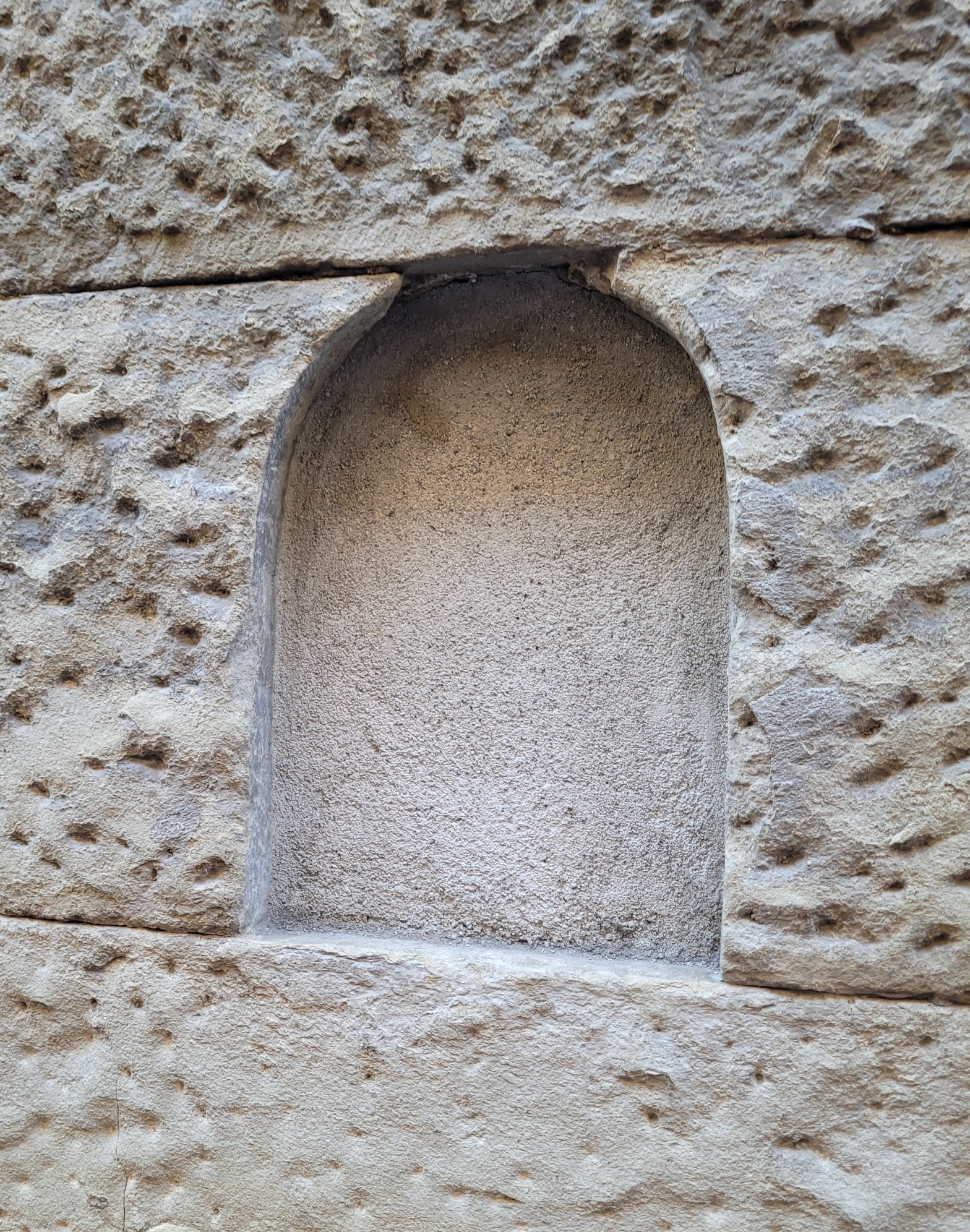
What I didn’t expect was that Italian architecture had been influenced by the wine culture of Italy. One day, while we were walking to the Uffizi Gallery in Florence, I came across a tiny, filled-in window on the side of a grand palace. The Italian friend who was walking with us told us that it was a wine window from the late medieval times.
Families, such as the Strozzi, Albizi, Pazzi, Ricasoli, and Antinori, who owned vineyards in the country often built palaces in Florence and other towns. Most of the wine grown in Italy in the late medieval times and early Renaissance era was sold to local customers. The wine families installed the tiny windows into the sides of their palaces so they could sell wine to customers without allowing the public into their homes or without coming into contact with them. For a reasonable price, customers could purchase a wicker wine bottle or glass of wine and maybe some ham to go with it. These tiny portals, once referred to as wine tabernacles were popular in Florence from the 15th Century to the early 20th Century.
The Italian word for this architectural feature is buchette. Each one is about 15 inches high and most are little arched doors carved into the stone wall of the noble palaces. This shape has also been used to hang street lanterns, and these are referred to as false buchette. Another type of false buchette is an arched, stone border used to frame a sacred image made out of fresco, terra cotta, or porcelain. These religious images were placed higher up on the wall of a building and served as protector for the inhabitants.
The Association Buchette del Vino has counted 179 buchette windows in Florence and about 280 in the Tuscany Region. I couldn’t find any indication of buchette that were still functioning as wine windows; now, most are filled in with stone, but some serve other purposes today. The portal of the Palazzo Landi on Borgo degli Albizi 17 is now a mailbox. Two others serve as doorbells and some others have been filled in with sacred pictures of Christ or the Virgin Mary.
Last night, I dreamed that I was standing on the outside of a buchette ordering a glass of Pino Grigio. It was a blistering, hot day—the sun beat on my head like a furnace. I ordered a Pino Grigio with a small bowl of olives. Mmm. Nothing tastes better than a Pino Grigio when the heat parches your throat.
I hope the buchette tradition catches on in California like the Little Free Libraries. When I go walking in my neighborhood, I walk past three of these tiny libraries and have so much fun perusing through the titles. I think a glass of wine would be wonderful to accompany my reading.
Sources:
Cornsini, Diletta and Lucrezia Giordano. Wine Windows in Florence and Tuscany. 2021.
Gheesling, Robbin. Wine Doors of Florence. 2021
“Le Buchette del Vino, Florence’s Little Wine Tabernacles.” L’Italo Americano. August 31, 2017. litaloamerican.org/buchette-vino/.
 Tess Perko's Blog